On this page
How to identify it
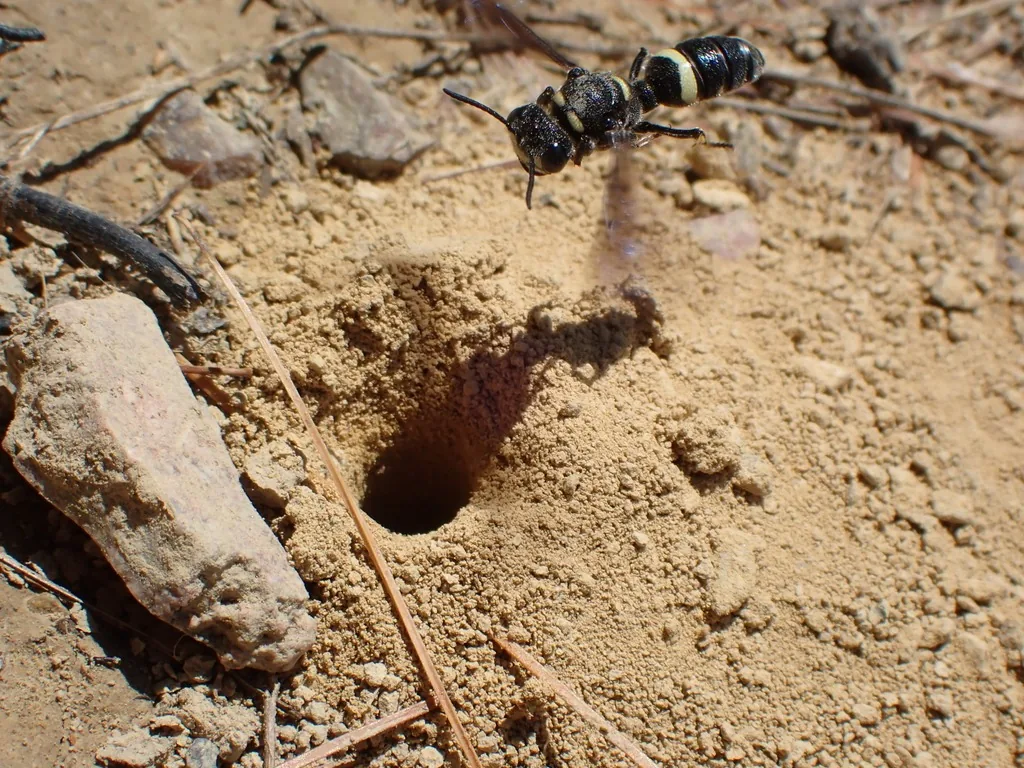
- It is about the size of a yellow jacket, with a black body, a single yellow or cream band across the abdomen, and dark, smoky blue or black wings.[1]
- Its face markings are unique among eastern North American wasps: females have three rectangular cream spots between the eyes, below the antennae, and males have two triangular marks beside the eyes pointing toward the center of the face.[1]
- Nest entrances are about the circumference of a pencil and are surrounded by a circular mound of loose soil about 1 to 2 cm (under an inch) high.[1]
Where it lives
It is native to eastern North America. Wisconsin runs a volunteer program that watches its nests, and in Virginia its flight season usually begins between mid-May and June, earlier in warmer coastal areas.[1][2]
Biology and life cycle
It preys almost exclusively on adult metallic wood-boring beetles (family Buprestidae), both native species and the invasive emerald ash borer. The female lands on a beetle, stings it at the base of a leg to paralyze it, and carries it back to her underground nest.[1][2]
Though each female nests alone, nests tend to be grouped in disturbed areas with packed, sandy soil, such as dirt parking lots, campsites, footpaths and baseball diamonds.[1][2]
Brood cells sit 7 to 20 cm (about 3 to 8 inches) below ground, usually 5 to 12 per nest and up to 25. Each cell is stocked with living, paralyzed beetles and receives a single egg; the larva eats the beetles and pupates, and the new adults dig their way out about 10 months after the egg was laid.[1]
Females fly for 5 to 8 weeks each season and make daily orientation flights over the nest, using landmarks to find it again. They can hunt up to 2 km (about 1.2 miles) away, though about 750 m (roughly half a mile) is more typical.[1]
Damage and signs
Health risk
Virginia Tech describes it as docile when handled and says a wasp held during a survey will not sting, and Wisconsin's program calls it a stingless wasp. Its sting is used on prey, to paralyze beetles.[1][2]
Control
Prevention
No control is needed. Both extension programs present it as a helpful native wasp whose nests are worth watching, because the beetles it carries home reveal whether emerald ash borer is in the area.[1][2]
How the wasp is used to find emerald ash borer
Early detection of emerald ash borer is critical for saving infested ash trees and protecting nearby ones, and the wasp can find the beetle even where it is scarce. Virginia Tech reports that watching the wasps has proved more effective than monitoring methods that rely on human technology, which cost more and take more labor.[1]
To survey a nest, a strip of index card about 2 by 6 cm with a hole punched at each end is laid over the entrance, one hole over the nest and the other pinned down with a golf tee. A wasp without prey fits through, but one carrying a beetle cannot, so it buzzes and claws at the entrance and draws the observer's attention. An emerald ash borer is taken from the wasp for reporting; for any other beetle the strip is simply moved aside to let the wasp in.[1]
In Wisconsin, volunteers scout baseball fields and other packed sandy ground for nests starting in mid to late June, visit them through mid-September to collect beetles the wasps drop, freeze the beetles and send them in at the end of summer.[2]
Common questions
- Will the smoky-winged beetle bandit sting me?
- It is docile around people; Virginia Tech says a wasp handled gently during a survey will not sting, and Wisconsin's program describes it as stingless.[1][2]
- Why are there wasp holes all over my ball field or path?
- This wasp nests in groups in packed, sandy soil, including baseball diamonds, footpaths and dirt parking lots. Each hole is about pencil-sized with a small ring of loose soil around it.[1][2]
- What is biosurveillance?
- It means using one species to find another. Because these wasps are much better at finding metallic wood-boring beetles in a forest than people are, checking the beetles they bring home shows which species, including emerald ash borer, are present nearby.[2]
Sources
- Virginia Cooperative Extension (Virginia Tech), “Cerceris fumipennis "The Smokey Winged Beetle Bandit", ENTO-171NP (H. Wantuch, T. Kuhar and S. Salom, 2015).” vtechworks.lib.vt.edu/handle/10919/70823 (accessed 2026-11-09)
- University of Wisconsin-Madison Division of Extension, “Wasp Watchers (Wisconsin First Detector Network).” fyi.extension.wisc.edu/wifdn/wasp-watchers/ (accessed 2026-11-09)
- iNaturalist, “Cerceris fumipennis taxon page (order and family).” www.inaturalist.org/taxa/326370 (accessed 2026-11-09)