On this page
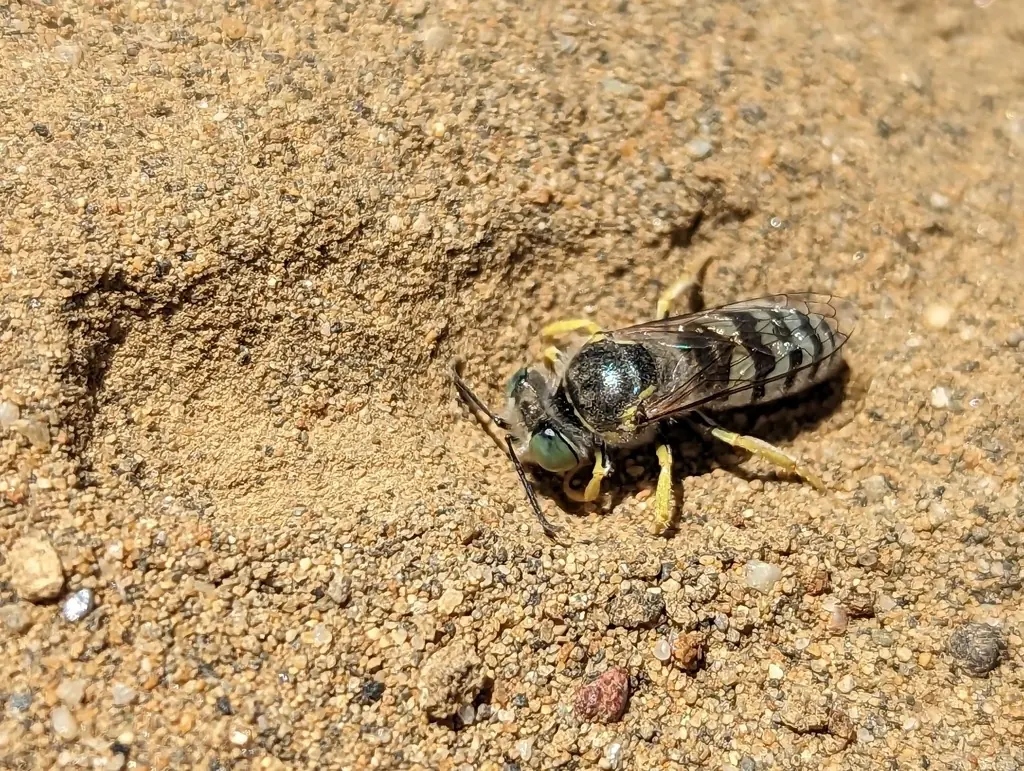
How to identify it
Look-alikes
| Look-alike | How to tell them apart |
|---|---|
| Cicada killer | A larger ground-nesting wasp that Utah State groups with sand wasps; both often nest in sandy spots.[3] |
Where it lives
Found across the United States, southern Canada, Mexico and the Caribbean.[1]
Biology and life cycle
Females provision nests with paralyzed flies; one larva may eat about two dozen.[1][2]
Males emerge first and fly low over nesting sites waiting for females.[1]
Damage and signs
Health risk
They are not aggressive and nests pose minimal risk, though a sting is painful; their habit of hovering near people is usually hunting flies drawn to them.[2][3]
Control
Prevention
Cover bare sandy areas with turf or other plantings to make them less attractive for nesting.[3]
Biological control
Tolerate them where possible: they catch pest flies.[2]
Common questions
- Why are wasps hovering around me in the yard?
- Sand wasps often hover near people to catch flies attracted to them; it isn't aggression.[2]
Sources
- University of Florida IFAS Extension (EDIS, Featured Creatures), “American Sand Wasp, Bembix americana (EENY-809).” ask.ifas.ufl.edu/publication/IN1424 (accessed 2026-10-16)
- Missouri Department of Conservation, “Sand Wasps (Field Guide).” mdc.mo.gov/discover-nature/field-guide/sand-wasps (accessed 2026-10-16)
- Utah State University Extension (Integrated Pest Management), “Sand Wasps / Cicada Killer (nuisance pest fact sheet).” extension.usu.edu/planthealth/ipm/notes_nuisance/sand-wasp-cicada-killer.php (accessed 2026-10-16)
- iNaturalist, “Bembix americana taxon page (order and family).” www.inaturalist.org/taxa/53072 (accessed 2026-10-06)