The short answer
- A nest away from doors, walkways, mowed lawn and play areas can usually be ignored. In states with cold winters the colony dies once the weather turns cold, and abandoned nests aren't reused. Minnesota Extension notes one exception: European paper wasps can reuse an old nest.[4][1][2][11]
- If anyone treating the nest is allergic to stings, don't do it yourself. Nests inside walls or attics, and nests you'd need a ladder to reach, are also jobs for a professional.[1][4][2][11]
- Find the entrance during the day from a safe distance, then treat at night, when most of the wasps are in the nest and less active. Minnesota Extension says late evening or early morning also works, since the wasps are less active then.[1][2][11]
- Aerosol wasp and hornet sprays suit exposed nests. Insecticide dusts work better for nests underground, behind siding or in other cavities, because the wasps carry the dust through the colony.[1][2][11]
- Never plug the entrance of a nest in a wall, and skip gasoline, fire and the garden hose. They're dangerous and seldom work.[2][4][1][11][5]
If someone may be poisoned
Wasps and hornets that build nests around homes
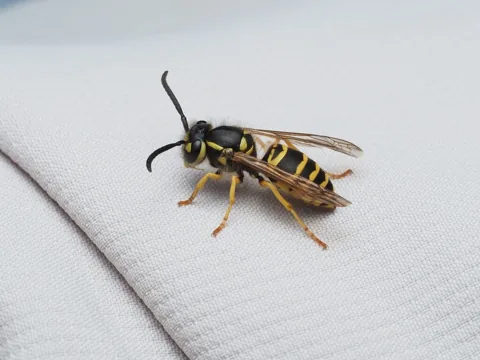 Eastern Yellowjacket
Vespula maculifrons
The eastern yellowjacket is a native, ground-nesting yellowjacket common across the eastern US in lawns, woodlands, pastures and parks; it defends its nest aggressively and can sting repeatedly.
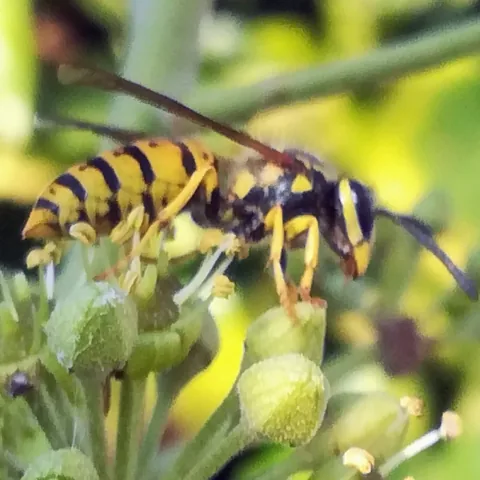 German Yellowjacket
Vespula germanica
The German yellowjacket is an invasive wasp from Eurasia that has spread across the northern US, displaces native yellowjackets and often nests in buildings.
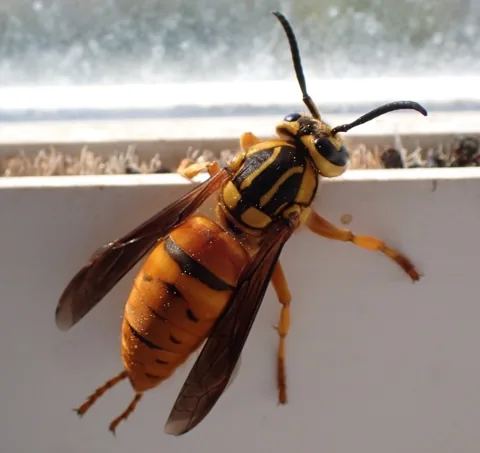 Southern Yellowjacket
Vespula squamosa
The southern yellowjacket is a native yellowjacket that normally nests in the ground. Its large, burnt-orange queens often start colonies by taking over eastern yellowjacket nests.
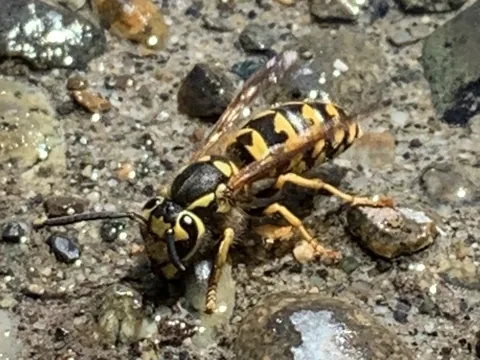 Western Yellowjacket
Vespula pensylvanica
Yellowjackets are social wasps that nest mostly in the ground and in wall voids, defend their nests vigorously, and become persistent scavengers at picnics and garbage cans in late summer and fall.
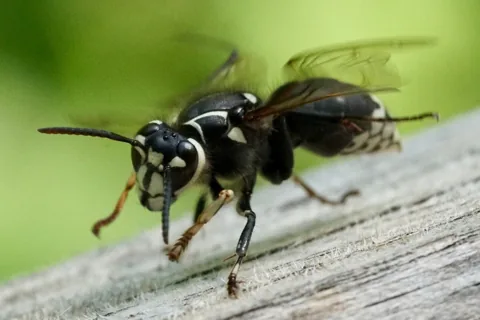 Bald-faced Hornet
Dolichovespula maculata
The bald-faced hornet is a large black-and-white aerial yellowjacket that builds gray, football-shaped paper nests in trees, shrubs and on buildings and defends them aggressively.
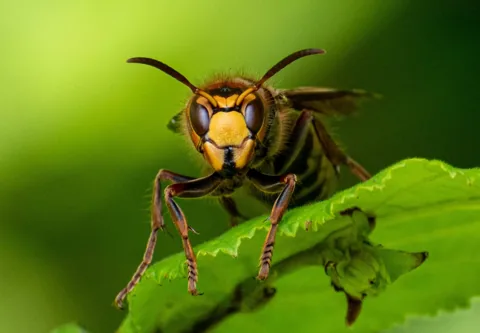 European Hornet
Vespa crabro
The European hornet is a large wasp introduced from Europe and first reported in the United States in 1840. It is now widespread in the East and is the only true hornet (genus Vespa) established in North America.
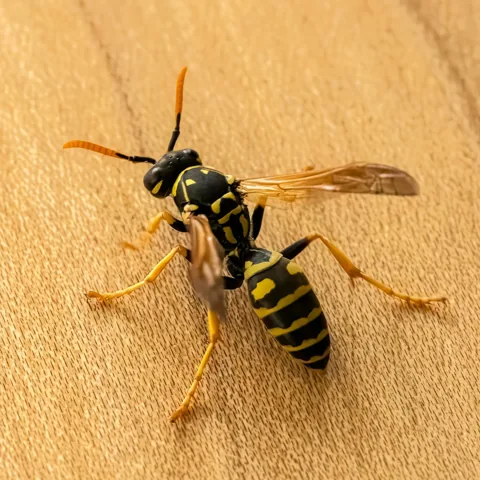 European Paper Wasp
Polistes dominula
Paper wasps hang open, umbrella-shaped paper nests under eaves and in sheltered spots; they are much less defensive than yellowjackets and rarely sting unless a nest is disturbed.
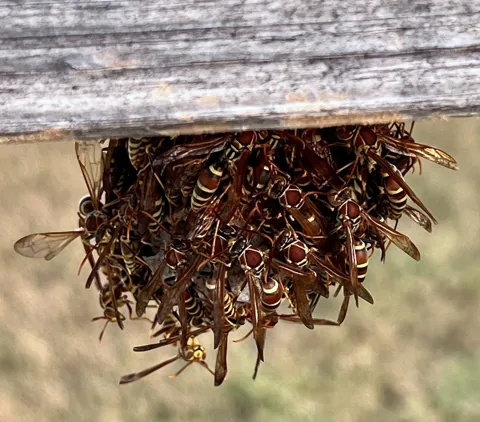 Guinea Paper Wasp
Polistes exclamans
The guinea paper wasp is a small paper wasp, yellow with brown bands, that hangs single open combs in sheltered spots like eaves, grills, gates and shrubs; it is not very aggressive until its nest is jarred.
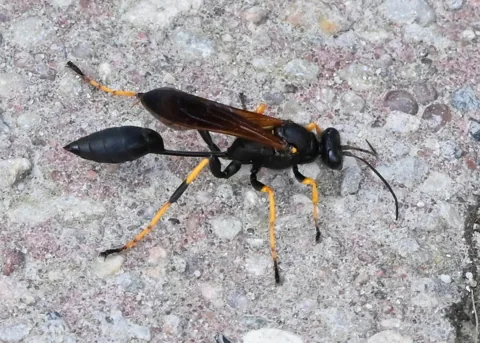 Black and Yellow Mud Dauber
Sceliphron caementarium
Mud daubers are solitary wasps that build mud nests on walls, ceilings, eaves and equipment and stock them with paralyzed spiders. They don't defend their nests and rarely sting.
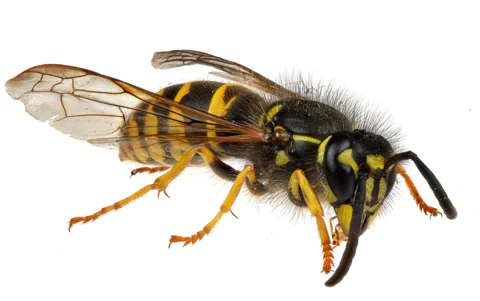 American yellowjacket
Vespula alascensis
The American yellowjacket, also called the common yellowjacket, is a black-and-yellow social wasp that nests in underground cavities or inside structures and scavenges protein and sugar. North American references long called it Vespula vulgaris, but that name now belongs to a European species. It is considered a pest because its nesting and scavenging habits bring it into frequent contact with people.
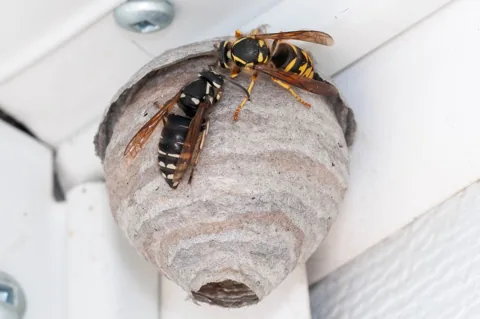 Aerial yellowjacket
Dolichovespula arenaria
The aerial yellowjacket is a black-and-yellow social wasp that builds its enclosed paper nest above ground: in shrubs and trees, under eaves and on outbuildings. It hunts live prey instead of raiding picnics, but it defends its nest fiercely and sometimes bites and stings at the same time.
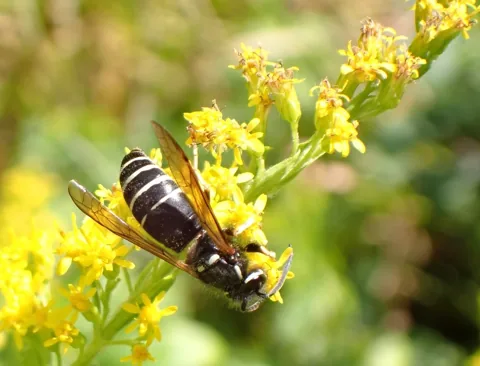 Blackjacket
Vespula consobrina
The blackjacket is a yellowjacket that is black with narrow white markings instead of yellow ones. It lives across Canada and the northern United States and south through the western mountains, hunts live insects, and nests in cavities such as hollow logs, rodent burrows and the wall voids of houses.
First decide whether the nest has to go
Wasps flying straight in and out of one spot are probably going to and from a nest there. Wasps foraging away from their nest seldom sting unless they're swatted or trapped against skin; it's a threatened nest that the colony defends.[3][2][11]
Paper wasps, yellowjackets and hornets hunt caterpillars, flies and other insects, and UC IPM says social wasps should be left to nest where there's little human or animal activity. Penn State frames the choice as ignoring the nest, hiring a professional, or doing the work yourself, and each option carries some risk.[1][3][11][12]
Paper wasps are much less defensive than yellowjackets and rarely sting people. Their nests shouldn't need treatment unless they're near people, such as beside a door or window.[3][12]
Nests near building entrances, busy walkways, mowed lawns and places where children play are the ones likely to be disturbed sooner or later.[1][4][11]
Season matters. These colonies start in late spring or early summer and die off over winter, so a nest found in fall will soon die anyway. A nest found in May or June may be small enough to ignore, but it can grow into a problem by August or September, and dealing with it while it's small is safer and easier.[1][11]
How big the colony gets depends on the wasp. Minnesota Extension says paper wasp nests often hold fewer than a dozen wasps and at most about 100, while yellowjacket and bald-faced hornet nests can hold hundreds to thousands, peaking in late summer at up to about 5,000 yellowjackets.[11]
Cold ends the season. Minnesota Extension says freezing temperatures, usually in the mid to upper 20s °F, kill the workers and the old queen, and Clemson says most paper wasps die by the first hard frost, so workers found late in the year may not need treatment.[11][12]
When to call a professional
A technician takes on the risk of being stung and brings the tools and experience. Professionals often use dusters on long extension poles so they can treat nests from a greater, safer distance.[1][2][11]
- Someone in the household has a known sting allergy. Penn State says people who know they're allergic shouldn't try to remove a colony themselves.[1][4][11][5]
- The nest is inside a wall or attic. Penn State Extension says these should be treated by professionals because of how hard the treatment is. Minnesota Extension also says hidden nests in buildings are usually best left to a pest management professional.[4][11]
- Reaching the nest takes a ladder or special equipment, as with many bald-faced hornet nests, which can hold hundreds of wasps that are extremely aggressive when disturbed.[2]
- You need a fast fix for a severe yellowjacket problem. In parts of California, the local mosquito and vector control district may remove nests.[3]
- A nest you suspect belongs to an invasive hornet is never a do-it-yourself job. The northern giant hornet defends its nest aggressively, and the Pacific Northwest handbook says not to try to remove or destroy a suspected nest. Washington and USDA declared that hornet eradicated from the United States at the end of 2024, but Washington still asks for reports of any invasive hornet, ideally with a photo, since it generally can't confirm a report without one; outside Washington, report to your state agriculture department.[8][9]
- Suspected yellow-legged hornets should be reported with photos of the wasps, not just the nest, because their nests look like bald-faced hornet nests: in South Carolina through Clemson, and in Pennsylvania to Penn State's Insect ID Lab. Penn State says the hornet is currently found in South Carolina and Georgia, and Washington reports one was photographed alive at the Port of Vancouver in April 2026.[10][9]
Planning a do-it-yourself treatment
- Locate the nest by day. Watch from 10 to 15 feet away to learn the flight path in and out, and stay out of that path while you watch and while you treat.[1]
- Treat at night. Most of the colony is home then, and the wasps are less likely to fly and have trouble seeing.[1][2][11]
- Use a light that's bright enough to work by but leaves you in the dark. Don't shine the beam into the entrance; set the light off to the side, on the ground if you can, so wasps that take off fly toward it instead of you. Most stinging insects have trouble seeing red light.[2][1]
- Plan an escape route. If the wasps get too defensive, walk calmly and quickly straight away without swatting, and try again after a few hours or days, once they've settled.[1]
- Keep people and pets away. The wasp spray label used for this guide says to keep them out of the area during application and to stay out yourself until the spray has dried.[6]
- Bring soap and water. A sting releases an alarm scent that draws more wasps to sting, and washing it off right away helps avoid more stings.[1]
What to wear
No clothing is completely sting-proof, so cover as much skin as you can. Stings go through most fabric but can't reach the skin through thick, baggy layers; a thick, loose sweatshirt tucked into similar pants works about as well as a bee suit.[1]
- Tuck your pant legs into long socks or tape them closed, and wear gloves with the cuffs closed by tape or rubber bands. Minnesota Extension gives similar advice: tie sleeves and pant legs shut, or pull your socks over the pant cuffs.[1][11]
- Protect your face and eyes. Stinging insects target the face, and at least some yellowjackets can spray venom at the eyes through a bee veil; safety glasses, goggles or a face shield help.[1]
- Check the insecticide label for its required protective equipment. At a minimum, Penn State advises long sleeves, long pants, closed-toed shoes with socks and chemical-resistant gloves, eye protection for any spraying above shoulder height, and respiratory protection with dusts.[1]
- For a hornet nest, the University of Kentucky strongly recommends a full wasp suit and head veil sealed at the wrists, ankles and collar.[2]
- If you need a ladder, make sure it's stable and well supported; you're dealing with heights and stings at the same time.[1]
- Afterward, launder your clothes and shower right away.[4]
Sprays, dusts and other products
Use an insecticide whose label lists wasps, hornets or yellowjackets as target pests and doesn't prohibit the application method you plan to use.[1][11]
Aerosol wasp and hornet sprays come in pressurized cans, and most spray 15 to 20 feet. They knock down the insects they hit, but they usually lose their toxicity once dry and penetrate large or hidden nests poorly, so they suit open-comb nests and small exposed ones. Wasps attack when they sense spray on their nest, and UC IPM notes that even freeze-type products aren't guaranteed to stop every wasp that comes out. Minnesota Extension names tetramethrin and prallethrin as typical active ingredients in these sprays.[1][3][11]
Insecticide dusts are puffed into the entrance with a bulb or bellows duster. They work best for nests inside a paper envelope, underground or in a cavity, and they reach farther than sprays when the nest is some distance from the opening, as in stone walls, behind siding or deep in old animal burrows. The wasps track the dust through the colony.[1][2][11][5]
Kentucky names dusts containing cyfluthrin or deltamethrin. One EPA-stamped deltamethrin dust label says to treat wasp nests in the evening, check them one or two days later, and then remove and destroy the nest; the same label says not to use it on overhead nests. Minnesota Extension names permethrin dust for ground nests and says a deltamethrin dust works best for nests hidden in buildings, though few such products are sold to the public.[2][7][11]
One EPA-stamped wasp and hornet spray, containing prallethrin and cypermethrin (EPA Reg. No. 4822-553), says to spray in early morning or early evening, stand a safe distance from the nest and not directly underneath it, keep the wind at your back, spray until the nest is saturated, and wait at least 24 hours before removing it. Follow the label on the product you buy.[6]
That label is for outdoor use only and warns that the can is extremely flammable and the product extremely toxic to fish and aquatic invertebrates. It says not to spray in rain or in wind over 15 mph, and not to apply it to or near water or into storm drains.[6]
Foams suit underground nests, and liquid concentrates mixed in a sprayer can soak large exposed nests or drench the soil over an underground one. Be careful with either inside a building, where the liquid can damage wood, drywall or wiring; dust is usually the better choice there. Sources differ on liquids: Penn State describes a soil drench as one option, while Minnesota Extension says pouring a liquid into the entrance is less effective than spraying or dusting, because it may not reach a nest deep in the burrow.[1][11]
Treating each kind of nest
- A brand-new nest with only the queen: there are no workers yet, so the sting risk is low. Swat or spray the queen, then knock down and destroy the nest. Early in the season, knocking down a newly started paper wasp nest makes the founding queen go elsewhere.[1][3]
- Paper wasps: their open, umbrella-shaped combs hang under eaves, gutters and ledges, behind shutters, and inside porch lights, grills and mailboxes. An accessible nest can be sprayed with a wasp and hornet spray; Kentucky says paper wasps can even be treated in daytime as long as you don't stand directly under the nest, because sprayed wasps drop instantly. Wait a few days, then scrape or knock the nest down. Clemson suggests spraying the nest directly with an aerosol labeled for wasp and hornet control and removing it once the wasps are dead, and Minnesota Extension says to spray so all of the comb gets some insecticide.[2][12][11]
- Small nests in a paper envelope: at night, aim the spray up into the entrance and soak the whole nest. Once it dries, knock the nest down and destroy it so protected pupae can't mature and emerge.[1]
- Bald-faced hornets and other large aerial nests: these usually have a single opening, often toward the bottom. At night, spray or dust into that opening without breaking the paper envelope, which would scatter the hornets in all directions. Kentucky advises waiting at least 3 to 4 days before removing the nest and treating again if hornets are still seen; Penn State notes repeat treatments on successive nights may be needed.[2][1]
- Underground yellowjackets: dust works well. Approach quietly and puff a generous amount directly down the opening, back off when the wasps start investigating, and return once they settle. Don't stand back and dust only the outside of the entrance; that angers the colony and raises the risk of stings for several days. Minnesota Extension says to dust in and around the entrance at night; the dust clings to wasps going in and out, and the colony should be dead within a few days.[1][4][11]
- Remember that an underground nest can be several feet from its entrance hole, so a spray may not reach the wasps.[1][3]
- Nests in walls, attics or behind siding: never plug the entrance. Trapped yellowjackets can chew through drywall and come out inside the house. If they're already getting indoors, deal with the inside entry before the outside one so you don't push the colony into the living space. Minnesota Extension adds that an aerosol is not very effective here and can send yellowjackets looking for another exit, often into the house.[4][2][1][11]
- Honey bees in a wall: their colonies are often 10 to 100 times larger than yellowjacket colonies. A beekeeper may be able to remove them. If the colony is killed instead, the comb and honey need to come out, because they hold moisture and can rot. Minnesota Extension says that if a honey bee colony must be killed, early spring (March to April) is the best time, when little honey is left, and that comb or honey from a treated colony should not be saved.[1][11]
- Mud daubers and other solitary wasps: each nest is tended by one female, with no workers to defend it, so the sting risk is low.[1][3][11]
After the treatment
- Confirm the next day that the colony is dead before you go near it. Partly poisoned, agitated wasps can still be around the entrance the day after a treatment. If wasps are still flying in and out after a day, Minnesota Extension says to treat again.[1][3][11]
- Knock down and destroy an exposed nest once it's dead, so larvae and pupae sheltered inside don't emerge later.[1][7][12]
- An underground nest can be left in place, but skunks or other scavengers may dig it up to eat the dead larvae, and the cavity can collapse so the ground above sinks. Digging the nest out avoids both.[1]
- A dead nest left inside a wall can later feed carpet beetles, and a very large one can rot and cause odors or stains. Penn State suggests opening the void, removing the nest and repairing any damage.[1]
- To keep wasps out of walls in future years, seal cracks in siding and gaps around windows and pipes. Do this once the colony is dead, never while it's active.[5][2][11]
- Where paper wasps keep coming back, Clemson suggests screening openings and vents into attics and other voids, putting a fresh coat of paint or varnish on outside surfaces so nests are harder to attach, and keeping shrubs trimmed and thinned so wasps don't nest on the inner branches.[12]
What not to do
- Don't pour gasoline or kerosene on a nest or set it on fire. Penn State says fire is much more dangerous than the insecticide methods, fuels such as gasoline and kerosene are more toxic than most suitable insecticides, and fires spread quickly.[1]
- Don't try to drown a nest with a garden hose. Kentucky says folk remedies like dousing nests with gasoline or a garden hose seldom work and can lead to many stings.[2]
- Don't count on decoy nests. Penn State says there's no clear evidence that a fake hornet nest keeps paper wasps or yellowjackets from building nearby.[1]
- Don't expect traps to remove a nest. Lure traps catch foragers, but a late-season nest can hold thousands of wasps, and trapping seldom makes a noticeable difference; if you use traps, hang them around the edge of the area you want to protect. Minnesota Extension says traps catch only a very small number of wasps.[2][3][11]
If you're stung
Most stings cause pain, redness, swelling and itching where you were stung and can be treated at home. A few people have a severe allergic reaction that needs emergency care.[13][15]
- Have someone stay with the person who was stung for a while to watch for an allergic reaction.[15]
- Wash the sting with soap and water. Put ice wrapped in a washcloth on it for 10 minutes, then off for 10 minutes, and repeat. An antihistamine or an anti-itch cream can help if needed.[13][15]
- Don't scratch; scratching can increase swelling and itching and raise the risk of infection. Over the next several days, watch for signs of infection such as increasing redness, swelling or pain.[15][13]
- If a stinger is left in the skin, scrape it out with a fingernail or the edge of a credit card. Don't squeeze it or use tweezers, which can squeeze the venom sac and release more venom.[13][15]
- A stinger left behind usually points to a honey bee. Yellowjackets and paper wasps can pull their stinger back out and sting again, so they don't leave it in the skin.[11]
- If several wasps attack at once, run away and get indoors; shade is better than an open area. Don't jump into water, because some insects hover over it.[15]
- For a severe reaction, call 911 and check the person's breathing. Keep them calm, remove rings or anything tight because the area may swell, use their epinephrine auto-injector if they carry one, and stay with them until help arrives. Don't use a tourniquet, and don't give aspirin, other pain medicine or stimulants unless a health care provider prescribed them.[13]
- People with a history of severe reactions should carry epinephrine; CDC/NIOSH also suggests a medical ID bracelet or necklace. After a severe, bodywide reaction, MedlinePlus says a provider should refer you to an allergist for testing and treatment.[15][14][13]
Common questions
- Will wasps reuse the nest next year?
- No. In cold-winter areas the colony dies in late fall and the paper nest falls apart over winter; new queens start fresh nests in spring. In mild climates or heated buildings, some yellowjacket nests do survive the winter and keep growing. Minnesota Extension says European paper wasps are the exception that can reuse a nest, and that in the Upper Midwest yellowjacket and paper wasp nests don't survive winter even inside a building.[2][3][5][11]
- Can I spray a wasp nest during the day?
- Night is safer for any nest. Kentucky says paper wasps can be sprayed in daytime if you don't stand directly under the nest, but hornet and yellowjacket nests should be treated at night. Minnesota Extension suggests late evening or early morning, when the wasps are less active.[2][11]
- Should I plug the hole after I spray?
- Not on a building while any wasps may still be alive inside, because they can chew through to the inside. Seal entry gaps after the colony is dead.[2][4][5][11]
- How long should I wait before removing a treated nest?
- Follow the label. The spray label used here says at least 24 hours; for hornet nests, Kentucky advises at least 3 to 4 days, and a deltamethrin dust label says to check one or two days after treating.[6][2][7]
- Do wasps leave their stinger in the skin?
- Usually not. Minnesota Extension says yellowjackets and paper wasps can pull the stinger out and sting more than once; honey bees are the ones that leave a barbed stinger behind.[11]
- What should I do right after a wasp sting?
- Wash it with soap and water, ice it (10 minutes on, 10 minutes off), and use an antihistamine or anti-itch cream if needed. Call 911 for trouble breathing, swelling of the face or mouth, or throat tightness.[13][15]
Photo credits
- Eastern Yellowjacket: Brighton Lee, public domain (CC0), via iNaturalist
- German Yellowjacket: (c) Gianni Del Bufalo bygdb, some rights reserved (CC BY) — via iNaturalist, CC BY 4.0
- Southern Yellowjacket: (c) Cole Shoemaker, some rights reserved (CC BY) — via iNaturalist, CC BY 4.0
- Western Yellowjacket: (c) eebee, some rights reserved (CC BY) — via iNaturalist, CC BY 4.0
- Bald-faced Hornet: (c) Amy Schnebelin, some rights reserved (CC BY) — via iNaturalist, CC BY 4.0
- European Hornet: (c) Михаил Малышев, some rights reserved (CC BY) — via iNaturalist, CC BY 4.0
- European Paper Wasp: (c) Andrew McKinlay, some rights reserved (CC BY) — via iNaturalist, CC BY 4.0
- Guinea Paper Wasp: (c) Sue Ann Kendall, some rights reserved (CC BY) — via iNaturalist, CC BY 4.0
- Black and Yellow Mud Dauber: (c) Maciej Boenisch, some rights reserved (CC BY) — via iNaturalist, CC BY 4.0
- American yellowjacket: (c) Christian Back, some rights reserved (CC BY) — via iNaturalist, CC BY 4.0
- Aerial yellowjacket: (c) Chris O'Donoghue, some rights reserved (CC BY) — via iNaturalist, CC BY 4.0
- Blackjacket: Dominique Bérubé, public domain (CC0), via iNaturalist
Sources
- Penn State Extension, “Getting Rid of Paper Wasps, Yellowjackets, and Other Stinging Insects (Jamie Kopco, updated January 29, 2026).” extension.psu.edu/getting-rid-of-paper-wasps-yellowjackets-and-other-stinging-insects (accessed 2026-11-11)
- University of Kentucky Entomology, “ENTFACT-620: Controlling Wasps, Hornets, & Yellowjackets (Michael F. Potter, revised March 2026).” entomology.mgcafe.uky.edu/ef620 (accessed 2026-11-11)
- University of California Statewide IPM Program, “Pest Notes: Yellowjackets and Other Social Wasps, UC ANR Publication 7450.” ipm.ucanr.edu/home-and-landscape/yellowjackets-and-other-social-wasps/ (accessed 2026-11-11)
- Penn State Extension, “Eastern Yellowjacket.” extension.psu.edu/eastern-yellowjacket (accessed 2026-11-11)
- Penn State Extension, “German Yellowjackets.” extension.psu.edu/german-yellowjackets (accessed 2026-11-11)
- U.S. EPA Pesticide Product Label System, “RWH 33 wasp and hornet spray (alternate brand name Raid Wasp & Hornet Killer 33) label, EPA Reg. No. 4822-553 (EPA-stamped, Feb. 13, 2026).” www3.epa.gov/pesticides/chem_search/ppls/004822-00553-20260213.pdf (accessed 2026-11-11)
- U.S. EPA Pesticide Product Label System, “K-Othrine Dust Insecticide (alternate brand name DeltaDust) label, EPA Reg. No. 432-772 (EPA-stamped, Aug. 5, 2016).” www3.epa.gov/pesticides/chem_search/ppls/000432-00772-20160805.pdf (accessed 2026-11-11)
- Pacific Northwest Insect Management Handbook (Oregon State, Washington State and University of Idaho Extension), “Northern Giant Hornet (2019), Emerging Insect Pests in the Pacific Northwest.” pnwhandbooks.org/insect/emerging-insect-pests/ongoing-eradication-programs/northern-giant-hornet-2019 (accessed 2026-11-11)
- Washington State Department of Agriculture, “Invasive Hornets.” agr.wa.gov/departments/insects-pests-and-weeds/insects/hornets (accessed 2026-11-11)
- Penn State Extension, “Yellow-Legged Hornet.” extension.psu.edu/yellow-legged-hornet (accessed 2026-11-11)
- University of Minnesota Extension, “Wasps and bees (K. Lee, J. Hahn, L. Jesse, P. Liesch).” extension.umn.edu/insects-infest-homes/wasps-and-bees (accessed 2026-11-11)
- Clemson Cooperative Extension Home and Garden Information Center, “Paper Wasps (HGIC, E. P. Benson, P. A. Zungoli).” hgic.clemson.edu/factsheet/paper-wasps/ (accessed 2026-11-11)
- MedlinePlus, U.S. National Library of Medicine, “Insect bites and stings (Medical Encyclopedia).” medlineplus.gov/ency/article/000033.htm (accessed 2026-11-11)
- MedlinePlus, U.S. National Library of Medicine, “Insect Bites and Stings (health topic).” medlineplus.gov/insectbitesandstings.html (accessed 2026-11-11)
- CDC, National Institute for Occupational Safety and Health (NIOSH), “Insects and Scorpions at Work.” www.cdc.gov/niosh/outdoor-workers/about/insects-and-scorpions.html (accessed 2026-11-11)