On this page
How to identify it
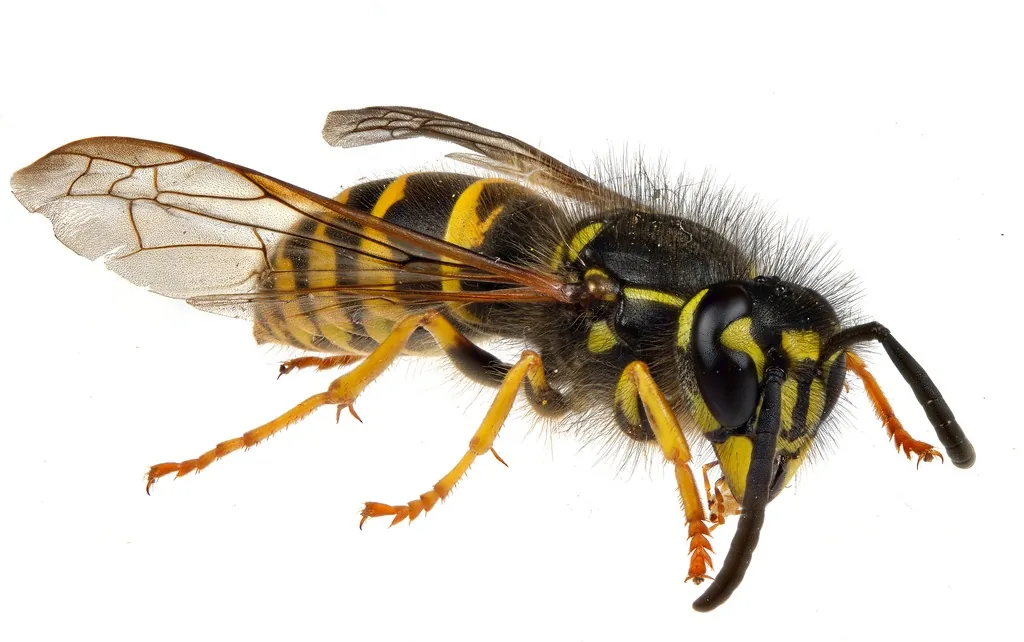
- Like other yellowjackets it is 1/2 to 1 inch long, with jagged bright yellow and black stripes and a narrow waist that is barely visible.[4]
- Seen from above, the yellow band around each compound eye is broken, and the first segment of the abdomen has no diamond-shaped black mark like the western yellowjacket's.[2]
- The first antennal segment is entirely black or dark brown.[2]
- From the side, the yellow band on the cheek (the gena) is broken by a black spot; in the German yellowjacket that band is continuous.[2][1]
Look-alikes
| Look-alike | How to tell them apart |
|---|---|
| Western yellowjacket | The western yellowjacket has a continuous yellow ring around each eye, seen from above, and a diamond-shaped black mark on the first abdominal segment.[2] |
| German yellowjacket | The German yellowjacket, introduced from Europe, has an unbroken yellow band on the cheek in side view.[2][3] |
| European Vespula vulgaris | The true Vespula vulgaris is now considered restricted to Europe and Asia; North American and European populations differ in male genitalia and mitochondrial DNA.[3][1] |
Where it lives
Kimsey and Carpenter describe it as widespread in North America. The British Columbia checklist gives its range as Alaska east through the Northwest Territories to Newfoundland, south to Georgia, Illinois, Iowa and Nebraska, and south in the western mountains to New Mexico, Arizona and California. GBIF holds about 3,100 U.S. records since 1990, the most from California, Washington, Alaska and Oregon, and about 2,600 from Canada.[1][3][5][6]
Biology and life cycle
Nests are usually built in underground cavities or in structures and can grow huge. Kimsey and Carpenter say they may become perennial in warmer climates; the Bohart Museum key says often perennial there.[1][2]
In California, UC IPM (using the older name V. vulgaris) notes that it is common in rotted tree stumps at higher elevations.[4][2]
Workers hunt live prey but will scavenge any source of protein or sugar.[1][2]
Like other yellowjackets, colonies start in spring from a single overwintered queen. Workers gather mostly protein, usually other insects, while the nest grows into midsummer, then turn to sugars as growth slows in late summer.[4]
Most colonies live only one season, but in very mild winters, and in coastal California south of San Francisco, some survive for several years and get quite large.[4]
The nest is made of plant fibers mixed with saliva.[1]
It was introduced to Hawaii but is not now established there.[1]
Damage and signs
- Kimsey and Carpenter list it with the German yellowjacket as a pest species, because its habit of nesting in structures and scavenging foods other than live insects brings it into frequent contact with people.[1]
- Ground- and cavity-nesting yellowjackets defend their nests vigorously, and they get more defensive as the season goes on and colonies grow while food runs short.[4]
- In fall, scavenging yellowjackets gather at picnics, barbecues, garbage cans, outdoor pet food and ripe fruit, and they will crawl into soda cans.[4]
Health risk
Yellowjacket stingers have no barbs, so one wasp can sting repeatedly. Stings from wasps are most often painful, and reactions range from mild discomfort to anaphylaxis, a severe allergic reaction that needs emergency care. A medical review of multiple wasp stings reports organ injury, most often to the kidneys, liver and muscles. Kimsey and Carpenter note that yellowjackets cause most sting-related deaths.[4][7][8][9][1]
Control
Prevention
Social wasps eat large numbers of pest insects, so UC IPM suggests leaving nests alone where people and animals seldom go and simply avoiding them. A wasp flying straight in and out of one spot is probably using a nest there.[4]
Sanitation
When scavenging wasps are around, keep food, drinks and pet food covered or indoors and garbage in tightly sealed cans. Once wasps find food, they keep searching that spot long after it is gone.[4]
Traps and physical control
Standard lure traps baited with heptyl butyrate attract mainly the western yellowjacket, not this species. Adding meat such as chicken is believed to improve catches of the German yellowjacket and of this species, which UC IPM lists under its old name, V. vulgaris. Replace the meat often, because yellowjackets ignore rotting meat.[4][2]
A homemade water trap, a bucket of soapy water with protein bait hung 1 to 2 inches above it, works best for catching queens in late winter and early spring.[4]
Pesticides
Aerosol wasp and hornet sprays labeled for nests can work, but wasps attack when they sense the spray, so full protective clothing with a veil and gloves is needed. Spray may not reach an underground nest far from its entrance, and agitated wasps can turn up some distance away even the day after. Esfenvalerate baits have not proven effective in research trials.[4]
When to call a professional
Digging out underground or cavity nests isn't practical. If a nest must go, professional help is the easiest and safest choice; in some areas of California a mosquito and vector control district may remove nests.[4]
If you are stung
Move away from the nest. If several stinging insects attack at once, NIOSH advises running away, into shade if possible, and not jumping into water, since some insects hover above it.[8][4]
Wash the site with soap and water, apply ice wrapped in a cloth for 10 minutes on and 10 minutes off, and use an antihistamine or anti-itch cream if needed. Don't scratch, which NIOSH says can increase swelling, itching and infection risk, and have someone stay with the person to watch for an allergic reaction.[7][8]
Call 911 or the local emergency number for trouble breathing, wheezing, swelling of the face or mouth, or throat tightness. People with a history of severe reactions should carry an epinephrine auto-injector, and MedlinePlus says anyone who had a severe, bodywide reaction should be referred to an allergist.[7][8]
Venom allergy and the name change
A 2026 study found that widely used yellowjacket venom immunotherapy preparations contain venom from this North American species rather than from European Vespula vulgaris, and that the two venoms behave very similarly in allergic patients.[10]
Common questions
- Is the common yellowjacket the same as Vespula vulgaris?
- Not in North America. Carpenter and Glare showed in 2010 that the American populations are a separate species, Vespula alascensis, and true V. vulgaris is now considered restricted to Europe and Asia.[1][3]
- Why doesn't my yellowjacket trap catch them?
- The usual lure, heptyl butyrate, attracts mainly the western yellowjacket. UC IPM says adding fresh meat such as chicken is believed to improve catches of this species (under its old name, V. vulgaris).[4][2]
- Where do American yellowjackets nest?
- Usually in underground cavities or inside structures. At higher elevations in California, UC IPM notes they are common in rotted tree stumps.[1][2][4]
Sources
- Pensoft (Journal of Hymenoptera Research), “Kimsey LS, Carpenter JM. The Vespinae of North America (Vespidae, Hymenoptera). Journal of Hymenoptera Research 28:37-65 (2012).” doi.org/10.3897/jhr.28.3514 (accessed 2026-11-11)
- Bohart Museum of Entomology, University of California, Davis, “Key to the Yellow Jackets of California (Information No. 61).” bohart.ucdavis.edu/sites/g/files/dgvnsk4616/files/media/documents/note_61_yellow_jacket_key.pdf (accessed 2026-11-11)
- E-Fauna BC, University of British Columbia, “Checklist of the Yellowjacket and Paper Wasps of British Columbia (R. Cannings, Royal BC Museum; revised October 2018).” linnet.geog.ubc.ca/biodiversity/efauna/documents/Checklist%20of%20the%20Yellowjacket%20and%20Paper%20Wasps%20of%20BC%20RAC%20revised%2020Oct2018.pdf (accessed 2026-11-11)
- University of California Statewide IPM Program, “Pest Notes: Yellowjackets and Other Social Wasps (UC ANR Publication 7450).” ipm.ucanr.edu/home-and-landscape/yellowjackets-and-other-social-wasps/ (accessed 2026-11-11)
- Global Biodiversity Information Facility (GBIF), “Vespula alascensis: U.S. occurrence records since 1990 by state (GBIF occurrence search).” api.gbif.org/v1/occurrence/search?taxonKey=6247225&country=US&hasGeospatialIssue=false&occurrenceStatus=PRESENT&year=1990%2C2026&facet=stateProvince&facetLimit=400&limit=0 (accessed 2026-11-11). Exact count at access: 3,109 U.S. records since 1990 (California 909, Washington 623, Alaska 514, Oregon 376).
- Global Biodiversity Information Facility (GBIF), “Vespula alascensis: occurrence records since 1990 by country (GBIF occurrence search).” api.gbif.org/v1/occurrence/search?taxonKey=6247225&hasGeospatialIssue=false&occurrenceStatus=PRESENT&year=1990%2C2026&facet=country&limit=0 (accessed 2026-11-11). Exact counts at access: 5,670 records since 1990; United States 3,109, Canada 2,555.
- MedlinePlus, U.S. National Library of Medicine, “Insect bites and stings (Medical Encyclopedia).” medlineplus.gov/ency/article/000033.htm (accessed 2026-11-11)
- CDC National Institute for Occupational Safety and Health (NIOSH), “Insects and Scorpions at Work.” www.cdc.gov/niosh/outdoor-workers/about/insects-and-scorpions.html (accessed 2026-11-11)
- Tropical Medicine and Health, via PubMed, “Clinical manifestations of wasp stings: a case report and a review of literature (2022).” pubmed.ncbi.nlm.nih.gov/36307881/ (accessed 2026-11-11)
- Journal of Investigational Allergology and Clinical Immunology, via PubMed, “Assessing the allergenic relevance of Vespula alascensis venom: implications for venom immunotherapy (Slusarenko et al. 2026).” pubmed.ncbi.nlm.nih.gov/41277633/ (accessed 2026-11-11)
- iNaturalist, “Vespula alascensis taxon page (order and family).” www.inaturalist.org/taxa/332394 (accessed 2026-11-08)