On this page
How to identify it
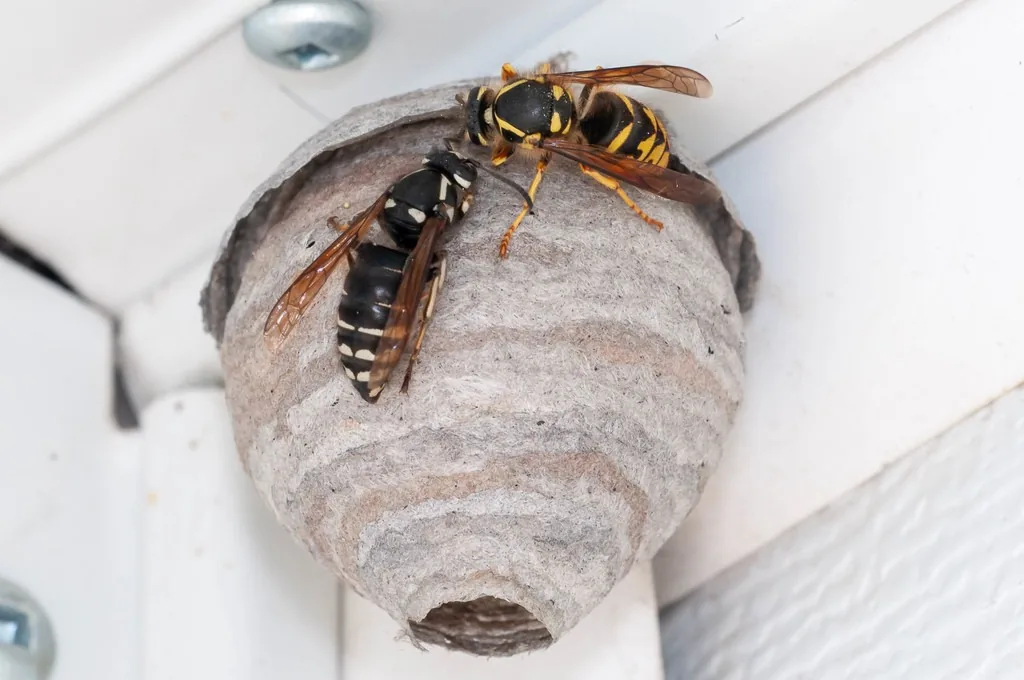
- A black wasp with yellow markings, smaller than the bald-faced hornet at under 15 mm (about 0.6 inch) long.[2]
- Seen from above, the first three abdominal segments carry yellow markings; the bald-faced hornet's are all black there.[2]
- There is a broad gap between the bottom of each compound eye and the base of the jaw (mandible). In the ground-nesting Vespula yellowjackets, that gap is narrow.[2]
- Its nest is gray paper wrapped in an outer envelope, attached to eaves or hanging from a branch, with the entrance hole normally at the bottom.[4]
Look-alikes
| Look-alike | How to tell them apart |
|---|---|
| Bald-faced hornet | The bald-faced hornet, its close relative, is larger (15 mm or more), with the top of the first three abdominal segments entirely black and whitish rather than yellow markings. It usually nests in more exposed places and feeds only on live prey, especially spiders.[2][1] |
| Ground-nesting yellowjackets | Western, German and American yellowjackets have only a narrow gap between eye and jaw, usually nest underground or in wall voids, and turn to scavenging human food late in the season, which aerial yellowjackets do not.[2][4] |
| Paper wasps | Paper wasp nests hang like open umbrellas with the cells visible from below; aerial yellowjacket nests are closed in a paper envelope.[4] |
Where it lives
Kimsey and Carpenter call it abundant throughout boreal North America. The British Columbia checklist gives its range as Alaska east through the Northwest Territories to Newfoundland, and south to Georgia, Illinois, Iowa, Nebraska, New Mexico, Arizona and California.[1][3]
Biology and life cycle
Nests go up in sheltered spots: inside shrubs and bushes, in trees, and on houses and outbuildings, and rarely even under rocks.[1][2]
The nest is made of wood or plant fibers mixed with saliva, built as tiers of cells inside the paper envelope.[4][1][6]
Each colony is started in spring by a single mated queen. The Connecticut Agricultural Experiment Station (CAES) describes the queen building 30 to 55 cells, laying an egg in each and feeding the larvae herself until the first 5 to 7 workers emerge about 30 days later; after that she only lays eggs.[4][6]
Colonies grow through summer. CAES gives peaks of 1,000 to 4,000 wasps for Connecticut's common yellowjackets, depending on species. In late summer the colony makes new queens and males; after mating, only the new queens hide away for winter, and the nest is not reused.[6][4]
Workers hunt live prey and only occasionally visit carrion. Unlike the ground-nesting yellowjackets, aerial nesters don't become scavengers at the end of the season.[1][2][4]
Genetic studies of this species found that most queens mate only once and lay most of the colony's males, though workers in some colonies produce some males. A 2015 study found that workers in some colonies kill their own queen.[10][11]
Damage and signs
Health risk
Defending aerial yellowjackets sometimes bite and sting at the same time, and their unbarbed stingers can be used again and again, especially if a wasp gets inside clothing. Most stings cause pain, redness and swelling that can be treated at home, but people allergic to the venom can have anaphylaxis, a fast, life-threatening reaction that needs emergency care.[4][8][9]
Control
Prevention
Social wasps kill large numbers of pest insects, so a nest well away from people and pets can be left alone. Be on the lookout for nests when working outdoors: wasps flying straight in and out of one spot are probably using a nest there.[4][6]
Near a nest, avoid rapid, jerky movements and never put your hands into a nest. If one wasp flies around you, stay calm and don't swat. If several attack, leave the area quickly, preferably indoors or into shade, and don't jump into water.[8][9][4]
After a sting, wash the site with soap and water, apply wrapped ice for 10 minutes on and 10 off, don't scratch it, and have someone watch for an allergic reaction. Call 911 for trouble breathing, face or mouth swelling, throat tightness or fainting.[8][9]
Traps and physical control
Lure traps are a poor fit: the usual lure, heptyl butyrate, attracts mainly the western yellowjacket, and aerial yellowjackets hunt live prey instead of scavenging.[4][1]
Pesticides
Aerosol insecticides labeled for wasp and hornet nests can be effective, but the wasps attack when they sense the spray. CAES advises treating at night, when the wasps see poorly and are less active, after marking the nest by day; UC IPM warns stings are still likely even after dark. Wear clothing that covers the whole body, plus a face veil, gloves and eye protection.[4][6][7]
When to call a professional
When a nest has to go, calling a professional is the easiest and safest course; in parts of California, a local mosquito and vector control district may remove nests. CAES also suggests a professional for nests that are hard to reach.[4][6]
Common questions
- Do aerial yellowjackets come to picnics and garbage cans?
- Seldom. They feed on live prey and only occasionally on carrion, and UC IPM notes that the aerial nesters don't turn to scavenging late in the season the way ground-nesting yellowjackets do.[1][4]
- How do I tell an aerial yellowjacket from a bald-faced hornet?
- Look at size and color: the aerial yellowjacket is under 15 mm with yellow markings, including on top of the first three abdominal segments, while the bald-faced hornet is 15 mm or longer, black and white, with those segments all black on top.[2]
- Where do aerial yellowjackets nest?
- Above ground in sheltered places: inside shrubs and bushes, in trees, under eaves and on outbuildings, and rarely under rocks.[1][2][4]
- What should I do if I'm stung many times?
- Get away from the nest first, indoors if possible. Then wash the stings, use cold packs and watch for signs of a severe reaction, such as trouble breathing, swelling of the face or mouth, chest pain or fainting; call 911 if any appear.[9][8][4]
- Is the aerial yellowjacket found where I live?
- It occurs across much of North America; Kimsey and Carpenter call it abundant throughout boreal North America. CAES lists it as one of the four yellowjackets most often met in Connecticut and gives its range as throughout the United States; the British Columbia checklist gives a range from Alaska to Newfoundland and south to Georgia, Illinois, Iowa, Nebraska, New Mexico, Arizona and California.[1][6][3]
Sources
- Pensoft (Journal of Hymenoptera Research), “Kimsey LS, Carpenter JM. The Vespinae of North America (Vespidae, Hymenoptera). Journal of Hymenoptera Research 28:37-65 (2012).” doi.org/10.3897/jhr.28.3514 (accessed 2026-11-11)
- Bohart Museum of Entomology, University of California, Davis, “Key to the Yellow Jackets of California (Information No. 61).” bohart.ucdavis.edu/sites/g/files/dgvnsk4616/files/media/documents/note_61_yellow_jacket_key.pdf (accessed 2026-11-11)
- E-Fauna BC, University of British Columbia, “Checklist of the Yellowjacket and Paper Wasps of British Columbia (R. Cannings, Royal BC Museum; revised October 2018).” linnet.geog.ubc.ca/biodiversity/efauna/documents/Checklist%20of%20the%20Yellowjacket%20and%20Paper%20Wasps%20of%20BC%20RAC%20revised%2020Oct2018.pdf (accessed 2026-11-11)
- University of California Statewide IPM Program, “Pest Notes: Yellowjackets and Other Social Wasps (UC ANR Publication 7450).” ipm.ucanr.edu/home-and-landscape/yellowjackets-and-other-social-wasps/ (accessed 2026-11-11)
- iNaturalist, “Dolichovespula arenaria taxon page (order and family).” www.inaturalist.org/taxa/118913 (accessed 2026-11-11)
- The Connecticut Agricultural Experiment Station, “Yellowjackets (Family Vespidae), fact sheet by Gale E. Ridge.” portal.ct.gov/-/media/caes/documents/publications/fact_sheets/entomology/yellowjackets_vespidae.pdf (accessed 2026-11-11)
- University of Kentucky Entomology, “ENTFACT-411: Yard Wasps.” entomology.mgcafe.uky.edu/ef411 (accessed 2026-11-11)
- MedlinePlus, U.S. National Library of Medicine, “Insect bites and stings (Medical Encyclopedia 000033).” medlineplus.gov/ency/article/000033.htm (accessed 2026-11-11)
- CDC, National Institute for Occupational Safety and Health (NIOSH), “Insects and Scorpions at Work.” www.cdc.gov/niosh/outdoor-workers/about/insects-and-scorpions.html (accessed 2026-11-11)
- Molecular Ecology, via PubMed, “Freiburger BJ, Breed MD, Metcalf JL (2004), Mating frequency, within-colony relatedness and male production in a yellow jacket wasp, Dolichovespula arenaria, Molecular Ecology 13:3703-3707.” pubmed.ncbi.nlm.nih.gov/15548284/ (accessed 2026-11-11). Cited from the PubMed abstract.
- Current Biology, via PubMed, “Loope KJ (2015), Queen killing is linked to high worker-worker relatedness in a social wasp, Current Biology 25:2976-2979.” pubmed.ncbi.nlm.nih.gov/26526371/ (accessed 2026-11-11). Cited from the PubMed abstract.