The short answer
- Cover food and drinks until you eat, clean up spills and leftovers right away, and keep trash in cans with tight, preferably self-closing lids, set away from tables and doors.[3][9][1]
- Drink from covered cups with straws, and look into a can or cup before you sip. Yellowjackets crawl into soda cans, and a sting in the mouth or throat can be dangerous.[9][1][3][11]
- Don't swat. Foragers away from the nest seldom sting unless they're slapped or trapped against skin. Brush one away slowly with a piece of paper, or wait for it to leave.[3][10][2]
- If you use traps, hang them around the edge of the yard or picnic area, as far from people as you can. A trap next to the table can draw in more wasps than it catches.[1][3]
- Expect traps to reduce the number of wasps, not to end the problem. Late-season nests hold thousands of workers, so trapping alone seldom makes a noticeable difference.[3][4][1][6]
- Get emergency help (call 911) for swelling of the face or mouth, throat tightness, trouble swallowing or breathing after a sting.[17][3]
Yellowjacket profiles
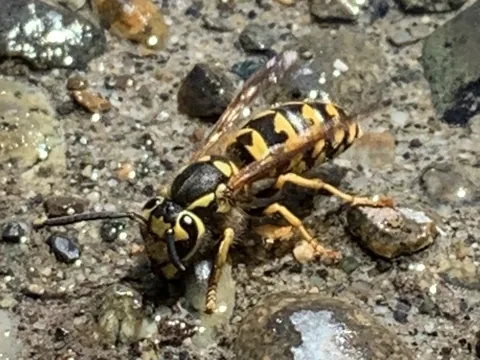 Western Yellowjacket
Vespula pensylvanica
Yellowjackets are social wasps that nest mostly in the ground and in wall voids, defend their nests vigorously, and become persistent scavengers at picnics and garbage cans in late summer and fall.
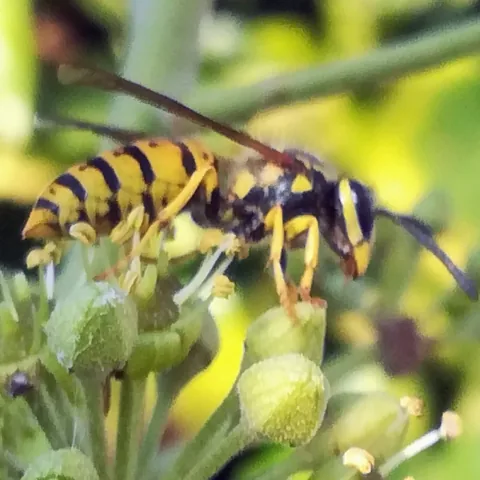 German Yellowjacket
Vespula germanica
The German yellowjacket is an invasive wasp from Eurasia that has spread across the northern US, displaces native yellowjackets and often nests in buildings.
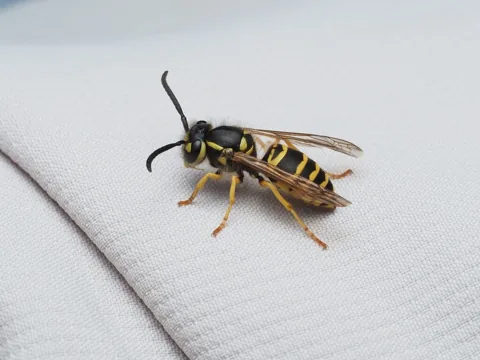 Eastern Yellowjacket
Vespula maculifrons
The eastern yellowjacket is a native, ground-nesting yellowjacket common across the eastern US in lawns, woodlands, pastures and parks; it defends its nest aggressively and can sting repeatedly.
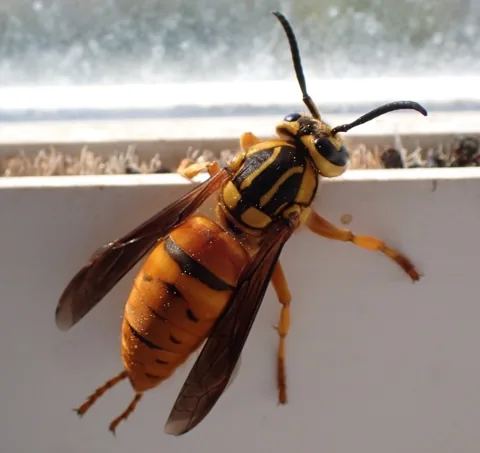 Southern Yellowjacket
Vespula squamosa
The southern yellowjacket is a native yellowjacket that normally nests in the ground. Its large, burnt-orange queens often start colonies by taking over eastern yellowjacket nests.
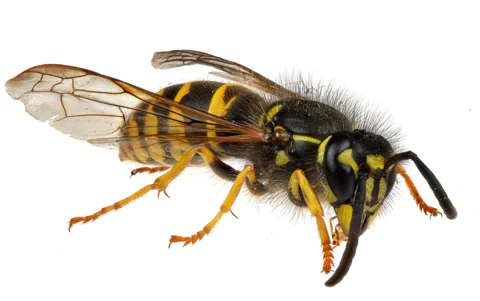 American yellowjacket
Vespula alascensis
The American yellowjacket, also called the common yellowjacket, is a black-and-yellow social wasp that nests in underground cavities or inside structures and scavenges protein and sugar. North American references long called it Vespula vulgaris, but that name now belongs to a European species. It is considered a pest because its nesting and scavenging habits bring it into frequent contact with people.
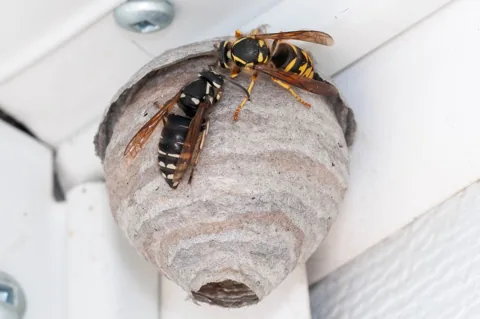 Aerial yellowjacket
Dolichovespula arenaria
The aerial yellowjacket is a black-and-yellow social wasp that builds its enclosed paper nest above ground: in shrubs and trees, under eaves and on outbuildings. It hunts live prey instead of raiding picnics, but it defends its nest fiercely and sometimes bites and stings at the same time.
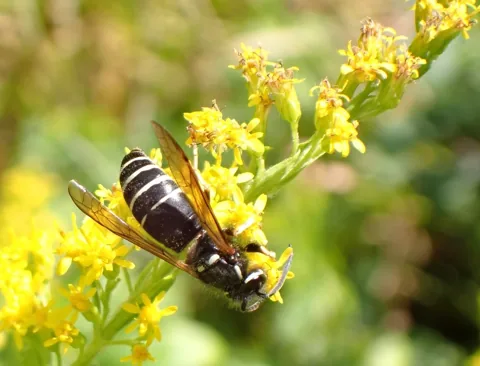 Blackjacket
Vespula consobrina
The blackjacket is a yellowjacket that is black with narrow white markings instead of yellow ones. It lives across Canada and the northern United States and south through the western mountains, hunts live insects, and nests in cavities such as hollow logs, rodent burrows and the wall voids of houses.
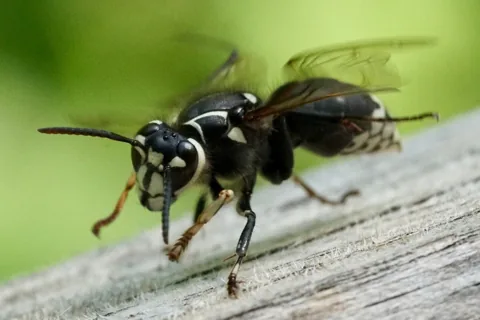 Bald-faced Hornet
Dolichovespula maculata
The bald-faced hornet is a large black-and-white aerial yellowjacket that builds gray, football-shaped paper nests in trees, shrubs and on buildings and defends them aggressively.
Why yellowjackets show up at picnics in late summer
A yellowjacket colony starts in spring with one queen that spent the winter alone. From spring to midsummer the nest is growing, the larvae need a lot of protein, and the workers mostly hunt other insects. By late summer, colony growth slows or stops and the colony needs large amounts of sugar to keep the queen and workers going, so foragers become very interested in sweet things.[1][6]
At the same time, the colonies are at their biggest and natural food is running short. Kentucky Extension describes huge numbers of workers out foraging for the developing queens and scavenging widely: sweets such as fruit, soft drinks and ice cream, but also meat, fish and almost anything else people eat. The Missouri Department of Conservation adds that late-summer yellowjackets are more likely to visit soda cans and garbage, and may simply be more irritable.[3][10]
Colony size is why late summer feels like an invasion. UC IPM gives 1,500 to 15,000 individuals per colony depending on the species; Penn State puts fall German yellowjacket nests at 1,000 to 3,000 workers; Oregon State says a colony can yield up to 5,000 workers at its peak.[1][5][6]
Once yellowjackets find food, they keep hunting around that spot long after the food is gone. They search by smell and sight and forage as individuals; unlike honey bees, they don't tell nestmates where food is.[1][9]
- The scavengers: the western yellowjacket, German yellowjacket and common yellowjacket are the usual pests at outdoor eating areas in much of the US. Penn State says German yellowjackets, which often nest in buildings, frequently forage around trash cans, picnics and fallen fruit.[6][7][5]
- Not every yellowjacket does this. In the Lake Tahoe area, El Dorado County Vector Control describes the aerial yellowjacket as one that rarely scavenges, and the prairie yellowjacket as a predator of live insects that isn't a pest.[11]
- Yellowjackets also come for water. In hot, dry weather, wasps and bees visit swimming pools, bird baths, leaky sprinklers and dripping faucets.[4][9][11]
Food, drinks and trash: the part that works best
Sanitation comes first. Kentucky Extension calls cutting off food sources the best way to reduce the threat of foraging yellowjackets, and UC IPM notes that scavenging wasps usually don't become a problem when there's no food around to draw them.[3][1]
Starting early helps. Kentucky Extension says keeping things clean early in the summer makes an area less attractive to yellowjackets later in the year, which matters most for parks and other places where people eat outdoors.[3]
- Food: keep it covered until it's eaten, and clear it away as soon as the meal is over. Clean up spills and leftovers right away.[3][9][4]
- Drinks: serve sweet drinks in covered cups with straws, and check food and drinks for a landed wasp before every bite or sip.[9][11]
- Trash: use cans with tight-fitting, preferably self-closing lids and a plastic liner. Empty and wash them often, and move trash cans and dumpsters away from serving tables, doors and other busy spots.[3][9][11]
- Pet food: don't leave dishes of dog or cat food outside; scavenging yellowjackets find them.[1]
- Fruit: rake up and throw away fallen apples, peaches and other ripe fruit.[3][1]
- Water: fix dripping faucets, get rid of standing water, and put bird baths well away from the house.[9][11]
- Scents: skip perfume, cologne, hairspray, scented soap, shampoo, deodorant and scented sunscreen when you'll be outside around wasps; Kentucky Extension says these tend to attract foragers.[3][2][9]
- Clothing: UC IPM, Connecticut and Washington State advise against bright or patterned clothing; Washington State names yellow, orange and red.[2][9][7]
- Bug spray won't keep them off. Mosquito and tick repellents don't stop persistent foraging. Kentucky Extension says DEET may make wasps a little less likely to land on bare skin, but long sleeves and pants are a better bet.[3][2]
When a yellowjacket lands on you or your drink
Foragers away from their nest are seldom aggressive. Kentucky Extension says most stings happen when a forager is slapped or trapped against the skin, and UC IPM says scavenging yellowjackets sometimes sting when people try to swat them off food.[3][1][4]
- Stay calm and let it leave. If you don't want to wait, brush it away gently and slowly with a piece of paper.[2][10][9]
- Never swat a yellowjacket that's on your body.[10][9]
- If one gets into your car, stop the car and open all the windows so it can fly out.[3]
- Spraying individual yellowjackets with insecticide won't control the rest of the foragers.[9]
Types of yellowjacket traps
Traps come in two broad kinds: store-bought lure traps that use a chemical attractant, and homemade traps baited with meat, fish or sweet liquid. Which one catches your yellowjackets depends partly on the species.[1][7][6]
- Heptyl butyrate lure traps: UC IPM calls these the easiest to use. The lure mainly attracts the western yellowjacket and not other species, and Washington State Extension also describes heptyl butyrate lures as effective against the western yellowjacket. UC IPM says adding meat such as chicken is believed to improve catches of the German and common yellowjackets.[1][7]
- Acetic acid plus isobutanol (or 2-methyl-1-butanol) lures: in USDA research reviewed by Landolt and Zhang, acetic acid with isobutanol attracted nearly all North American pest social wasps, including yellowjackets, the European hornet and several paper wasps, while heptyl butyrate was a very good attractant for two major pest species. 2-methyl-1-butanol works about as well as isobutanol and is used in commercial lures.[12][13]
- In Wisconsin vineyards, acetic acid plus isobutanol caught significantly more eastern, German and Vespula flavopilosa yellowjackets than heptyl butyrate did; heptyl butyrate caught more of one species, V. vidua. UC IPM likewise says heptyl butyrate attracts mainly the western yellowjacket.[15][1]
- Homemade water traps: hang a piece of protein bait such as turkey, ham, fish or liver on a string just above a bucket of soapy water. The wasp cuts off a piece too heavy to fly with, drops into the water and drowns; the soap lets it sink. UC IPM suspends the bait 1 to 2 inches above the water and suggests wide mesh screen over the bucket to keep other animals off the bait. El Dorado County hangs a can of tuna, mackerel or fish-flavored cat food, with holes punched in the bottom, about 1/2 inch above about 6 inches of water with 4 or 5 drops of dish detergent.[1][7][11]
- Bottle traps: Washington State Extension describes a clear 2-liter soda bottle cut a third of the way from the top, with the top turned upside down into the base as a funnel. Wet traps like this can be baited with soft drinks or juice; 50% apple juice in water attracted western and German yellowjackets.[7]
- Sweet baits have a downside. Oregon State warns that sugary attractants in homemade traps can draw honey bees, and notes that heptyl butyrate or meat attracts yellowjackets but not honey bees.[6]
- One field trial, published in the Journal of Economic Entomology, found two citrus sodas outcaught an isobutanol-acetic acid mix for almost all of the wasp species caught.[14]
Keeping traps working
Traps lose their pull as baits spoil and lures run down, so they need regular upkeep.[1][6]
- Keep meat fresh. Yellowjackets aren't attracted to rotting meat. Washington State says to replace meat in a cone trap daily and other food baits within a few days; Oregon State says fresh meat or fish can spoil within hours.[1][7][6]
- Replace chemical lures as the trap directions say, and check traps now and then to empty them and make sure they're still catching.[1][6]
- To kill what's in a closed trap before emptying it, Washington State Extension puts the trap in a freezer for several hours.[7]
- Hang traps where children and pets can't reach them.[11]
Where to hang traps: away from people
A trap pulls yellowjackets toward itself, so put it between the wasps' nesting areas and the place you want to protect, not on the picnic table. Kentucky Extension warns that a trap placed in the wrong spot may attract more wasps than it catches.[1][3]
- Backyard: set lure traps along the property line, as far from the patio or eating area as possible.[1]
- Parks and large areas: UC IPM suggests traps about 200 feet from the protected area and about every 150 feet around it. Oregon State cites a study that cut yellowjacket numbers at a picnic pavilion with 50 traps set 200 feet from it, refreshed often.[1][6]
- Height: Oregon State says yellowjackets tend to forage near the ground and suggests placing traps low.[6]
- Near beehives: Oregon State keeps traps at least 20 feet from hives so the wasps don't find the hives while checking the traps.[6]
- Water traps go away from the patio or picnic area too, so the bait doesn't draw wasps to your food.[1]
- How far they travel: UC IPM says yellowjackets typically forage about 1/4 mile; Oregon State says within 1,100 feet of the nest; Connecticut says up to a mile.[1][6][9]
Do yellowjacket traps actually work?
They catch wasps, often a lot of them, but the sources agree that catching isn't the same as solving the problem. Kentucky Extension says well-maintained traps often catch large numbers of foragers, but because late-season nests hold thousands of wasps, trapping seldom brings a noticeable decline. Penn State says traps can thin out foraging workers but can't eliminate established colonies.[3][4]
UC IPM says lure traps reduce localized foragers but don't eliminate large populations. The Connecticut Agricultural Experiment Station says they may give some temporary control for short outdoor events. Oregon State says casual trapping usually won't cut a population enough to matter, although an intercepting ring of traps can reduce numbers in a small area.[1][9][6]
Trapping queens in spring
Only mated queens survive the winter, hidden in places like soil cavities, leaf litter, compost piles, logs, firewood and wall siding. They come out on warm spring days, feed, and look for a nest site. The first nest is small: Connecticut counts 30 to 55 cells, and Illinois Extension 40 to 50. The first workers emerge about a month later.[8][9][7]
That makes spring the time when one wasp equals one future colony. UC IPM says lure and water traps work best as queen traps in late winter to early spring, El Dorado County says to put traps out in early spring when queens begin foraging, and Illinois Extension calls spring the best time for yellowjacket control.[1][11][8]
The evidence is mixed, though. Oregon State says each queen caught in spring may sharply cut late-season numbers, since a colony can yield up to 5,000 workers, but it also cites a California study in which heptyl butyrate traps caught queens without reducing the number of workers trapped in late summer.[6]
- Walk the property in early spring, watching for queens searching for nest sites.[8]
- Fill empty rodent burrows with soil, and seal or screen gaps in siding, sheds, garages, porches and attic vents so queens can't move in.[8]
- If you find a small new nest, Illinois Extension says to deal with the queen first and then remove the nest, not the other way around, because she will defend it. Commercial traps placed near likely nest sites are the option for anyone who doesn't want to get that close.[8]
Poison baits
Insecticide baits that foragers carry back to the nest have a mixed history. UC IPM says reliable bait products were taken off the market in the early 2000s and that the esfenvalerate products that came later haven't been shown to work in research trials. Oregon State says microencapsulated esfenvalerate is the only insecticide approved for yellowjacket bait stations and that results vary.[1][6]
Don't make your own. Oregon State warns that baiting yellowjackets with any other insecticide or chemical breaks state and federal pesticide laws, and that adding more insecticide than the label allows can repel the wasps.[6]
When it's a nest, not just foragers
Wasps flying straight in and out of one spot are probably going to and from a nest. Late-season foragers at a picnic may come from nests several hundred yards away, so hunting for the nest is often impractical, but checking your yard in daytime, when wasps are entering and leaving, can prevent a run-in while mowing.[1][3]
Yellowjackets inside the house in fall may mean a nest in a nearby wall. Don't cover the outside entrance: trapped yellowjackets may chew through interior walls into the living space.[9][5]
Most nests die out with freezing weather and aren't reused, so a nest found in fall may not need treatment. If it has to go, our nest removal guide covers when to call a professional and how to treat each type of nest safely.[3][4][7]
Stings: first aid and allergic reactions
Yellowjackets don't leave their stinger behind the way honey bees do, and they can sting more than once.[9][11]
A sting in the mouth or throat is the picnic risk to take seriously. Yellowjackets crawl into soda cans and can sting the lips, mouth or throat. UC IPM says to get medical attention right away for a sting on the neck or in the mouth, because swelling there can block breathing.[1][2][3]
For an ordinary sting, wash the site with soap and water and put ice on it. MedlinePlus advises ice wrapped in a cloth, 10 minutes on and 10 minutes off, then watching over the next few days for signs of infection. Kentucky Extension says over-the-counter antihistamines and an ice pack can reduce pain, itching and swelling. CDC NIOSH suggests having someone stay with the person to watch for an allergic reaction.[17][16][3]
How many people are seriously allergic: Kentucky Extension and El Dorado County say about 1% of the US population; UC IPM says one to two people out of 1,000.[3][11][2]
Being stung many times at once is a separate danger, even without an allergy. UC IPM explains that venom from many stings can damage tissues and clog the kidneys days later, sometimes needing dialysis.[1][2]
- Call 911 for swelling anywhere on the face or in the mouth, throat tightness, trouble swallowing or breathing, widespread hives or itching, dizziness, or a racing pulse. Kentucky Extension warns that death can follow within minutes, so don't wait to see whether the symptoms pass. While waiting for help, MedlinePlus says to keep the person calm, remove rings and anything tight near the sting, and use their epinephrine kit if they carry one.[17][3]
- If you've had a severe reaction before, carry an epinephrine auto-injector and, CDC NIOSH adds, a medical ID bracelet or necklace. Kentucky Extension says to still go to an emergency room after using the injector.[16][3]
- After a severe, whole-body reaction, MedlinePlus says your doctor should refer you to an allergist for testing and treatment. Allergy shots with venom (desensitization) can build protection against future stings.[17][2]
- Poison control (1-800-222-1222) can advise on stings; the Connecticut Agricultural Experiment Station cites its first-aid advice.[9]
Common questions
- Why are yellowjackets so bad in late summer?
- Colonies are at peak size, insect prey is getting scarce, and the colony needs lots of sugar, so thousands of workers scavenge for sweets, meat and trash.[1][3][10]
- Do yellowjacket traps work?
- They catch many foragers and can thin numbers around a small area, but they don't eliminate colonies, and casual trapping seldom makes a noticeable difference in late summer.[3][4][1][6]
- Where should I hang a yellowjacket trap?
- Along the edge of the property, between the eating area and where the wasps come from, as far from people as possible; never on or next to the table.[1][3]
- What's the best bait for a yellowjacket trap?
- Heptyl butyrate lures mainly catch western yellowjackets. Acetic acid with isobutanol lures attract most pest species, including eastern and German yellowjackets. Fresh meat or fish works in water traps. Sweet baits work but can catch honey bees.[1][12][15][6]
- Should I put out yellowjacket traps in spring?
- Several sources say spring is the best time, since each queen caught is one less colony, but a California study found spring queen catches didn't reduce late-summer worker numbers.[1][11][8][6]
- Do insect repellents keep yellowjackets away?
- No. Mosquito and tick repellents don't stop yellowjacket foraging. Covering food and skipping scented products helps more.[3][2]
- What should I do if a yellowjacket stings me in the mouth?
- Get medical help right away. Swelling in the mouth or throat can block breathing; call 911 for any face or mouth swelling or throat tightness.[2][17][3]
Photo credits
- Western Yellowjacket: (c) eebee, some rights reserved (CC BY) — via iNaturalist, CC BY 4.0
- German Yellowjacket: (c) Gianni Del Bufalo bygdb, some rights reserved (CC BY) — via iNaturalist, CC BY 4.0
- Eastern Yellowjacket: Brighton Lee, public domain (CC0), via iNaturalist
- Southern Yellowjacket: (c) Cole Shoemaker, some rights reserved (CC BY) — via iNaturalist, CC BY 4.0
- American yellowjacket: (c) Christian Back, some rights reserved (CC BY) — via iNaturalist, CC BY 4.0
- Aerial yellowjacket: (c) Chris O'Donoghue, some rights reserved (CC BY) — via iNaturalist, CC BY 4.0
- Blackjacket: Dominique Bérubé, public domain (CC0), via iNaturalist
- Bald-faced Hornet: (c) Amy Schnebelin, some rights reserved (CC BY) — via iNaturalist, CC BY 4.0
Sources
- University of California Statewide IPM Program, “Pest Notes: Yellowjackets and Other Social Wasps, UC ANR Publication 7450.” ipm.ucanr.edu/home-and-landscape/yellowjackets-and-other-social-wasps/ (accessed 2026-11-10)
- University of California Statewide IPM Program, “Pest Notes: Bee and Wasp Stings, UC ANR Publication 7449.” ipm.ucanr.edu/home-and-landscape/bee-and-wasp-stings/ (accessed 2026-11-10)
- University of Kentucky Entomology, “ENTFACT-620: Controlling Wasps, Hornets, and Yellowjackets (M. F. Potter).” entomology.mgcafe.uky.edu/ef620 (accessed 2026-11-10)
- Penn State Extension, “Getting Rid of Paper Wasps, Yellowjackets, and Other Stinging Insects.” extension.psu.edu/getting-rid-of-paper-wasps-yellowjackets-and-other-stinging-insects (accessed 2026-11-10)
- Penn State Extension, “German Yellowjackets.” extension.psu.edu/german-yellowjackets (accessed 2026-11-10)
- Oregon State University Extension Service, “EM 9211: Protecting Honey Bees from Yellowjacket Wasps (C. Breece, R. Sagili, D. Wyns; 2018, reviewed 2024).” extension.oregonstate.edu/catalog/em-9211-protecting-honey-bees-yellowjacket-wasps (accessed 2026-11-10)
- Washington State University Cooperative Extension, “EB0643: Yellowjackets and Paper Wasps (P. Landolt, A. Antonelli).” ehs.wsu.edu/documents/2019/09/yellowjackets-and-paper-wasps.pdf (accessed 2026-11-10)
- Iowa State University Extension and Outreach, “Yellowjacket Control: Spring Is the Best Time to Do It! (J. Schmidt-Bailey, University of Illinois Extension; Yard and Garden, May 11, 2001).” yardandgarden.extension.iastate.edu/article/2001/5-11-2001/yellowjacketcontrol.html (accessed 2026-11-10)
- Connecticut Agricultural Experiment Station, “Yellowjackets (Family Vespidae) fact sheet (G. E. Ridge).” portal.ct.gov/-/media/caes/documents/publications/fact_sheets/entomology/yellowjackets_vespidae.pdf (accessed 2026-11-10)
- Missouri Department of Conservation, “Yellowjackets (Vespula Wasps).” mdc.mo.gov/discover-nature/field-guide/yellowjackets-vespula-wasps (accessed 2026-11-10)
- El Dorado County Environmental Management, California, “Yellow Jackets (Vector Control, South Lake Tahoe).” www.eldoradocounty.ca.gov/County-Government/County-Departments/Environmental-Management/EM-Vector-Control/Yellow-Jackets (accessed 2026-11-10)
- Journal of Chemical Ecology (PubMed 27435228), “Landolt P, Zhang QH. Discovery and development of chemical attractants used to trap pestiferous social wasps (Hymenoptera: Vespidae). J Chem Ecol 2016;42(7):655-665.” pubmed.ncbi.nlm.nih.gov/27435228/ (accessed 2026-11-10)
- Journal of Economic Entomology (PubMed 11142289), “Landolt PJ, Smithhisler CS, Reed HC, McDonough LM. Trapping social wasps (Hymenoptera: Vespidae) with acetic acid and saturated short chain alcohols. J Econ Entomol 2000;93(6):1613-1618.” pubmed.ncbi.nlm.nih.gov/11142289/ (accessed 2026-11-10)
- Journal of Economic Entomology (PubMed 16022290), “Wegner GS, Jordan KK. Comparison of three liquid lures for trapping social wasps (Hymenoptera: Vespidae). J Econ Entomol 2005;98(3):664-666.” pubmed.ncbi.nlm.nih.gov/16022290/ (accessed 2026-11-10)
- Insects (PubMed 29857557), “Guédot C, Hietala-Henschell K, Lois AN. Species composition, abundance and seasonal phenology of social wasps (Hymenoptera: Vespidae) in Wisconsin vineyards. Insects 2018;9(2):57.” pubmed.ncbi.nlm.nih.gov/29857557/ (accessed 2026-11-10)
- Centers for Disease Control and Prevention, “Insects and Scorpions at Work (NIOSH).” www.cdc.gov/niosh/outdoor-workers/about/insects-and-scorpions.html (accessed 2026-11-10)
- MedlinePlus, U.S. National Library of Medicine, “Insect bites and stings (Medical Encyclopedia).” medlineplus.gov/ency/article/000033.htm (accessed 2026-11-10)