The short answer
- Small oval bugs rowing around the pool are usually water boatmen or backswimmers, both usually under 1/2 inch long. They fly in at night, drawn to lights.[1][2][8]
- Water boatmen swim right side up, have fine dark crosslines on the back and don't bite. Backswimmers swim upside down, have a keeled, often pale back and can give a painful bite.[1][2]
- A brown, flattened bug up to about 2 inches long with grabbing front legs is a giant water bug. Its bite is described as excruciating, though the pain doesn't last.[3][7]
- Water beetles also fly to lights and land in pools; their bites hurt but aren't medically significant.[5][6]
- Masses of tiny gray specks on the surface are usually springtails, which are harmless and come out with normal filtering or a skimmer.[14][15]
- Wasps and bees visit pools for water in hot, dry weather, and horse flies are drawn to the shiny surface and to moving swimmers.[11][12]
Bugs found in pools
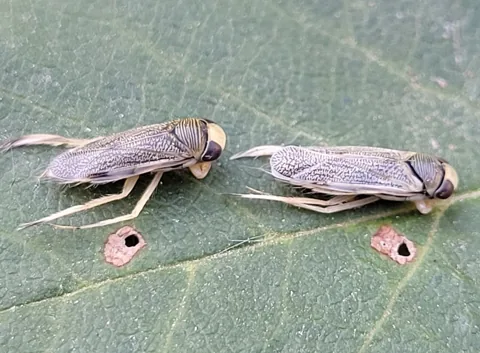 Water boatmen
Corixidae (about 125 North American species)
Water boatmen are the small, streamlined water bugs that row through ponds with long, hair-fringed hind legs and occasionally show up in swimming pools and birdbaths after a night of flying toward lights. There are about 125 species in North America. Unlike most aquatic true bugs they are not predators and do not bite people; they feed on algae, plant juices and detritus. Their look-alikes, the backswimmers, do bite, so it is worth learning the difference.
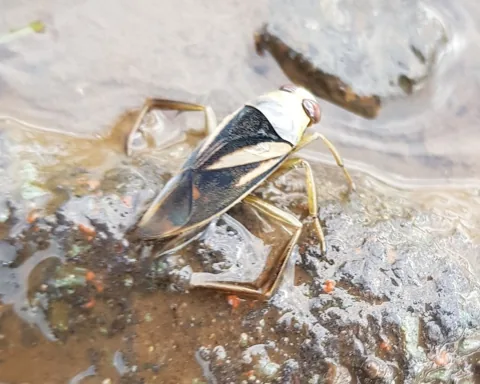 Backswimmers
Notonectidae (about 32 North American species)
Backswimmers are predatory water bugs that swim upside down. They fly at night, often land in swimming pools, and, unlike the look-alike water boatmen, can give a painful bite if handled.
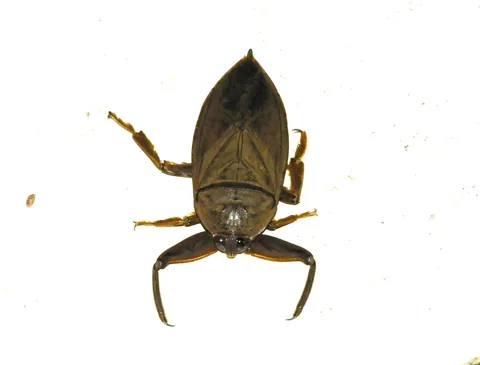 Giant Water Bugs
Belostomatidae (Lethocerus, Abedus, Belostoma)
Giant water bugs are large, flattened aquatic predators also called toe-biters and electric light bugs. On summer nights adults leave the water to find mates and fly to lights, so they turn up on sidewalks and in pools; if handled or stepped on, they can give an extremely painful bite.
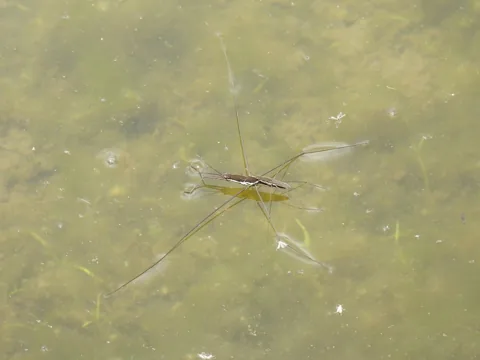 Water striders
Gerridae (e.g., Aquarius remigis and Gerris species)
Water striders are the long-legged bugs that skate across the surface of calm water. Water-repellent hairs on their middle and hind legs keep them on top of the surface film, and velvety hairs on the body keep them dry. They are predators and scavengers of insects that fall onto the water, including mosquito larvae, and the Missouri Department of Conservation calls them harmless. In Missouri the most common and conspicuous species is the large water strider, Aquarius remigis, with a dark body half to three quarters of an inch long; Gerris species are smaller.
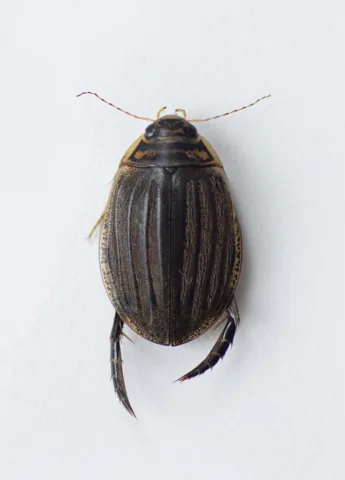 Predaceous diving beetles
Dytiscidae (predaceous diving beetles, e.g., Cybister, Dytiscus, Thermonectus)
Predaceous diving beetles are freshwater beetles of the family Dytiscidae. Adults and their larvae, called water tigers, are fierce hunters in ponds, wetlands and slow streams. Because the adults are strong fliers and electric lights can lure them away from home, they sometimes land in swimming pools and birdbaths.
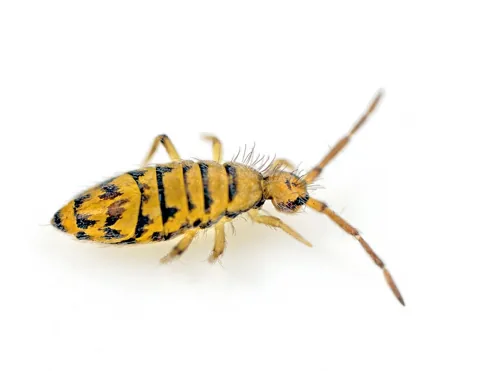 Springtail
Collembola (shown: Entomobrya sp.)
Springtails are tiny jumping creatures that sometimes appear in large numbers in moist spots indoors. They don't bite or sting and don't damage furniture or food; their presence indoors points to a moisture problem.
Why bugs end up in the pool
Most of the swimming bugs people find in pools are aquatic insects that live in ponds and the quiet parts of lakes and streams. Water boatmen, backswimmers, giant water bugs, predaceous diving beetles and water scavenger beetles all fly, and all are attracted to artificial lights at night. Missouri Department of Conservation says each of them turns up in swimming pools after those night flights.[1][2][3][5][6]
A University of Wisconsin-Milwaukee field station note lists swimming pools and bird baths among the still waters where water boatmen and backswimmers are found, and says both are more active in the dark than in the light.[8]
Giant water bugs are so drawn to lights that they are also called electric light bugs. Mississippi State notes that, much like moths, they sometimes crash-land and get stranded near the lights.[7][3]
Other visitors come for different reasons: springtails move toward pools when the ground around them dries out, wasps and bees come to drink in hot, dry weather, and horse flies and deer flies are drawn to the shiny water and the people in it.[14][11][12]
Water boatmen: harmless
Water boatmen (family Corixidae) are slender, oval, streamlined bugs, usually less than 1/2 inch long; a Utah State key gives 3 to 12 mm. The back is flattened and crossed by several narrow, dark, parallel lines, and they row with long, hairy, oar-like hind legs.[1][9]
They swim right side up. A silvery bubble of air held against the body lets them stay under, and they are so buoyant that they hook a front leg around a plant or other object to keep from floating up.[1][8]
Unlike most aquatic true bugs, water boatmen are not predators and don't bite people. They feed on algae, other plant material and detritus, and only a few species eat small animals such as mosquito larvae.[1][8]
Backswimmers: the ones that bite
Backswimmers (family Notonectidae) look a lot like water boatmen, which is why they get confused. The differences: backswimmers swim on their backs, their back is keeled like the bottom of a boat and often light in color, and it lacks the crosslines of a water boatman. At rest they hang tilted head-down at the surface with the tip of the abdomen sticking out. Adults are usually under 1/2 inch; the Utah State key gives 8.5 to 16 mm.[2][1][9]
They are predators that grab other insects and even small fish and tadpoles, then deliver what Missouri Department of Conservation calls a stinging bite that subdues the prey. They can bite people too, painfully, if mishandled, which is how they got the names water bees and water wasps.[2][8]
Because the common names get mixed up, Missouri Department of Conservation notes that many people use the family names (notonectids for backswimmers, corixids for water boatmen) to avoid a painful mistake. If you can't tell which one you have, don't pick it up.[2][1]
Giant water bugs (toe-biters)
Giant water bugs (family Belostomatidae) are among the largest insects you'll see in a pool. Mississippi State says adults reach up to 2.5 inches, and Missouri Department of Conservation says to about 2 inches; the Utah State key gives 2 to 12 cm for the family as a whole. They are brownish, flattened and oval, with large grabbing front legs.[7][3][9]
Their bite is the reason for the name toe-biter. Missouri Department of Conservation calls it excruciatingly painful when one is handled or stepped on by a barefoot wader. Mississippi State says people who've been bitten rank it as more painful than any other insect bite or sting they've had, but the pain is relatively short-lived and there are no long-term effects. Bites are rare because the bugs are rarely encountered and most people avoid handling them.[3][7]
A report of seven bite cases in Brazil describes intense, excruciating pain, with numbness in the forearm in one patient, and notes there is no specific treatment known to work, so prevention matters.[10]
Not sure whether the big brown bug is a giant water bug or a large cockroach? Our cockroach look-alike guide compares them side by side.[3][7]
Water striders
Water striders (family Gerridae) skate on top of the water rather than swimming under it, on long middle and hind legs with water-repellent hairs. Missouri Department of Conservation calls them harmless. The common large water strider is 1/2 to 3/4 inch long not counting the legs, and Gerris species are under 1/2 inch.[4][9]
They prefer calm water and eat insects that fall onto the surface and struggle there, along with mosquito larvae. Despite the nickname water spider, they are insects with six legs.[4]
Water beetles
Predaceous diving beetles and water scavenger beetles are strong fliers that are drawn to lights, which Missouri Department of Conservation says is why they are sometimes found in pools, bird baths and buckets. Adults of both reach about 1 1/2 inches, depending on the species.[5][6]
Both can bite or pinch. Missouri Department of Conservation says diving beetle bites are painful but not medically significant, and that water scavenger beetle bites aren't medically significant either, but suggests handling them with care. Use the net.[5][6]
Wasps and bees coming to drink
During hot, dry weather, Penn State Extension says bees and wasps may be drawn to swimming pools, bird feeders, leaky sprinkler systems and other water sources. Sometimes giving them another water source somewhere else, and chasing them away from the pool until they decide the alternative is safer, solves the problem.[11]
Yellowjackets that keep coming back may be nesting nearby. Our yellowjacket guide covers traps, finding nests and keeping them away from food outdoors.[11]
Horse flies and deer flies
University of Kentucky entomologists say horse flies and deer flies can be serious nuisances around swimming pools, possibly drawn by the shiny surface of the water or by swimmers moving. Their bites can be very painful.[12]
Kentucky says there are no effective recommendations for the problem at pools. Our horse fly and deer fly guide covers repellents, clothing and traps for the rest of the yard.[12]
Springtails coating the surface
Springtails are tiny jumping creatures that live in damp soil, mulch and leaf litter. When the surrounding area dries out, they move to wetter places, including the area around a pool. UC IPM says they can fall in and drown in large numbers, often coating the pool surface, and Clemson notes they can be a nuisance in pool drains.[14][15]
They are unsightly but harmless: springtails don't bite or harm people or pets. Normal pool filtering removes them, or you can skim them off. Cutting back lush plants and mulch along the pool edge may reduce repeat problems.[14]
For springtails in the house, see our springtail guide.[14][15]
Mosquitoes and the neglected pool
An unmaintained pool can become a mosquito nursery. CDC lists unmaintained swimming pools among the permanent standing water where Culex mosquitoes prefer to lay their eggs, and Culex mosquitoes can spread West Nile virus.[17]
UC IPM advises keeping water quality up in swimming pools with chemical treatments and keeping water off pool covers. For a pool that sits unused, CDC says mosquito dunks or other larvicides can be used to kill the larvae before they become adults.[16][17]
Our mosquito breeding guide covers the rest of the yard: buckets, gutters, tires and other containers.[16][17]
What to do about bugs in the pool
Use a net or skimmer, not your hand. Backswimmers, giant water bugs and water beetles can all bite, and Missouri Department of Conservation advises care in handling them. Skimming also clears springtails and drowned insects.[2][3][5][14]
Think about the lights. All of the swimming bugs here fly to artificial lights at night. University of Kentucky entomologists suggest yellow or sodium vapor bulbs at outside entrances because they attract fewer night-flying insects than conventional bulbs. We found no source that has tested lighting changes around pools specifically, but fewer bright lights near the water at night gives these insects less reason to come down there.[2][1][3][13]
Keep the water clean. Water boatmen feed on algae and plant debris, and a maintained pool also keeps mosquitoes from breeding. We found no extension or agency source showing that normal chlorine levels kill or repel water boatmen or backswimmers; they arrive by air, so new ones can show up after any warm night.[1][16][8]
Expect them to leave on their own. These insects are clumsy out of water but strong fliers, and a backswimmer has to climb out and flip onto its belly before it can take off. Missouri Department of Conservation says giant water bugs are usually considered beneficial because they eat mosquito larvae.[2][1][8][3]
If someone gets bitten
For most insect bites, MedlinePlus says to wash the area well with soap and water, then put ice wrapped in a washcloth on it for 10 minutes on and 10 minutes off, and repeat. An antihistamine or anti-itch cream can help if needed. Watch the bite over the next several days for signs of infection, such as more redness, swelling or pain.[18]
Call 911 or the local emergency number for trouble breathing, wheezing, swelling of the face or mouth, throat tightness or trouble swallowing, weakness or turning blue. If the person carries an emergency kit for allergic reactions, MedlinePlus says to use it.[18]
Giant water bug bites are extremely painful at first, but Mississippi State says the pain is short-lived and leaves no long-term effects. For other bites and stings around the yard, see our bite identification guide.[7][10]
Common questions
- What are the little bugs swimming in my pool?
- Usually water boatmen or backswimmers, both under about 1/2 inch long. They live in ponds, fly at night, are drawn to lights and land in pools.[1][2][8]
- Do water boatmen bite?
- No. Water boatmen are among the few aquatic true bugs that don't bite people. They feed on algae and plant debris.[1]
- Do backswimmers bite?
- Yes, if handled. Their bite is painful, which is why they're also called water bees and water wasps. Remove them with a net.[2][8]
- How do I tell a backswimmer from a water boatman?
- Backswimmers swim upside down and have a keeled, often pale back without crosslines. Water boatmen swim right side up and have fine dark crosslines on a flatter back.[2][1]
- What is the big brown bug in my pool?
- Probably a giant water bug, up to about 2 to 2.5 inches long, with grabbing front legs. It can give a very painful bite, so don't pick it up.[3][7]
- Why are there wasps at my pool?
- In hot, dry weather, bees and wasps come to pools for water. Offering another water source away from the pool can help.[11]
- Are springtails in the pool harmful?
- No. They don't bite or harm people or pets, and normal filtering or a skimmer removes them.[14]
Photo credits
- Water boatmen: (c) Doug Macaulay, some rights reserved (CC BY) — via iNaturalist, CC BY 4.0
- Backswimmers: Neil Clark, public domain (CC0), via iNaturalist
- Giant Water Bugs: (c) Francisco Farriols Sarabia, some rights reserved (CC BY) — via iNaturalist, CC BY 4.0
- Water striders: renshuchu, public domain (CC0), via iNaturalist
- Predaceous diving beetles: (c) Евгений Рыбальченко, some rights reserved (CC BY) — via iNaturalist, CC BY 4.0
- Springtail: AJ Cann, public domain (CC0), via iNaturalist
Sources
- Missouri Department of Conservation, “Water Boatmen (field guide).” mdc.mo.gov/discover-nature/field-guide/water-boatmen (accessed 2026-11-10)
- Missouri Department of Conservation, “Backswimmers (field guide).” mdc.mo.gov/discover-nature/field-guide/backswimmers (accessed 2026-11-10)
- Missouri Department of Conservation, “Giant Water Bugs (Field Guide).” mdc.mo.gov/discover-nature/field-guide/giant-water-bugs (accessed 2026-11-10)
- Missouri Department of Conservation, “Water Striders (field guide).” mdc.mo.gov/discover-nature/field-guide/water-striders (accessed 2026-11-10)
- Missouri Department of Conservation, “Predaceous Diving Beetles (Water Tigers) (Field Guide).” mdc.mo.gov/discover-nature/field-guide/predaceous-diving-beetles-water-tigers (accessed 2026-11-10)
- Missouri Department of Conservation, “Water Scavenger Beetles (Field Guide).” mdc.mo.gov/discover-nature/field-guide/water-scavenger-beetles (accessed 2026-11-10)
- Mississippi State University Extension Service, “Giant Water Bug, Bug's Eye View Vol. 10, No. 08 (B. Layton).” extension.msstate.edu/newsletters/bugs-eye-view/2024/giant-water-bug-vol-10-no-08 (accessed 2026-11-10)
- University of Wisconsin-Milwaukee Field Station, “Water Boatmen, Backswimmers (Bug of the Week).” uwm.edu/field-station/bug-of-the-week/water-boatmen-backswimmers/ (accessed 2026-11-10)
- Utah State University Extension Water Quality Program, “Water Beetles and Bugs: Utah aquatic macroinvertebrate key.” extension.usu.edu/waterquality/resources/macrokey/beetles-bugs.php (accessed 2026-11-10)
- Wilderness & Environmental Medicine, via PubMed, “Haddad, Schwartz, Schwartz and Carvalho (2010), Bites caused by giant water bugs belonging to Belostomatidae family (Hemiptera, Heteroptera) in humans: a report of seven cases, Wilderness Environ. Med. 21(2):130-133.” pubmed.ncbi.nlm.nih.gov/20591375/ (accessed 2026-11-10)
- Penn State Extension, “Getting Rid of Paper Wasps, Yellowjackets, and Other Stinging Insects.” extension.psu.edu/getting-rid-of-paper-wasps-yellowjackets-and-other-stinging-insects (accessed 2026-11-10)
- University of Kentucky Entomology, “Horse Flies and Deer Flies (Entfact 511).” entomology.ca.uky.edu/ef511 (accessed 2026-11-10)
- University of Kentucky Entomology, “Eliminating Spiders Around Homes and Buildings (ENTFACT-623).” entomology.mgcafe.uky.edu/ef623 (accessed 2026-11-10)
- University of California Statewide IPM Program, “Pest Notes: Springtails (Home and Landscape).” ipm.ucanr.edu/home-and-landscape/springtails/ (accessed 2026-11-10)
- Clemson Cooperative Extension Home & Garden Information Center, “Springtails (Collembola) in South Carolina: Identification and Management (HGIC 2445).” hgic.clemson.edu/factsheet/springtails/ (accessed 2026-11-10)
- University of California Statewide IPM Program, “Pest Notes: Mosquitoes, Publication 7451 (revised April 2020).” ipm.ucanr.edu/legacy_assets/PDF/PESTNOTES/pnmosquitoes.pdf (accessed 2026-11-10)
- U.S. Centers for Disease Control and Prevention, “Life Cycle of Culex Mosquitoes.” www.cdc.gov/mosquitoes/about/life-cycle-of-culex-mosquitoes.html (accessed 2026-11-10)
- MedlinePlus, U.S. National Library of Medicine, “Insect bites and stings (Medical Encyclopedia).” medlineplus.gov/ency/article/000033.htm (accessed 2026-11-10)