The short answer
- Dry things out. Springtails need moisture, so fix leaks, run a fan, dehumidifier or air conditioning, and remove mold and wet wood. Minnesota Extension says springtails are generally a temporary problem that dies off once moisture is reduced.[3][2][1][5][7]
- Sweep or vacuum the ones you see, and wash any in a sink or tub down the drain. Never pour or spray insecticide down a drain.[1][3]
- Houseplants: let the soil dry between waterings and don't leave water standing in the saucer.[1][3][6][9]
- Outside: pull back thick mulch and wet leaves from the foundation, send downspout water away from the house, and seal gaps around doors, windows and vents.[1][3][4]
- Pools: normal filtering or a pool skimmer removes them, and they're harmless in the water. Cutting back lush plants and mulch at the pool edge may help keep them from coming back.[1]
- Skip the sprays indoors. UC IPM and Minnesota say pesticides aren't needed or don't work for springtails inside; moisture control is what lasts.[1][3][5][9]
Moisture pests
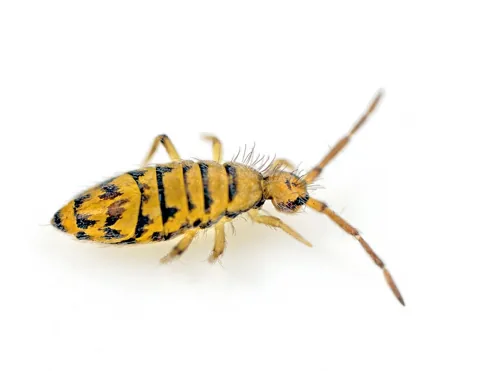 Springtail
Collembola (shown: Entomobrya sp.)
Springtails are tiny jumping creatures that sometimes appear in large numbers in moist spots indoors. They don't bite or sting and don't damage furniture or food; their presence indoors points to a moisture problem.
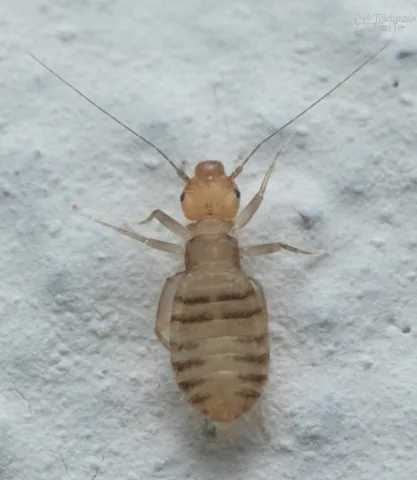 Booklice
Liposcelis species and other psocids (family Liposcelididae)
Booklice, also called psocids, are tiny insects that feed on mold and fungi. Finding them indoors usually means high humidity or a moisture problem, and drying things out is the most effective control.
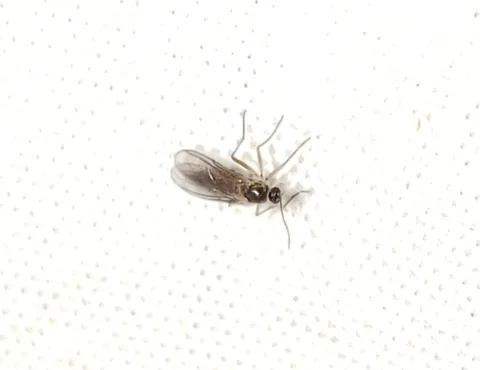 Fungus Gnat
Bradysia and related species
Fungus gnats are small flies whose larvae live in moist potting mix and organic matter. Indoors the adults emerge from houseplants and become a nuisance; they don't bite, and Colorado State calls the larvae minor pests of houseplants.
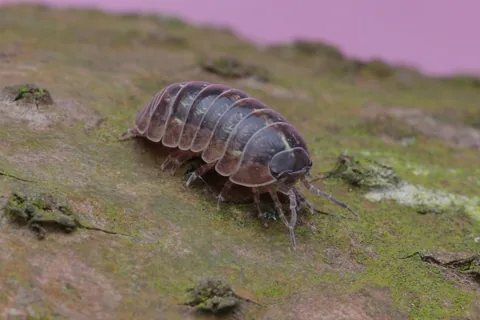 Common Pillbug
Armadillidium vulgare
Sowbugs and pillbugs are land-living crustaceans, more closely related to shrimp and crayfish than to insects, that feed mostly on decaying plant matter. They are harmless indoors, and finding many inside usually points to dampness, a large population outdoors or a gap at a door or window.
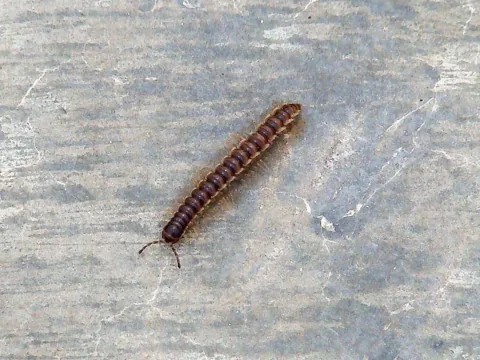 Greenhouse Millipede
Oxidus gracilis
Millipedes live in cool, damp places under leaves, mulch and stones; occasionally they migrate into buildings in large numbers but do no damage and soon die indoors. Clemson says the garden millipede (Oxidus gracilis) is the species that most often invades homes in large numbers.
Make sure they're springtails
Springtails are small enough to be mistaken for fleas, mites or specks of dirt. A few checks sort them out quickly. If they don't match, the tiny bugs guide covers the other usual suspects by where they turn up.[1][3]
- Size: tiny. UC IPM gives about 1/16 inch and Minnesota 1/16 to 1/8 inch. In metric, Ohio State says usually 1 to 3 mm, Penn State says most that get into homes are 1 to 2 mm, and Clemson says most are 1 to 2 mm, about the width of a grain of rice. Clemson says springtails are usually less than 6 mm long, and the Missouri Department of Conservation gives less than 6 mm (less than ¼ inch), with the largest kinds reaching nearly ¼ inch.[1][3][4][2][5][7]
- Color: Minnesota says most are dark brown, gray or black, with some white and a few bright. UC IPM says young ones are usually whitish, and Clemson adds yellow, red and blue species. Missouri adds that some are covered in tiny scales that make them look iridescent or metallic.[3][1][5][7]
- They jump. A forked structure tucked under the abdomen snaps down and flings them up to several inches when disturbed. They have no wings and can't fly.[1][3][2][7]
- Springtail or flea? Minnesota's test: fleas are flattened side to side with very hard bodies and are hard to crush, while springtails are rounder, soft and crush easily. Springtails also don't bite people or pets. South Dakota State notes snow fleas are often mistaken for real fleas but are completely harmless.[3][1][8]
- Where you find them matters. Springtails gather where it's damp: sinks, tubs, floor drains, damp basements and the soil of overwatered plants.[1][3]
- The kind most often seen indoors may be shiny. Missouri says springtails in the genus Willowsia are often found in homes, living in houseplant containers, near sink drains and in damp basements, and their translucent, iridescent scales make them look metallic.[7]
Why springtails come inside
Springtails live in soil, leaf litter, mulch and under bark and rotting wood, feeding on fungi, mold, algae and decaying plant matter. Ohio State says populations can reach up to 100,000 per cubic meter of surface soil, and Minnesota says you can find lots of springtails in mulch. Missouri notes that with only a few exceptions they can't tolerate dry places.[1][4][2][3][7]
- Dry spells. When their outdoor habitat dries out, springtails move in search of moisture, and some end up inside. Clemson and Ohio State say the same about drought and hot, dry weather.[1][5][4]
- Heavy rain. Penn State says prolonged, saturating rains also drive them out of the soil, so indoor problems tend to come during extended droughts or long wet spells.[2]
- Season: UC IPM and Ohio State say they're usually most noticeable in spring and early summer, but can show up year-round where it stays moist.[1][4]
- How they get in: under doors, through window screens and vent pipes, around sill plates, siding and windows, and in potted plants. UC IPM says they may be attracted to light and that after a hot day they may gather on the side of a building in huge numbers. Ohio State lists doorways, screens and other openings.[1][2][4]
- Most don't last. UC IPM says springtails soon die after entering a home unless they find moisture, which is why they end up trapped in sinks, washbasins and bathtubs. Missouri agrees that springtails generally don't survive long in houses, because homes are rarely damp continuously.[1][7]
- When they do stay: Penn State says springtails can keep up an indoor population in homes with high humidity and mold, usually in bathrooms and basements, and sometimes inside the walls of newly built homes where rain soaked the framing before it was closed in. Ohio State likewise says buildings with constant high humidity may be overrun with springtails.[2][4]
Inside the house: dry out the spots they need
Every source agrees on the main fix: lower the moisture. Penn State calls lowering humidity with air conditioning or dehumidifiers the best method for managing springtails in the home, especially in bathrooms, showers and saunas. Clemson also names dehumidifiers and air conditioning, and Missouri's advice for springtails in homes is to find ways to dehumidify.[2][3][1][5][7]
- Small numbers: Minnesota says you can ignore them or remove them by hand or with a vacuum. UC IPM says to sweep or vacuum and repeat as needed.[3][1]
- Sinks and tubs: wash them down the drain. UC IPM says never pour or spray insecticides down drains.[1]
- Air it out. Use fans and dehumidifiers to dry damp rooms; UC IPM says a fan speeds up drying.[1][3][4]
- Fix leaks. Check bathroom, kitchen and basement plumbing, and wrap and insulate pipes and air-conditioning shafts where water condenses.[3][4][1][5]
- Remove mold, mildew and wet wood, especially moldy wood. Ohio State notes that in wet basements springtails have been known to cover walls that have mold growing on them.[2][3][4]
- Crawl spaces and low spots near the house should be dried out too.[1]
- Clemson says reducing moisture often helps bring springtail numbers down within a few days.[5]
How dry is dry enough?
Sources on springtails say to lower the humidity but don't give a number. EPA's guide to mold and moisture does: keep indoor humidity below 60 percent if possible, ideally between 30 and 50 percent relative humidity, which a humidity meter can measure. Those are mold targets, but mold and damp are what springtails need.[10][2][7]
- Dry fast after a leak or spill. EPA says that if wet materials are dried within 24 to 48 hours, in most cases mold will not grow.[10]
- Watch for condensation. EPA says moisture collecting on windows, walls or pipes can be a sign of high humidity, and suggests covering cold water pipes with insulation; Ohio State gives the same pipe advice for springtails.[10][4]
- Vent the moisture out. EPA suggests running the bathroom fan or opening a window when showering, using exhaust fans when cooking or running the dishwasher, and venting clothes dryers outside.[10]
Outside: cut off the source near the foundation
The springtails in your bathroom usually started in the damp soil and mulch against the house. Minnesota lists the moisture problems to look for outdoors: downspouts that don't carry water far enough from the foundation, ground that slopes toward the building, too much irrigation, and drainage systems that don't work.[3][1]
- Thin the mulch. UC IPM says to remove excess mulch and moist leaves around the foundation; Ohio State recommends keeping mulch to 2 to 3 inches deep.[1][4][3][2]
- Water less. Don't overwater mulched landscape plants, and let the soil dry slightly between waterings.[1][4][3]
- Let sun and air in. Ohio State suggests pruning shrubs so light reaches the soil, pruning plants back from the walls for air circulation, and avoiding dense ground covers.[4]
- Seal entry points. Repair torn screens and close gaps under doors, around windows, pipes and attic or basement vents with caulk, weather stripping, fine-mesh screen, steel wool or expandable foam. Ohio State also says to caulk cracks and crevices around door and window frames.[1][4]
- Fix the drainage. Ohio State says to correct downspouts that dump water at the foundation, and EPA says to keep gutters clean and make sure the ground slopes away from the foundation so water doesn't collect there.[4][10][3]
- Thick mulch, leaf litter and damp soil against the foundation are springtail habitat. If centipedes, millipedes or pillbugs are coming in too, the centipede and millipede guide has a foundation checklist that overlaps with this one.[1][3]
Springtails in houseplants
Minnesota says springtails are commonly found in the soil of overwatered houseplants and prefer soil that is very damp or high in peat. Colorado State says they're most often seen right after watering, which brings them to the surface, and that they do little if any damage to houseplants. Minnesota's indoor plant guide agrees they rarely, if ever, damage indoor plants and are mostly a nuisance.[3][6][9]
- Water less often. Let the soil dry between waterings, and don't let drain water stand in the saucer. Minnesota says to let the surface soil dry as much as possible without letting the plant wilt.[1][6][4][9]
- Water deeply when you do. Minnesota suggests watering less frequently but more deeply; Penn State says to water thoroughly, then let the soil dry before watering again.[3][2]
- Watch the mix. Colorado State suggests avoiding soils high in organic matter and fish emulsion fertilizers, which favor the fungi that fungus gnats feed on; it lists that advice for both fungus gnats and springtails. Minnesota notes springtails prefer potting mixes with a high percentage of peat.[6][9]
- Plants that spent the summer outdoors can come back in with springtails, according to Ohio State.[4]
- Check when you water. Minnesota says springtails and fungus gnats move when the soil is watered, which makes them easier to spot, and Colorado State says watering brings springtails to the surface.[9][6]
- Flying too? Colorado State describes fungus gnats as small, dark flies that jump and fly across the soil surface, and excessively moist soil favors them as well. Drying the soil helps with both; the houseplant pest guide covers fungus gnats and other indoor plant pests.[6]
- No spray needed. Minnesota's indoor plant guide says there are no pesticides to treat springtails; drying the soil is the control.[9][3]
Springtails in the swimming pool
UC IPM says springtails can become a nuisance around pools when they fall in and drown in large numbers, sometimes coating the surface. Clemson says they can even be a nuisance in pool drains. They look bad, but UC IPM says they can be removed without cause for concern.[1][5]
- Let the filter and skimmer do the work. UC IPM says normal pool filtering removes them, or you can skim them off by hand.[1]
- Trim the pool edge. Limiting lush plants and mulch around the pool may reduce repeat problems.[1]
- Check for wet soil. Ohio State says springtails can build up around above-ground pools where water saturates the soil, and suggests keeping swimming or play pools as far from the house as possible and checking them regularly for leaks.[4]
- Why they head for pools: UC IPM says that when the surrounding area dries out, springtails move to wetter spots, including the area around a pool. Clemson notes some springtails live on the surface of water.[1][5]
Do sprays work on springtails?
Not for long. UC IPM says insecticide sprays are often no more effective than vacuuming, may need repeating, and give only temporary relief if the moisture isn't fixed. Clemson adds that insecticides break down quickly in moist conditions. Ohio State and Minnesota both say pesticides generally aren't needed if the moisture is managed.[1][5][4][3]
- Indoors, sources differ. Minnesota says pesticides are not effective against springtails and should not be used inside the home for them. Ohio State says indoor aerosol crawling-insect products can give some short-term knockdown. Minnesota's indoor plant guide adds that there are no pesticides to treat springtails in houseplants.[3][4][9]
- Bug bombs: Ohio State says total-release foggers aren't recommended because they rarely reach the cracks and crevices where springtails hide.[4]
- Perimeter treatments: when the outdoor moisture can't be fixed, Ohio State says a band of residual insecticide starting at the foundation and extending a foot or more out can discourage springtails from moving in. UC IPM and Penn State suggest leaving that work to a professional, and Clemson calls it temporary unless the moisture is reduced. UC IPM says pyrethroid insecticides are the ones available for treating foundation walls, and Clemson says perimeter sprays can be effective when springtails are invading.[4][1][2][5]
- Keep it out of storm drains. UC IPM warns to avoid runoff from foundation treatments into storm drains, which lead straight to creeks and rivers. Choose a product labeled for this use and follow the label.[1][4]
Snow fleas, puddles and well water
Springtails show up in some odd places outdoors, and most of the time they need no treatment at all.[1][4]
- Snow fleas: a dark springtail, Hypogastrura nivicola, that appears in groups on snow as the ground starts to thaw in late winter and early spring. Penn State says it's more common in or near wooded areas. South Dakota State says they are less than a tenth of an inch long, appear by the hundreds on melting snow on warm, sunny days, and are completely harmless. Missouri says thousands can form patches on the snow and collect in footprints, and that they spend most of their time in the ground or under loose bark.[3][2][4][8][7]
- Sidewalks, driveways and puddles: Ohio State says some semi-aquatic species alarm homeowners by appearing in large numbers on sidewalks, driveways and mud puddle surfaces. Missouri describes the water springtail, which floats in clusters on ponds and other quiet water and collects on banks and objects sticking out of the water.[4][1][7]
- Wells and springs: in rural areas, Ohio State says springtails can end up in well or spring water because some species feed on the bacterial and algal scum that coats the well surface.[4]
- Gardens: a few species chew small pits or holes in seedling leaves and roots, but UC IPM says mature plants aren't significantly hurt and damage rarely warrants control. Minnesota suggests reducing decaying plant matter before the next planting if damage is heavy. Missouri names the garden springtail, which can be a garden pest in very large numbers.[1][3][5][7]
- They are useful outdoors. Clemson and Missouri both describe springtails as decomposers that break down leaf litter and other dead plant material, and Ohio State calls them beneficial for the same reason.[5][7][4]
Common questions
- Will springtails go away on their own?
- Usually, once things dry out. UC IPM says springtails soon die indoors unless they find moisture, and Minnesota calls them a temporary problem that dies off when moisture is reduced. If they keep coming back, look for a leak, high humidity or wet mulch against the house.[1][3][7]
- Do springtails bite or hurt pets?
- No. Springtails don't bite or sting, don't spread disease, and don't damage food, clothes or furniture.[3][1][4][7]
- Why do I have springtails in my new house?
- Penn State says springtails can live inside the walls of newly built homes when rain soaked the floor and walls before they were covered and mold is growing. Lowering humidity and removing mold is the fix. Ohio State says buildings with constant high humidity may be overrun with springtails.[2][4]
- Should I use a bug bomb for springtails?
- No. Ohio State says total-release foggers rarely reach the cracks and crevices where springtails hide, and Minnesota says pesticides aren't effective against springtails indoors.[4][3]
- Are springtails in my pool harmful?
- No. UC IPM says springtails in pools are unsightly but can be removed safely with normal filtering or a skimmer. Clemson says they can be a nuisance in pool drains but cause no damage to buildings or other structures.[1][5]
- How do I get rid of springtails in potted plants?
- Let the soil dry out between waterings, water less often but more deeply, and empty the saucer. They rarely hurt the plant.[3][1][6][9]
- What humidity keeps springtails away?
- No springtail source gives a number. EPA's mold guide says to keep indoor humidity below 60 percent, ideally 30 to 50 percent; Penn State calls dehumidifiers and air conditioning the best way to manage springtails indoors.[10][2]
- What are the black jumping bugs on the snow?
- Snow fleas, a kind of springtail. South Dakota State and Minnesota say they show up on snow in late winter or early spring and are harmless.[8][3]
Photo credits
- Springtail: AJ Cann, public domain (CC0), via iNaturalist
- Booklice: (c) Luis Fernando Valdez Ojeda, some rights reserved (CC BY) — via iNaturalist, CC BY 4.0
- Fungus Gnat: (c) aispinsects, some rights reserved (CC BY) — via iNaturalist, CC BY 4.0
- Common Pillbug: (c) Carlos Alexandre Mattos Raposo, some rights reserved (CC BY) — via iNaturalist, CC BY 4.0
- Greenhouse Millipede: (c) capacoscar, some rights reserved (CC BY) — via iNaturalist, CC BY 4.0
Sources
- University of California Statewide IPM Program, “Pest Notes: Springtails (Publication 74136).” ipm.ucanr.edu/home-and-landscape/springtails/ (accessed 2026-11-11)
- Penn State Extension, “Springtails.” extension.psu.edu/springtails (accessed 2026-11-11)
- University of Minnesota Extension, “Springtails.” extension.umn.edu/nuisance-insects/springtails (accessed 2026-11-11)
- Ohio State University Extension, Ohioline, “Springtails (ENT-52).” ohioline.osu.edu/factsheet/ENT-52 (accessed 2026-11-11)
- Clemson Cooperative Extension Home & Garden Information Center, “Springtails (Collembola) in South Carolina: Identification and Management (HGIC 2445).” hgic.clemson.edu/factsheet/springtails/ (accessed 2026-11-11)
- Colorado State University Extension, “Managing Houseplant Pests.” extension.colostate.edu/resource/managing-houseplant-pests/ (accessed 2026-11-11)
- Missouri Department of Conservation, “Field Guide: Springtails.” mdc.mo.gov/discover-nature/field-guide/springtails (accessed 2026-11-11)
- South Dakota State University Extension, “What Are Those Black Bugs Jumping on the Snow?.” extension.sdstate.edu/what-are-those-black-bugs-jumping-snow (accessed 2026-11-11)
- University of Minnesota Extension, “Managing insects on indoor plants.” extension.umn.edu/product-and-houseplant-pests/insects-indoor-plants (accessed 2026-11-11)
- U.S. Environmental Protection Agency, “A Brief Guide to Mold, Moisture and Your Home.” www.epa.gov/mold/brief-guide-mold-moisture-and-your-home (accessed 2026-11-11)