The short answer
- If it flies up from a plant when you brush the leaves, it's a whitefly. Mississippi State says adults hold white, powdery wings tent-like over the body and fly around the plant when the leaves are disturbed.[6][5]
- If it jumps, it's a springtail. Minnesota Extension says springtails can't fly but can jump up to several inches with a forked structure under the abdomen, and UC IPM says they don't bite people or pets.[11][10]
- If it's covered in white, cottony wax on stems or where leaves join the stem, it's likely a mealybug. Minnesota Extension describes white, powdery, waxy secretions over the body with white filaments along the sides and tail.[1][2]
- If it's crawling over damp paper, old books or walls, it's likely a booklouse. Penn State says booklice feed on mold and fungi and are a sign of high humidity or moisture.[16][17]
Profiles of tiny white pests
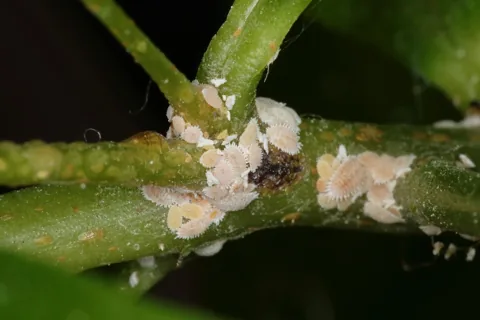 Mealybugs
Planococcus citri
Mealybugs are soft, oval insects covered in white wax that suck sap from houseplants and outdoor plants. They thrive indoors and where winters are mild, and their wax and hiding habits make them hard to reach with sprays.
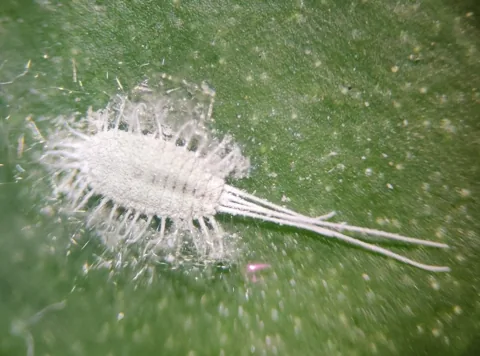 Longtailed Mealybug
Pseudococcus longispinus
The longtailed mealybug is a white, waxy mealybug named for the pair of tail filaments that are as long as or longer than the adult female's body. It is a common pest of houseplants and greenhouse plants, especially dracaena, and also turns up in some California vineyards.
No photo yet
Root mealybugs
Rhizoecus
Root mealybugs are small, bluish white mealybugs that live in the soil and feed on plant roots. They are most often a problem in potted plants such as African violets and gardenias, and because they stay underground, the first sign is often a declining plant whose roots and soil are dusted with white, waxy fluff.
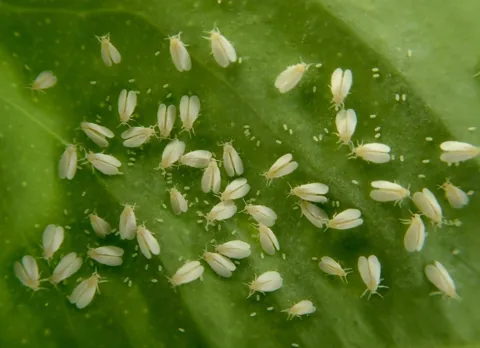 Whiteflies
Trialeurodes vaporariorum
Whiteflies are tiny sap-sucking insects that build large colonies on leaf undersides, especially in warm weather. Outbreaks usually follow disruption of their natural enemies, and heavy infestations are hard to control, so prevention matters most.
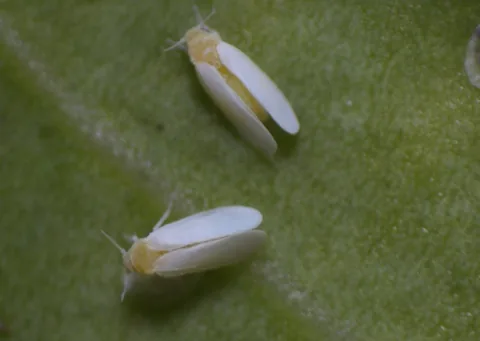 Silverleaf Whitefly
Bemisia tabaci (the B biotype is also called Bemisia argentifolii)
The silverleaf whitefly, also called the sweetpotato whitefly, is a tiny yellowish whitefly that can feed on more than 500 kinds of plants, from ornamentals to warm-season vegetables, weakening plants, coating leaves with honeydew and sooty mold, and spreading plant viruses.
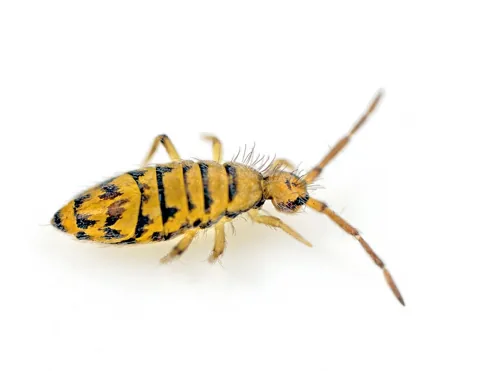 Springtail
Collembola (shown: Entomobrya sp.)
Springtails are tiny jumping creatures that sometimes appear in large numbers in moist spots indoors. They don't bite or sting and don't damage furniture or food; their presence indoors points to a moisture problem.
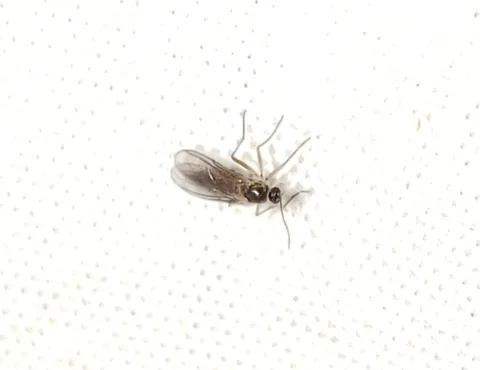 Fungus Gnat
Bradysia and related species
Fungus gnats are small flies whose larvae live in moist potting mix and organic matter. Indoors the adults emerge from houseplants and become a nuisance; they don't bite, and Colorado State calls the larvae minor pests of houseplants.
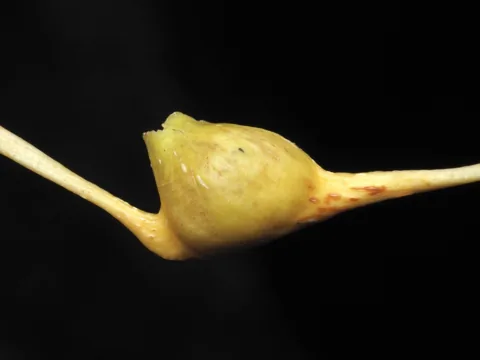 Lettuce root aphid
Pemphigus bursarius
The lettuce root aphid lives out of sight on lettuce roots, in clustered colonies covered with white powdery wax. It is a serious pest mostly where lettuce grows near Lombardy poplars, the trees it uses as a winter host, and once a crop is infested no insecticide will control it.
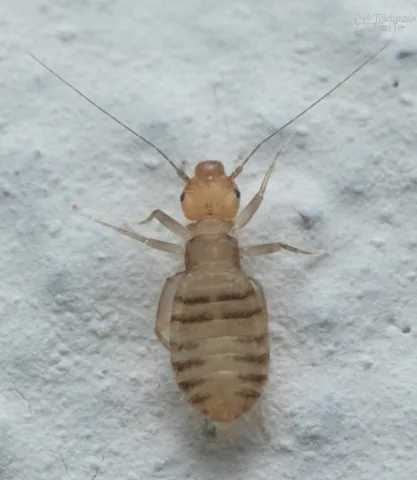 Booklice
Liposcelis species and other psocids (family Liposcelididae)
Booklice, also called psocids, are tiny insects that feed on mold and fungi. Finding them indoors usually means high humidity or a moisture problem, and drying things out is the most effective control.
No photo yet
Grain Mite
Acarus siro
The grain mite, also called the flour mite, is a tiny, pale mite that multiplies in damp flour, grain and other stored foods. When numbers get high, the food, the bag or the shelf looks like it is covered in moving dust.
Three quick tests
A hand lens helps, but you can sort most of these by watching how the bug moves and where it lives. Color alone is a weak clue: Minnesota Extension says psocids can be white, gray or brown, and that most springtails are dark, with only some species white.[17][11]
- Brush the plant. Whitefly adults fly up and settle again. Their young don't move: UC IPM says the nymphs are oval and legless, and Mississippi State says they stay fixed to the underside of leaves.[5][6]
- Water the pot. Minnesota Extension says springtails are particularly noticeable right after a plant is watered, and that springtails and fungus gnats move when the water hits them. NC State says root mealybugs sometimes crawl out of drainage holes when potted plants are watered.[1][4]
- Count the legs under a lens. Insects have six legs; the Canadian Grain Commission says adult grain mites have eight, are soft bodied, white and under 1 mm long, and have only a single body part. It also notes some psocids are about the same size but built differently.[20]
White bugs on houseplant leaves and stems
Mississippi State says most houseplant pests are small insects or mites that spend most of their time on the undersides of leaves, so turn the leaves over before deciding a plant is clean.[6]
- Mealybugs: soft-bodied and covered in white, waxy, cottony fluff. Minnesota Extension gives about 3/16 inch long; Wisconsin Horticulture gives about 1/16 inch for the rounded, wingless females. Wisconsin says they are actually pink under the wax and, unlike scales, most keep their legs and can move around. UC IPM says they usually feed in colonies in protected spots such as the crown of the plant or branch crotches.[1][2][3]
- Longtailed mealybug: UC IPM says it has two tail filaments longer than its body, gives birth to live young and makes no egg masses, and shows up on indoor ornamentals as well as citrus and grapes.[3]
- Whiteflies: Minnesota Extension describes adults as very small, about 1/16 inch long, white gnat-like insects, with flat, oval, scale-like young under 1/16 inch on the undersides of leaves. Mississippi State names the greenhouse whitefly and the silverleaf whitefly as the two most common on houseplants.[1][6]
- Sticky leaves are a shared clue. UC IPM lists sticky honeydew and black sooty mold among the signs of whiteflies, and the Arizona houseplant reference says sooty mold can follow mealybug honeydew too.[5][8]
- Where to go next: the mealybug guide covers alcohol swabs, soaps and oils, and the whitefly guide covers sticky traps and sprays. Mississippi State warns that you won't get rid of whiteflies by treating only the adults, because the immatures have to be controlled too.[6]
White bugs in potting soil
White things in potting mix are usually linked to soil that stays wet. Minnesota Extension says springtails prefer damp potting soil, and UC IPM says fungus gnats thrive in moist conditions.[1][12]
- Springtails: Minnesota Extension gives about 1/16 inch, usually slender and white or gray, jumping when disturbed. They are scavengers on decaying roots and fungi. Its advice is to let the surface soil dry as much as possible between waterings without letting the plant wilt, and it says there are no pesticides to treat springtails in houseplants.[1]
- Fungus gnat larvae: UC IPM says the larvae have a shiny black head and an elongated, whitish-to-clear, legless body. They don't jump. The adults are the small dark flies on the soil and windows; Mississippi State says the slender white larvae feed on decaying organic matter and developing root hairs.[12][6]
- Root mealybugs: NC State describes adult females 1/16 to about 1/8 inch long, bluish white under a white, fluffy bloom, that look like large white springtails but move much more slowly. They also leave a powdery white fluff that can give the soil a bluish tint. African violets are among the hosts it names.[4]
- Root aphids: NC State's Henderson County center says they are very small and hard to see, settle in colonies on the roots, and give themselves away with the white fluffy wax they excrete; it says to check by sliding the plant out of the pot and looking over the root ball. In vegetable gardens, UC IPM and the Pacific Northwest handbook describe the lettuce root aphid living in clustered colonies under white powdery wax on lettuce roots.[13][14][15]
- For root pests, the advice is blunter than for leaf pests. NC State's Henderson County center says the best option is to throw away infested plants, clean tools and pots, and not reuse the potting soil; for a plant too valuable to lose, it suggests an azadirachtin drench, which may need several applications. NC State's root mealybug page recommends a systemic insecticide labeled for residential use instead. Either way, follow the product label.[13][4]
White bugs on books, papers, walls and windowsills
Tiny, pale, wingless insects running over old books, cardboard, wallpaper or damp window frames are usually booklice (psocids). Washington State says psocids are white, pale cream, light gray or dark gray, and that the species found in stored foods favor damp, dark, warm, undisturbed places.[18][16]
- Size and look: Penn State gives 1 to 2 mm long, soft bodied, wingless and flattened, mostly light to dark tan but sometimes gray, brown or nearly clear, especially when young. Minnesota Extension gives less than 3/16 inch with long, slender antennae.[16][17]
- Why they're there: Penn State says they feed on mold and fungi and point to high humidity or moisture. Minnesota Extension says psocids do not survive when humidity falls below 45% to 50%, and recommends a dehumidifier or fan to keep air moving.[16][17]
- They don't bite. Minnesota Extension says booklice are harmless to people and pets and that the best way to manage psocids in homes is to reduce moisture. The booklice guide covers drying out rooms, books and boxes.[17]
White specks in flour, cereal or pet food
If the dust on a shelf or the surface of the flour seems to move, look for mites. The Canadian Grain Commission says that with grain mites the grain dust may appear to be moving, and very high numbers give off a sweet odor.[20]
- Grain, mold and cheese mites: the Pacific Northwest handbook describes them as very small, light-colored mites, often with very long body hairs, in stored foods such as grain, flour, cereal, dried fruit, pet food and cheese, usually where conditions are moist or damp. Piles of brownish mite dust may build up on shelves or around flour sacks.[19]
- How common they are: Texas A&M calls stored product mites uncommon pests in homes and names the grain mite as one of the most common of them, found most often on processed cereal products such as flour. The Canadian Grain Commission says females may lay up to 250 eggs in a month and that mites thrive in high humidity.[21][20]
- Health: the Pacific Northwest handbook says long contact with infested food may cause a mild dermatitis, other contact may bring on asthma and dust allergies, and eating infested food can upset the stomach.[19]
- What to do: Texas A&M says removing the infested product and thoroughly cleaning the storage area is usually enough. The Pacific Northwest handbook adds moisture control and containers with tight-fitting lids, and says food you suspect can be frozen at 0°F for seven days, heated at 140°F for 30 minutes in a shallow pan in the oven, or wrapped securely and thrown out. If a pesticide is needed, it says to spot-treat cracks and crevices only. Booklice turn up in damp stored food too, so see the pantry pests guide if what you find has six legs.[21][19][18]
If you can see it, it's not a dust mite
Dust mites are often blamed for tiny white bugs in bedding, but the National Institute of Environmental Health Sciences says they are microscopic. They live in house dust and feed on skin flakes shed by people and pets, and they are a major source of indoor allergens. Something you can see crawling is a different animal; booklice, for comparison, are 1 to 2 mm long, according to Penn State.[22][16]
Keeping them out of houseplants
Colorado State says scale, mealybug and whitefly infestations almost always start from plants recently bought or received as gifts, and recommends keeping new plants in quarantine in a separate area for at least three weeks. Minnesota Extension suggests isolating new plants for one to two weeks so any problems show up. Both say to inspect before the plant joins the others.[7][1]
Clemson says soaps and oils are most effective against soft-bodied pests such as mealybugs and whiteflies, and that because pests may be hidden or still in the egg stage, getting rid of them often takes more than one treatment. Minnesota Extension says insecticidal soap has no residual activity, so it has to hit the insect directly. Minnesota Extension says to water the soil a day or two before spraying and never to use a pesticide on a moisture-stressed plant.[9][1]
Common questions
- What are the tiny white bugs in my houseplant soil?
- If they jump, they're springtails; if they're legless, see-through worms with a black head, they're fungus gnat larvae; if they crawl slowly under white fluff on the roots, they're root mealybugs. Minnesota Extension says springtails are most noticeable right after watering, and NC State says root mealybugs resemble large white springtails but move much more slowly.[1][12][4]
- Are tiny white bugs harmful to people?
- Most aren't. UC IPM says springtails don't bite people or pets, and Minnesota Extension says booklice are harmless to people and pets. Food mites are the exception worth knowing about: the Pacific Northwest handbook says long contact with infested food can cause mild dermatitis and allergy or asthma symptoms.[10][17][19]
- What tiny white bugs fly?
- Whiteflies. Minnesota Extension describes them as about 1/16 inch long, white and gnat-like, on the undersides of leaves, and Mississippi State says they fly around the plant when the leaves are disturbed. Fungus gnat adults fly too, but they are dark, not white.[1][6]
- Why do white bugs keep coming back on my plant?
- Usually because the young or eggs survived. Mississippi State says whiteflies can't be beaten by treating only adults, and Clemson says hidden pests and eggs often mean more than one treatment. Colorado State says new plants are the usual source of mealybugs and whiteflies.[6][9][7]
Photo credits
- Mealybugs: (c) Carlos Alexandre Mattos Raposo, some rights reserved (CC BY) — via iNaturalist, CC BY 4.0
- Longtailed Mealybug: (c) Svavar Martin Andreasen, some rights reserved (CC BY) — via iNaturalist, CC BY 4.0
- Whiteflies: (c) Mike Bowie, some rights reserved (CC BY) — via iNaturalist, CC BY 4.0
- Silverleaf Whitefly: (c) Mike Bowie, some rights reserved (CC BY) — via iNaturalist, CC BY 4.0
- Springtail: AJ Cann, public domain (CC0), via iNaturalist
- Fungus Gnat: (c) aispinsects, some rights reserved (CC BY) — via iNaturalist, CC BY 4.0
- Lettuce root aphid: (c) Joss Carr, some rights reserved (CC BY) — via iNaturalist, CC BY 4.0
- Booklice: (c) Luis Fernando Valdez Ojeda, some rights reserved (CC BY) — via iNaturalist, CC BY 4.0
Sources
- University of Minnesota Extension, “Managing insects on indoor plants.” extension.umn.edu/product-and-houseplant-pests/insects-indoor-plants (accessed 2026-11-10)
- University of Wisconsin-Madison Extension, Wisconsin Horticulture, “Mealybugs.” hort.extension.wisc.edu/articles/mealybugs-2/ (accessed 2026-11-10)
- UC Statewide Integrated Pest Management Program, “Mealybugs (Pest Notes).” ipm.ucanr.edu/home-and-landscape/mealybugs/ (accessed 2026-11-10)
- NC State Extension, “Root Mealybugs.” content.ces.ncsu.edu/root-mealybugs (accessed 2026-11-10)
- UC Statewide Integrated Pest Management Program, “Whiteflies.” ipm.ucanr.edu/home-and-landscape/whiteflies/ (accessed 2026-11-10)
- Mississippi State University Extension, “Insect Pests of Houseplants (P2652).” extension.msstate.edu/sites/default/files/publications/P2652.pdf (accessed 2026-11-10)
- Colorado State University Extension, “Managing Houseplant Pests.” extension.colostate.edu/resource/managing-houseplant-pests/ (accessed 2026-11-10)
- University of Arizona Cooperative Extension, “Houseplant Insect Management (reference table).” extension.arizona.edu/sites/extension.arizona.edu/files/attachment/HouseplantInsect-Reference.pdf (accessed 2026-11-10)
- Clemson Cooperative Extension Home and Garden Information Center, “Common Houseplant Insects & Related Pests.” hgic.clemson.edu/factsheet/common-houseplant-insects-related-pests/ (accessed 2026-11-10)
- UC Statewide Integrated Pest Management Program, “Springtails.” ipm.ucanr.edu/home-and-landscape/springtails/ (accessed 2026-11-10)
- University of Minnesota Extension, “Springtails.” extension.umn.edu/nuisance-insects/springtails (accessed 2026-11-10)
- UC Statewide Integrated Pest Management Program, “Fungus Gnats (Pest Notes).” ipm.ucanr.edu/home-and-landscape/fungus-gnats/ (accessed 2026-11-10)
- N.C. Cooperative Extension, Henderson County Center, “Pest Alert - Root Aphids (2026).” henderson.ces.ncsu.edu/news/pest-alert-root-aphids (accessed 2026-11-10)
- UC Statewide Integrated Pest Management Program, “Lettuce Root Aphid (Lettuce Pest Management Guidelines).” ipm.ucanr.edu/agriculture/lettuce/lettuce-root-aphid/ (accessed 2026-11-10)
- Pacific Northwest Pest Management Handbooks, “Lettuce-Lettuce root aphid.” pnwhandbooks.org/insect/vegetable/vegetable-pests/hosts-pests/lettuce-lettuce-root-aphid (accessed 2026-11-10)
- Penn State Extension, “Booklice.” extension.psu.edu/booklice (accessed 2026-11-10)
- University of Minnesota Extension, “Booklice and barklice.” extension.umn.edu/garden-and-home/home-maintenance/household-insects/booklice-barklice (accessed 2026-11-10)
- Washington State University Pestsense, “Psocids (Booklice or Barklice).” pestsense.cahnrs.wsu.edu/fact-sheet/psocids-booklice-or-barklice/ (accessed 2026-11-10)
- Pacific Northwest Pest Management Handbooks, “Nuisance and household pests-Cheese mite, grain mite, and mold mite.” pnwhandbooks.org/insect/structural-health/nuisance-household/nuisance-household-cheese-mite-grain-mite-mold-mite (accessed 2026-11-10)
- Canadian Grain Commission, “Grain mite.” www.canada.ca/en/grain-commission/services/grain-quality/manage-stored-grain/identify-insect/secondary-insect-pests/grain-mite.html (accessed 2026-11-10)
- Texas A&M AgriLife Extension, “Biting Mites (Insects in the City).” citybugs.tamu.edu/factsheets/biting-stinging/others/ent-3009/ (accessed 2026-11-10)
- National Institute of Environmental Health Sciences, “Dust Mites and Cockroaches.” www.niehs.nih.gov/health/topics/agents/allergens/dustmites (accessed 2026-11-10)