The short answer
- Turn the leaves over. Whitefly nymphs look like tiny flat ovals or scales stuck to the leaf underside, and they cause most of the feeding damage. Sticky honeydew or black sooty mold on or below the plant is another sign.[1][4]
- Pick off or prune the most heavily infested leaves while the problem is small, and pull infested vegetable plants once you've finished harvesting them.[1][3]
- Knock adults down with a strong spray of water, or vacuum them with a small hand-held vacuum in the cool early morning when they move slowly.[1][3][4]
- Hang yellow sticky traps near infested plants. They catch adults and show you how bad things are, but traps alone won't get rid of whiteflies.[1][3][4]
- Keep natural enemies working: skip broad-spectrum sprays, keep ants off plants and keep dust down.[1][3]
- If you need a spray, use insecticidal soap, horticultural oil or neem oil, wet the undersides of the leaves, and repeat. Don't spray drought-stressed plants or when it's over 90°F.[1][4]
- In a greenhouse or sunroom, the parasitic wasp Encarsia formosa can control greenhouse whitefly if it's kept warm enough. Outdoors, releases aren't generally recommended.[1][4][3]
Whitefly profiles
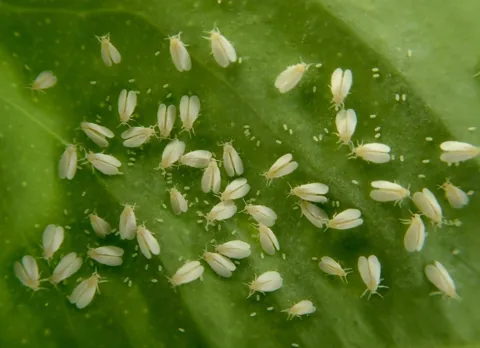 Whiteflies
Trialeurodes vaporariorum
Whiteflies are tiny sap-sucking insects that build large colonies on leaf undersides, especially in warm weather. Outbreaks usually follow disruption of their natural enemies, and heavy infestations are hard to control, so prevention matters most.
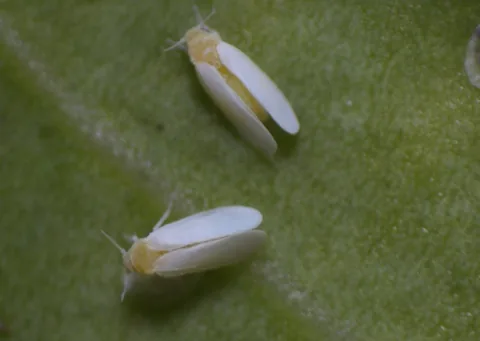 Silverleaf Whitefly
Bemisia tabaci (the B biotype is also called Bemisia argentifolii)
The silverleaf whitefly, also called the sweetpotato whitefly, is a tiny yellowish whitefly that can feed on more than 500 kinds of plants, from ornamentals to warm-season vegetables, weakening plants, coating leaves with honeydew and sooty mold, and spreading plant viruses.
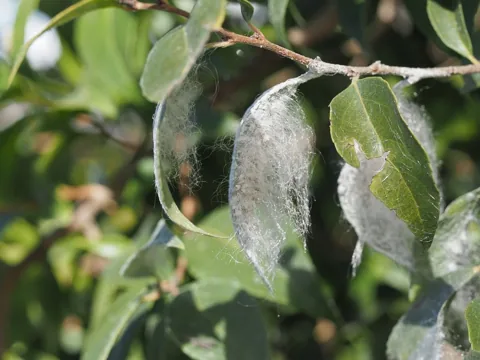 Giant Whitefly
Aleurodicus dugesii
Giant whitefly is a large whitefly that leaves long, beard-like strands of wax under the leaves of many ornamentals.
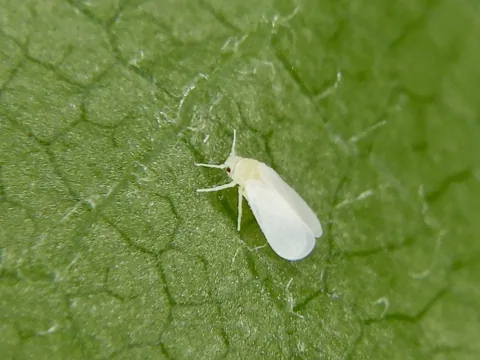 Citrus Whitefly
Dialeurodes citri
The citrus whitefly is a tiny, moth-like insect covered in a snow-white waxy bloom. Its flat, scale-like young suck sap from the undersides of gardenia, citrus, privet and other shrub leaves, and the honeydew they excrete turns the leaves black with sooty mold.
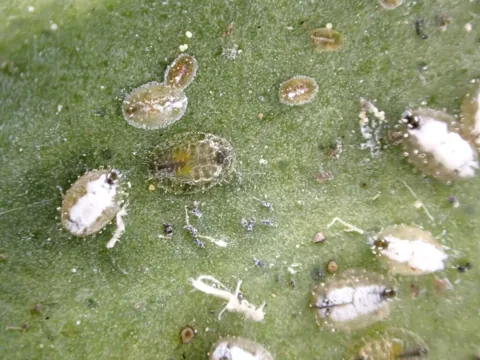 Ash Whitefly
Siphoninus phillyreae
The ash whitefly is an invasive whitefly first found in California in 1988 and in Oregon by 2014. Clouds of it appear in late summer and fall on ash, pear, hawthorn, pomegranate and many other trees, though a parasitic wasp now keeps it scarce in California.
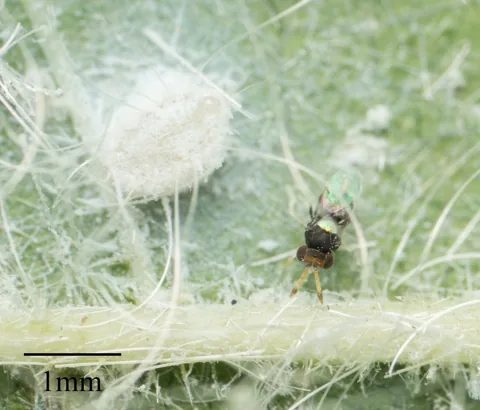 Encarsia Wasps
Encarsia species (e.g., E. formosa)
Encarsia wasps are smaller than a pinhead and develop inside immature whiteflies; Encarsia formosa is released worldwide to control whiteflies in greenhouses.
How to tell it's whiteflies
Despite the name, whiteflies aren't true flies. They belong to the same insect order as aphids, scales and mealybugs. Adults are tiny, with yellowish bodies and four whitish wings dusted with a mealy white wax, and they look like miniature moths. They gather on the undersides of leaves and fly up when the plant is disturbed.[1][3]
- Adults: Missouri Extension describes four broad wings held rooflike over the body. Colorado State calls them somewhat gnat-like. Some species have darker wing markings; the bandedwinged whitefly, for example, has brownish bands across its wings.[3][4][1]
- Nymphs: after the first stage, nymphs settle, stop moving and look like small flat, oval scale insects. Depending on species they range from nearly clear yellow or whitish to black with a white fringe. Colorado State notes they are often inconspicuous and easy to overlook.[1][3][4]
- Eggs: tiny and oblong, usually on leaf undersides. Missouri Extension says females often lay them in a circle of 30 to 40 eggs because they keep feeding while swinging the abdomen around.[1][3]
- Common species: UC IPM names greenhouse whitefly (Trialeurodes vaporariorum) and sweetpotato whitefly (Bemisia tabaci) as the most common pests, both with a wide range of crops and weeds as hosts. Other species, especially on trees and shrubs, tend to stick to fewer host plants. The whitefly profiles below cover the species one by one.[1][3]
- Not whiteflies: small, dark flies that run and fly across potting soil and collect at windows are usually fungus gnats, which Colorado State says cause little or no injury to houseplants. The houseplant pests guide covers them.[4]
Why numbers climb so fast
Eggs hatch into crawlers that wander for a few hours before settling to feed. Later nymphs stay fixed in one spot and pass through four nymphal stages; the last one, sometimes called a pupa, gives rise to the winged adult. Every stage feeds on sap. Generations overlap, so eggs, nymphs and adults are all on a plant at the same time.[1][3]
Sources give slightly different timings. Missouri Extension says eggs hatch within about a week, nymphs feed for about four weeks, adults live about a month and a female usually lays 200 to 400 eggs. Colorado State says greenhouse whitefly eggs hatch in three to seven days, nymphs feed for two to four weeks, the pupal stage lasts one to two weeks, and adults may lay eggs for two months if conditions suit them.[3][4]
In colder climates whiteflies die outdoors in winter, but in warm areas, indoors and in greenhouses they breed all year. Colorado State says greenhouse whitefly can't overwinter outdoors in Colorado, and freezing or a fairly short host-free period eliminates it; most houseplant problems start with infested plants brought in.[3][4][1]
Damage, honeydew and viruses
Whiteflies suck sap from the plant's food-conducting tissue. Large populations make leaves turn yellow, look dry and drop early, and heavily infested plants grow poorly. Like aphids, they excrete sticky honeydew, which coats leaves and things below the plant and grows black sooty mold.[1][3][4]
- Silvering: feeding by immature sweetpotato whitefly can distort plants and turn leaves silvery, and can cause serious losses in some vegetable crops.[1]
- Viruses: some whiteflies carry plant viruses to certain vegetable crops.[1][3]
- Ants: honeydew draws ants, which protect whiteflies from their natural enemies.[1]
- Sooty mold: UC IPM says the fungus doesn't infect plants but grows wherever honeydew collects. Once the honeydew producers are reduced, sooty mold gradually decreases, and it can be washed off plants and surfaces with a strong stream of water or soap and water.[2]
When to act and when to wait
UC IPM says low whitefly numbers usually aren't damaging, adults alone rarely cause significant harm unless they are spreading a plant disease, and plant losses generally need a large population of nymphs. On ornamental trees and shrubs most whitefly species stay uncommon because parasites and predators keep them down. Whiteflies are not normally a problem in fruit trees, though they can build up in citrus, pomegranate and avocado.[1]
The catch is that heavy infestations are hard to manage, so both UC IPM and Missouri Extension stress acting early. Missouri Extension advises that if you use an insecticide, you apply it as soon as whiteflies are detected rather than waiting until the infestation is severe.[1][3]
- Check new plants for adults and nymphs before they go into the garden, house or greenhouse. Missouri Extension says a slight infestation on one plant can quickly spread to others.[1][3]
- Inspect leaf undersides regularly, especially in warm weather, when whiteflies multiply quickly.[1][3]
- Look for parasitized nymphs before treating (see natural enemies below). If parasites are already active, UC IPM advises against using pesticides.[1]
Remove infested leaves and plants
Picking off older leaves loaded with the immobile nymphs and pupae can bring numbers down to a level natural enemies can handle. Prune isolated infested leaves as soon as you find them.[1][3]
- Annual vegetables and flowers: remove and destroy infested plants promptly when they finish flowering or fruiting, so they don't feed the next generation.[1]
- Problem perennials: if an evergreen perennial carries heavy whitefly numbers every winter, UC IPM suggests removing it to cut down the overwintering population, and avoiding or removing plants that repeatedly host high populations.[1]
- New houseplants: Missouri Extension suggests isolating new plants for a few days and checking them before they join the others; Colorado State recommends quarantining new houseplants in a separate area for at least three weeks, then inspecting them.[3][4]
Hosing and vacuuming adults
A water spray, also called syringing, dislodges adults. UC IPM adds that watering cuts the hot, dry, dusty conditions that favor whiteflies and hold back their natural enemies.[1]
Vacuuming works for adults on small plants and houseplants. Missouri Extension says to vacuum early in the morning, when it's cool and adults move slowly. Afterward, take out the vacuum bag (not the vacuum), seal it in a large plastic bag and freeze it for 24 hours to kill the insects. Vacuuming helps most when an infestation is just starting and the adults haven't laid many eggs yet.[3][4]
Yellow sticky traps: what they can and can't do
Adult whiteflies are drawn to yellow and get stuck on the sticky coating. Traps are most useful for detecting and monitoring whiteflies. They can reduce numbers somewhat as part of a wider plan, but they won't eliminate a damaging population, partly because the eggs and nymphs stay on the plant.[1][3][4]
Research points the same way. In a study of sweetpotato whitefly, yellow sticky traps significantly suppressed adult and immature whiteflies in a greenhouse, but made no significant difference in open fields. Missouri Extension likewise says traps can help control light infestations in greenhouses and have limited value outside because so many are needed.[5][3]
- How many: UC IPM's quick tips say one trap for every medium-size vegetable plant; its full Pest Note says you may need as many as one trap for every two large plants, the same figure Missouri Extension gives. Whiteflies don't fly far, so traps need to be close.[1][3]
- Where: put the yellow sticky part level with the infestation, sticky side toward the plants, out of direct sunlight. Hang traps vertically or mount them on stakes just above the plants.[1][3]
- Homemade traps: paint cardboard, poster board or 1/4-inch plywood bright yellow (Missouri suggests a 12-by-6-inch strip) and coat it with petroleum jelly or mineral oil. UC IPM suggests a mix of one part petroleum jelly or mineral oil and one part household detergent, which washes off with soap and water.[1][3][4]
- Upkeep: clean traps regularly and recoat them so they stay sticky.[1][3]
- Natural enemies: traps also catch beneficial insects. Missouri Extension suggests putting traps out when whiteflies first appear and taking them down once the whitefly population seems to be falling.[3]
- Indoors: Colorado State says yellow sticky traps on houseplants also catch winged aphids and fungus gnats. See the indoor sticky traps guide for using traps inside the house.[4]
Reflective mulch and row covers in the vegetable garden
Shiny metallic-coated construction paper or reflective plastic mulch repels whiteflies, especially from small plants. It also repels aphids and leafhoppers, helps crops grow and controls weeds. You can make your own by spraying clear plastic mulch with silver paint.[1]
- Laying it: clear weeds, spread the mulch over the bed and bury the edges, then cut 3- to 4-inch holes for seeds or transplants. Plastic needs drip irrigation underneath; sturdy paper mulch can take sprinklers or furrow irrigation. Remove mulch when plants get large and summer heat arrives, so plants don't overheat.[1]
- Research: in zucchini trials in Georgia and Alabama, silver reflective plastic cut sweetpotato whitefly numbers compared with white plastic by 87%, 33% and 30% in three trials, and an insect row cover kept whiteflies at zero until it was removed at flowering. Silver mulch raised total yield 17% over white plastic, and row covers 14% over no cover.[6]
- The effect can fade. In a Florida organic snap bean study, silver reflective mulch reduced whitefly egg densities only during the first week after the crop came up, and only in 2 of the 3 years.[7]
- In that study the row cover went on at transplanting and came off at flowering. See the row covers guide for timing on other crops.[6]
Natural enemies and Encarsia wasps
Whiteflies have many natural enemies, and UC IPM says outbreaks often follow their disruption by insecticides, dust or ants. Predators include lacewings, bigeyed bugs, minute pirate bugs, spiders and several small lady beetles. Tiny parasitic wasps lay eggs in whitefly nymphs and can be very important for some species.[1][3]
- Check for parasites: look at empty whitefly cases on the leaves. A round or oval exit hole means a parasite came out; a T-shaped slit means a healthy whitefly emerged. Parasitized nymphs often darken, though some parasites don't turn their hosts black and some whiteflies are naturally black.[1]
- Avoid disruptive sprays: UC IPM says carbaryl, pyrethroids and imidacloprid, especially sprayed on leaves, can be particularly disruptive to natural enemies. Missouri Extension notes frequent insecticide use for other garden pests keeps predators from controlling whiteflies.[1][3]
- Ants and dust: keep ants off plants, since they guard whiteflies, and reduce dusty conditions, which can kill or disrupt beneficial insects. Controlling dust and ants matters most in citrus and other trees.[1]
- Encarsia formosa: this parasitic wasp is sold for whitefly control in greenhouses and conservatories and has been used there for many years. A 1998 review describes its worldwide use in greenhouses and its outstanding success against greenhouse whitefly on tomatoes.[3][1][8]
- Temperature matters: Colorado State says Encarsia formosa and Eretmocerus californicus can manage greenhouse whitefly if temperatures average at least 72 to 75 degrees F and work poorly at lower temperatures. UC IPM says releases aren't generally recommended outdoors because the wasps aren't well adapted to survive in temperate zones; Missouri Extension says their use is limited outdoors, where temperature and light can't be kept favorable.[4][1][3]
- Releases: UC IPM notes Encarsia species are commercially available for greenhouse release. See the guide to releasing beneficial insects and the Encarsia profile before buying.[1]
Greenhouses, sunrooms and houseplants
Indoors and in greenhouses whiteflies breed year-round with overlapping generations, and most infestations arrive on new plants. Colorado State lists poinsettia, ivy, hibiscus and lantana among houseplants greenhouse whitefly attacks, along with greenhouse tomatoes and cucumbers.[3][4]
- Starve them out: UC IPM says that with high numbers in a greenhouse, removing all host plants for at least 2 weeks, while making sure no whiteflies get in from outside, may eliminate the problem.[1]
- Traps work better here: the trap study above found yellow sticky traps suppressed whiteflies in a greenhouse but not in the field.[5]
- Vacuum and quarantine: vacuum adults off small plants and keep new plants apart until you've checked them.[4][3]
- Biological control: Encarsia or Eretmocerus releases fit enclosed, warm spaces; see above for temperature limits.[4][1]
Insecticidal soaps, oils and neem
UC IPM recommends products least harmful to natural enemies, such as insecticidal soaps and oils, combined with the other steps above. Soaps, neem oil and petroleum-based oils kill only the whiteflies they actually hit, so they reduce but don't eliminate populations.[1]
Colorado State's houseplant chart rates horticultural oil and neem insecticides as able to control whitefly nymphs but not adults, and insecticidal soap as able to suppress nymphs but not adults. Neem seed extracts disrupt the growth of developing whiteflies.[4]
- Coverage: wet the undersides of all infested leaves. These are usually the lowest leaves and the hardest to reach.[1][3]
- Repeat: more than one application is often needed. Missouri Extension says eggs and pupae are less affected by insecticides than nymphs and adults, so wiping out a population usually takes four to five applications at five- to seven-day intervals.[1][3]
- Avoid plant burn: use soaps and oils only on plants that aren't drought-stressed and when it's under 90°F. Early evening, with enough light to work but no direct sun on the plants, can be a good time to spray.[1]
- Strength: Colorado State says insecticidal soaps (potassium salts of fatty acids) are used as dilute sprays of one to three percent. Hand and dish soaps also kill insects but can injure plants. Follow the product label.[4]
- Labels: before using any insecticide, make sure both the site and the plant are listed on the label, and follow its directions.[3]
Other insecticides, resistance and systemics
Whiteflies are hard to control with insecticides. UC IPM says even the most toxic products are only partly effective, most other pesticides kill natural enemies, and whiteflies build up resistance quickly. Missouri Extension notes that because of resistance a product may work in one area and fail in another, and that alternating types of insecticides can delay resistance.[1][3]
Sources disagree on pyrethrins. Colorado State calls pyrethrins and related insecticides the most effective chemical controls for adult whiteflies on houseplants. UC IPM advises avoiding pesticides other than soaps and oils for whiteflies and lists pyrethroids among the broad-spectrum products to avoid in gardens.[4][1]
- Imidacloprid: this soil-applied systemic can control whitefly nymphs, and Colorado State calls it highly effective against greenhouse whitefly. Both UC IPM and Colorado State warn of harm to bees and other non-target insects; UC IPM says the risk is highest as a foliar spray or on plants that are flowering or about to flower, and that it can trigger spider mite outbreaks. Reserve it for situations where those problems can be avoided.[1][4]
- Carbaryl: UC IPM notes that since August 1, 2020, carbaryl products are restricted-use materials in California, requiring a pesticide applicator's license.[1]
A simple whitefly plan
- 1. Confirm whiteflies: flat, scale-like nymphs under the leaves, adults that fly up when disturbed, honeydew or sooty mold.[1][4]
- 2. Check for parasitized nymphs and round exit holes; if natural enemies are active, hold off on sprays.[1]
- 3. Remove heavily infested leaves; pull spent vegetable plants after harvest.[1][3]
- 4. Hose or vacuum adults in the cool morning; hang yellow sticky traps close to the plants.[1][3]
- 5. Keep ants and dust down and avoid broad-spectrum sprays.[1]
- 6. Use reflective mulch or row covers for young vegetable plants.[1][6]
- 7. If numbers keep building, spray insecticidal soap or oil under the leaves, repeat, and skip hot days and stressed plants.[1][3]
- 8. Indoors or in a greenhouse, quarantine new plants and consider Encarsia releases in warm conditions.[4][3]
Common questions
- What kills whiteflies instantly?
- Nothing reliably. Soaps and oils kill only the whiteflies they touch, and eggs and pupae are harder to kill than nymphs and adults, so it usually takes repeated treatments. Vacuuming or hosing removes adults on the spot but leaves nymphs on the leaves.[1][3]
- Do yellow sticky traps get rid of whiteflies?
- Not by themselves. They catch adults and show you when numbers rise, and they can help reduce light infestations in a greenhouse, but they don't touch the nymphs on the leaves and work poorly in open gardens.[1][3][4][5]
- Can I vacuum whiteflies?
- Yes. Use a small hand-held vacuum early in the morning when adults are sluggish, then seal the vacuum bag in a plastic bag and freeze it for 24 hours. It works best early in an infestation.[3][4]
- Why do whiteflies keep coming back?
- Nymphs and eggs stay on the leaves after adults are removed, generations overlap, and new infested plants or weeds bring more in. Insecticides that kill natural enemies, ants protecting the whiteflies and dusty conditions can all set off new outbreaks.[1][3]
- Will whiteflies die in winter?
- Outdoors in cold climates, yes. In warm areas, indoors and in greenhouses they breed all year, so a houseplant or greenhouse infestation won't clear up on its own over winter.[3][4][1]
- Should I buy ladybugs or Encarsia wasps for whiteflies?
- Encarsia formosa is sold for greenhouse use and, per Colorado State, works against greenhouse whitefly when temperatures average at least 72 to 75 degrees F. Outdoors, UC IPM doesn't generally recommend it, and Missouri Extension says its use there is limited. In the garden, protecting the lacewings, lady beetles and pirate bugs already present works better.[1][3][4]
Photo credits
- Whiteflies: (c) Mike Bowie, some rights reserved (CC BY) — via iNaturalist, CC BY 4.0
- Silverleaf Whitefly: (c) Mike Bowie, some rights reserved (CC BY) — via iNaturalist, CC BY 4.0
- Giant Whitefly: (c) Aiver, some rights reserved (CC BY) — via iNaturalist, CC BY 4.0
- Citrus Whitefly: (c) りなべる, some rights reserved (CC BY) — via iNaturalist, CC BY 4.0
- Ash Whitefly: (c) Grey Smith, some rights reserved (CC BY) — via iNaturalist, CC BY 4.0
- Encarsia Wasps: Jesse Rorabaugh, public domain (CC0), via iNaturalist
Sources
- University of California Statewide IPM Program, “Pest Notes: Whiteflies (Publication 7401).” ipm.ucanr.edu/home-and-landscape/whiteflies/ (accessed 2026-11-10)
- University of California Statewide IPM Program, “Pest Notes: Sooty Mold.” ipm.ucanr.edu/home-and-landscape/sooty-mold/ (accessed 2026-11-10)
- University of Missouri Extension, “Managing Whiteflies on Indoor and Outdoor Plants (G7275).” extension.missouri.edu/sites/default/files/legacy_media/wysiwyg/Extensiondata/Pub/pdf/agguides/pests/g07275.pdf (accessed 2026-11-10)
- Colorado State University Extension, “Managing Houseplant Pests.” extension.colostate.edu/resource/managing-houseplant-pests/ (accessed 2026-11-10)
- Journal of Insect Science, abstract via PubMed (PMID 23445077), “Lu, Bei and Zhang 2012, Are yellow sticky traps an effective method for control of sweetpotato whitefly, Bemisia tabaci, in the greenhouse or field?.” pubmed.ncbi.nlm.nih.gov/23445077/ (accessed 2026-11-10)
- Insects, abstract via PubMed (PMID 37999062), “Rutz et al. 2023, Use of Insect Exclusion Row Cover and Reflective Silver Plastic Mulching to Manage Whitefly in Zucchini Production.” pubmed.ncbi.nlm.nih.gov/37999062/ (accessed 2026-11-10)
- Journal of Economic Entomology, abstract via PubMed (PMID 10902322), “Smith et al. 2000, Effect of silver reflective mulch and a summer squash trap crop on densities of immature Bemisia argentifolii on organic bean.” pubmed.ncbi.nlm.nih.gov/10902322/ (accessed 2026-11-10)
- Annual Review of Entomology, abstract via PubMed (PMID 15012401), “Hoddle, Van Driesche and Sanderson 1998, Biology and use of the whitefly parasitoid Encarsia formosa.” pubmed.ncbi.nlm.nih.gov/15012401/ (accessed 2026-11-10)