The short answer
- Confirm it first: hold white paper under a speckled leaf, tap or shake the leaf, and look for tiny moving dots. A hand lens on the leaf underside shows the mites, their round eggs and webbing.[1][2]
- Water the plants well. Drought-stressed plants get more mites and more damage, and dusty conditions set off outbreaks.[1][2][3]
- Spray the undersides of leaves with a strong stream of water. UC IPM suggests a water spray or mist at least once a day on infested plants.[1][2][3]
- If you need more, use insecticidal soap or horticultural oil, covering the leaf undersides, and repeat. Don't spray stressed plants or spray above 90°F.[1][2]
- Avoid broad-spectrum insecticides such as carbaryl, malathion, bifenthrin and permethrin for other pests where mites are a problem; they kill mite predators and often cause mite outbreaks.[1][3][2]
- Houseplants: rinse them in the sink or shower, wipe or swab the leaves, treat all susceptible plants at once, and throw out badly infested ones.[3][4][5]
Spider mite and predator profiles
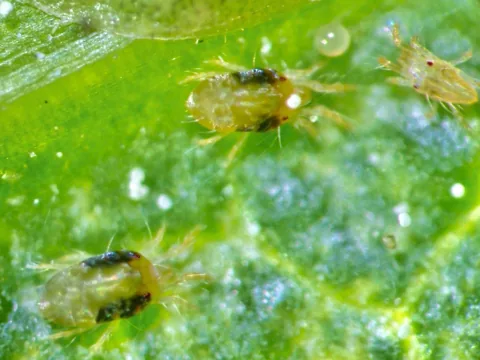 Spider Mites
Tetranychus urticae
Spider mites are tiny arachnids, relatives of spiders and ticks, that live in colonies on leaf undersides and suck out plant cells. The twospotted spider mite is the most important species in yards and gardens and on house plants, and Minnesota says it can infest over 200 species of plants.
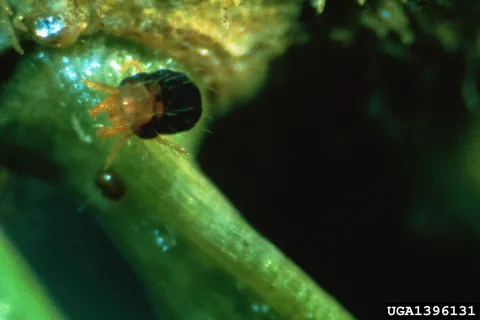 Spruce Spider Mite
Oligonychus ununguis
The spruce spider mite is one of the most destructive spider mites in the US, speckling and browning the needles of spruce, arborvitae, juniper, hemlock and other conifers.
No photo yet
Honeylocust Spider Mite
Platytetranychus multidigituli
Honeylocust spider mites build up in midsummer on honeylocust, bronzing the foliage and causing early leaf drop.
No photo yet
Southern Red Mite
Oligonychus ilicis
The southern red mite is a cool-season spider mite of broadleaf evergreens such as azalea, camellia, holly and rhododendron. It sucks fluid from leaf cells, leaving leaves stippled, dull and grayish.
No photo yet
European Red Mite
Panonychus ulmi
The European red mite is a tiny, bright red mite that feeds on fruit tree leaves; heavy feeding bronzes the foliage and weakens next year's fruit buds.
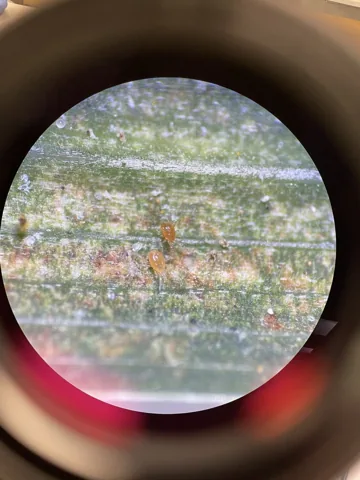 Predatory Mites
Phytoseiulus persimilis
Phytoseiulus persimilis is a predatory mite that feeds and reproduces only on web-spinning spider mites. Greenhouses, interior plantings and strawberry growers use it for spider mite control.
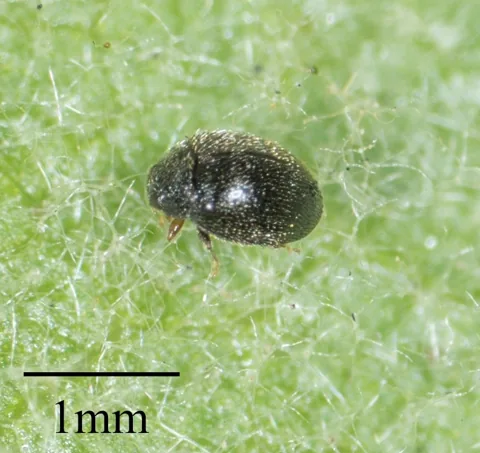 Spider Mite Destroyer
Stethorus species (S. punctum in the East, S. picipes in California)
Barely 1/16 inch long, the spider mite destroyer is a lady beetle that eats nothing but plant-feeding mites, and it homes in on mite outbreaks.
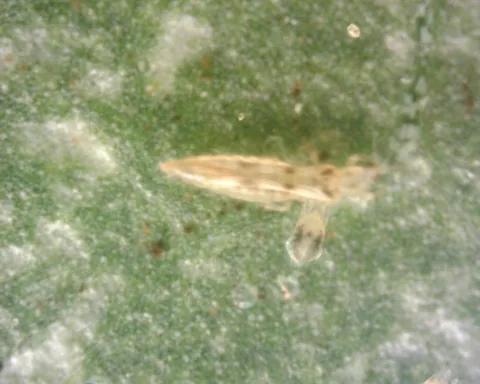 Sixspotted Thrips
Scolothrips sexmaculatus
Not all thrips are pests. The sixspotted thrips eats spider mites and their eggs and is common wherever mites are abundant.
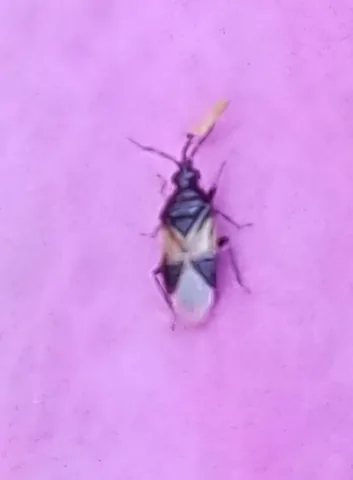 Minute Pirate Bugs
Orius species (e.g., O. insidiosus)
Minute pirate bugs are among the first predators to start feeding in spring, hunting thrips, spider mites and insect eggs. In late summer they also bite people, painfully but harmlessly.
Is it spider mites?
To the naked eye spider mites look like tiny moving dots. Adults are less than 1/20 inch long by UC IPM's measure; Minnesota Extension puts the twospotted spider mite at about 1/50 inch. A 10X hand lens shows the eight legs, the oval body and, on the twospotted spider mite, a dark spot on each side.[1][2]
You'll usually notice the leaves before the mites. Feeding leaves tiny white or yellow dots (stippling) that give the leaf a speckled look. As it gets worse, leaves turn bronze, gray, yellow or reddish and may drop. Minnesota Extension notes the symptoms can be confused with drought stress.[1][2][3]
Mites live in colonies on the undersides of leaves, and one colony can hold hundreds of them. Heavy infestations cover leaves, twigs and fruit with fine silk webbing.[1]
- The white paper tap test: hold a sheet of white paper or cardboard under a suspect leaf and shake or tap it. Spider mites that fall run around on the paper once disturbed.[1][2]
- Check the leaf underside with a hand lens for mites, their eggs and webbing. The eggs are round and translucent like tiny droplets, turning cream colored before they hatch, and the empty shells stay on the leaf after hatching.[1][3]
- Webbing sets spider mites apart from other mites and from aphids and thrips that also feed under leaves. Colorado State warns that spider webs and cottonwood fluff are often mistaken for mite webbing.[1][3]
- Make sure the mites are still there before you treat. Sometimes they're gone by the time you notice the damage, and the plant often recovers on its own.[1]
- Not every mite is a pest. Predatory mites are about the same size but have longer legs, move faster and are more teardrop-shaped. Phytoseiulus persimilis, a common one, is bright reddish to orange and lacks the twospotted mite's two dark blotches.[1][6]
Twospotted spider mite and the other common ones
The twospotted spider mite (Tetranychus urticae) is the most important species in gardens and on houseplants, according to Colorado State. Minnesota Extension says it can infest more than 200 species of plants, from beans, cucumbers, tomatoes and strawberries to marigolds, roses, azaleas and spruce. It is yellow-orange with a dark spot on each side and spins a lot of webbing.[3][2]
The Pacific, twospotted and strawberry spider mites and several other close relatives in the genus Tetranychus can't be reliably told apart in the field. UC IPM says there's little need to, because their damage, biology and management are virtually the same.[1]
- Spruce spider mite on spruce and juniper, and the mites on most turfgrass, are cool-season species. Colorado State says they are most active in spring and fall and may lay dormant eggs to get through hot summers.[3]
- Honeylocust trees, especially on dry sites, are almost always infested with the honeylocust spider mite, Colorado State notes.[3]
- Clover mites live in turfgrass and commonly wander into homes in fall and spring, where they're a nuisance rather than a plant problem.[3]
- Cyclamen mites are a different, nearly invisible mite on African violets and cyclamen. They twist and blacken leaves and deform buds and flowers, and Kentucky Extension suggests trimming damaged parts and dipping the plant in water held at 110°F for 15 minutes.[4]
Why spider mites explode in hot, dry, dusty weather
Spider mites breed fast in hot weather and are often numerous from June through September. With warm temperatures and good food, UC IPM says a generation can take less than a week. Colorado State adds that mated females may lay a dozen eggs a day for a couple of weeks.[1][3]
Minnesota Extension says that above 90°F colonies can reach high numbers in less than two weeks.[2]
Dry conditions favor all spider mites. Colorado State explains three reasons: mites feed more in dry air, most of their natural enemies need more humid conditions, and drought-stressed plants change their chemistry in ways that make them more nutritious to mites.[3]
Dust makes it worse. UC IPM says outbreaks usually start on plants next to dusty roads or at the edges of gardens, and Colorado State notes that dust on the leaves interferes with mite predators.[1][3]
Outdoors, UC IPM and Colorado State say twospotted spider mites spend the winter as adults (often red or orange mated females) under bark scales, bud scales and garden debris, and start feeding and laying eggs when warm weather returns. Minnesota Extension says they overwinter as eggs on vegetation.[1][3][2]
Mite numbers often crash in late summer when predators catch up, the plant becomes a poor host, the weather cools, or after rain.[1]
Start with water: irrigation, hosing and dust control
Water-stressed plants are the most likely to be damaged, so the first step is enough water. Minnesota Extension suggests about one inch of water a week for most plants, with mulch to hold moisture, and warns against overwatering, which can lead to root rot. It also says not to fertilize plants during drought, which stresses them further.[1][2]
A forceful jet of water knocks off and kills many mites, washes away their webbing and rinses off the dust that hinders their predators. Colorado State adds that breaking up the webbing may delay egg laying until the mites spin new silk.[3][2][1]
- Aim at the undersides of the leaves, where the colonies are.[1]
- Repeat often. UC IPM suggests a water spray or mist on the leaf undersides at least once a day while plants are infested.[1]
- Keep dust down: wet pathways and other dusty areas at regular intervals, and use ground covers and mulch. UC IPM says washing trees and vines with water in midseason may help prevent serious late-season infestations.[1]
- Check garden plants every 3 to 5 days, especially during drought, Minnesota Extension advises.[2]
- For hot, dry spots, choose drought-tolerant plants. Colorado State notes that small changes in where mite-prone plants sit or how they're watered can make a big difference.[2][3]
Let the predators work
Spider mites have many natural enemies that often keep them in check, especially where pesticides don't disturb them. The most important are predatory mites, including the western predatory mite (Galendromus occidentalis) and Phytoseiulus species.[1][3]
Insects eat them too: the small dark lady beetles called spider mite destroyers (Stethorus species), sixspotted thrips and other predatory thrips, minute pirate bugs, bigeyed bugs, lacewing larvae and the larvae of a predatory midge, Feltiella acarivora.[1][3][2]
Minnesota Extension cautions that when mite numbers are already high, natural enemies are less effective.[2]
Buying and releasing predatory mites
Predatory mites sold for release include Galendromus occidentalis, Phytoseiulus persimilis, Mesoseiulus longipes and Neoseiulus californicus. UC IPM calls releases useful for establishing predators in large plantings or orchards, but says the best results come from creating good conditions for the predators already there.[3][1]
Colorado State reports that released predatory mites have worked against spider mites on interior plants, but that effective use outdoors hasn't been shown in Colorado, partly because the predators need fairly high humidity.[3]
Phytoseiulus persimilis is a heavy feeder: adults eat 5 to 20 eggs or mites a day, and a female can lay up to 60 eggs over about 50 days at 74°F. It needs humid air, though. Its development almost stops at 25 to 30% relative humidity, and below 70% the young have trouble molting.[6]
The western predatory mite does better than Phytoseiulus under hot, dry conditions.[1]
- Knock a heavy infestation down first with a soap spray or a selective miticide, then release the predators.[1]
- UC IPM's rule of thumb is one predator for every 10 spider mites. Concentrate releases on the hot spots, and expect to release more than once for fast control.[1]
- Predatory mites don't eat plants. If there are no pest mites, they starve or leave, so release them only where spider mites are present.[1][6]
- Phytoseiulus spreads best where neighboring plants touch. Before a release, UC IPM suggests controlling ants, hosing off dusty shrubs and avoiding broad-spectrum, persistent insecticides and miticides.[6]
Insecticidal soaps and horticultural oils
When water isn't enough, UC IPM recommends insecticidal soap or insecticidal oil, or a combination. Petroleum horticultural oils and plant oils such as neem, canola or cottonseed oil are all acceptable. Minnesota Extension says soaps and oils are reasonably effective against mites and have little impact on people, animals and nontarget insects.[1][2]
Colorado State rates horticultural oil at the 2 percent summer rate as perhaps the most effective miticide for home use, and insecticidal soap as only marginally effective against twospotted spider mite, especially where webbing keeps the spray out.[3]
- Soaps and oils kill only the mites they touch and leave no residue that keeps working, so cover the undersides of the leaves thoroughly and plan on repeat sprays.[1][2][5]
- Use a commercial insecticidal soap. Minnesota Extension warns that homemade soap solutions can burn and damage plants.[2]
- Water plants thoroughly before spraying, spray in early morning or early evening, and skip it on water-stressed plants or above 90°F.[2][1]
- Some plants are injured by soaps and oils. Check the label and test on a small part of the plant several days before a full spray.[1]
- Sulfur sprays can be used against mites on some vegetables, fruit trees and ornamentals, but sulfur can burn cucurbits and other plants. UC IPM says not to use it above 90°F or within 30 days of an oil spray, to prefer liquid products over drifting dusts, and to wear protective clothing.[1]
Miticides and resistance
Few ordinary insecticides work well on spider mites, and products made for them are called miticides or acaricides. Most don't kill eggs, so Colorado State says a repeat application about 10 to 14 days later is usually needed.[3]
Twospotted spider mites become resistant quickly. A 2010 review calls the species the "most resistant species" by the total number of pesticides populations have become resistant to, because of its short life cycle and large numbers of offspring. Colorado State notes resistant strains frequently develop and make control difficult.[8][3]
Clemson's houseplant guidance is to alternate the pesticide from one application to the next, since some pests develop resistance quickly.[5]
- Colorado State lists abamectin (Avid), hexythiazox (Hexygon) and spiromesifen (Forbid) as commercial-use-only products; abamectin and spiromesifen are for ornamental plants. Hexythiazox works only on eggs and developing mites, and spiromesifen spares natural enemies.[3]
- Bifenthrin has good activity against spider mites, Colorado State says, but Minnesota Extension warns that it and permethrin also kill natural enemies and could make infestations worse in the long run.[3][2]
- If mites keep coming back on valuable plants, Minnesota Extension suggests hiring a landscape professional, who has more products and training.[2]
Why spraying for other pests can cause a mite outbreak
Spider mites often become a problem right after an insecticide spray. UC IPM says the spray usually kills the mites' natural enemies, and some insecticides also help mites directly: in lab tests mites exposed to carbaryl reproduced faster, and carbaryl, some organophosphates and some pyrethroids appear to raise leaf nitrogen in ways that favor mites. Sprays in hot weather can set off dramatic outbreaks within a few days.[1]
Colorado State names carbaryl as devastating to most mite predators and says malathion can aggravate some mite problems despite being sold for mites. It also links soil applications of the systemic imidacloprid to some outbreaks.[3]
Research on elms in New York's Central Park backs that up. After imidacloprid treatments aimed at an invasive beetle, a spider mite that had been harmless there (Tetranychus schoenei) became abundant. Predators were poisoned by eating prey exposed to imidacloprid, and the mites laid more eggs on treated trees.[7]
Spider mites on houseplants
Indoor plants are easy to miss until the mites are numerous or start spinning webs. Clemson notes spider mites are more of a problem on houseplants kept indoors all year, especially palms and English ivy.[4][5]
Colorado State calls houseplant control particularly frustrating, with few effective chemical options beyond soaps and horticultural oils.[3]
- Treat all susceptible houseplants at the same time, and trim, bag and remove heavily infested leaves.[3]
- Rinse small plants in the sink or shower and wipe the leaves of larger ones with a soft, damp cloth. Spray sturdy plants forcefully with water, undersides included, to dislodge mites and break up the webs.[3][5][4]
- Kentucky Extension says a cotton swab dipped in rubbing alcohol can be used to wipe mites off.[4]
- Insecticidal soap can be sprayed or the foliage dipped in it. Mite eggs aren't affected, so treat at least twice, 10 days apart (Kentucky), or weekly for several weeks (Clemson). Colorado State suggests repeating the washing and wiping every one to two weeks while mites persist.[4][5][3]
- Clemson says plants moved outdoors for summer may have fewer spider mite problems; start them in mostly shade so the leaves don't burn.[5]
- Outdoors, a wider choice of products is labeled for houseplants. Let the spray dry completely before bringing plants back inside.[4][5]
- If a badly damaged plant isn't worth saving, discard it with its soil.[5][3]
Common questions
- What kills spider mites instantly?
- Nothing gets them all at once. A forceful water spray knocks many off right away, and soaps and oils kill the mites they touch, but none of these reach the eggs, so repeat treatments over one to two weeks are needed.[3][2][4]
- How do I know if I have spider mites?
- Look for pale speckling on the leaves and fine webbing underneath. Hold white paper under the leaf and tap it: spider mites show up as tiny dots that start moving.[1][2]
- Does neem oil kill spider mites?
- Neem oil is one of the plant-based oils UC IPM lists as acceptable for spider mites. Like other oils it works only on contact, so cover the leaf undersides, repeat, and don't spray stressed plants or above 90°F.[1][2]
- Why do spider mites keep coming back?
- Their eggs survive most sprays, a generation can take under a week in hot weather, and many populations resist miticides. Broad insecticide sprays for other pests also kill the predators that keep mites down.[4][1][3][8]
- How long does it take to get rid of spider mites?
- Plan on at least a couple of weeks. Most sprays miss the eggs, so Colorado State suggests repeating a miticide about 10 to 14 days later, Kentucky Extension says to treat houseplants at least twice 10 days apart, and Clemson says weekly sprays for several weeks are often needed.[3][4][5]
- Can I just throw away a houseplant with spider mites?
- Yes. If the plant is badly damaged and not valuable, Clemson says discarding it with its soil may be the simplest fix. Check the plants around it, since Colorado State advises treating all susceptible plants at the same time.[5][3]
Photo credits
- Spider Mites: (c) Mike Bowie, some rights reserved (CC BY) — via iNaturalist, CC BY 4.0
- Spruce Spider Mite: USDA Forest Service - Northeastern Area, Bugwood.org (public domain), via Wikimedia Commons
- Predatory Mites: (c) rosaceae_roberts, some rights reserved (CC BY) — via iNaturalist, CC BY 4.0
- Spider Mite Destroyer: Jesse Rorabaugh, public domain (CC0), via iNaturalist
- Sixspotted Thrips: 余世文, public domain (CC0), via iNaturalist
- Minute Pirate Bugs: (c) Robert Roach, some rights reserved (CC BY) — via iNaturalist, CC BY 4.0
Sources
- University of California Statewide IPM Program, “Pest Notes: Spider Mites (UC ANR Publication 7405).” ipm.ucanr.edu/home-and-landscape/spider-mites/ (accessed 2026-11-10)
- University of Minnesota Extension, “Twospotted spider mites in home gardens.” extension.umn.edu/yard-and-garden-insects/spider-mites (accessed 2026-11-10)
- Colorado State University Extension, “Spider Mites (Fact Sheet 5.507).” extension.colostate.edu/topic-areas/insects/spider-mites-5-507/ (accessed 2026-11-10)
- University of Kentucky Entomology, “Houseplant Insect Control (ENTFACT-406).” entomology.mgcafe.uky.edu/ef406 (accessed 2026-11-10)
- Clemson Cooperative Extension Home & Garden Information Center, “Common Houseplant Insects & Related Pests.” hgic.clemson.edu/factsheet/common-houseplant-insects-related-pests/ (accessed 2026-11-10)
- University of California Statewide IPM Program, “Natural Enemies Gallery: Phytoseiulus Predatory Mites.” ipm.ucanr.edu/natural-enemies/phytoseiulus-predatory-mites/ (accessed 2026-11-10)
- PLoS One (PubMed 21655275), “Szczepaniec A, Creary SF, Laskowski KL, Nyrop JP, Raupp MJ. Neonicotinoid insecticide imidacloprid causes outbreaks of spider mites on elm trees in urban landscapes. PLoS One 2011;6(5):e20018.” pubmed.ncbi.nlm.nih.gov/21655275/ (accessed 2026-11-10)
- Insect Biochemistry and Molecular Biology (PubMed 20685616), “Van Leeuwen T, Vontas J, Tsagkarakou A, Dermauw W, Tirry L. Acaricide resistance mechanisms in the two-spotted spider mite Tetranychus urticae and other important Acari: a review. Insect Biochem Mol Biol 2010;40(8):563-72.” pubmed.ncbi.nlm.nih.gov/20685616/ (accessed 2026-11-10)