The short answer
- On windowsills and walls, especially on the sunny side of the house: clover mites. They are smaller than a pinhead, leave a red smear when crushed, and don't bite.[4][5][1]
- On patios, rocks and walls, often after rain, and larger and fuzzier: red velvet mites. They are harmless to people.[6][7]
- On your skin as itchy welts at the sock line, waistband or behind the knees: chiggers. The biting larvae are less than 1/150 inch across and rarely seen.[8][9]
- On plant leaves that look speckled or bronzed, with fine silk: spider mites.[11][13]
- Bright red, six-legged, wingless bugs on or under boxelder trees or on the side of the house in summer: boxelder bug nymphs. They don't bite.[14][16][15]
- Shiny reddish-brown beetles about 1/8 inch long in flour, cake mixes or cereal: red or confused flour beetles.[17][19]
Small red bugs
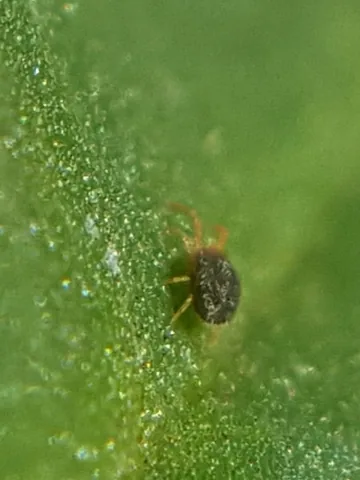 Clover Mite
Bryobia praetiosa
Clover mites are tiny plant feeders that invade homes in early spring and sometimes fall; they don't bite people or pets, don't breed indoors and soon die inside.
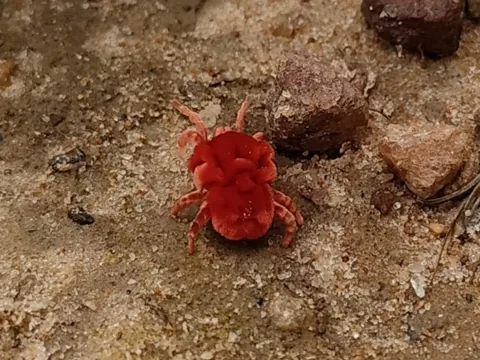 Velvet Mites
Trombidiidae (velvet mites)
Velvet mites are tiny, bright red, velvety mites seen scurrying over patios, brick walls and soil in spring. The adults prey on small insects and insect eggs, and they are harmless to people.
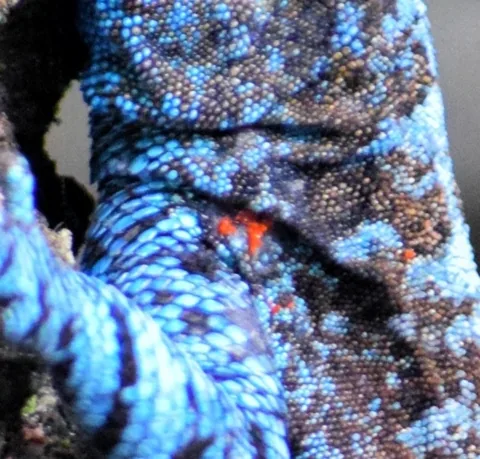 Chiggers
Trombiculidae (e.g., Trombicula / Eutrombicula alfreddugesi)
Chiggers are the tiny larvae of mites; only the larva bites, and its feeding causes intense itching and small red welts. Contrary to popular belief, chiggers don't burrow into the skin or suck blood.
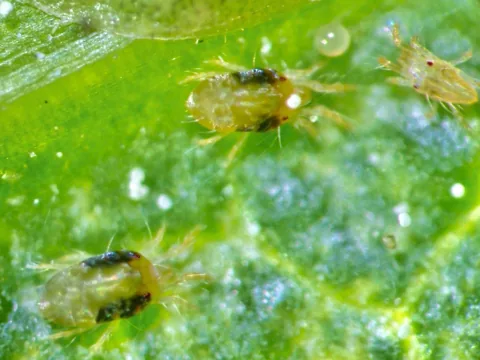 Spider Mites
Tetranychus urticae
Spider mites are tiny arachnids, relatives of spiders and ticks, that live in colonies on leaf undersides and suck out plant cells. The twospotted spider mite is the most important species in yards and gardens and on house plants, and Minnesota says it can infest over 200 species of plants.
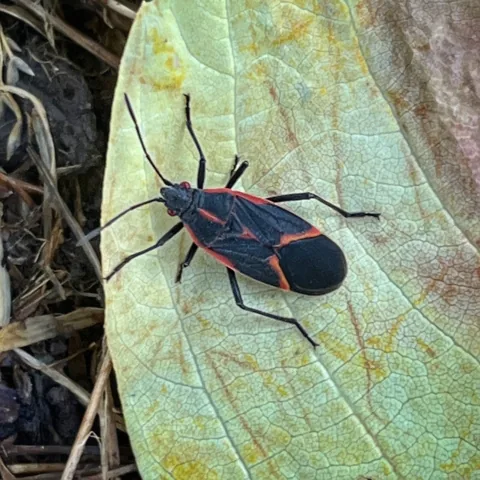 Boxelder Bug
Boisea trivittata
Boxelder bugs feed mainly on the seeds of female boxelder trees and become a nuisance in fall, when large numbers gather on and around homes looking for a place to spend the winter. Indoors they can stain fabrics and smell when crushed, but they don't damage the structure and don't breed inside.
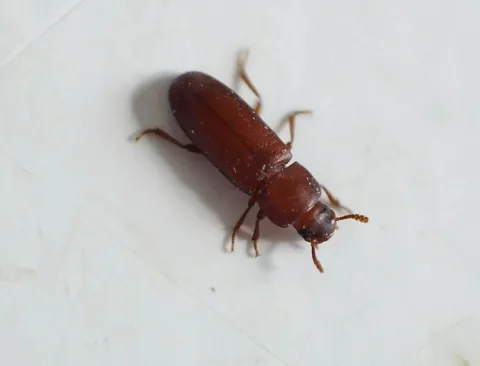 Red Flour Beetle
Tribolium castaneum
The red flour beetle is a shiny reddish-brown beetle that lives in flour, mixes and other processed or broken grain products; it can't chew into whole, sound kernels. Researchers call it a major storage pest.
Start with where you found them
Clover mites feed on grasses and clover and get into homes around windows and doors, so they are usually seen crawling on sills and thresholds. Most gather on the sunny side of the house, indoors or out.[1][4]
Velvet mites live in soil and leaf litter. In spring the adults are often seen scurrying over patios, brick walls and other objects, hunting insects and insect eggs; Missouri Department of Conservation says they are often seen on rocks, planters and tree trunks, especially after a rain.[7][6]
Chiggers live in brushy, grassy or weedy areas that stay a little moist. You usually find out about them from the itchy welts, not by seeing them.[8][9]
Spider mites live in colonies on the undersides of leaves, on garden plants, fruit trees, ornamentals and houseplants.[11]
Boxelder bugs feed mainly on the seed-bearing (female) boxelder tree, and adults and nymphs can cover tree trunks, the ground, fences and the sides of houses.[14]
Flour beetles live in stored food: flour, cracked grains, cake mixes, beans, dried fruit, nuts, chocolate and spices. The first sign is often small beetles crawling over the counter.[19][17]
Clover mites: red dots on windowsills
Clover mites are tiny reddish-brown to rusty red mites; Penn State gives the adult length as 0.75 mm and Clemson as about 1/30 inch, smaller than a pinhead. Some look olive green. Up close, the very long first pair of legs sets them apart from other spider mites.[2][5][3]
Crush one and it leaves a rusty red stain. University of Kentucky says the stain is the mite's body pigment, not blood: clover mites don't feed on blood and won't harm people or pets.[1][4][3]
They are a nuisance mostly in early spring and sometimes in fall. Penn State says they don't reproduce indoors and die inside within a few days. Heavy, well-fertilized lawns that run right up to the foundation make invasions more likely.[1][2]
Vacuum them or wipe them up with a damp cloth, carefully, so you don't smear them. For keeping them out, including a grass-free strip along the foundation, see our clover mite guide.[1][4][2]
Red velvet mites: the fuzzy red mite on the patio
Velvet mites (family Trombidiidae) are small, velvety, usually bright red mites. Missouri Department of Conservation gives adults as usually no bigger than about 1/8 inch, much bigger than a clover mite, and says giant velvet mites in the arid Southwest can reach nearly 1/2 inch. Adults have eight legs.[6][7][5]
They are predators, not pests. The tiny larvae are parasites on insects and spiders, and the older stages eat insect eggs and small insects. Missouri Department of Conservation says they don't parasitize people or other vertebrates at any stage and are harmless to people.[6][7]
NC State notes that no pesticide is labeled for velvet mites and recommends washing them away with a garden hose, or killing them with soapy water, rather than leaving a pesticide residue on the patio.[7]
Velvet mites and chiggers are related, but they're different families. Chigger larvae feed on vertebrates, people included; velvet mite larvae feed only on insects and other small arthropods.[6]
Chiggers: the red bug you feel but don't see
Chiggers are the larval stage of a mite. The larvae are bright red with six legs and less than 1/150 inch across, so small that you need a hand lens or microscope to see them well, although a cluster of them on skin can sometimes be seen because of the color. They are red to begin with, not from blood.[8][9][10]
The adult mites are not parasitic. University of Missouri Extension says they are brilliant red, are often called red bugs, and are often seen in lawns and moving across pavement.[9]
Bites cluster where clothing fits tightly against the skin: sock tops, waistbands, the backs of the knees, the crotch and armpits. Chiggers don't burrow into the skin or suck blood. Itching usually starts within a few hours.[9][8][10]
A warm shower with a good scrub within an hour or two after being in chigger habitat greatly reduces the number of bites. MedlinePlus says antihistamines and corticosteroid creams or lotions may help with the itching; see a health care provider if the rash itches very badly or isn't getting better. More on symptoms, treatment and repellents is in our chigger bites guide.[9][10]
Spider mites: red specks on plants
To the naked eye, spider mites look like tiny moving dots. UC IPM gives adults as less than 1/20 inch long and University of Minnesota as about 1/50 inch. Their color ranges from red and brown to yellow and green; Colorado State says most turn more red or orange as winter approaches, which may be why they are sometimes called red spiders.[11][12][13]
Look for leaves stippled with tiny pale dots or turning bronze, and fine silk webbing on the undersides. Damage is usually worst in hot, dusty weather and on water-stressed plants.[11]
To check, hold a sheet of white paper under a leaf and shake it, then look for specks that move.[12]
Missouri Department of Conservation says spider mites, like velvet mites, are harmless to people. It also notes that when you squish them, they often leave a red mark. For control, including water sprays, predators and the sprays to avoid, see our spider mite guide.[6][11]
Boxelder bug nymphs: bright red with six legs
Young boxelder bugs are bright red when they hatch, about 1/16 inch long, and turn red and black as they grow. Adults are about 1/2 inch long, mostly black with three red lines behind the head and a red abdomen.[16][14]
They can be told apart from mites by counting legs: nymphs are insects with six legs, and they grow much larger than any mite here.[16][6]
University of Kentucky says boxelder bugs don't bite or sting and haven't been reported to harm people, pets or livestock, but their droppings can stain fabrics and surfaces in the home. Adults move into wall voids and attics in fall.[15][16]
Clearing fallen boxelder seeds and debris and sealing entry points, best done in fall, are the main steps. Our boxelder bug guide covers each one.[14][16]
Red flour beetles: small red-brown beetles in food
The red flour beetle gets its name from its rust-red color. It and the nearly identical confused flour beetle are shiny, reddish brown, flattened and oval; University of Kentucky and Illinois Extension give them as about 1/8 inch long and UC IPM as about 1/7 inch. The antennae tell them apart: in the red flour beetle they end in an abrupt three-segmented club.[19][17][18]
Sources differ on whether the red flour beetle flies. Illinois Extension says it can fly while the confused flour beetle cannot; University of Kentucky says the confused flour beetle flies and the red flour beetle apparently does not.[19][17]
They can't attack whole, undamaged grain but feed on flour, meal, dried fruit, dry pet food, candy and many other processed foods. University of Kentucky says the life cycle takes about 7 weeks.[17]
Find and throw out infested packages, vacuum shelves with a crevice tool, wash them with soap and water, and store food in containers with tight-fitting lids. UC IPM says insecticides aren't recommended for pantry pests. Our pantry beetle guide has the full steps.[18][17]
Quick ways to tell them apart
Count the legs if you can. Adult mites (clover mites, velvet mites, spider mites) have eight legs and one main body section; insects such as boxelder nymphs and flour beetles have six legs and three body parts. Chigger larvae and newly hatched spider mites are exceptions, with six legs.[6][8][11]
Compare size: chiggers are practically microscopic, spider mites and clover mites are dots, velvet mites are about 1/8 inch, and flour beetles are shiny beetles about 1/8 inch long.[8][11][5][6][17]
Ask whether they bite. Chiggers do. Clover mites, velvet mites, spider mites and boxelder bugs don't bite people. Flour beetles are a food problem, not a biting one; UC IPM warns that spraying pesticides on or near food may cause more harm than the beetles.[9][1][6][15][18]
Common questions
- What are the tiny red bugs on my windowsill?
- Most likely clover mites. They gather on sunny windowsills in spring and fall, don't bite, and die indoors within a few days. Vacuum them up instead of crushing them.[4][2][1]
- Do tiny red bugs bite?
- Of the common ones, chiggers. Clover mites, velvet mites, spider mites and boxelder bugs don't bite people.[9][1][6][15]
- Why do the little red bugs leave a red stain when I squish them?
- That's the clover mite's body pigment, not blood. Clover mites don't feed on blood.[1]
- What is the big fuzzy red mite on my patio?
- A velvet mite. It eats insects and insect eggs and is harmless to people. Hose it off if you don't want it there.[6][7]
- Are red velvet mites the same as chiggers?
- No. They are related but in different families. Velvet mite larvae feed on insects and spiders, not people.[6]
- What are the small red bugs in my flour?
- Red or confused flour beetles, about 1/8 inch long. Throw out infested food and store the rest in containers with tight lids.[17][18][19]
Photo credits
- Clover Mite: (c) Alexis Tinker-Tsavalas, some rights reserved (CC BY) — via iNaturalist, CC BY 4.0
- Velvet Mites: (c) Firos AK, some rights reserved (CC BY) — via iNaturalist, CC BY 4.0
- Chiggers: (c) Alberto Alcalá, some rights reserved (CC BY) — via iNaturalist, CC BY 4.0
- Spider Mites: (c) Mike Bowie, some rights reserved (CC BY) — via iNaturalist, CC BY 4.0
- Boxelder Bug: (c) Alfonso Benítez-Mora, some rights reserved (CC BY) — via iNaturalist, CC BY 4.0
- Red Flour Beetle: (c) Roman, some rights reserved (CC BY) — via iNaturalist, CC BY 4.0
Sources
- University of Kentucky Entomology, “ENTFACT-627: Clover Mites.” entomology.mgcafe.uky.edu/ef627 (accessed 2026-11-10)
- Penn State Extension, “Clover Mites.” extension.psu.edu/clover-mites (accessed 2026-11-10)
- Colorado State University Extension, “Clover Mites and Other Mites of Turfgrass, Fact Sheet 5.505.” extension.colostate.edu/topic-areas/insects/clover-and-other-mites-of-turfgrass-5-505/ (accessed 2026-11-10)
- University of Minnesota Extension, “Clover mites.” extension.umn.edu/insect-relatives/clover-mites (accessed 2026-11-10)
- Clemson Cooperative Extension Home & Garden Information Center, “Clover Mites.” hgic.clemson.edu/factsheet/clover-mites/ (accessed 2026-11-10)
- Missouri Department of Conservation, “True Velvet Mites (Red Velvet Mites) (Field Guide).” mdc.mo.gov/discover-nature/field-guide/true-velvet-mites-red-velvet-mites (accessed 2026-11-10)
- NC State Extension, “Velvet Mites, Brick Mites or Patio Mites.” content.ces.ncsu.edu/velvet-mites-brick-mites-or-patio-mites (accessed 2026-11-10)
- Missouri Department of Conservation, “Chiggers (Field Guide).” mdc.mo.gov/discover-nature/field-guide/chiggers (accessed 2026-11-10)
- University of Missouri Extension, “Chiggers (G7398).” extension.missouri.edu/publications/g7398 (accessed 2026-11-10)
- NIH National Library of Medicine, MedlinePlus, “Chiggers (Medical Encyclopedia).” medlineplus.gov/ency/article/001333.htm (accessed 2026-11-10)
- University of California Statewide IPM Program, “Pest Notes: Spider Mites (UC ANR Publication 7405).” ipm.ucanr.edu/home-and-landscape/spider-mites/ (accessed 2026-11-10)
- University of Minnesota Extension, “Spider mites.” extension.umn.edu/yard-and-garden-insects/spider-mites (accessed 2026-11-10)
- Colorado State University Extension, “Spider Mites (Fact Sheet 5.507).” extension.colostate.edu/topic-areas/insects/spider-mites-5-507/ (accessed 2026-11-10)
- University of California Statewide IPM Program, “Pest Notes: Boxelder Bug (Publication 74114).” ipm.ucanr.edu/home-and-landscape/boxelder-bug/ (accessed 2026-11-10)
- University of Kentucky Entomology, “Boxelder Bugs (ENTFACT-444).” entomology.mgcafe.uky.edu/ef444 (accessed 2026-11-10)
- University of Minnesota Extension, “Boxelder bugs.” extension.umn.edu/nuisance-insects/boxelder-bugs (accessed 2026-11-10)
- University of Kentucky Entomology, “ENTFACT-612: Stored Product Pests in the Pantry.” entomology.mgcafe.uky.edu/ef612 (accessed 2026-11-10)
- University of California Statewide IPM Program, “Pest Notes: Pantry Pests (Home and Landscape).” ipm.ucanr.edu/home-and-landscape/pantry-pests/ (accessed 2026-11-10)
- University of Illinois Extension, “Common Pantry Pests.” extension.illinois.edu/sites/default/files/common_pantry_pests.pdf (accessed 2026-11-10)