The short answer
- Indoors, vacuum them or wipe them up with a damp cloth, soapy rag or wet sponge, carefully, so you don't crush them. A crushed clover mite leaves a red-brown stain.[1][2][3][4][5][6][8]
- Don't spray insecticide inside. The mites can't breed indoors and die within a few days; Kentucky says not to put insecticide on kitchen counters or other interior surfaces, and Texas A&M says indoor sprays generally aren't needed.[1][2][7]
- Outside, keep a strip of bare soil, gravel or non-host plants between the lawn and the foundation. Recommended widths vary: 6 to 24 inches (Penn State), about 18 inches (Clemson), 18 to 24 inches (Ohio State), about three feet (Colorado State).[2][5][6][3]
- Seal cracks around windows and doors, especially on the sunny sides of the house, where most mites get in: south and west according to Colorado State, south, southwest and east according to Ohio State.[3][6][5][4][7]
- Spring invasions end on their own. Colorado State says they stop with warm weather in May or early June, when the mites go dormant for the summer; Ohio State says mites that hatch in April stay active into early June.[3][6]
Mites and fall invaders
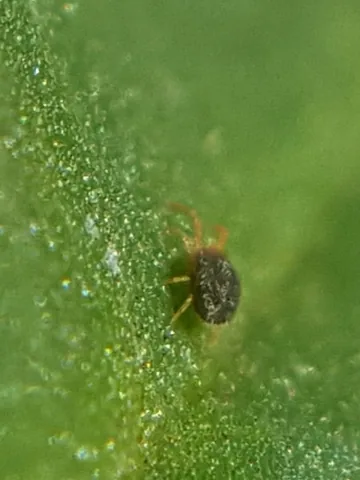 Clover Mite
Bryobia praetiosa
Clover mites are tiny plant feeders that invade homes in early spring and sometimes fall; they don't bite people or pets, don't breed indoors and soon die inside.
No photo yet
Banks grass mite
Oligonychus pratensis
The Banks grass mite is a spider mite that feeds on grasses. It can be destructive in turfgrass, and on farms it attacks corn and sorghum in summer and moves into winter wheat in the fall. Drought-stressed grass suffers the most, and in healthy turf chemical control is usually not warranted.
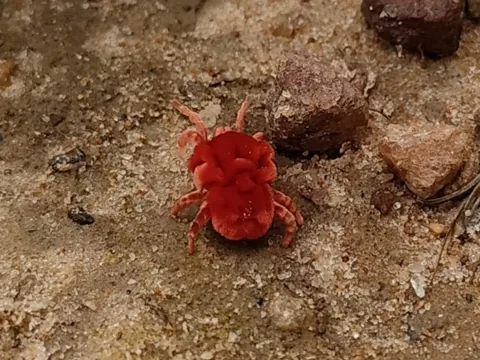 Velvet Mites
Trombidiidae (velvet mites)
Velvet mites are tiny, bright red, velvety mites seen scurrying over patios, brick walls and soil in spring. The adults prey on small insects and insect eggs, and they are harmless to people.
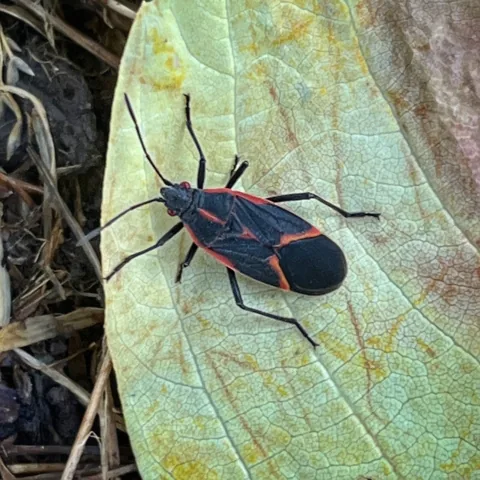 Boxelder Bug
Boisea trivittata
Boxelder bugs feed mainly on the seeds of female boxelder trees and become a nuisance in fall, when large numbers gather on and around homes looking for a place to spend the winter. Indoors they can stain fabrics and smell when crushed, but they don't damage the structure and don't breed inside.
What clover mites are
Clover mites (Bryobia praetiosa) are plant-feeding mites, more closely related to ticks than to insects. They are smaller than a pinhead: Penn State gives 0.75 mm, Clemson and Ohio State about 1/30 inch, and Texas A&M about 1 mm for adults. The Pacific Northwest handbook's photo caption puts them at about 1/16 inch. Most are reddish or reddish-brown, some olive or dark green.[5][2][6][7][8][4]
The best clue is the front legs. They are much longer than the others, about twice as long according to Clemson, and the mites hold them out in front so they look like antennae. To the naked eye the mites look like moving dark spots, or, as Colorado State puts it, "walking dust specks."[5][3][1][2][6][7]
They feed on lawn grasses, clover and many other plants (Clemson says more than 200), and they are especially abundant in the heavy, succulent growth of well-fertilized lawns.[5][1][4][6]
Ohio State says that despite the name they seem to prefer turfgrasses and honeysuckles, and lists clover, dandelion, strawberry and iris among other hosts.[6]
Are clover mites harmful?
No. Clover mites do not bite people or pets, do not feed on blood, do not transmit diseases and will not infest food, fabrics or furniture. Kentucky notes that the red stain from a crushed mite is not blood but the mite's own body pigment.[1][3][4][2][6][7]
What color is the stain? Kentucky calls it red-brown, Colorado State rusty red and Minnesota rusty or blood-red. Ohio State describes a green stain with red-orange marks, noticeable on linens, curtains, walls and woodwork.[1][3][4][6]
They also don't breed indoors. Penn State says they will not reproduce under indoor conditions and die within a few days from drying out.[2][1]
Because clover mites don't bite, tiny mites that are biting you indoors are something else; the bird and rodent mite guide covers those.[1][3][7]
When and where they come in
Clover mites are cool-season mites. Their eggs spend the summer dormant and hatch in fall; the mites are active through the cooler months and hatch again early in spring. Penn State gives roughly April 1, or temperatures over 45°F, for the overwintering eggs to hatch, and warm spells can stir mites as early as mid-January in southeastern Pennsylvania.[3][2][5][6]
Penn State says spring is when they bother homeowners most, and Kentucky calls them an early-spring nuisance that occasionally shows up in fall. Colorado State describes them coming in on warm days in both fall and spring, and Minnesota describes them gathering on walls, windows and tree trunks in fall to find hiding places. In Ohio, they come into buildings mostly from mid-October through December and again from mid-April through mid-June.[2][1][3][4][6]
They come in on the sunny sides of the house by crawling up the outside wall and through cracks around windows and doors, which is why they turn up on windowsills and thresholds. Colorado State names the south and west walls; Ohio State names the south, southwest and east sides. Mites spending the winter under siding or inside wall voids may wander into rooms instead of back outside.[3][6][4][1][2]
Where the eggs go: Penn State says the mites overwinter, mostly as eggs, in any dry, protected spot, such as cracks in concrete sidewalks, under tree bark and between the walls of buildings. Ohio State lists the same kinds of places, cracks in foundations and mortar, gaps between walls and loose bark, but says the adults prefer dark, cool, moist spots for laying.[2][6][5]
Life cycle
There are no known male clover mites; females lay eggs that develop without mating. Ohio State says each female lays about 70 eggs, and that the eggs are bright red when first laid.[5][6]
How long they take to grow up depends on temperature. Clemson gives about one month from egg to adult; Ohio State says each young stage lasts two to six days and the cycle is finished outdoors in two to three weeks.[5][6]
Ohio State says the mites are most active between 50 and 75 °F, that eggs laid in late spring wait out the summer and hatch in early autumn once temperatures fall below 85 °F, and that fall and spring usually each see two or more generations. Clemson says they develop best at around 69 °F.[6][5]
Getting rid of clover mites indoors
Rely on non-chemical control inside. The mites are a temporary problem and die indoors, so the goal is to pick them up without leaving stains.[1][2][7]
- Vacuum. Penn State calls a strong vacuum the best control in the home because it also prevents staining; the crevice tool reaches mites along sills and frames.[2][1][3][4][6][8]
- Wipe gently. A damp cloth, wet sponge or soapy rag works, but wipe carefully so you don't crush the mites. Clemson warns that the stains can be permanent on walls, flooring and fabrics.[1][4][5]
- Get the vacuum bag out of the house. Mites can crawl back out of the bag; Clemson says to put it in the outside trash, and Ohio State says to seal it inside a heavy plastic bag.[5][6]
- Skip indoor sprays. Penn State says chemical treatment inside isn't necessary, Kentucky says not to apply insecticides to counters or other interior surfaces, and Texas A&M says indoor sprays generally aren't needed. Ohio State's older fact sheet is the exception: it says to choose a product registered for interior use against crawling pests if you do treat inside.[2][1][7][6]
Make a grass-free strip at the foundation
Clover mites build up in lawn that grows right up to the walls, and a gap of bare ground stops many of them from reaching the house. Kentucky calls a plant bed or open area along the foundation the long-term solution to persistent problems, and Ohio State says the mites don't cross bare, loose soil as readily as grass touching the foundation. Texas A&M suggests at least keeping grass and weeds cut short right around the foundation.[1][6][7][3][4]
Sources disagree on how wide the strip needs to be. Penn State suggests removing grass from a band 6 to 24 inches wide, Clemson about 18 inches, Ohio State 18 to 24 inches, and Colorado State about three feet, noting that mites sometimes cross even that. Put the barrier on the sunny sides first.[2][5][6][3]
What to put in the strip also differs. Clemson and Ohio State suggest pea gravel or plants clover mites don't favor; both list marigold, zinnia, rose, chrysanthemum, petunia, spruce and juniper, and Ohio State adds geranium, salvia, arborvitae, yew and barberry. Minnesota recommends clean bare soil free of grass and leaves, says landscape rock alone is not enough of a deterrent, and advises spacing any plants in the zone far enough apart that the mites can't bridge across.[5][6][4]
Seal entry points
Caulking or weather-stripping cracks and gaps around windows, doors and sills keeps mites from crawling in; Colorado State says to pay particular attention to cracks around windows. Ohio State says mites in the basement or on inside walls mean there are openings to find and seal, around foundations as well as windows and doors.[3][5][6][7]
Colorado State also says a fine layer of dust around windows and other entry points can act as a barrier the mites won't cross, and lists talc-containing baby powder, diatomaceous earth, baking soda and corn starch.[3]
Lawn care that helps
Avoid overfertilizing. Kentucky says lush, overfertilized lawns let mites build to huge numbers, Ohio State says most outbreaks happen where well-fertilized lawn runs up to the sunny side of the foundation, and Penn State links the mite's rise as a household pest since World War II to more lawn fertilizer and lawns close to houses.[1][6][2]
Water dry spots. Colorado State says some extra watering of warm, dry areas at the base of sunny walls and around evergreens can greatly reduce clover mite numbers on the lawn.[3]
Clover mites can also damage grass. Colorado State describes small, meandering silver streaks on leaves in early to mid-spring and, at high numbers, light brown dead patches reaching several feet out from the foundation, often mistaken for winter kill; almost all of it is within 10 feet of a building, tree or other upright surface. Clemson describes a bronze or silvery look to infested lawn, and Ohio State a silvered look where feeding is heavy.[3][5][6]
Outdoor sprays: when they help
Most homes don't need them. Clemson says chemical control should only be needed for heavy infestations, the Pacific Northwest handbook says a perimeter spray by a pest control operator may be needed in extreme cases, and Colorado State says there are currently no highly effective chemical controls for clover mites.[5][8][3]
For mites crawling on outside walls, Kentucky suggests a direct spray of insecticidal soap or plain liquid dish soap at 2 tablespoons per gallon of water. It kills the mites it hits but leaves no residual protection.[1]
Extension sources that list a residual treatment describe spraying the outside wall up to the bottom of the first windows (Penn State) or first-floor windows (Ohio State) and the lawn out from the foundation: about 10 feet (Kentucky), up to 15 feet (Penn State) or a 10- to 20-foot strip (Ohio State). Colorado State names lawn products with bifenthrin or lambda-cyhalothrin as most likely to help; Minnesota lists permethrin, bifenthrin or cyfluthrin for the foundation. Clemson adds the trunks of trees and shrubs where mites shelter. Ohio State says to spray at the start of an invasion.[2][6][1][3][4][5]
Expect limits. Treatments break down over time, Kentucky notes there is no way to predict when the mites will move, and Penn State says repeat sprays may be needed because eggs tend to hatch after rain. Use a product labeled for the site you are spraying (lawn, shrubs or house exterior); Penn State warns that misapplication can stain siding or burn foliage.[1][2][5]
Common questions
- What are the tiny red bugs on my windowsill?
- If they are smaller than a pinhead, red or reddish-brown, have long front legs and show up on sunny windows in spring or fall, they are almost certainly clover mites.[3][2][5][1][6][7]
- Do clover mites bite?
- No. They feed on plants, not blood, and don't bite people or pets or spread disease.[1][3][4][6][7]
- Why do clover mites leave a red stain?
- The red is the mite's body pigment, not blood. Crushing them smears it, and the stain can be hard to remove from walls and fabrics, so vacuum or wipe them gently instead.[1][5][3]
- Will clover mites go away on their own?
- Yes. Indoors they die within a few days, and Colorado State says spring problems end with warm weather in May or early June when the mites go dormant.[2][3]
- How wide should the grass-free strip be?
- Recommendations run from 6 to 24 inches (Penn State) to about 18 inches (Clemson), 18 to 24 inches (Ohio State) and about three feet (Colorado State). Start with the sunny sides of the house.[2][5][6][3]
- Should I spray inside for clover mites?
- No. Penn State says indoor chemical treatment isn't necessary, Kentucky advises against putting insecticide on counters or other indoor surfaces, and Texas A&M says indoor sprays generally aren't needed. Vacuum instead.[2][1][7]
- Are there male clover mites?
- None are known. Females lay eggs that develop without males; Ohio State says each lays about 70.[5][6]
Photo credits
- Clover Mite: (c) Alexis Tinker-Tsavalas, some rights reserved (CC BY) — via iNaturalist, CC BY 4.0
- Velvet Mites: (c) Firos AK, some rights reserved (CC BY) — via iNaturalist, CC BY 4.0
- Boxelder Bug: (c) Alfonso Benítez-Mora, some rights reserved (CC BY) — via iNaturalist, CC BY 4.0
Sources
- University of Kentucky Entomology, “Clover Mites (ENTFACT-627).” entomology.mgcafe.uky.edu/ef627 (accessed 2026-11-10)
- Penn State Extension, “Clover Mites.” extension.psu.edu/clover-mites (accessed 2026-11-10)
- Colorado State University Extension, “Clover Mites and Other Mites of Turfgrass, Fact Sheet 5.505.” extension.colostate.edu/topic-areas/insects/clover-and-other-mites-of-turfgrass-5-505/ (accessed 2026-11-10)
- University of Minnesota Extension, “Clover mites.” extension.umn.edu/insect-relatives/clover-mites (accessed 2026-11-10)
- Clemson Cooperative Extension Home & Garden Information Center, “Clover Mites.” hgic.clemson.edu/factsheet/clover-mites/ (accessed 2026-11-10)
- Ohio State University Extension and Ohio Department of Agriculture, “Clover Mites (HYG-2095, 2010).” ohioline.osu.edu/factsheet/HYG-2095 (accessed 2026-11-10)
- Texas A&M AgriLife Extension, Insects in the City, “Biting Mites (ENT-3009), clover mite section.” citybugs.tamu.edu/factsheets/biting-stinging/others/ent-3009/ (accessed 2026-11-10)
- Pacific Northwest Pest Management Handbooks, “Nuisance and household pests: Clover mite.” pnwhandbooks.org/insect/structural-health/nuisance-household/nuisance-household-clover-mite (accessed 2026-11-10)