The short answer
- The mites that bite people in the U.S. are chiggers (from grass and brush outdoors), bird and rodent mites (from nests in or on the house), oak leaf itch mites (dropping from pin oaks in late summer and fall) and straw itch mites (in hay, straw and stored grain). Bird, rodent and itch mites can't live on people, and chiggers die once they are scratched or brushed off.[5][17][9][10][12][14][15]
- The scabies mite is different. It burrows into the top layer of human skin and lives and lays eggs there. It spreads mainly by prolonged skin-to-skin contact and needs a prescription treatment, so see a health care provider if you suspect it.[1][2][4]
- Location and timing are the best clues: chigger bites cluster at sock tops, waistbands and skin folds; oak leaf itch mite bites show up on the neck, shoulders and chest; straw itch mite bites are on the arms and trunk after handling bales; bird and rodent mite bites happen indoors, often in one room near a nest.[5][13][16][14][9]
- Bird and rodent mites go away when the nest or host does. Remove the source, then treat the area around it.[9][10]
- Mites are tiny but not invisible, and an entomologist can identify them from a sample. If bites continue and nothing is ever found, the cause may be something else entirely, from dry skin and fibers to a medical condition, and a doctor is the right next step.[10][18][19][20]
Mites that bite, and look-alikes that don't
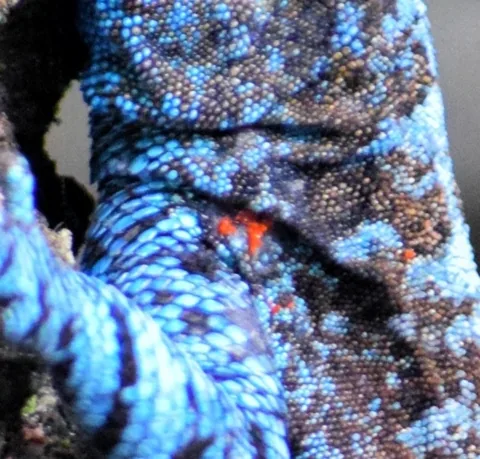 Chiggers
Trombiculidae (e.g., Trombicula / Eutrombicula alfreddugesi)
Chiggers are the tiny larvae of mites; only the larva bites, and its feeding causes intense itching and small red welts. Contrary to popular belief, chiggers don't burrow into the skin or suck blood.
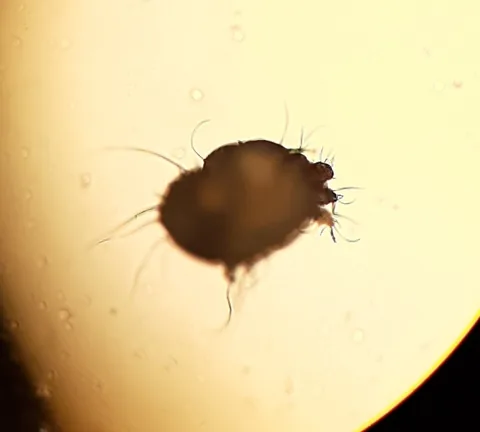 Scabies mite
Sarcoptes scabiei
Scabies is a skin infestation caused by a microscopic mite, Sarcoptes scabiei, that burrows into the upper layer of the skin of people and many other mammals. Its hallmark is intense itching, especially at night, and it spreads mainly through direct, prolonged skin-to-skin contact.
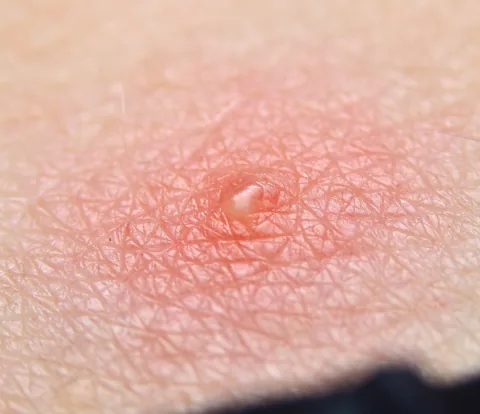 Oak Leaf Itch Mite
Pyemotes herfsi
The oak leaf itch mite is a tiny predatory mite that feeds on gall-making midge larvae on oak leaves. When its numbers explode in late summer, mites fall from the trees and bite people underneath.
No photo yet
Straw itch mite
Pyemotes tritici
The straw itch mite is a microscopic mite that lives in hay, straw, dried beans and stored grain, where it preys on the insects infesting them. People who carry, handle or sit on infested bales get intensely itchy red welts, usually 11 to 18 hours later, on whatever skin touched the material.
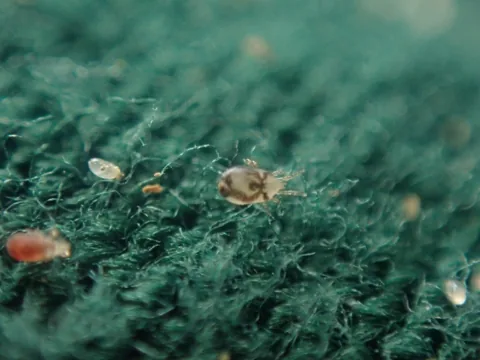 Northern Fowl Mite
Ornithonyssus sylviarum
The northern fowl mite is a tiny blood-feeding mite that Mississippi State Extension calls the most serious external parasite of poultry in North America. It lives its whole life on chickens and other birds, crowding around the vent, and heavy infestations cause anemia, fewer eggs and even death.
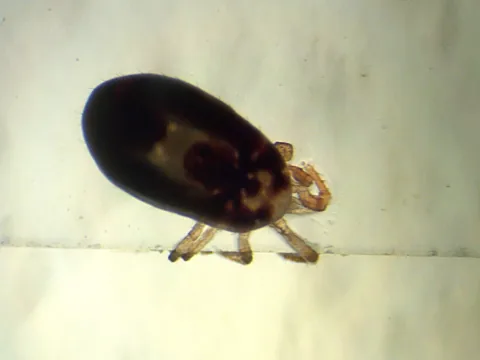 Chicken Mite
Dermanyssus gallinae
The chicken mite (poultry red mite, roost mite) is a tiny blood-feeding mite that hides in cracks, nests and litter by day and crawls onto chickens and wild birds to feed at night. Mites from coops or bird nests can also crawl onto people and bite.
No photo yet
Cheyletiella mites
Cheyletiella yasguri (dogs), C. blakei (cats) and C. parasitivorax (rabbits)
Cheyletiella mites live in the fur of dogs, cats and rabbits, each host with its own species. They can often be seen moving in the hair coat, which gives the infestation its nickname, walking dandruff. The mites pass readily to people, who may break out in itchy red bumps even when the pet shows no signs.
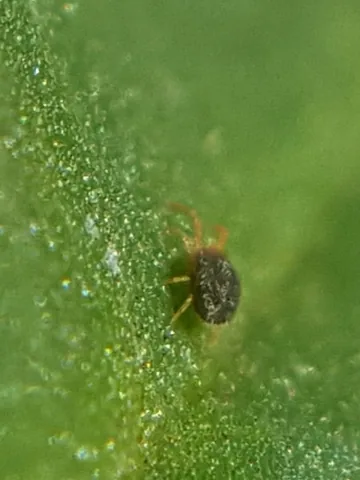 Clover Mite
Bryobia praetiosa
Clover mites are tiny plant feeders that invade homes in early spring and sometimes fall; they don't bite people or pets, don't breed indoors and soon die inside.
Few mites bite, and only one lives in skin
Texas A&M AgriLife Extension says most mites are harmless predators of insects or feed on decaying plant material, some feed on stored products such as cheese and grain, and only a few species are parasites of birds or mammals that occasionally become biting pests in homes. Identifying the mite, or its likely host, is the first step in solving an indoor mite problem.[9]
Ohio State University Extension adds that very few arthropods in the U.S. bite people, and fewer still burrow into human skin. The only one that burrows is the scabies mite. Bite reactions vary so much from person to person that even a dermatologist can't tell what bit someone from the look of the bite alone.[18]
Bird, rodent and itch mites share one trait: they bite people while looking for their real host or prey, and they can't build up a population on people. That is why getting rid of the source (a nest, a tree, a bale) matters more than treating your skin or your house.[9][10][15][16]
Clues from where and when the bites happen
Use these clues to narrow the list, then confirm with a sample or a visit to a health care provider.[18][19]
- After walking or sitting in tall grass, weeds or brush in summer or fall, with bites at the ankles, sock tops, waistband, behind the knees or in skin folds: likely chiggers. MedlinePlus notes the rash may stop where underwear meets the legs.[5][17]
- Indoors, often in one room, with a bird nest in a chimney, soffit or vent, or signs of rats or mice: likely bird or rodent mites. Texas A&M says rodent-related problems are most frequent in fall and winter and bird-related ones in spring and summer, and that infestations are often first noticed after the birds or rodents die, leave or are exterminated.[9]
- Under or near oak trees (especially pin oaks) in late summer and fall, with itchy red bumps on the neck, shoulders, chest and other loosely covered skin that show up many hours later: likely oak leaf itch mites.[13][12]
- After handling or sitting on hay or straw bales, or working with stored grain, dried beans or peas, with bites on the arms, trunk and waist: likely straw itch mites.[14][16][15]
- Intense itching that is worse at night, a pimple-like rash between the fingers, on the wrists, elbows, waist or other skin folds, and more than one person in the household itching: see a provider about scabies.[1][7][4]
Chiggers
Chiggers are the six-legged larvae of a type of mite. They live in tall grass and weeds, bite around the waist, the ankles and warm skin folds, and are most active in summer and fall. The bite itself is painless; itching starts several hours after they attach.[5]
University of Missouri Extension explains that chiggers do not burrow into the skin or suck blood. They inject a digestive enzyme, feed on the liquefied tissue through a feeding tube that hardens in the skin, and die quickly once they are brushed or scratched off. The itch lasts until the body breaks down that tube. Our chigger bites guide covers prevention, repellents, yard control and itch relief in detail.[17]
Bird mites and rat mites
Texas A&M lists the tropical rat mite (Ornithonyssus bacoti) as one of the most common house-invading biting mites, along with the tropical fowl mite and northern fowl mite from birds and the house mouse mite where house mice live. None of them is truly a parasite of people, but they bite readily and can cause itching and dermatitis.[9]
They are about the size of the period at the end of a sentence; University of Minnesota Extension gives about 1/32 inch and says they are visible to the naked eye, brownish or grayish, and darker after feeding. They don't hop or fly, but they can crawl several yards from a nest, and unlike bed bugs they don't hitchhike on people or belongings.[9][10][11]
Bird mites cannot reproduce on human blood, so they cannot set up an ongoing infestation in a home, and Minnesota Extension says they have not been found to transmit any diseases to people. How long they last without birds is where sources differ: Minnesota Extension says northern fowl mites can live off a host for 2 to 3 weeks, while Cornell's IPM program says bird mites die off in a matter of days once the birds leave the nest.[10][19]
The fix is the host. Find and remove the nest or the rodents, seal the openings they used, and treat the nest area as you remove it so mites don't scatter indoors. Our bird and rodent mites guide walks through finding the source, the rules on removing songbird nests, and indoor treatment.[9][10][11]
Oak leaf itch mite
The oak leaf itch mite (Pyemotes herfsi) is about 0.2 mm long, barely visible. It feeds on the larvae of tiny flies that make marginal fold galls on the leaves of pin oaks and other red oaks, and it can complete a generation in as little as a week, so numbers explode by late summer.[12][13]
It was first recognized in the U.S. in Kansas in the autumn of 2004, when Penn State Extension says it was estimated to have affected around 19,000 people. It has since been reported from several Midwestern and southern states and Pennsylvania.[12]
Mites drop from infested trees, Penn State cites studies of up to 370,000 per day, and drift on the wind, so they can get through window screens. Bites are typically raised, red and itchy with a small blister in the center and land where clothing is loose, at the neck, shoulders and chest. Sources give the delay differently: K-State Extension says bites appear 10 to 16 hours after exposure.[12][13]
Tree sprays don't reach mites inside the galls, and DEET has given mixed results. Both Penn State and K-State advise limiting time under infested trees, especially when raking oak leaves in fall, and washing clothes and bathing right after exposure.[12][13]
Straw itch mite (hay itch mite)
The straw itch mite (Pyemotes tritici), a close relative of the oak leaf itch mite, is a predator of insects that infest stored grain, dried beans and peas, straw, hay and other dried grasses. Females are about 0.2 mm long. The mites cannot use people as hosts but bite anyone who handles infested material.[15][16][14][12]
NC State Extension notes that complaints peak in fall, when bales are used for decorations, hayrides and covering newly seeded lawns. Bites show up on the arms and trunk where bales were carried, and the Bohart Museum at UC Davis says the rash, red itchy lumps like flea bites, usually takes 11 to 18 hours to develop. The mites don't stay on the skin after biting.[14][16]
Control options for bales are limited. NC State suggests putting a plastic tarp over bales before people sit on them; South Dakota State Extension says removing infested material, keeping stored products dry, baling straw only when thoroughly dry and keeping storage areas clean all reduce the mites by removing their prey.[14][15]
Scabies: the mite that lives in human skin
Scabies is an infestation of the skin by the human itch mite, Sarcoptes scabiei var. hominis. The female burrows into the upper layer of the skin, where she lives and lays eggs; you may see tiny burrows, which MedlinePlus says can look like a pencil mark. The itchy rash is an allergic reaction to the mites and their feces.[1][4][2]
Scabies spreads mainly through direct, prolonged skin-to-skin contact, less often through shared clothing, towels or bedding. Anyone can get it, regardless of age or how clean they are, and whole families are often affected. Outbreaks are more common where people live in close contact, such as nursing homes, extended-care facilities, jails and prisons, and child care facilities.[1][4][6][8]
The main symptoms are intense itching, especially at night, and a pimple-like rash. CDC lists the spaces between the fingers, the skin folds of the wrist, elbow, knee and armpit, and the penis, nipples, waist, buttocks and shoulder blades. Infants and young children often get a rash on the head, face, neck, palms and soles.[1][7][4]
Symptoms are slow to appear the first time, and you can spread scabies before you notice them. CDC says they typically take 4 to 8 weeks to develop; the Wisconsin Department of Health Services and the American Academy of Dermatology say 2 to 6 weeks. In someone who has had scabies before, itching can start within 1 to 4 days.[1][8][7]
Most people with scabies carry few mites: CDC says fewer than 10 to 15 in an otherwise healthy person, and the AAD says 15 to 20. Crusted (Norwegian) scabies is a severe form with hundreds or thousands of mites and thick crusts on the skin; it is very contagious and mostly affects people with weakened immune systems, older adults and people living in institutions.[1][7][4]
Scabies treatment and cleaning
Scabies needs a diagnosis and a prescription. A provider may confirm it by scraping the skin or lifting a mite from the end of a burrow and looking at it under a microscope, though a person can still have scabies when no mite is found. CDC says no over-the-counter products have been tested and approved to treat scabies, and that insecticide sprays and fumigants should not be used against it.[1][2][4]
Prescription creams or lotions are applied from the neck down (on infants and young children, the head and neck too) and left on for the prescribed time. MedlinePlus says treatment is typically repeated in 1 week and that a pill (ivermectin) may be prescribed for hard-to-treat cases.[1][2][4]
Itching can continue after the mites are dead because it is an allergic reaction. CDC says it may last several weeks and that retreatment may be needed if itching continues more than 2 to 4 weeks after treatment or new burrows or rash appear. MedlinePlus says itching may continue for 2 weeks or more; Wisconsin DHS says one to two weeks and that this should not be taken as treatment failure.[2][4][8]
- Treat household members and close contacts at the same time, even if they have no symptoms, and tell people you had skin-to-skin contact with in the previous two months to seek care.[1][3][4]
- Wash clothing, towels and bedding used in the three days before treatment in hot water and dry them hot, or dry-clean them. CDC says temperatures above 122°F (50°C) for 10 minutes kill mites and eggs; MedlinePlus says to dry at 140°F (60°C) or higher.[1][3][4]
- Seal items you can't wash in a plastic bag. CDC says for at least 72 hours to a week, MedlinePlus at least 72 hours, Wisconsin DHS 5 to 7 days.[1][2][4][8]
- Scabies mites generally don't survive more than two to three days away from human skin, according to CDC; the AAD says about three to four days. Wisconsin DHS advises against using pesticides in the home.[1][6][8]
- Children and adults can usually return to child care, school or work the day after treatment.[1][8]
- If skin sores develop or you think the skin is infected, contact your provider. Scratching can lead to infections such as impetigo.[2][4]
Mites from pets and other animals
CDC says animals do not spread human scabies. Pets get a different kind of scabies mite that causes mange; those mites can't survive or reproduce on people but can get under the skin and cause temporary itching, so infested animals should be treated. MedlinePlus also says pets and animals usually do not spread human scabies.[3][4]
Pet rodents such as gerbils, white mice and hamsters can carry rodent mites; Texas A&M advises having them checked by a vet if bites occur where they are kept. Pet birds such as parrots or canaries can bring in bird mites.[9][10]
Mites in the house that don't bite
Clover mites are reddish, about 1 mm long, with a long front pair of legs. They feed on grasses and weeds, wander in through windows and doors in late winter and early spring, and may leave a red stain when crushed, but they do not bite. Our clover mites guide explains how to keep them out.[9]
Grain mites live in processed cereal products such as flour. They are uncommon in homes, and they can be told from biting mites only under a high-powered microscope, so where you find them is the best clue.[9]
Getting a sample identified
A specimen is the only way to know. Texas A&M notes that many pest control companies rightly won't treat a home for mites without proof of them, so collect mites before any treatment.[9][18]
- Pick mites off skin or surfaces with an artist's brush or a tissue dipped in rubbing alcohol, and put them in a small vial with a little rubbing alcohol. Clear tape works too, though it makes accurate identification less likely.[9][18]
- Set sticky traps (glue boards) near beds, chairs or wherever bites happen.[9][18]
- Have the sample examined by an entomologist, such as a university plant and pest diagnostic clinic. Samples from skin or body openings should be collected and submitted by medical staff only.[18][20]
- Cornell's IPM program points out that an entomologist can only say whether an identifiable arthropod is in a sample; other health causes have to be sorted out by a medical provider.[19]
When bites continue but no mite is found
Many things besides arthropods cause itching, prickling or a crawling feeling. Cornell and Ohio State list low humidity and dry skin, fiberglass insulation, paper and fabric fibers, static electricity, animal hair, new detergents, soaps and other household products, and plants such as poison ivy. Carpet beetle larvae are another overlooked cause: Penn State Extension describes allergic reactions to their hairs that people report as being bitten.[19][18][20][21]
Ohio State suggests a humidifier, better air filtration, frequent vacuuming and moisturizing lotions where dry air, static and fibers may be the cause, and says insecticides are not recommended unless insect or mite specimens are found and properly identified. Cornell warns that repeated exposure to cleaning chemicals, rubbing alcohol and pesticides can make itching worse.[18][19]
Medical conditions and medicines can cause the same sensations. UC IPM advises seeing a primary care provider about unexplained itching first, and taking a list of your prescriptions to a pharmacist to check for side effects that cause itching or crawling sensations.[20][23]
Sometimes the cause is a condition called delusional infestation (also called delusional parasitosis or Ekbom syndrome). A medical review defines it as a fixed belief of being infested against all medical evidence, and notes it can occur on its own or along with many other conditions. The sensations are real to the person feeling them; a review in the Annual Review of Entomology says people often feel them in the skin and believe they can see the bugs, though no one else can, and that because it is a medical condition, successful treatment typically requires medication from a medical professional.[23][24][20]
Cornell notes that bird mites are a specific worry for many people in this situation. Bird mites are real and visible to the naked eye, but they need birds to live and do not infest the human body.[19][10]
A CDC-led study of 115 people in Northern California who reported fibers or material coming from their skin (sometimes called Morgellons) found no parasites or mycobacteria in their skin samples. Most of the material was cellulose, likely from cotton, and no common underlying medical condition or infectious source was identified, similar to delusional infestation.[22]
If you've been told no mites were found, Cornell suggests treating that as good news: not having bed bugs, fleas or bird mites is a good outcome. Keep working with your doctor or a dermatologist on what is causing the itch.[19][20]
A word on insecticides
Spraying the house won't help with chiggers, itch mites or scabies, and bird and rodent mites come back unless the nest or host is gone. Texas A&M says indoor sprays only suppress bird and rodent mites when combined with bird or rodent control and should go on the bases of walls and entry points, not on furniture or other surfaces people touch. CDC says not to use insecticide sprays or fumigants for scabies, and Ohio State says not to use insecticides at all until a mite or insect has been found and identified.[9][2][18]
Common questions
- Can bird mites or rat mites live on people?
- No. They bite people while searching for a host, but they cannot reproduce on human blood, so they can't set up an ongoing infestation on a person or in a home without birds or rodents.[10][9][19]
- Do chiggers burrow under the skin?
- No. Chiggers pierce the skin and feed through a tube that forms in the skin, then fall or get scratched off. The only mite that burrows into human skin is the scabies mite.[17][18]
- How long can scabies mites live off the body?
- CDC says generally no more than two to three days away from human skin; the AAD says about three to four days. Washing in hot water, drying hot or sealing items in a bag for at least 72 hours handles bedding and clothing.[1][6][4]
- Can I get scabies from my dog or cat?
- Not human scabies. Animal mange mites can get under your skin and cause temporary itching, but they can't survive or reproduce on people. Have the pet treated for mange.[3][4]
- What bit me if no one can find any bugs?
- Possibly nothing alive. Dry skin, fibers, static, household products, medical conditions and medicines can all cause itching or crawling sensations. Have a sample checked by an entomologist if you can collect one, and see a doctor or dermatologist about the itch.[19][18][20]
Photo credits
- Chiggers: (c) Alberto Alcalá, some rights reserved (CC BY) — via iNaturalist, CC BY 4.0
- Scabies mite: Tero Linjama, public domain (CC0), via iNaturalist
- Oak Leaf Itch Mite: (c) Zachary Dankowicz, some rights reserved (CC BY) — via iNaturalist, CC BY 4.0
- Northern Fowl Mite: Deniz Wilson, public domain (CC0), via iNaturalist
- Chicken Mite: Dermanyssus gallinae, microscopic view by Sylvain Larrat — via Wikimedia Commons, CC BY 4.0
- Clover Mite: (c) Alexis Tinker-Tsavalas, some rights reserved (CC BY) — via iNaturalist, CC BY 4.0
Sources
- Centers for Disease Control and Prevention, “About Scabies (2024).” www.cdc.gov/scabies/about/index.html (accessed 2026-11-10)
- Centers for Disease Control and Prevention, “Treatment of Scabies (2024).” www.cdc.gov/scabies/treatment/index.html (accessed 2026-11-10)
- Centers for Disease Control and Prevention, “Preventing Scabies (2023).” www.cdc.gov/scabies/prevention/index.html (accessed 2026-11-10)
- MedlinePlus, U.S. National Library of Medicine, “Scabies (Medical Encyclopedia).” medlineplus.gov/ency/article/000830.htm (accessed 2026-11-10)
- MedlinePlus, U.S. National Library of Medicine, “Chiggers (Medical Encyclopedia).” medlineplus.gov/ency/article/001333.htm (accessed 2026-11-10)
- American Academy of Dermatology, “Scabies: Overview.” www.aad.org/public/diseases/a-z/scabies-overview (accessed 2026-11-10)
- American Academy of Dermatology, “Scabies: Signs and Symptoms.” www.aad.org/public/diseases/a-z/scabies-symptoms (accessed 2026-11-10)
- Wisconsin Department of Health Services, Division of Public Health, “Scabies, Disease Fact Sheet P-42089.” www.dhs.wisconsin.gov/publications/p4/p42089.pdf (accessed 2026-11-10)
- Texas A&M AgriLife Extension, Insects in the City, “Rat and Bird Mites, ENT-3009.” citybugs.tamu.edu/factsheets/biting-stinging/others/ent-3009/ (accessed 2026-11-10)
- University of Minnesota Extension, “Bird and Rodent Mites.” extension.umn.edu/insect-relatives/bird-and-rodent-mites (accessed 2026-11-10)
- Utah State University Extension, IPM Program, “Bird Mites.” extension.usu.edu/planthealth/ipm/notes_nuisance/bird-mites.php (accessed 2026-11-10)
- Penn State Extension, “Oak Leaf Itch Mite.” extension.psu.edu/oak-leaf-itch-mite (accessed 2026-11-10)
- K-State Research and Extension, Johnson County, “Oak Leaf Itch Mites.” www.johnson.k-state.edu/programs/natural-resources/agent-articles/home-insect-control/oak-leaf-itch-mites.html (accessed 2026-11-10)
- NC State Extension, Entomology, “Itch Mite Problems.” entomology.ces.ncsu.edu/2015/10/itch-mite-problems/ (accessed 2026-11-10)
- South Dakota State University Extension, “Straw Itch Mites, P-00402.” extension.sdstate.edu/sites/default/files/2026-07/P-00402.pdf (accessed 2026-11-10)
- Bohart Museum of Entomology, University of California, Davis, “Hay Itch Mites, Note 43.” bohart.ucdavis.edu/sites/g/files/dgvnsk4616/files/media/documents/note_43_hay_itch_mites.pdf (accessed 2026-11-10)
- University of Missouri Extension, “Chiggers, G7398.” extension.missouri.edu/publications/g7398 (accessed 2026-11-10)
- Ohio State University Extension (Ohioline), “Mystery Bugs and Bites, ENT-66.” ohioline.osu.edu/factsheet/ent-66 (accessed 2026-11-10)
- Cornell University, New York State Integrated Pest Management, “Mystery Bites.” cals.cornell.edu/integrated-pest-management/mystery-bites (accessed 2026-11-10)
- University of California Statewide IPM Program, “Pest Notes: Itching and Infestation: What's Attacking Me?.” ipm.ucanr.edu/PMG/PESTNOTES/pn7443.html (accessed 2026-11-10)
- Penn State Extension, “Carpet Beetle Dermatitis.” extension.psu.edu/carpet-beetle-dermatitis (accessed 2026-11-10)
- PLoS ONE (CDC-led study), abstract via PubMed, “Pearson et al. 2012, Clinical, epidemiologic, histopathologic and molecular features of an unexplained dermopathy.” pubmed.ncbi.nlm.nih.gov/22295070/ (accessed 2026-11-10)
- Clinical Microbiology Reviews, abstract via PubMed, “Freudenmann and Lepping 2009, Delusional infestation.” pubmed.ncbi.nlm.nih.gov/19822895/ (accessed 2026-11-10)
- Annual Review of Entomology, abstract via PubMed, “Hinkle 2010, Ekbom syndrome: the challenge of 'invisible bug' infestations.” pubmed.ncbi.nlm.nih.gov/19961324/ (accessed 2026-11-10)