The short answer
- Jumps, hard-bodied, on pets or in pet bedding, and bites around the ankles: fleas.[2][15][7]
- Jumps, soft and easily crushed, in damp spots like sinks, tubs, basements or houseplant soil: springtails. They don't bite.[7][5]
- Jumps, shiny, on vegetable leaves full of small holes: flea beetles, a garden pest.[8][9]
- Doesn't jump, pale and soft, around damp books, papers, stored food or moldy spots: booklice (psocids). They don't bite.[11][14][13]
- Doesn't jump, straw-colored to reddish and flat, in mattress seams: young bed bugs. Near a bat roost or swallow nest: bat bugs or swallow bugs.[15][18]
- Doesn't jump, a crawling speck about 1/32 inch with eight legs, near a bird or rodent nest, with bites: bird or rat mites.[19][20]
Fleas and look-alikes
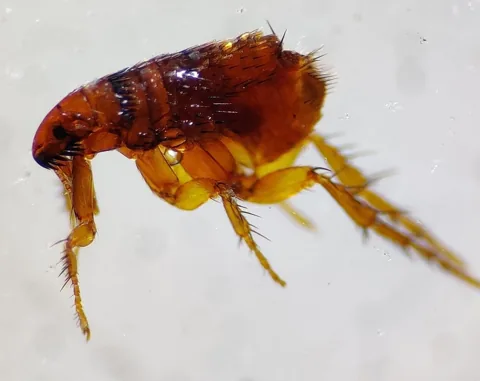 Cat Flea
Ctenocephalides felis
The cat flea is the most common external parasite of domestic cats and dogs, and the flea most often found on both. Adults spend most of their time on the pet, while eggs, larvae and pupae build up wherever the pet rests.
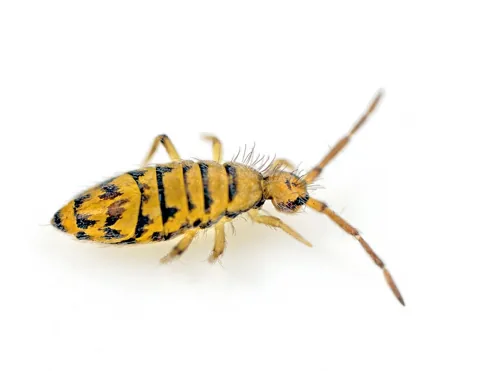 Springtail
Collembola (shown: Entomobrya sp.)
Springtails are tiny jumping creatures that sometimes appear in large numbers in moist spots indoors. They don't bite or sting and don't damage furniture or food; their presence indoors points to a moisture problem.
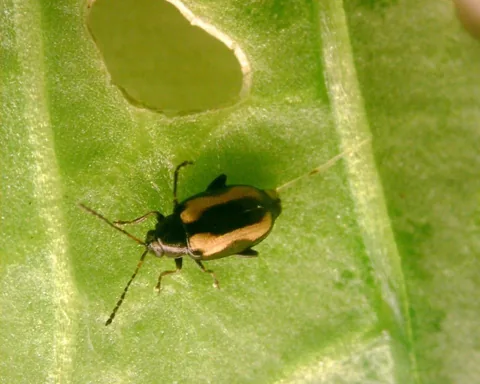 Flea Beetles
Phyllotreta striolata
Flea beetles are tiny, shiny beetles with enlarged hind legs that jump like fleas when disturbed. Adults chew small holes and pits in the leaves of radishes, cabbage and other crucifers, eggplant, potatoes, tomatoes and many other vegetables, and they do the most harm to seedlings in spring.
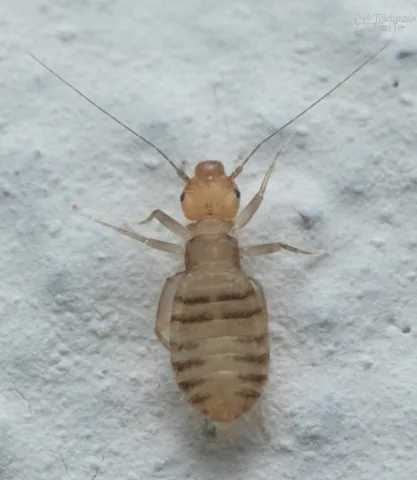 Booklice
Liposcelis species and other psocids (family Liposcelididae)
Booklice, also called psocids, are tiny insects that feed on mold and fungi. Finding them indoors usually means high humidity or a moisture problem, and drying things out is the most effective control.
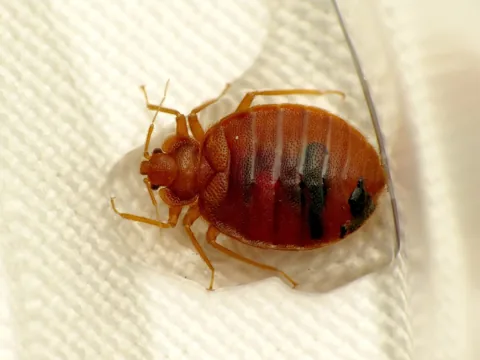 Bed Bug
Cimex lectularius
Bed bugs are wingless, blood-feeding insects that feed on sleeping or resting people, mostly at night; they have resurged worldwide and now turn up even in the finest hotels. CDC says they turn up in five-star hotels and resorts, and how clean a place is does not determine whether bed bugs are present.
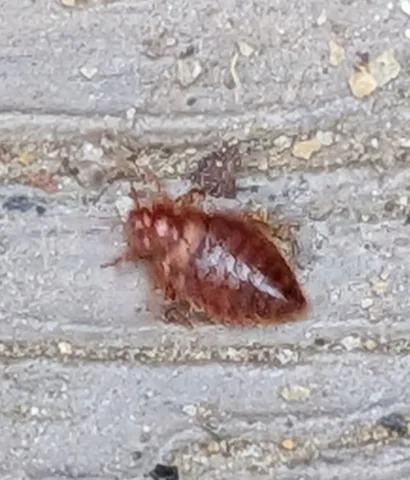 Bat Bugs
Cimex adjunctus (eastern bat bug) and Cimex pilosellus (western bat bug)
Bat bugs are close relatives of bed bugs that feed on the blood of roosting bats. They turn up in homes that have bats in the attic or walls, and they may bite people when the bats leave or are shut out.
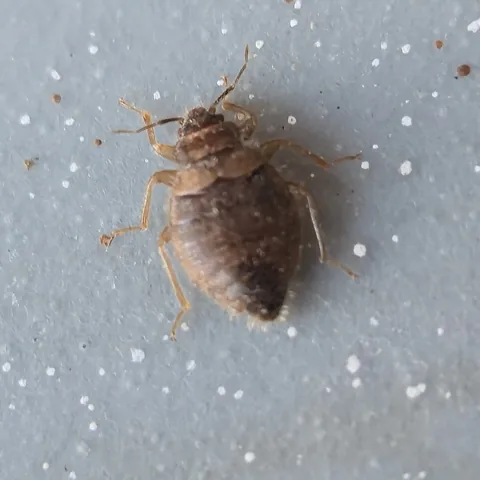 Swallow Bug
Oeciacus vicarius
Swallow bugs are close relatives of bed bugs that feed on the blood of swallows, mainly cliff swallows and sometimes barn swallows. They live in and around mud nests on buildings and bite people mainly when their birds are away.
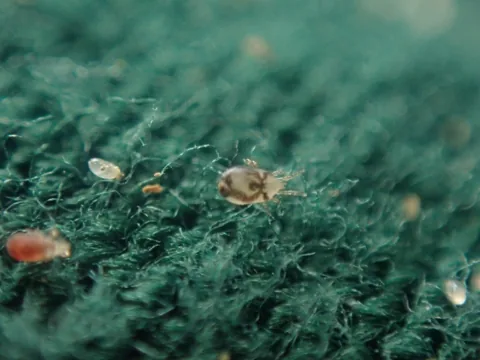 Northern Fowl Mite
Ornithonyssus sylviarum
The northern fowl mite is a tiny blood-feeding mite that Mississippi State Extension calls the most serious external parasite of poultry in North America. It lives its whole life on chickens and other birds, crowding around the vent, and heavy infestations cause anemia, fewer eggs and even death.
No photo yet
Tropical rat mite
Ornithonyssus bacoti
The tropical rat mite is a tiny blood-feeding mite that lives in the nests of rats and mice. It isn't a true parasite of people, but when its hosts die, leave or are exterminated, the hungry mites wander through the house and bite readily, causing itchy red bumps.
Start with the jump test
Fleas are built for jumping. University of Kentucky says adults can jump vertically up to about 6 inches, which is how they hitch rides onto passing pets or a person's shoes and pant legs.[2][3]
Two common look-alikes jump too. Springtails flick a forked structure tucked under the abdomen and can jump several inches; flea beetles have enlarged back legs and jump like fleas when disturbed.[5][7][8][9]
Bed bugs don't jump or fly; they crawl. Texas A&M AgriLife says rat and bird mites don't hop or fly either but may crawl several yards from an infested nest. UC IPM notes that psocids run or fly away when disturbed rather than jumping.[15][20][14]
If it jumps, try to catch one and press it on a hard surface. University of Minnesota says fleas are flattened from side to side and so hard-bodied that they are difficult to kill by crushing, while springtails have rounder, soft bodies and crush easily.[7]
What a real flea looks like
Adult fleas are no larger than 1/8 inch long, reddish-brown to black and wingless, with strong jumping legs. UC IPM says they are flattened from side to side, so they look as if they are walking on edge. The cat flea is the one usually found on both cats and dogs.[1][3]
Look on the pet first. Flea droppings show up as dark, pepper-like specks in the fur; this is digested blood, and it is what flea larvae feed on in pet resting areas. Combing with a fine-toothed flea comb, paying attention to the face, neck and the area in front of the tail, brings up adult fleas.[2][3][1]
To check a room or yard, walk through pet resting areas wearing white socks pulled up to the knee. If fleas are there, they jump onto the socks and are easy to see.[1][2]
Fleas bite pets and people. University of Kentucky says flea bites occur mainly around the ankles, unlike bed bug bites, which can be on any skin exposed during sleep. UC IPM describes a flea bite as a small red spot with a red halo, usually without much swelling. CDC notes fleas can spread germs, including the cause of flea-borne (murine) typhus.[2][15][1][4]
If these clues fit, our guides on getting rid of fleas in the house and in the yard cover treating pets, vacuuming and growth-regulator sprays.[2][1]
Springtails: jumping specks in damp places
Springtails are the bug most often confused with fleas, because they jump when disturbed. UC IPM gives them as about 1/16 inch long; University of Minnesota as between 1/16 and 1/8 inch. Most are gray, brown or black, though some are white or brightly colored. They are wingless.[5][7][6]
They need moisture. Indoors they turn up around plumbing leaks and condensation in bathrooms, basements and kitchens, in sinks and tubs, and in the soil of overwatered houseplants. Penn State says they also wander in from mulch and landscaping during dry spells or when soil is waterlogged.[7][5][6]
Springtails don't bite or sting and are harmless to people and pets. They don't spread disease or damage furnishings.[7][5]
The black specks hopping on snow on a warm winter day are springtails too; one species is known as the snow flea.[6]
Drying things out is the fix: lower the humidity with air conditioning or a dehumidifier and correct the moisture source. Our springtail guide has the details.[6][7]
Flea beetles: jumping beetles on garden plants
Flea beetles are small, shiny beetles with enlarged hind legs that jump like fleas when disturbed. UC IPM says all are less than 1/10 inch long; University of Minnesota says most are 1/16 to 1/8 inch, with the spinach flea beetle reaching 1/4 inch. They can be black, bronze, bluish, brown or metallic gray.[8][9]
They are plant feeders. Look for them on radishes, broccoli, cabbage, eggplant, peppers, tomatoes, potatoes and other vegetables, and for leaves chewed full of small holes, which UC IPM calls shot-hole damage.[9][8][10]
Unlike fleas, adult flea beetles can fly; UC IPM notes they fly into crops in spring after overwintering in weeds or debris. University of Minnesota recommends row covers to keep them off seedlings; our flea beetle guide covers that and the other options.[8][9]
Booklice: pale specks on books, papers and food
Booklice are psocids, small soft-bodied insects. Penn State gives them as 1 to 2 mm long; Washington State University gives psocids as usually 1/16 to 1/8 inch. Indoor booklice are wingless and white, cream, tan, gray or nearly clear.[11][12][13]
They don't jump. UC IPM says psocids run or fly away when disturbed. Penn State notes booklice are flattened from top to bottom, wider than thick, the opposite of a flea.[14][11][7]
Booklice live in damp, warm, undisturbed spots where mold and fungi grow. They feed on mold, grains, insect fragments and other starchy material, including the glue in book bindings. They don't bite, don't spread disease and are harmless to people and pets.[13][11]
Lowering the humidity stops them. Penn State says keeping relative humidity under 50% prevents mold and booklouse development; University of Minnesota says psocids don't survive below 45% to 50%. See our booklice guide for the steps.[11][13]
Young bed bugs: small, pale and flat
Newly hatched bed bugs are straw-colored and no bigger than a pinhead. EPA describes young bed bugs as translucent or whitish-yellow and says that if they haven't fed recently they can be nearly invisible. EPA gives the first stage as 1.5 mm; UC IPM gives the nymphs as 1/20 to 1/5 inch.[15][16][17]
Unlike fleas, bed bugs have oval, flattened bodies, and they don't fly or jump; they crawl. They hide close to where they feed, and beds and other places where people rest or sleep are the most common places to find them. Penn State notes a newly hatched bed bug is about the size of an adult booklouse, so the two get confused.[15][11]
Bed bugs feed on any skin exposed while sleeping, such as the face, neck, shoulders, back, arms and legs, while flea bites are mostly around the ankles. Look for live bugs, eggs, tan shed skins and fecal spots on the mattress. Our bed bug look-alike page and bed bug guides cover what to do next.[15]
Bat bugs and swallow bugs
Bat bugs and swallow bugs are close relatives of bed bugs that feed on bats and birds. Colorado State University says they are similar to bed bugs in size and color and can only be told apart with a hand lens or microscope.[18][15]
They show up near bat roosts in attics, walls and chimneys, or near swallow nests under overhangs of buildings. When the bats or birds leave or are excluded, the bugs wander into living areas and can bite people, but they can't reproduce on human blood. Colorado State says bat bugs can live seven or eight months without feeding.[18][15]
University of Kentucky says treatment should focus on the roosting or nesting site, combined with excluding the bats or birds. Bats are protected and can carry rabies, so Colorado State recommends professional help for the bat exclusion.[15][18]
Bird mites and rat mites: crawling specks that bite
Bird mites are about 1/32 inch long, small but visible to the naked eye. Like all adult mites they have eight legs and two main body parts, while fleas are insects with six legs.[19]
They come from bird or rodent nests on or in the building. When a nest is abandoned or its host dies, the mites go looking for another host and bite people; Texas A&M AgriLife says bites are often noticed only in certain rooms, presumably close to the nest. Bird problems are most common in spring and summer.[19][20]
They can't reproduce on human blood. University of Minnesota says northern fowl mites can live without a host for 2 to 3 weeks before dying. A wet finger, brush or piece of sticky tape picks them up for identification.[19][20]
The fix is the nest: remove it once it is inactive (nests of federally protected songbirds can't be disturbed while eggs or young are present), and treat for mites at the same time as, or before, getting rid of rodents. Our pages on bird and rodent mites and on mites that bite people go further.[19][20]
Where you found them
On a dog or cat, in pet bedding, or jumping onto your ankles in a room where pets rest: fleas.[2][1]
In a sink, tub, damp basement or houseplant pot: springtails.[7][5]
On garden vegetables, including seedlings: flea beetles.[9][8]
On old books, papers, cardboard boxes or in damp cupboards and stored food: booklice.[11][13]
In mattress seams, bed frames or the couch: bed bugs. Upstairs or near an attic or chimney with bats or birds: bat bugs, swallow bugs or bird mites.[15][18][19]
Common questions
- What jumps like a flea but isn't a flea?
- Most often a springtail, a tiny soft-bodied scavenger found in damp places. Outdoors on vegetable plants, it is probably a flea beetle. Neither bites people.[5][7][8]
- How can I tell springtails from fleas?
- Fleas are hard, flattened side to side and hard to crush. Springtails are soft and rounder and crush easily. Springtails also live in damp spots, not on pets.[7]
- Do bed bugs jump like fleas?
- No. Bed bugs don't fly or jump; they crawl.[15]
- Are booklice fleas?
- No. Booklice are pale, soft psocids that feed on mold. They run rather than jump and don't bite.[14][11]
- I have bites but no pets. Could it still be fleas?
- Yes. University of Kentucky says that when fleas infest a home with no pets, raccoons, opossums, skunks or squirrels living in the attic, chimney or under the house are often the source. Also check for bed bugs, and for bird or rodent nests or bat roosts that could be the source of biting mites or bat bugs.[2][15][19][18]
- What are the black jumping bugs on snow?
- Springtails, often called snow fleas. They are harmless.[6][7]
Photo credits
- Cat Flea: (c) Thomas Gyselinck, some rights reserved (CC BY) — via iNaturalist, CC BY 4.0
- Springtail: AJ Cann, public domain (CC0), via iNaturalist
- Flea Beetles: 螯蝦, public domain (CC0), via iNaturalist
- Booklice: (c) Luis Fernando Valdez Ojeda, some rights reserved (CC BY) — via iNaturalist, CC BY 4.0
- Bed Bug: (c) Katja Schulz, some rights reserved (CC BY) — via iNaturalist, CC BY 4.0
- Bat Bugs: (c) Jason Hill, some rights reserved (CC BY) — via iNaturalist, CC BY 4.0
- Swallow Bug: (c) John Clonce, some rights reserved (CC BY) — via iNaturalist, CC BY 4.0
- Northern Fowl Mite: Deniz Wilson, public domain (CC0), via iNaturalist
Sources
- University of California Statewide IPM Program, “Pest Notes: Fleas (Publication 7419).” ipm.ucanr.edu/home-and-landscape/fleas/ (accessed 2026-11-10)
- University of Kentucky Entomology, “Flea Control and Prevention (ENTFACT-602).” entomology.mgcafe.uky.edu/ef602 (accessed 2026-11-10)
- Texas A&M AgriLife Extension, Urban and Structural Entomology, “Fleas (ENT-3001).” citybugs.tamu.edu/factsheets/biting-stinging/others/ent-3001/ (accessed 2026-11-10)
- Centers for Disease Control and Prevention, “About Fleas.” www.cdc.gov/fleas/about/index.html (accessed 2026-11-10)
- University of California Statewide IPM Program, “Pest Notes: Springtails.” ipm.ucanr.edu/home-and-landscape/springtails/ (accessed 2026-11-10)
- Penn State Extension, “Springtails.” extension.psu.edu/springtails (accessed 2026-11-10)
- University of Minnesota Extension, “Springtails.” extension.umn.edu/nuisance-insects/springtails (accessed 2026-11-10)
- University of California Statewide IPM Program, “Pest Notes: Flea Beetles (Home and Landscape).” ipm.ucanr.edu/home-and-landscape/flea-beetles/ (accessed 2026-11-10)
- University of Minnesota Extension, “Flea beetles.” extension.umn.edu/yard-and-garden-insects/flea-beetles (accessed 2026-11-10)
- University of Wisconsin-Madison Extension, “Flea Beetles.” hort.extension.wisc.edu/articles/flea-beetles/ (accessed 2026-11-10)
- Penn State Extension, “Booklice.” extension.psu.edu/booklice (accessed 2026-11-10)
- Washington State University PestSense, “Psocids (Booklice or Barklice).” pestsense.cahnrs.wsu.edu/fact-sheet/psocids-booklice-or-barklice/ (accessed 2026-11-10)
- University of Minnesota Extension, “Booklice and barklice.” extension.umn.edu/garden-and-home/home-maintenance/household-insects/booklice-barklice (accessed 2026-11-10)
- University of California Statewide IPM Program, “Pest Notes: Psyllids (Publication 7423).” ipm.ucanr.edu/PMG/PESTNOTES/pn7423.html (accessed 2026-11-10)
- University of Kentucky Entomology, “Bed Bugs (ENTFACT-636).” entomology.mgcafe.uky.edu/ef636 (accessed 2026-11-10)
- U.S. Environmental Protection Agency, “Bed Bugs: Appearance and Life Cycle.” www.epa.gov/bedbugs/bed-bugs-appearance-and-life-cycle (accessed 2026-11-10)
- University of California Statewide IPM Program, “Pest Notes: Bed Bugs.” ipm.ucanr.edu/home-and-landscape/bed-bugs/ (accessed 2026-11-10)
- Colorado State University Agricultural Biology, “Bed bug look-alikes.” agsci.colostate.edu/agbio/ipm-pests/bed-bug-look-alikes/ (accessed 2026-11-10)
- University of Minnesota Extension, “Bird and rodent mites.” extension.umn.edu/insect-relatives/bird-and-rodent-mites (accessed 2026-11-10)
- Texas A&M AgriLife Extension, Urban and Structural Entomology, “Biting Mites (ENT-3009).” citybugs.tamu.edu/factsheets/biting-stinging/others/ent-3009/ (accessed 2026-11-10)