The short answer
- The signs to look for are live bugs, dark spots of dried excrement along seams, rusty or reddish smears from crushed bugs, eggs and eggshells about 1 mm long, and pale shed skins.[1][5][6][4]
- Look at the bed first. UC IPM says 85% of bed bugs are found in or near the bed: mattress seams and tufts, the box spring, the bed frame and the headboard.[6]
- Bites alone don't prove anything. They look like mosquito or flea bites, they can take as long as 14 days to show, and some people never react.[4][1][5]
- Interceptor cups under the bed and couch legs find infestations that a quick look misses. In one study of New Jersey apartments they detected 89% of infestations, against 72% for brief visual inspections.[7][5][2]
- If you find something, keep a sample and have it identified before you treat, because carpet beetles and other insects are easily mistaken for bed bugs.[2][1]
Bed bugs and their look-alikes
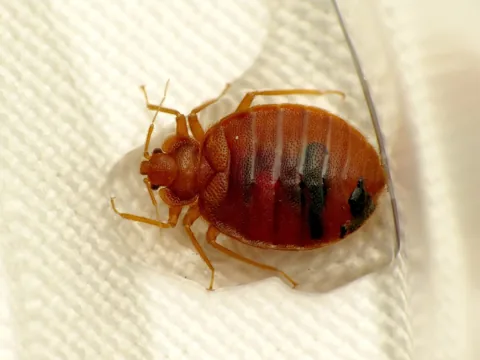 Bed Bug
Cimex lectularius
Bed bugs are wingless, blood-feeding insects that feed on sleeping or resting people, mostly at night; they have resurged worldwide and now turn up even in the finest hotels. CDC says they turn up in five-star hotels and resorts, and how clean a place is does not determine whether bed bugs are present.
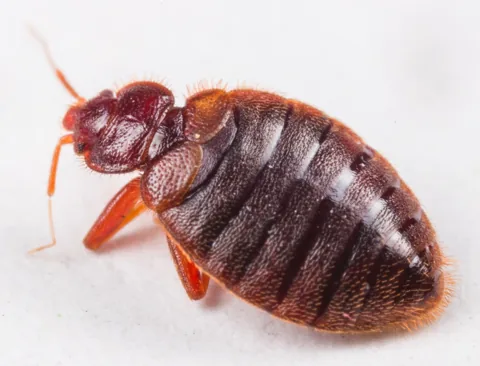 Tropical Bed Bug
Cimex hemipterus
The tropical bed bug is one of two bed bug species that feed on people. UC IPM says it is the dominant species in the tropics, and a 2021 study describes it spreading to new areas, including the United States, northern Australia, the Middle East, Russia and Central Europe.
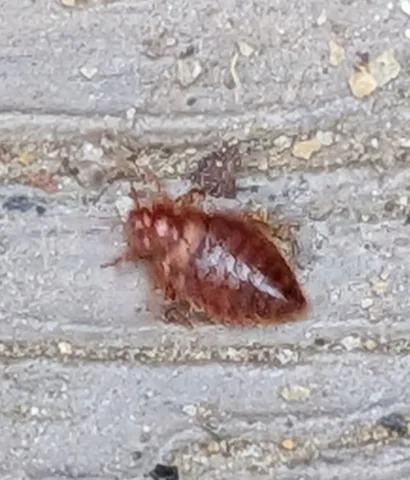 Bat Bugs
Cimex adjunctus (eastern bat bug) and Cimex pilosellus (western bat bug)
Bat bugs are close relatives of bed bugs that feed on the blood of roosting bats. They turn up in homes that have bats in the attic or walls, and they may bite people when the bats leave or are shut out.
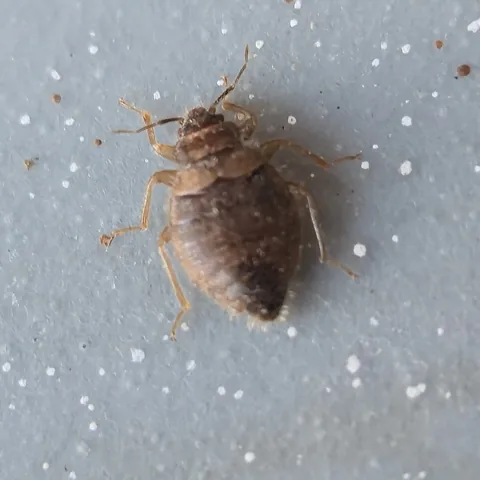 Swallow Bug
Oeciacus vicarius
Swallow bugs are close relatives of bed bugs that feed on the blood of swallows, mainly cliff swallows and sometimes barn swallows. They live in and around mud nests on buildings and bite people mainly when their birds are away.
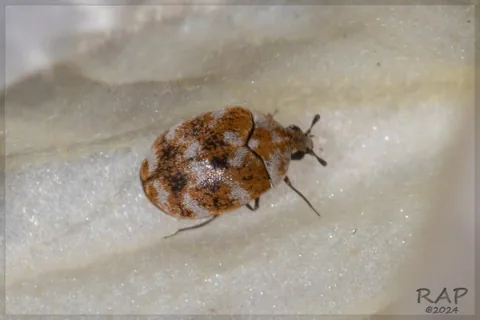 Varied Carpet Beetle
Anthrenus verbasci
Carpet beetles are small beetles whose larvae damage wool, silk, fur, feathers, leather and other animal products; the adults feed on pollen outdoors and often fly in through windows.
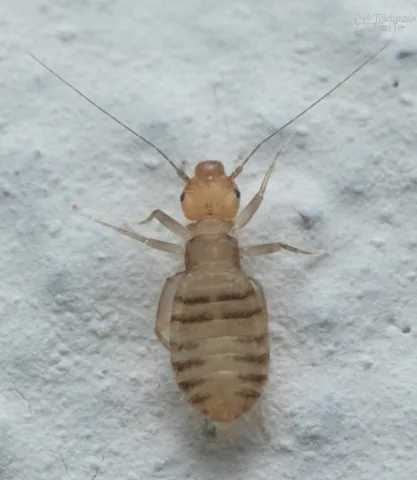 Booklice
Liposcelis species and other psocids (family Liposcelididae)
Booklice, also called psocids, are tiny insects that feed on mold and fungi. Finding them indoors usually means high humidity or a moisture problem, and drying things out is the most effective control.
The signs, one by one
Fecal spots. Kentucky calls dark spots on the mattress and box spring a telltale sign. They are dried excrement, found along mattress seams and wherever the bugs hide. EPA says they may bleed into fabric the way a marker would. UC IPM describes them as reddish brown or dark brown to black, sometimes yellowish, roughly round but sometimes streaked, and possibly very small.[1][5][6]
Blood smears. Rusty or reddish stains on sheets or the mattress come from engorged bed bugs that were crushed. EPA notes that adults and large nymphs void remains of earlier blood meals about 20% of the time while they are still feeding, which is part of why rusty or tarry spots show up on sheets.[1][5][6][4]
Eggs and eggshells. Eggs are about 1 mm long (UC IPM gives 1/20 inch), pearly white and about the size of a pinhead. They are glued to rough surfaces such as wood or paper near where people sleep or rest, and the empty shells often stay stuck in place after hatching. Eggs more than five days old show a dark eye spot. You will usually need a hand lens to see them.[1][3][6][5]
Shed skins. Young bed bugs molt five times on the way to adulthood, and the skins they leave behind are light brown or tan. Along with eggs and fecal spots, they mark the places where bed bugs gather.[5][6][4]
Live bugs. Adults are about the size of an apple seed: EPA gives 5 to 7 mm (3/16 to 1/4 inch), and UC IPM says about 1/5 inch. They are flat, oval, wingless and reddish brown, and they look swollen and longer after a meal. Nymphs range from 1/20 to 1/5 inch and are whitish yellow or translucent; unfed ones can be nearly invisible. Bed bugs don't build nests, but they tend to gather in the same hiding places, so adults, nymphs, eggs and spots are often found together.[3][6][5]
Odor. Sources differ on how useful smell is. CDC lists a sweet, musty odor among the signs of an infestation, and UC IPM says a foul or acrid 'buggy' smell might be present in heavily infested areas. Kentucky says the smell is seldom noticeable except in extreme infestations and should not be relied on. Don't rule bed bugs out because you smell nothing.[4][6][5]
Where to look
Bed bugs hide in cracks about as thin as a credit card; Kentucky compares it to the width of a toothpick. They favor wood, paper and fabric over metal or plastic, so wooden furniture and fabric seams deserve the most time.[1][5][6]
The bed comes first. Check mattress piping, seams, tufts and tags; the box spring, especially its upper seams and the bottom edge where it rests on the frame; cracks and screw holes in the bed frame; and the headboard. If the box spring has a fabric dust cover underneath, it may have to come off so you can see inside. Wooden slats or support boards collect bugs where their ends rest on the frame, and items stored under the bed can hide them too.[1][5][6]
Next, check upholstered seating, which Kentucky calls the next most likely place: the seams, skirts and folds of chairs, recliners and sofas, and between cushions. A sofa or recliner that someone sleeps on can become a hotspot of its own.[5][1]
Then the rest of the room. UC IPM says the remaining 15% are usually in other upholstered furniture, bedroom cabinets, along baseboards, under wallpaper, and in carpets and wall hangings. Kentucky and EPA add nightstand and dresser drawers and joints, the edge of wall-to-wall carpet behind beds and sofas, cracks in molding, the seam where wall meets ceiling, behind pictures, mirrors, outlets and switch plates, clothing and clutter in closets, book bindings, electronics and smoke detectors, and even the head of a screw.[6][5][1]
How far from the bed? UC IPM says common hiding places are usually 6 feet or less from where people sleep or rest, and CDC says bed bugs tend to live within 8 feet. They can go farther to feed: EPA says they readily travel 5 to 20 feet from their hiding places, and CDC says they can travel over 100 feet in a night. So the bed is the place to start, not the place to stop.[6][4][1]
How to inspect, step by step
Gather a bright flashlight, a hand lens or magnifying glass, and a small mirror for looking under and behind things. UC IPM recommends all three, and notes that seeing eggs needs a magnifier.[6][5]
Strip the bed and look over the sheets and mattress pad for spots and smears. Then take the bed apart and stand the mattress and box spring on edge, so you can see the seams on both sides and the underside. A thorough job can take several hours; low-level infestations take time and patience to find.[5][6][1]
Work outward: the bed frame and headboard, then nightstands (empty them and tip them over to see the woodwork underneath), then seating, baseboards behind the bed and sofa, and the other spots listed above. Clutter around the bed makes this much harder, and Kentucky notes that ordinary vacuuming seldom reaches the places bed bugs hide.[5][6]
Write down what you find. EPA suggests recording the date and exact location of every find, which helps you target treatment and track whether it is working.[2]
Look again. EPA suggests checking for signs whenever you change bedding or clean, and after treatment, carefully looking every few days. Because bed bugs hide by day and come out mainly at night, Kentucky says visual inspection alone can fail to reveal them, which is where interceptors help.[1][2][5]
Interceptors and other monitors
Interceptors are double-walled cups that go under the legs of beds and furniture. A bed bug climbing toward a sleeping person crawls up the rough outer wall, drops into the cup and can't climb the slippery inner wall to get out. UC IPM cites research in which interceptors trapped six times more bed bugs than human visual searches found. They also give you a simple way to check: you look in the cups instead of taking furniture apart.[6][5]
They perform well in real homes. In a survey of 2,372 low-income apartments in four New Jersey cities, Rutgers researchers found interceptors detected 89% of infestations and brief visual inspections detected 72%; only two of 291 infestations were missed by both. Traps at the bed caught more bed bugs per trap than those at the sofa or upholstered chair.[7]
A University of Tennessee study in high-rise apartments found two pitfall-style monitors caught bed bugs in 88% and 79% of infested apartments, but a sticky monitor did so in only 39% and took longer. Using one, two or four of the better monitors per apartment made no significant difference, and the authors stress that at least one should go at the bed.[8]
To use them, put one under each leg of the bed and of any couch or chair where people sleep or sit. Pull the bed a few inches away from the wall, and keep sheets, blankets and bed skirts from touching the floor, so the legs are the only way up. EPA gives directions for making interceptors from two nested plastic containers, rough tape on the outside and a little talcum powder inside, and says to check and clean them every week.[2][5]
Other monitors use heat, carbon dioxide or lures to draw bugs out. UC IPM notes these may detect bed bugs that would otherwise stay hidden, especially when no one is sleeping in the room.[6]
Bed bug detection dogs
Some pest control companies use dogs trained to the scent of bed bugs, often in hotels, offices and theaters. In lab and simulated tests they have been very accurate, but UC IPM says accuracy in real homes has been highly variable, and Kentucky says reliability can vary from one inspection to the next.[6][5]
A Rutgers field study tested 11 dog teams in naturally infested apartments. Every handler believed their dog found infestations at a very high rate (95% or more), but the average detection rate was 44% (range 10 to 100%), with a 15% average false-positive rate. Teams tested on different days were inconsistent, and experience or certification didn't predict how well a team did.[9]
If you hire a dog team, UC IPM advises checking third-party certification and ongoing training first, and having any alert confirmed by a detailed inspection from a trained professional.[6]
Why bites alone don't confirm bed bugs
Bed bug bites look like other bites. CDC describes them as slightly swollen, red and itchy, like mosquito or flea bites, sometimes random and sometimes in a line. EPA adds that they can look like rashes such as eczema or fungal infections, or like hives. UC IPM says telling them apart from mosquito, flea or spider bites is difficult to impossible, and that skin symptoms should never be used to diagnose bed bugs.[4][1][6]
Many people don't react, or react late. Kentucky cites studies in infested apartments where about 30 percent of people didn't react even when bitten repeatedly, with even higher shares among the elderly. In the New Jersey survey, only 68% of residents living with bed bugs reported any symptoms, and 49% of the infestations found were in apartments whose residents didn't know they had bed bugs.[5][7]
The delay can be long. CDC says bite marks may take as long as 14 days to appear, and Kentucky says days or even weeks. In a small study of people exposed to bed bugs, the delay between bite and skin reaction started at about 10 days and shortened to a few seconds with repeated exposure, so a first-time reaction may not point to where or when you were bitten.[4][5][10]
Bites do raise suspicion in some cases. Kentucky says bed bugs are more likely if you have traveled or brought home used beds or furniture before the welts appeared, or if you wake up with itchy welts you didn't have at bedtime. Even then, confirmation means finding the bugs or their signs. For other causes of bites and rashes, see our bite identification guide.[5]
If you find something
Get it identified. Collect the bug and take it to your county extension office, which EPA notes will identify pests at no cost. Carpet beetles and other insects are easily mistaken for bed bugs, and treating for the wrong insect gives a real infestation time to spread. See our bed bug look-alikes guide.[2][1]
Bat bugs and swallow bugs look almost identical. Telling them apart takes a hand lens or microscope to compare the hairs behind the head, and it matters, because those bugs are managed at the bat roost or bird nest.[6][5]
Bed bugs spread on belongings: CDC says they ride in the seams and folds of luggage, bags, folded clothes, bedding and furniture. In a Rutgers study marked bugs moved between apartments, turning up in neighboring units next to five of six test apartments. If you rent, tell your landlord; EPA says the units near yours should be inspected.[11][2][4]
Then make a plan. Our step-by-step treatment guide covers laundering, vacuuming, encasements, heat and insecticides, and the encasement guide explains how to isolate the bed so interceptors can do their job.[5][6]
Checking secondhand furniture and hotel rooms
Before bringing home a used bed, mattress or upholstered piece, inspect it closely for fecal spots and the other signs. Kentucky advises against bringing discarded mattresses and sofas into the home at all.[5][6]
In a hotel, check the sheets and mattress seams before unpacking, especially at the pillow end, and look behind the headboard if you can see it. Kentucky notes that the area behind the headboard is often where bed bugs first get established in hotel rooms, but headboards are heavy, and untrained guests shouldn't try to remove them. Our travel guide covers the rest.[5][1][6]
Common questions
- What do bed bug droppings look like?
- Small dark spots, reddish brown to black, roughly round or sometimes streaked, often in clusters along mattress seams. On fabric they can bleed in like a marker dot.[6][1][5]
- Can you see bed bug eggs?
- Barely. They are about 1 mm long, pearly white and glued in place, and a hand lens helps. Older eggs show a dark eye spot.[1][3][6]
- Do bed bugs smell?
- Sometimes. CDC lists a sweet, musty odor as a sign, but Kentucky says the smell is seldom noticeable except in extreme infestations, so don't count on it.[4][5]
- Can I tell bed bug bites from other bites?
- Not reliably. They look like mosquito or flea bites, may take up to 14 days to show, and some people don't react at all. Finding the bugs or their signs is the only confirmation.[4][6][5]
- Are bed bug dogs reliable?
- They can be, but field results vary. In one study of 11 teams in infested apartments, the average detection rate was 44% with 15% false positives. Ask for certification and have any alert confirmed by inspection.[9][6]
- How many interceptors do I need?
- One under each leg of the bed and of any couch or chair used for sleeping. In one apartment study, one, two or four good monitors per apartment found infestations at similar rates, as long as one was at the bed.[2][8]
- I found one bug. Do I have an infestation?
- Not necessarily, but don't ignore it. Bed bugs tend to cluster, so inspect the bed and nearby furniture closely, set interceptors, and get the bug identified.[5][2]
Photo credits
- Bed Bug: (c) Katja Schulz, some rights reserved (CC BY) — via iNaturalist, CC BY 4.0
- Tropical Bed Bug: (c) portioid, some rights reserved (CC BY) — via iNaturalist, CC BY 4.0
- Bat Bugs: (c) Jason Hill, some rights reserved (CC BY) — via iNaturalist, CC BY 4.0
- Swallow Bug: (c) John Clonce, some rights reserved (CC BY) — via iNaturalist, CC BY 4.0
- Varied Carpet Beetle: (c) RAP, some rights reserved (CC BY) — via iNaturalist, CC BY 4.0
- Booklice: (c) Luis Fernando Valdez Ojeda, some rights reserved (CC BY) — via iNaturalist, CC BY 4.0
Sources
- U.S. Environmental Protection Agency, “How to Find Bed Bugs.” www.epa.gov/bedbugs/how-find-bed-bugs (accessed 2026-11-10)
- U.S. Environmental Protection Agency, “Do-it-yourself Bed Bug Control.” www.epa.gov/bedbugs/do-it-yourself-bed-bug-control (accessed 2026-11-10)
- U.S. Environmental Protection Agency, “Bed Bugs Appearance and Life Cycle.” www.epa.gov/bedbugs/bed-bugs-appearance-and-life-cycle (accessed 2026-11-10)
- Centers for Disease Control and Prevention, “About Bed Bugs.” www.cdc.gov/bed-bugs/about/index.html (accessed 2026-11-10)
- University of Kentucky Entomology, “ENTFACT-636: Bed Bugs (M. F. Potter).” entomology.mgcafe.uky.edu/ef636 (accessed 2026-11-10)
- UC Statewide Integrated Pest Management Program, “Pest Notes: Bed Bugs.” ipm.ucanr.edu/home-and-landscape/bed-bugs/ (accessed 2026-11-10)
- Journal of Medical Entomology, via PubMed, “Wang, Singh, Zha and Cooper (2016), Bed bugs: prevalence in low-income communities, resident's reactions, and implementation of a low-cost inspection protocol, J. Med. Entomol. 53(3):639-646.” pubmed.ncbi.nlm.nih.gov/27049026/ (accessed 2026-11-10)
- Journal of Economic Entomology, via PubMed, “Vail and Chandler (2017), Bed bug detection in low-income, high-rise apartments using four or fewer passive monitors, J. Econ. Entomol. 110(3):1187-1194.” pubmed.ncbi.nlm.nih.gov/28369372/ (accessed 2026-11-10)
- Journal of Economic Entomology, via PubMed, “Cooper, Wang and Singh (2014), Accuracy of trained canines for detecting bed bugs, J. Econ. Entomol. 107(6):2171-2181.” pubmed.ncbi.nlm.nih.gov/26470083/ (accessed 2026-11-10)
- Medical and Veterinary Entomology, via PubMed, “Reinhardt, Kempke, Naylor and Siva-Jothy (2009), Sensitivity to bites by the bedbug, Cimex lectularius, Med. Vet. Entomol. 23(2):163-166.” pubmed.ncbi.nlm.nih.gov/19292820/ (accessed 2026-11-10)
- PLoS One, via PubMed, “Cooper, Wang and Singh (2015), Mark-release-recapture reveals extensive movement of bed bugs within and between apartments, PLoS One 10(9):e0136462.” pubmed.ncbi.nlm.nih.gov/26352145/ (accessed 2026-11-10)