The short answer
- Stages: egg, five nymph stages (instars) and adult. Each nymph stage must take at least one blood meal before it can molt to the next.[1][2][3][6]
- Eggs: a female lays 200 to 500 eggs in her life, usually one to five a day. Eggs hatch in about 6 to 15 days at room temperature, depending on the source and conditions.[1][2][6][8]
- Egg to adult: as little as about a month at 70 to 82°F with regular blood meals, and up to four months when it's cooler or food is scarce.[1][2][6][8]
- Without feeding: typically 1 to 4 months in a heated or air-conditioned home, and a year or longer in cold conditions. Young nymphs die soonest.[2][6][1][9]
- For treatment: many insecticides don't kill eggs, so plan on follow-up treatments about two weeks apart to catch nymphs that hatch after the first one, and keep watching for at least a year.[6][7][4][5]
Related profiles
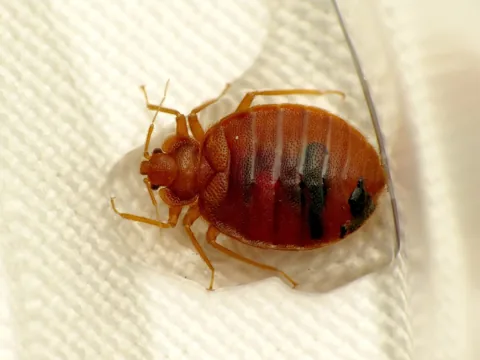 Bed Bug
Cimex lectularius
Bed bugs are wingless, blood-feeding insects that feed on sleeping or resting people, mostly at night; they have resurged worldwide and now turn up even in the finest hotels. CDC says they turn up in five-star hotels and resorts, and how clean a place is does not determine whether bed bugs are present.
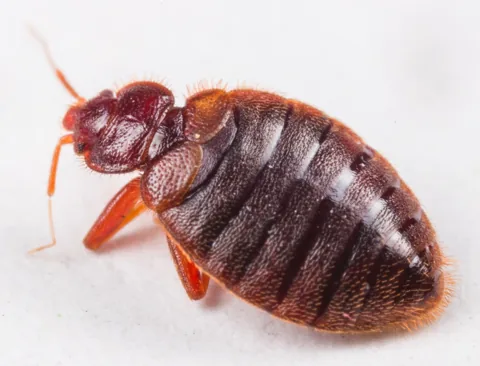 Tropical Bed Bug
Cimex hemipterus
The tropical bed bug is one of two bed bug species that feed on people. UC IPM says it is the dominant species in the tropics, and a 2021 study describes it spreading to new areas, including the United States, northern Australia, the Middle East, Russia and Central Europe.
The stages, egg to adult
Nymphs look like adults, only smaller and lighter in color, and they grow by shedding their skin five times. The shed skins stay behind in hiding places and are one of the signs you'll find during an inspection.[2][1][6]
EPA lists these approximate sizes for each stage of the common bed bug, Cimex lectularius:[3]
- Egg: about 1 mm, pearl-white, the size of a pinhead. Eggs more than five days old show a dark eye spot.[3][1]
- First-stage nymph: about 1.5 mm. Newly hatched nymphs are straw-colored and no bigger than a pinhead.[3][2]
- Second-stage nymph: about 2 mm.[3]
- Third-stage nymph: about 2.5 mm.[3]
- Fourth-stage nymph: about 3 mm.[3]
- Fifth-stage nymph: about 4.5 mm.[3]
- Adult: 5 to 7 mm (3/16 to 1/4 inch), about the size of an apple seed. Unfed adults are flat and brown; recently fed ones swell and turn reddish.[3][2]
Eggs: how many, where, and how fast they hatch
Females lay eggs in secluded places near where people sleep or rest, usually on rough surfaces such as wood or paper. The eggs are covered with a glue-like material, so they stick where they're laid, and the empty shells often stay stuck in place after hatching. They're hard to see without a magnifier, especially on light-colored fabric.[1][2]
UC IPM says a female lays 200 to 500 eggs in her lifetime, usually two to five a day. Kentucky Entomology says one, two or more a day, potentially hundreds. Virginia Tech studies of field-collected bed bugs measured lower daily rates: about one egg per female per day on average, and in a separate life table study, females that laid on a given day laid 1 to 3 eggs on 79% of those days and 4 to 6 on 21%.[1][2][10][8]
A female has to keep feeding to keep laying. Kentucky notes adult females must feed periodically to produce eggs.[2]
Hatching time depends on temperature, and published figures differ. UC IPM says eggs hatch in about 10 to 15 days at room temperature, NPIC says 6 to 10 days, and Kentucky says about a week. In the Virginia Tech life table study, run at about 26°C (79°F), eggs hatched in an average of 5.4 to 6.3 days depending on the strain.[1][6][2][8]
Mating isn't always what limits egg-laying. Virginia Tech researchers found that females mated once laid an average of 83.8 eggs over six feeding cycles, while females mated repeatedly laid 61.0, about 27% fewer. They concluded that in the first six weeks or so of a new infestation, a single mated female on her own, with regular blood meals, can produce more offspring than the same female with a male present.[10]
NPIC puts it the other way around for prevention: a male or an immature bed bug brought into a home won't start an infestation, but one pregnant female can.[6]
Nymphs: five molts, a blood meal before each
There are five nymph stages, each larger than the last, and each needs at least one blood meal before it can molt. Nymphs that feed fully usually molt within about 5 days of the meal.[1][2][9]
Nymphs are translucent or whitish-yellow and, when unfed, can be nearly invisible to the naked eye because of their color and size.[3][1]
In the Virginia Tech life table study, egg-to-adult development took about 35 days in one field strain and about 40 days in a laboratory strain and a second field strain, with each nymph stage lasting roughly 3 to 8 days when the bugs were fed about weekly. NPIC gives about 37 days under ideal conditions.[8][6]
How temperature speeds up or slows down the cycle
Warm rooms speed bed bugs up and cool rooms slow them down. UC IPM says development is fastest between 70 and 82°F, and that the full cycle takes anywhere from five weeks to four months depending on temperature and access to blood. Kentucky says that at 70 to 80°F with a steady blood supply, bed bugs can mature in as little as a month and produce multiple generations a year; cooler temperatures or limited access to a host prolong development.[1][2]
UC IPM says there can be up to four generations a year.[1]
- Egg hatching in a 2024 laboratory study: at 20°C (68°F) and 50% humidity, eggs began hatching after about 9.2 days and finished by about 10.7 days, with the lowest hatch rate of the conditions tested. At 30°C (86°F) and 90% humidity they began hatching after about 5.2 days and finished by about 7.2 days.[11]
- Molting in the same study was also slowest at 20°C with 50% humidity and fastest at 30°C with 90% humidity. The researchers found 25°C (77°F) with 90% humidity best for adult survival and egg-laying.[11]
- Limits for eggs: a review of bed bug stress tolerance reports that eggs of both the common and tropical bed bug aren't viable when held below 10°C (50°F) or above 37°C (98.6°F) for the whole time they develop.[12]
- Long warm spells hurt them too. Norwegian researchers held bed bug populations at 34, 36 or 38°C (about 93 to 100°F) for 2 or 3 weeks; many died, and the survivors laid fewer eggs, with fewer eggs hatching and fewer nymphs molting successfully over the next 7 weeks. The authors say this kind of heat stress is not enough to eliminate bed bugs on its own.[14]
Feeding and lifespan
Bed bugs feed only on blood, mostly at night. UC IPM says adults may feed every 5 to 7 days; NPIC says bed bugs usually feed every 3 to 7 days. Hungry bugs will feed at any time of day if a host is still and nearby.[1][6]
Sources give different lifespans. Kentucky says that with adequate resources the average lifespan is about 10 months, and UC IPM says adults may live a year or more. In the Virginia Tech laboratory study, at about 26°C (79°F) with feeding every 10 days, a newly molted adult female had a life expectancy of about 127 days, and the longest-lived females survived 227 days from egg to death.[2][1][8]
How long bed bugs survive without feeding
This is the number people most want, and it depends heavily on temperature, humidity and life stage. The sources agree on the direction: cooler means longer.[1][2][6][9]
- UC IPM: 20 to 400 days, depending on temperature and humidity. Older nymphs outlast younger ones, and adults have survived more than 400 days without food in the lab at low temperatures.[1]
- Kentucky Entomology: about 1 to 4 months is typical in temperature-controlled buildings, and potentially a year or longer at 55°F or less.[2]
- NPIC: up to about three months at room temperature, and much longer when it's cold.[6]
- Virginia Tech laboratory study of four strains: first-stage nymphs survived the shortest, 13.8 to 36.3 days on average; fifth-stage nymphs and adults survived longest, 41.5 to 142.6 days. Pyrethroid-resistant strains starved faster than susceptible ones; in the most resistant strain, no stage was expected to survive more than 51 days.[9]
- Older laboratory work cited in the same study found starved adult females surviving an average of 277 days at 18°C (64°F) and as long as 425 days at 10°C (50°F).[9]
Drying out, not hunger, is often what kills them
NPIC says it is usually drying out, rather than starving, that kills isolated bed bugs, and they dry out faster when the air is dry.[6]
Bed bugs are built to hold water between meals. Researchers at Ohio State found they lose water very slowly through a waxy, nearly waterproof cuticle and can tolerate losing 30 to 40% of their body water. They rely on blood to replace water, can't absorb moisture from the air, and drink only sparingly when offered water. Clustering together and staying still for long periods helps them conserve water.[13]
First-stage nymphs hold more water but lose it faster and survive less time in dry air than older stages, so the newest hatchlings are the most fragile. As bed bugs develop, each stage needs less water and resists drying out better.[13][9]
How fast an infestation grows
Because development is quick and adults live for months, numbers build fast. In the Virginia Tech life table, one field strain kept at about 26°C with regular feedings had a generation time of about 92 days and multiplied about 35-fold per generation, which works out to the population doubling roughly every 13 days.[8]
In that model the population was mostly young stages: about 54% nymphs, 34% eggs and only 12% adults. Most of what's in a hiding place at any moment is not yet an adult.[8]
Kentucky says the longer bed bugs go undetected, the more likely they are to spread beyond the places where people sleep and rest, which makes control harder.[2]
What the life cycle means for treatment timing
EPA says controlling bed bugs takes time and patience because of their biology: they reproduce quickly and their eggs resist many control methods, chemical and non-chemical. Each of the steps below follows from a stage of the life cycle.[4]
- Plan for eggs to survive a spray. NPIC says many insecticides don't kill eggs, so a second treatment is often needed to kill the nymphs that hatch afterward. EPA tells do-it-yourselfers they may need to repeat the steps more than once to get the bugs and their eggs.[6][5]
- Space follow-ups about two weeks apart. Virginia Tech's action plan calls for an intensive first treatment and two follow-up inspections or treatments at two-week intervals, and says follow-ups should come within two weeks even if the bugs seem gone after a week, to kill nymphs that hatched in between.[7]
- Don't spray every bug you see the first day or two. Virginia Tech notes that bugs may be more visible for about 24 hours after a treatment because they are sick and wandering, and should start dying in large numbers within two days.[7]
- Keep checking. EPA says to look for signs every few days after the first cleanup and at least every 7 days, including any interceptor traps, in case eggs remain, and to keep checking for at least a year.[5]
- Use methods that kill eggs where you can. Heat kills every stage when it gets hot enough for long enough; EPA's target for furniture, luggage and rooms is at least 120°F for 90 minutes to make sure eggs die. Freezing works too but takes days: EPA says items need three days in a sealed bag in a freezer set to 0°F. The heat and freezing guides linked below give the details.[4][5][1]
- Bag items you can't treat for long enough. EPA says items that can't be treated can go in a sealed plastic bag or container for up to a year to make sure any bugs are dead.[5]
- Leave encasements on for the long haul. Bugs sealed inside a mattress encasement eventually starve, but given the survival times above, that can take months.[1][2]
Why leaving the home empty doesn't work
Starving bed bugs out by moving away is usually impractical, Kentucky says. When a dwelling sits empty, bed bugs often spread to nearby units or slow down until someone moves back in.[2]
Virginia Tech adds that with no host present, bed bugs become inactive and may not cross insecticide-treated surfaces, and no monitoring device is fully reliable without a host. For a vacant apartment it recommends three inspections and treatments two weeks apart (six weeks in all) with no bugs found before renting again, and being ready to respond quickly if the new tenant reports bites.[7]
Common questions
- How long do bed bug eggs take to hatch?
- About 6 to 15 days at room temperature, depending on the source and conditions. Warmer rooms shorten it: in lab studies eggs hatched in about 5 to 7 days at around 79 to 86°F, and took about 9 to 11 days at 68°F.[1][6][2][8][11]
- How many eggs does a bed bug lay?
- UC IPM says 200 to 500 over a female's life, usually two to five a day. Laboratory studies of field-collected bugs found an average of about one a day.[1][10][8]
- How long does it take a bed bug to become an adult?
- About a month to six weeks in warm rooms with regular meals, and up to four months when it's cool or food is scarce. Each of the five nymph stages needs a blood meal before it molts.[1][2][6][8]
- How long can bed bugs live without feeding?
- Typically 1 to 4 months in a heated home, and a year or more in the cold. UC IPM gives a range of 20 to 400 days. First-stage nymphs die first, often within a few weeks.[2][1][9]
- Can one bed bug start an infestation?
- A single female that has mated can, because she can keep laying eggs as long as she feeds. NPIC says a male or an immature bed bug on its own can't.[6][10]
- Why do bed bugs come back after treatment?
- Often because eggs survived. Many insecticides don't kill eggs, so nymphs hatch after the first treatment; that's why follow-ups about two weeks apart and at least a year of monitoring are recommended.[6][7][5]
Photo credits
- Bed Bug: (c) Katja Schulz, some rights reserved (CC BY) — via iNaturalist, CC BY 4.0
- Tropical Bed Bug: (c) portioid, some rights reserved (CC BY) — via iNaturalist, CC BY 4.0
Sources
- UC Statewide Integrated Pest Management Program, “Pest Notes: Bed Bugs.” ipm.ucanr.edu/home-and-landscape/bed-bugs/ (accessed 2026-11-10)
- University of Kentucky Entomology, “ENTFACT-636: Bed Bugs (M. F. Potter).” entomology.mgcafe.uky.edu/ef636 (accessed 2026-11-10)
- U.S. Environmental Protection Agency, “Bed Bugs Appearance and Life Cycle.” www.epa.gov/bedbugs/bed-bugs-appearance-and-life-cycle (accessed 2026-11-10)
- U.S. Environmental Protection Agency, “Controlling Bed Bugs Using Integrated Pest Management (IPM).” www.epa.gov/bedbugs/controlling-bed-bugs-using-integrated-pest-management-ipm (accessed 2026-11-10)
- U.S. Environmental Protection Agency, “Do-it-yourself Bed Bug Control.” www.epa.gov/bedbugs/do-it-yourself-bed-bug-control (accessed 2026-11-10)
- National Pesticide Information Center (Oregon State University and U.S. EPA), “Bed Bugs.” npic.orst.edu/pest/bedbug.html (accessed 2026-11-10)
- Virginia Cooperative Extension, Virginia Tech, “Bed Bug Action Plan for Apartments (Dini M. Miller and Jeffrey Rogers, 2015).” vtechworks.lib.vt.edu/bitstreams/cb6b60e9-2ad8-4a75-b2b6-da57ce6e8a08/download (accessed 2026-11-10)
- Insects (MDPI), via PubMed Central, “Polanco, Brewster and Miller (2011), Population growth potential of the bed bug, Cimex lectularius L.: a life table analysis, Insects 2(2):173-185.” pmc.ncbi.nlm.nih.gov/articles/PMC4553456/ (accessed 2026-11-10)
- Insects (MDPI), via PubMed Central, “Polanco, Miller and Brewster (2011), Survivorship during starvation for Cimex lectularius L., Insects 2(2):232-242.” pmc.ncbi.nlm.nih.gov/articles/PMC4553461/ (accessed 2026-11-10)
- Insects (MDPI), via PubMed, “Polanco, Miller and Brewster (2011), Reproductive potential of field-collected populations of Cimex lectularius L. and the cost of traumatic insemination, Insects 2(3):326-335.” pubmed.ncbi.nlm.nih.gov/26467730/ (accessed 2026-11-10)
- Scientific Reports, via PubMed Central, “Banerjee et al. (2024), Optimization and establishment of laboratory rearing conditions for Cimex lectularius L. against variable temperature and relative humidity, Sci. Rep. 14:9163.” pmc.ncbi.nlm.nih.gov/articles/PMC11033264/ (accessed 2026-11-10)
- Insects (MDPI), via PubMed, “Benoit (2011), Stress tolerance of bed bugs: a review of factors that cause trauma to Cimex lectularius and C. hemipterus, Insects 2(2):151-172.” pubmed.ncbi.nlm.nih.gov/26467619/ (accessed 2026-11-10)
- American Journal of Tropical Medicine and Hygiene, via PubMed, “Benoit, Del Grosso, Yoder and Denlinger (2007), Resistance to dehydration between bouts of blood feeding in the bed bug, Cimex lectularius, Am. J. Trop. Med. Hyg. 76(5):987-993.” pubmed.ncbi.nlm.nih.gov/17488928/ (accessed 2026-11-10)
- PLoS One, via PubMed, “Rukke, Sivasubramaniam, Birkemoe and Aak (2018), Temperature stress deteriorates bed bug (Cimex lectularius) populations through decreased survival, fecundity and offspring success, PLoS One 13(3):e0193788.” pubmed.ncbi.nlm.nih.gov/29538429/ (accessed 2026-11-10)