The short answer
- Before unpacking, check the bed: the sheets and mattress seams, and perhaps the box spring, especially at the pillow end. A flashlight helps in dim rooms.[1][5]
- Check the luggage rack too, and keep your suitcase on a stand, table or other hard surface rather than on the floor or another bed.[4][1][7][5]
- If you find bed bugs or their signs, move. Kentucky's entomologists suggest another room in a different part of the hotel, since infestations sometimes extend to nearby units; UC IPM and CDC say changing hotels or finding other lodging is also reasonable.[1][3][5]
- As soon as you get home, wash and dry your clothes at the hottest settings the fabric will permit. If you had itchy welts suggestive of bites on the trip, put all your clothing straight into the washer and dryer.[3][1][7]
- Suitcases are hard to inspect. Kentucky's entomologists suggest heat-treating a suspect suitcase, for example in a hot car in summer, or discarding it.[1][8]
Related pest profiles
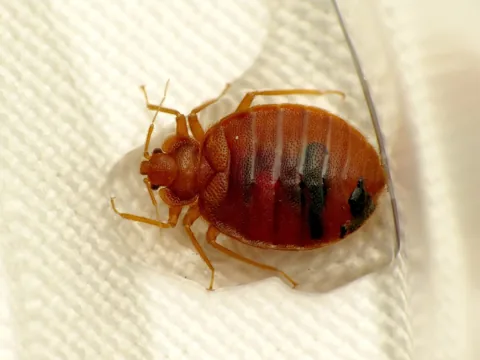 Bed Bug
Cimex lectularius
Bed bugs are wingless, blood-feeding insects that feed on sleeping or resting people, mostly at night; they have resurged worldwide and now turn up even in the finest hotels. CDC says they turn up in five-star hotels and resorts, and how clean a place is does not determine whether bed bugs are present.
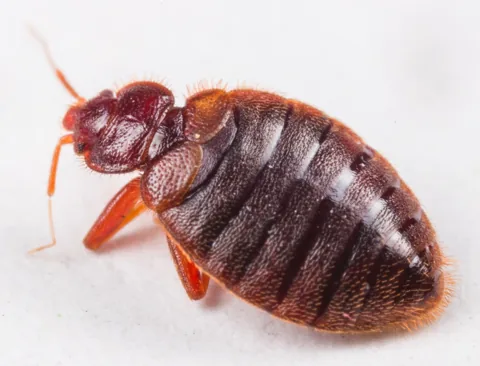 Tropical Bed Bug
Cimex hemipterus
The tropical bed bug is one of two bed bug species that feed on people. UC IPM says it is the dominant species in the tropics, and a 2021 study describes it spreading to new areas, including the United States, northern Australia, the Middle East, Russia and Central Europe.
How bed bugs travel
Bed bugs move from infested places to new homes on furniture, bedding, luggage, boxes and clothing. Hotels, homeless shelters, furnished apartments and dormitories are among the places most at risk of infestation.[4][3][6]
They don't fly, and they don't jump onto people and pets the way fleas do. During the day they usually stay hidden, becoming more active at night when they look for a host.[1][3]
CDC lists apartments, shelters, houses, hotels, cruise ships, buses, trains and dorm rooms as places infestations happen, and its Yellow Book for travelers adds theaters, workplaces and schools. You are at higher risk if you travel often and sleep where other people have slept before you. How clean a place is doesn't decide whether bed bugs are there; CDC notes they turn up in five-star hotels and resorts.[6][5]
How long they can wait for a meal depends on temperature, and the sources put it differently. Kentucky's entomologists say about 1 to 4 months is typical in temperature-controlled buildings, and up to a year or longer at 55°F or less. NPIC says up to three months at room temperature and much longer in the cold. UC IPM gives 20 to 400 days depending on temperature and humidity, and EPA says several months to a year.[1][7][3][4]
Hotel infestations are usually limited, often to just a few rooms, and in hotel rooms the area behind the headboard is often the first place bed bugs become established.[1]
They stay close to the bed. CDC says bed bugs can travel over 100 feet in a night but tend to live within 8 feet of where people sleep, hiding in mattress seams, box springs, bed frames and headboards, dressers, cracks and crevices, and behind wallpaper.[6]
Checking the room
Inspect the bed before you unpack: the sheets and the seams of the mattress, and perhaps the box spring, especially along the head of the bed where the pillows go. Look for the bugs themselves, the shed skins of nymphs, and blackish fecal spots, which are often along mattress seams.[1]
CDC's Yellow Book also has travelers look over the box springs, bedding and furniture, especially built-in furniture where the bed, desk and closets form one unit. The eggs and young nymphs are very small and easy to overlook, so look for signs as well as bugs: shed skins in the folds of mattresses and sheets, and blood spots on the linens.[5][6]
UC IPM suggests frequent travelers also look behind headboards and under sheets and check mattress seams and tufts, especially after being bitten. Headboards are heavy and cumbersome, though, and Kentucky's entomologists say untrained people shouldn't try to remove them.[3][1]
Check the luggage rack before you set a bag on it.[4][7]
If you find bed bugs, ask for another room, preferably in a different area of the hotel, because infestations sometimes extend to nearby units. UC IPM says to change rooms or hotels if you suspect bed bugs, and CDC's Yellow Book says travelers who see the bugs or their signs, such as blood spotting on linens, should look for other lodging.[1][3][5]
Keeping bed bugs out of your luggage
Keep luggage up on a stand, table or other hard surface instead of on the floor or another bed. Unpack only what you need and keep the rest zipped in the suitcase; cautious travelers can go further and keep belongings in sealed plastic pouches or totes.[1][5]
NPIC's advice is similar: don't set luggage on the bed or the floor until you have inspected the room, then use the luggage rack (after checking it) or keep the bag in the bathroom. CDC adds keeping suitcases closed when you aren't using them and looking over clothes and other items before they go back in.[7][5]
Encasements made for luggage, as inside liners or covers for the whole bag, are available.[2]
Before packing to leave, Cornell's NYS IPM program suggests using the room's hair dryer to heat the seams and folds of hard-shell or hard-frame luggage.[2]
When you get home
Inspect your luggage before you leave, and as soon as you get home, wash and dry all your clothes at the hottest settings the fabric will permit. Our heat treatment guide covers dryers and heat chambers in detail.[3][7]
Dryer times differ by source. UC IPM says at least 10 to 15 minutes at the hottest setting for suspect clothing or bedding, Kentucky's entomologists say 10 to 20 minutes at medium to high heat (faster if the items go in dry, and it can replace washing), and NPIC says to dry all clothing on a hot setting for thirty minutes before putting it away.[3][1][7]
NPIC calls coming home from a trip your best chance to keep bed bugs out: inspect the luggage before it comes into the house and don't store it near resting areas. UC IPM suggests frequent travelers keep luggage out of the bedroom, for example in the garage or a hall closet.[7][3]
Suitcases are harder. Kentucky's entomologists say inspecting or vacuuming them is less useful because bed bugs are hard to spot in luggage, and suggest heat-treating a suspect suitcase (a hot car can often do it in summer) or throwing it out.[1]
Sun heat can work for a bag and small items if they get hot enough. EPA says black plastic bags in the sun might kill bed bugs in luggage, and that bed bugs die when their body temperature reaches 113°F, so the bag has to get hotter than that throughout. Kentucky suggests wrapping items in plastic and leaving them at least a day in a hot, sunny spot such as pavement or a closed car parked in the sun.[8][1]
- Lint roller: Cornell suggests running one over your suitcase when you return from a trip, to pick up bugs hiding in the seams.[2]
- Hard-shell and hard-frame luggage: focus on piping, seams and pocket folds, and under the linings if the bag was left open. Vacuum all parts with a crevice tool, heat it with a hair dryer or space heater, or seal it in an airtight plastic bag or bin for six months.[2]
- Soft luggage such as backpacks, handbags and duffels: any form of heat, including a clothes dryer, hair dryer or space heater, will kill bed bugs and their eggs. You can also scrub the bag with hot soapy water and hang it outside to dry.[2]
- Portable heating chambers can treat luggage and other belongings, but they aren't regulated by EPA or other federal agencies, so read and follow the directions carefully.[4][2]
If you work in other people's homes
Caregivers, firefighters and other service providers who enter infested homes can carry bed bugs home or to work. The chance of picking them up by just walking through an infested home during the day is low, because the bugs are usually hidden then, but the risk rises while providing care.[1]
- Bring in only what you need, and put essential items on a table or other hard surface, preferably away from bedrooms and sleeping areas.[1]
- Don't sit on or set coats and bags on beds, sofas or floors. A hard, non-upholstered chair is better than a sofa or recliner, and try not to lean or brush against beds and furniture.[1]
- If you carry items out of an infested home, wrap them in plastic or at least don't hold them against your body.[1]
- Afterward, run a lint roller over your clothing, backpack and bags; Cornell suggests this for social workers, visiting nurses and others who work in people's homes.[2]
- For badly infested homes, Kentucky's entomologists say spraying the tops and bottoms of shoes with a DEET repellent may help, and suggest hot washing or drying work clothes and shoes on returning home or to the office.[1]
What doesn't help
Repellent on your skin at night isn't a good defense. Kentucky's entomologists say repellents used for ticks and mosquitoes don't seem to work as well against bed bugs and don't recommend applying them at bedtime.[1]
Don't spray luggage or rooms ahead of time. NPIC advises against using pesticides as a preventive treatment, because modern pesticides usually have to hit the bugs to work rather than leaving a residue that keeps killing.[7]
Foggers, bleach, alcohol and cigarette lighters should not be used on bed bugs; Kentucky's entomologists say they don't work and can cause fires and other harm. Our guide to getting rid of bed bugs covers what does work if they come home with you.[1]
If you think you were bitten
Bites are hard to pin on bed bugs. Travelers are often bitten without being able to produce a specimen, which makes diagnosis harder, but bed bugs become more likely if you've been traveling, or acquired used beds or furniture, before the symptoms appeared.[3][1]
Bites can show up late or not at all. CDC says most people don't notice bite marks until one to several days after the bite, they can take as long as 14 days to appear in some people, and some people have no physical signs. When they do appear they look like mosquito or flea bites, sometimes in a line.[6]
If you were bitten on a trip, put your clothing straight into the washer and dryer when you get home; our bed bug profile and sticky trap guide describe the signs to watch for at home.[1][3]
Common questions
- Can bed bugs live in a suitcase?
- Yes. They hide in piping, seams and pocket folds, and under the linings if the bag was left open. In temperature-controlled buildings they typically go about 1 to 4 months without feeding by Kentucky's figure (NPIC says up to three months at room temperature), and much longer in the cold.[2][1][7]
- Should I wash everything after every trip?
- UC IPM advises washing and drying all your clothes at the hottest settings the fabric allows as soon as you get home, and Kentucky's entomologists stress it if you had itchy welts suggestive of bites during your stay.[3][1][7]
- What if I find bed bugs in my hotel room?
- Ask for another room, preferably in a different area of the hotel. Infestations are usually limited to a few rooms but sometimes extend to nearby units.[1][5]
- How long should clothes go in the dryer after a trip?
- Sources differ: UC IPM says at least 10 to 15 minutes at the hottest setting, Kentucky 10 to 20 minutes at medium to high heat, and NPIC thirty minutes on hot. Consider first whether heat will damage the fabric.[3][1][7]
- Should I spray my suitcase with insecticide or repellent before a trip?
- No. NPIC advises against preventive pesticide treatments, and Kentucky's entomologists say bug repellents don't work well against bed bugs. The sources rely instead on inspection, keeping bags off beds and floors, and heat when you get home.[7][1]
Photo credits
- Bed Bug: (c) Katja Schulz, some rights reserved (CC BY) — via iNaturalist, CC BY 4.0
- Tropical Bed Bug: (c) portioid, some rights reserved (CC BY) — via iNaturalist, CC BY 4.0
Sources
- University of Kentucky Entomology, “ENTFACT-636: Bed Bugs (revised March 2026).” entomology.mgcafe.uky.edu/ef636 (accessed 2026-11-10)
- New York State Integrated Pest Management Program, Cornell University, “How to Get Bed Bugs Out of Your Belongings, NYS IPM Publication No. 620 (February 2018).” ecommons.cornell.edu/server/api/core/bitstreams/c774cabf-16af-4c52-8aab-b20acf2807c2/content (accessed 2026-11-10)
- University of California Statewide IPM Program, “Pest Notes: Bed Bugs, UC ANR Publication 7454 (Home and Landscape).” ipm.ucanr.edu/home-and-landscape/bed-bugs/ (accessed 2026-11-10)
- U.S. Environmental Protection Agency, “Protecting Your Home from Bed Bugs.” www.epa.gov/bedbugs/protecting-your-home-bed-bugs (accessed 2026-11-10)
- Centers for Disease Control and Prevention, “CDC Yellow Book: Mosquitoes, Ticks, and Other Arthropods (Box 3.6.2, bed bugs).” www.cdc.gov/yellow-book/hcp/environmental-hazards-risks/mosquitoes-ticks-and-other-arthropods.html (accessed 2026-11-10)
- Centers for Disease Control and Prevention, “About Bed Bugs.” www.cdc.gov/bed-bugs/about/index.html (accessed 2026-11-10)
- National Pesticide Information Center (Oregon State University and U.S. EPA), “Bed Bugs.” npic.orst.edu/pest/bedbug.html (accessed 2026-11-10)
- U.S. Environmental Protection Agency, “Top Ten Tips to Prevent or Control Bed Bugs.” www.epa.gov/bedbugs/top-ten-tips-prevent-or-control-bed-bugs (accessed 2026-11-10)