The short answer
- Most camping bites can be prevented with three things: an EPA-registered repellent on skin, clothing and gear treated with 0.5% permethrin, and a full tick check (plus a shower) when you come in from the woods. Add long sleeves and pants tucked into socks, and keep to the middle of trails.[1][2][3]
- At the campsite, keep food, drinks and trash covered so yellowjackets and rodents have nothing to find, shake out boots and clothes before you put them on, and don't sleep in a cabin or shelter with signs of mice. Rodent droppings can carry hantavirus, and in western mountain cabins, soft ticks living in rodent nests can spread relapsing fever.[19][20][4][5][8]
If someone may be poisoned
- Stings: a person with a venom allergy can have anaphylaxis, a severe and potentially life-threatening reaction that needs emergency care right away. NIOSH lists severe chest pain, nausea, severe sweating, loss of breath, serious swelling and slurred speech as reasons to get to an emergency facility immediately after fire ant stings. Anyone with a history of severe reactions should carry their prescribed epinephrine auto-injector.[4]
- Scorpions: contact a health care provider or poison control. Symptoms usually go away within 48 hours, but a bark scorpion sting can be life-threatening.[4]
- Hantavirus: symptoms usually start 1 to 8 weeks after contact with an infected rodent. If you think you might have it, see a doctor right away and mention the rodent exposure.[5]
- After a tick bite: see a doctor if you develop a rash or fever within several weeks of removing a tick, and tell them when and where the bite happened.[3]
Pests you may meet camping
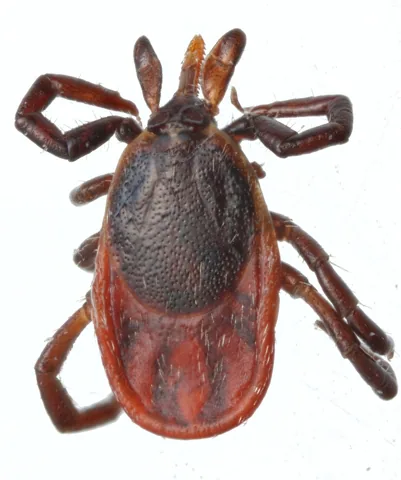 Blacklegged Tick
Ixodes scapularis
The blacklegged tick, often called the deer tick, is widely distributed across the eastern United States and transmits the bacteria that cause Lyme disease along with several other diseases.
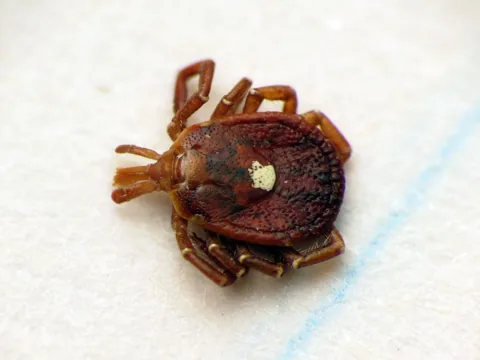 Lone Star Tick
Amblyomma americanum
The lone star tick is a very aggressive tick that readily bites people and pets across the Northeast, South and Midwest; its bite is linked to alpha-gal syndrome, a red meat allergy.
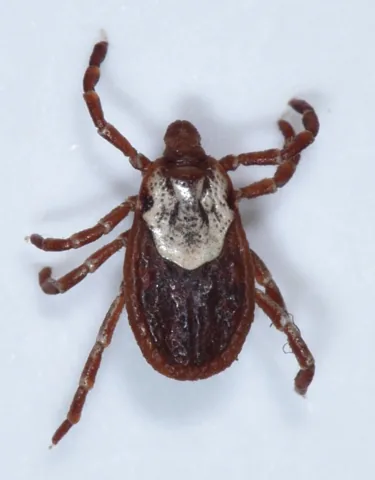 American Dog Tick
Dermacentor variabilis
The American dog tick, also called the wood tick, is widely distributed east of the Rocky Mountains. Adult females are the stage most likely to bite people, especially in spring and summer, and adults commonly climb to the crown of the head.
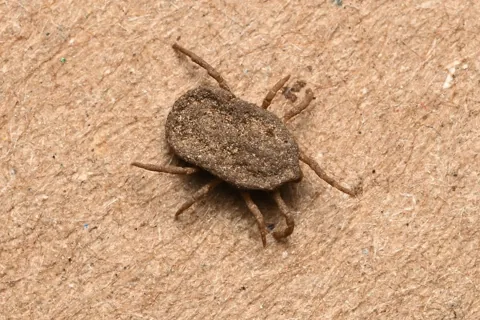 Soft Ticks (relapsing fever ticks)
Ornithodoros species (mainly O. hermsi and O. turicata in the U.S.)
Soft ticks live in rodent nests, often inside the walls and floors of rustic cabins, and come out at night to feed briefly on sleeping people. In the U.S., infected Ornithodoros soft ticks spread soft tick relapsing fever.
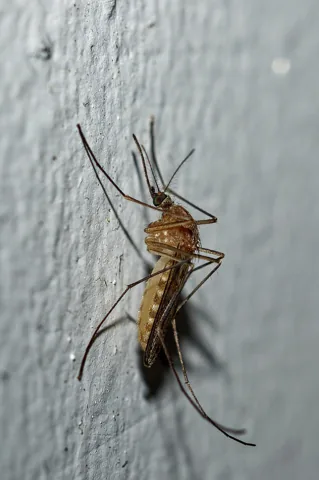 Mosquito
Culicidae (shown: Culex pipiens complex)
Mosquitoes are small, delicate flies whose females feed on blood and can pass on viruses such as West Nile; the control that works best goes after the larvae in standing water.
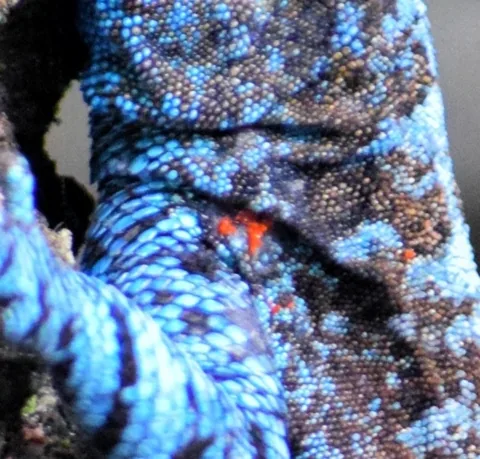 Chiggers
Trombiculidae (e.g., Trombicula / Eutrombicula alfreddugesi)
Chiggers are the tiny larvae of mites; only the larva bites, and its feeding causes intense itching and small red welts. Contrary to popular belief, chiggers don't burrow into the skin or suck blood.
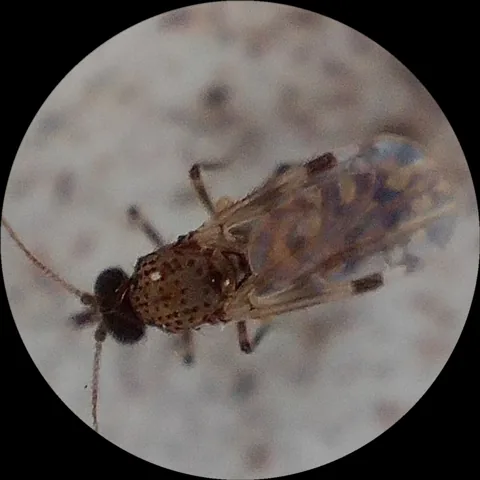 Biting Midges
Culicoides spp.
No-see-ums, also called biting midges, punkies, sand gnats or sand flies, are tiny flies, mostly in the genus Culicoides, whose bites itch intensely; most people feel them without ever seeing them.
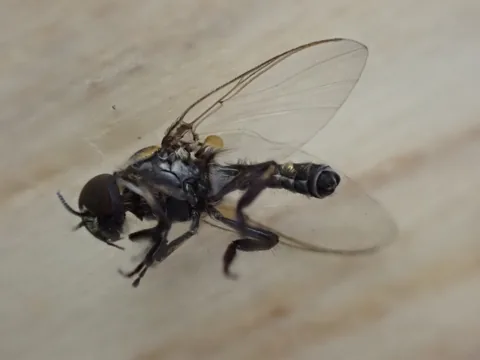 Black Flies
Simulium and related genera (family Simuliidae)
Black flies are tiny, stout, humpbacked biting flies, often called gnats or buffalo gnats. Their larvae live only in running water, and the females swarm around people and animals for blood, mostly in spring and early summer.
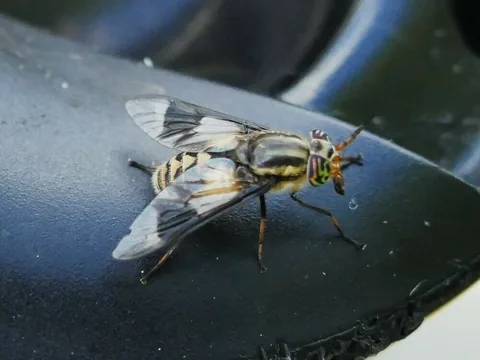 Deer Fly
Chrysops spp. (shown: Chrysops callidus)
Deer flies (genus Chrysops) are biting flies in the horse fly family. Only females bite, slicing the skin and lapping up the blood, mostly on warm days near the swamps, streams and woodland edges where their larvae develop.
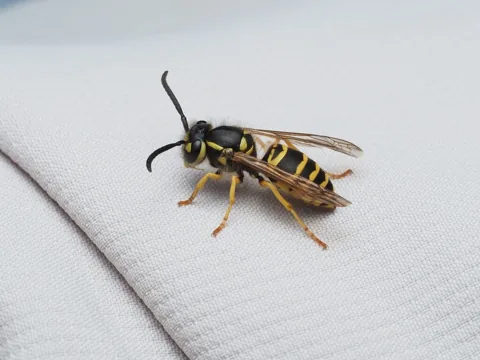 Eastern Yellowjacket
Vespula maculifrons
The eastern yellowjacket is a native, ground-nesting yellowjacket common across the eastern US in lawns, woodlands, pastures and parks; it defends its nest aggressively and can sting repeatedly.
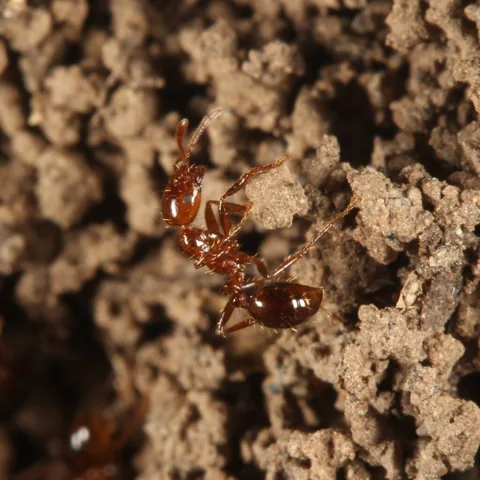 Red Imported Fire Ant
Solenopsis invicta
The red imported fire ant is an aggressive stinging ant that infests most of the southern United States and parts of California, building mounds in open, sunny areas such as lawns, parks and roadsides. USDA APHIS says imported fire ants came from South America, probably in soil on cargo ships, and now infest more than 367 million acres in Alabama, Arkansas, California, Florida, Georgia, Louisiana, Mississippi, North Carolina, Oklahoma, South Carolina, Tennessee, Texas, Virginia and Puerto Rico.
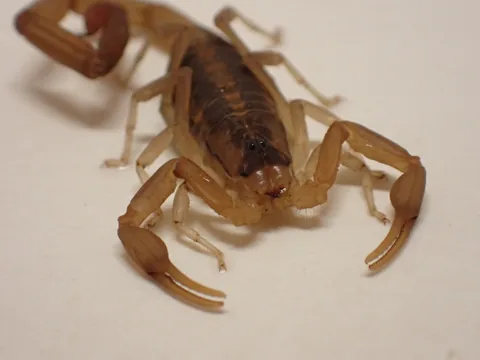 Scorpions
Order Scorpiones (shown: striped bark scorpion, Centruroides vittatus)
Scorpions are arachnids, relatives of spiders, ticks and mites, that hide by day and hunt insects at night. They live across the southern United States, and most U.S. stings are reported from Arizona, Texas and Nevada.
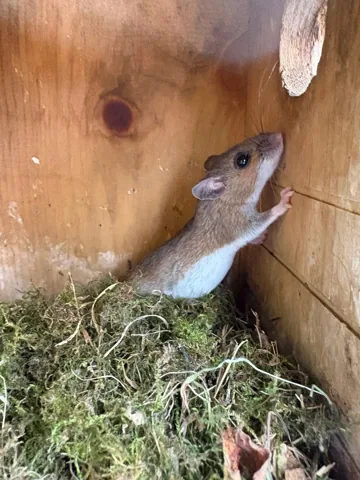 Deer Mouse
Peromyscus species (shown: P. maniculatus)
The deer mouse is a wild mouse with a white belly and a furred, two-toned tail that sometimes moves into cabins, sheds and homes. In the United States it spreads the most common hantavirus that causes hantavirus pulmonary syndrome (HPS), a severe and potentially deadly lung disease, so the droppings and nests it leaves need careful cleanup.
What to pack
CDC's advice for preventing tick bites, mosquito bites and flea bites outdoors comes down to the same short list, and it covers chiggers and no-see-ums too.[1][2][3][9]
- EPA-registered repellent. CDC recommends products with DEET, picaridin, IR3535, oil of lemon eucalyptus (OLE), para-menthane-diol (PMD) or 2-undecanone, and says to look for an EPA registration number on the label. Used as directed, they are proven safe and effective, even for pregnant and breastfeeding women. If you also use sunscreen, put it on first and repellent second. The repellent guide covers choosing and applying one; the kids' guide covers ages.[1][2][3]
- Permethrin-treated clothing and gear. CDC says to treat boots, clothing and camping gear with products containing 0.5% permethrin, or buy them pre-treated; treated items stay protective through several washings. The CDC Yellow Book says permethrin-treated clothing repels and kills ticks, chiggers, mosquitoes and other biting arthropods, and that items must be treated 24 to 48 hours before packing so they can dry. Never put permethrin on skin. The permethrin guide has the steps.[1][3][2]
- Covering clothes. Long-sleeved shirts, long pants, boots and hats; tuck in shirts, tuck pants into socks, and wear closed shoes instead of sandals. Missouri Extension adds that tucking pant legs into boots and buttoning cuffs and collars keeps chiggers on the outside of clothing, where they stay in contact with any repellent you've put on.[3][13]
- Head net, for black fly and no-see-um country. Arizona Extension calls mosquito head nets an excellent idea where biting midges are especially bad and notes that no-see-um-proof netting is sold as head nets, jackets and pants.[17]
- Tweezers. Fine-tipped tweezers work very well for removing ticks.[3]
- For pets that come along: flea control. CDC says to keep fleas off pets with flea control products. Don't use dog permethrin products on cats: NPIC says cats are more sensitive to permethrin than dogs or people because their bodies take a long time to break it down.[9][12]
Ticks: trails, checks and removal
Ticks live in grassy, brushy or wooded areas, and CDC names camping, hiking and hunting among the activities that bring people into close contact with them. Ticks can be active year-round but are most active in the warmer months, April through September.[1][3]
- On the trail: avoid wooded and brushy areas with high grass and leaf litter, and walk in the center of trails.[1][3]
- Daily checks: do a full-body check after being outdoors, using a hand-held or full-length mirror. CDC lists under the arms, in and around the ears, inside the belly button, the backs of the knees, in and around the hair, between the legs and around the waist. Check children and pets the same way.[1]
- Shower: showering within two hours of coming indoors has been shown to reduce the risk of Lyme disease, may help with other tickborne diseases, and washes off ticks that haven't attached yet.[1]
- Gear and clothes: ticks can ride in on clothing, packs and pets and attach later, so look over coats and daypacks. Tumbling dry clothes on high heat for 10 minutes kills ticks; damp clothes need longer, and if you wash first, use hot water, because cold and medium water won't kill them.[1]
- If one is attached: remove it as soon as possible. Grasp it close to the skin with fine-tipped tweezers and pull upward with steady, even pressure without twisting or jerking. Clean the bite and your hands with rubbing alcohol or soap and water, and never crush a tick with your fingers. The tick-bite guide covers what to watch for afterward.[3]
Mosquitoes around camp
Mosquitoes bite day and night, but timing varies by species. The CDC Yellow Book says Aedes mosquitoes bite most after sunrise and around sunset, while Culex quinquefasciatus, one of the mosquitoes that spread West Nile virus, bites mostly after sunset. UC IPM suggests staying in when mosquito activity is high in your area.[2][3][18]
- Repellent and permethrin-treated clothing are the main protection; loose-fitting long sleeves and pants help.[2][3]
- Mosquito coils and other spatial repellents can keep mosquitoes away from a limited area, and UC IPM says citronella candles and coils burned outdoors work best when there is little air movement. The CDC Yellow Book says they haven't been adequately tested for preventing disease, so use them along with a repellent on skin or clothing, and avoid breathing the smoke or spray.[3][18]
- Mosquito larvae grow in standing water. Empty, turn over or cover buckets and other items around camp that hold water.[18][2]
No-see-ums and chiggers
No-see-ums (biting midges) are less than 1/16 inch long, active in the early morning and evening of mid to late summer, and common near water. Chiggers are larval mites that wait on grass and low plants for a host to brush past.[17][16][14]
- No-see-ums and screens: ordinary insect screens don't stop them, and sources give different sizes for a screen that will. The CDC Yellow Book says 20x20 mesh; Arizona Extension says they get through standard 16 x 16 or 18 x 16 mesh and recommends 30 x 30 where possible. Check the mesh rating on a tent's screens if you camp where they are bad.[3][16][17]
- No-see-ums and repellents: the CDC Yellow Book says EPA-registered repellents labeled for flies, biting flies and no-see-ums are effective. Arizona Extension adds that fans keep them out of your immediate area.[3][17]
- Chigger country: Missouri Extension says chiggers are more common in damp areas with low shrubs, tall grass and weeds, and that they're patchy, so one person sitting in a hot spot gets bitten while someone a few yards away doesn't. Ohio State notes that sitting or playing on grass exposes you. Avoid sitting directly on the grass, and skip shorts, sleeveless shirts and sandals in chigger habitat.[13][14]
- After a day in chigger habitat: Missouri Extension says a warm shower with a vigorous scrub within an hour or two greatly reduces bites, and Ohio State says showering or wiping skin with a washcloth knocks off chiggers, which don't burrow. Change clothes and launder them before wearing them again; Ohio State says to use the hot setting. The chigger guide covers itching and what to expect.[13][14][15]
Yellowjackets, bees, fire ants and scorpions
Yellowjackets scavenge on human food and garbage, and in late summer and fall they show up at picnics and barbecues, around garbage cans and at pet food. Penn State says they can be particularly bad around picnics in late summer or fall.[19][20]
- Keep food and food waste tightly covered, cover soda cans so wasps can't crawl in, and keep garbage in sealed cans that are emptied regularly. If you use traps, hang them away from the picnic table, not on it.[20][19]
- NIOSH advice for stinging insects outdoors: avoid perfumed soaps, shampoos and deodorants, wear light-colored, smooth-finished clothing, and keep areas clean, since social wasps thrive where people discard food. Stay calm and still if one is flying around; swatting may cause it to sting.[4]
- If several attack at once, run away from them, to a shaded area or indoors if you can. Don't jump into water, because some insects will hover above it.[4]
- First aid for a bee, wasp or hornet sting: have someone stay with the person to watch for an allergic reaction, wash the site with soap and water, remove a stinger by wiping gauze or scraping a fingernail over it (don't squeeze it or use tweezers), apply ice, and don't scratch.[4]
- Fire ants (mostly in the Southeast, with limited areas of New Mexico, Arizona and California): don't stand on or near mounds, look over the area before setting up, and if they get on you, rub them off briskly, because they hold on with their jaws.[4]
- Scorpions (Southern and Southwestern U.S.): they hide by day under rocks, wood and anything lying on the ground and come out at night. Shake out clothing and shoes before putting them on, and wear gloves when moving rocks or wood.[4]
Mice, cabins and fleas
Rodents at a campsite or in a cabin bring their own risks. Hantavirus spreads when fresh urine, droppings or nesting material from an infected rodent is stirred up and breathed in, and CDC says to eliminate or minimize contact with rodents in your home, workplace or campsite. The deer mouse spreads the most common U.S. hantavirus that causes HPS, and deer mice often move into vacated homes and cabins to nest.[5][6][21]
- Don't sleep in a cabin or shelter with mouse droppings or nests, and don't sweep or vacuum them up. CDC's cleanup steps (open doors and windows for 30 minutes first, soak droppings with disinfectant for 5 minutes or as the label says, then wipe up) are on the hantavirus guide, which also covers cabins that have been closed up.[8][6][7]
- Soft tick relapsing fever: in the U.S., people most often get it by staying overnight in rodent-infested cabins, mostly in mountainous areas of western states and in parts of Texas. The soft ticks rest in the walls and woodwork of rodent-infested cabins, come out at night, and feed briefly and painlessly, usually for less than half an hour, so most people never know they were bitten. Exposure is most common in summer but can also happen in winter when a fire warms the cabin and wakes the ticks.[8]
- To lower that risk, CDC says to avoid sleeping in rodent-infested buildings, move beds away from walls, keep sheets off the floor, and avoid sleeping on the floor. Tell the owner if a cabin you're visiting has rodents, and don't remove rodent nests yourself. Symptoms can appear 4 to 21 days after exposure, with fevers that come and go.[8]
- Fleas and plague: CDC says people usually get plague from the bite of an infected rodent flea or by handling an infected animal. Use repellent if you could be exposed to fleas while camping or hiking (DEET on skin or clothing, permethrin on clothing), wear gloves to handle or skin animals, and don't let pets that roam free in plague areas sleep on your bed.[9]
- Wild animals: the CDC Yellow Book says not to feed or pet stray or wild animals, and CDC notes that campers are among those at higher risk of rabies exposure because of contact with wildlife. CDC's tularemia advice is to avoid sick or dead animals and use gloves when handling rabbits and rodents.[3][11][10]
- Check your vehicle: rodents may nest in cars, trucks and campers that sit unused. Clean nests out with the same precautions.[7]
Common questions
- What is the best bug repellent for camping?
- Any EPA-registered repellent with DEET, picaridin, IR3535, oil of lemon eucalyptus, PMD or 2-undecanone, used as the label says, plus clothing and gear treated with 0.5% permethrin. Look for the EPA registration number on the label.[1][2][3]
- Should I treat my tent with permethrin?
- CDC says boots, clothing and camping gear can be treated with 0.5% permethrin, and the CDC Yellow Book lists mosquito nets and camping gear among items you can treat. Follow the product label for what it may be used on, and let items dry before packing.[1][3]
- How do I keep no-see-ums out of my tent?
- Ordinary screening is too coarse. CDC's Yellow Book says 20x20 mesh keeps biting midges out; Arizona Extension recommends 30 x 30. Keep the tent zipped, and use a repellent labeled for no-see-ums.[3][16]
- How often should I check for ticks while camping?
- Do a full-body check after each time outdoors in tick habitat, ideally with a shower within two hours of coming in. Check children, pets, packs and coats too.[1]
- Is it safe to sleep in a cabin with mouse droppings?
- CDC advises against sleeping in rodent-infested buildings when you can avoid it. Droppings and nests can spread hantavirus, and in western mountain cabins, soft ticks that live in rodent nests can spread relapsing fever. Clean it the CDC way before using it, and tell the owner.[8][6][7]
Photo credits
- Blacklegged Tick: (c) Christian Back, some rights reserved (CC BY) — via iNaturalist, CC BY 4.0
- Lone Star Tick: (c) Katja Schulz, some rights reserved (CC BY) — via iNaturalist, CC BY 4.0
- American Dog Tick: (c) Don Loarie, some rights reserved (CC BY) — via iNaturalist, CC BY 4.0
- Soft Ticks (relapsing fever ticks): (c) Trevor Van Loon, some rights reserved (CC BY) — via iNaturalist, CC BY 4.0
- Mosquito: (c) Donald Davesne, some rights reserved (CC BY) — via iNaturalist, CC BY 4.0
- Chiggers: (c) Alberto Alcalá, some rights reserved (CC BY) — via iNaturalist, CC BY 4.0
- Biting Midges: Sinaloa Silvestre, public domain (CC0), via iNaturalist
- Black Flies: Stephen James McWilliam, public domain (CC0), via iNaturalist
- Deer Fly: (c) John A. Gerwin, some rights reserved (CC BY) — via iNaturalist, CC BY 4.0
- Eastern Yellowjacket: Brighton Lee, public domain (CC0), via iNaturalist
- Red Imported Fire Ant: (c) Natasha Taylor, some rights reserved (CC BY) — via iNaturalist, CC BY 4.0
- Scorpions: (c) dhasdf, some rights reserved (CC BY) — via iNaturalist, CC BY 4.0
- Deer Mouse: (c) Derek Duplessis, some rights reserved (CC BY) — via iNaturalist, CC BY 4.0
Sources
- Centers for Disease Control and Prevention, “Preventing Tick Bites.” www.cdc.gov/ticks/prevention/index.html (accessed 2026-11-10)
- Centers for Disease Control and Prevention, “Preventing Mosquito Bites.” www.cdc.gov/mosquitoes/prevention/index.html (accessed 2026-11-10)
- Centers for Disease Control and Prevention, “CDC Yellow Book: Mosquitoes, Ticks, and Other Arthropods.” www.cdc.gov/yellow-book/hcp/environmental-hazards-risks/mosquitoes-ticks-and-other-arthropods.html (accessed 2026-11-10)
- Centers for Disease Control and Prevention, NIOSH, “Insects and Scorpions at Work (updated September 28, 2026).” www.cdc.gov/niosh/outdoor-workers/about/insects-and-scorpions.html (accessed 2026-11-10)
- Centers for Disease Control and Prevention, “About Hantavirus.” www.cdc.gov/hantavirus/about/index.html (accessed 2026-11-10)
- Centers for Disease Control and Prevention, “Hantavirus Prevention.” www.cdc.gov/hantavirus/prevention/index.html (accessed 2026-11-10)
- Centers for Disease Control and Prevention, “How to Clean Up After Rodents.” www.cdc.gov/healthy-pets/rodent-control/clean-up.html (accessed 2026-11-10)
- Centers for Disease Control and Prevention, “About Soft Tick Relapsing Fever (STRF).” www.cdc.gov/relapsing-fever/about/about-strf.html (accessed 2026-11-10)
- Centers for Disease Control and Prevention, “Preventing Plague.” www.cdc.gov/plague/prevention/index.html (accessed 2026-11-10)
- Centers for Disease Control and Prevention, “Preventing Tularemia.” www.cdc.gov/tularemia/prevention/index.html (accessed 2026-11-10)
- Centers for Disease Control and Prevention, “About Rabies.” www.cdc.gov/rabies/about/index.html (accessed 2026-11-10)
- National Pesticide Information Center, “Permethrin General Fact Sheet.” npic.orst.edu/factsheets/PermGen.html (accessed 2026-11-10)
- University of Missouri Extension, “Chiggers (G7398).” extension.missouri.edu/publications/g7398 (accessed 2026-11-10)
- Ohio State University Extension (Ohioline), “Chiggers (ANR-0182).” ohioline.osu.edu/factsheet/anr-0182-0 (accessed 2026-11-10)
- Missouri Department of Conservation, “Chiggers (Field Guide).” mdc.mo.gov/discover-nature/field-guide/chiggers (accessed 2026-11-10)
- University of Arizona Cooperative Extension, “Something's biting me, but I can't see it! (No-See-Ums IPM Short, June 2018).” cales.arizona.edu/apmc/docs/No-See-Ums-IPMShort.pdf (accessed 2026-11-10)
- University of Arizona Cooperative Extension, Yavapai County, “"No-See-Um" Biting Flies, Backyard Gardener #59 (adapted from J. Schalau, 2023).” extension.arizona.edu/sites/extension.arizona.edu/files/barnesm/No-See-Um.pdf (accessed 2026-11-10)
- University of California Statewide IPM Program, “Pest Notes: Mosquitoes, Publication 7451 (revised April 2020).” ipm.ucanr.edu/legacy_assets/PDF/PESTNOTES/pnmosquitoes.pdf (accessed 2026-11-10)
- University of California Statewide IPM Program, “Yellowjackets and Other Social Wasps (Home and Landscape).” ipm.ucanr.edu/home-and-landscape/yellowjackets-and-other-social-wasps/ (accessed 2026-11-10)
- Penn State Extension, “Getting Rid of Paper Wasps, Yellowjackets, and Other Stinging Insects (Jamie Kopco, updated January 29, 2026).” extension.psu.edu/getting-rid-of-paper-wasps-yellowjackets-and-other-stinging-insects (accessed 2026-11-10)
- University of California Statewide IPM Program, “Pest Notes: Deer Mouse, Publication 74161 (June 2012).” ipm.ucanr.edu/legacy_assets/PDF/PESTNOTES/pndeermouse.pdf (accessed 2026-11-10)