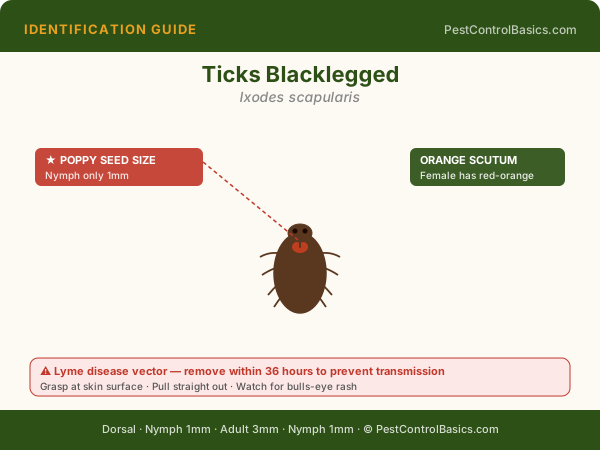
Original illustration by PestControlBasics.com. Use anatomical labels above to confirm your identification.
🔬
PestControlBasics Editorial Team
Reviewed by Derek Giordano · Updated 2026
🔍 Identification
Females: 3-4mm unfed; 10-12mm engorged; orange-brown body with darker brown scutum (back plate); black legs. Males: smaller; uniformly dark. Nymphs (most important transmission stage): 1-2mm; translucent; poppy seed-sized — this tiny size makes them easy to miss. Found throughout the eastern US; western blacklegged tick (I. pacificus) on the Pacific Coast.
🧬 Biology & Behavior
Three-host lifecycle over 2 years: larvae feed on small mammals (white-footed mice — primary Lyme reservoir); nymphs transmit Lyme in spring/early summer; adults feed on deer in fall. Lyme transmission requires 24-48 hours of tick attachment — prompt removal prevents most disease transmission. Nymphs are most important epidemiologically because they're tiny and often unfelt.
⚠️ Damage & Health Risk
Lyme disease (most common vector-borne disease in US — 476,000+ cases/year); anaplasmosis; babesiosis; Powassan virus (rare but severe); tick paralysis (rare).
🔧 DIY Treatment
Tick checks after every outdoor activity (focus on hairline, armpits, groin, behind knees — favorite attachment sites). Permethrin-treated clothing. DEET or picaridin repellent. Shower within 2 hours of outdoor exposure. Yard management: mulch barrier, mow, deer exclusion, tick tubes. Remove ticks promptly with fine-tip tweezers.
👷 When to Call a Pro
For properties with high tick burden and confirmed Lyme disease risk: annual professional tick spray application (bifenthrin in April-May) significantly reduces nymphal tick populations during peak transmission season.
❓ FAQ
How long does a tick need to be attached to transmit Lyme disease?
Studies show Lyme disease transmission requires 24-48 hours of tick attachment — the Lyme bacterium is stored in the tick's midgut and must migrate to the salivary glands. Prompt tick removal (within 24 hours) prevents the vast majority of Lyme transmission. This is why daily tick checks are so effective.
What does the Lyme disease rash look like?
The classic bull's-eye rash (erythema migrans) appears at the bite site in 70-80% of Lyme cases — a red expanding ring with central clearing, typically appearing 3-30 days after the bite. If you develop this rash, see a doctor immediately — Lyme disease is treatable with antibiotics and most effective when caught early.
DG
Derek Giordano
Certified Pest Control Operator · Former Business Owner
Derek ran his own pest control company in Florida for several years, servicing thousands of regular customers. All content is based on hands-on field experience and current EPA & university extension guidelines.
Confirming a Blacklegged (Deer) Tick infestation in the field
Misidentification is the most common reason home treatment fails for Blacklegged (Deer) Tick. Look-alike species often respond to completely different active ingredients, so a 30-second confirmation step before any spraying or baiting saves the most time over a season. The practical workflow begins with where you found the specimen — kitchen, bathroom, garden, attic — because habitat narrows the candidate list faster than morphology alone.
Specific cues for Blacklegged (Deer) Tick include body proportions, leg count, antenna shape, and any wing structure if present. Adults are usually the easiest stage to identify, but most real-world infestations show juveniles or evidence (frass, shed skins, webbing, damage patterns) more often than adults themselves. Photograph the specimen against a ruler or coin for scale, then compare against a regional reference rather than a global one — range maps from state Extension services beat generic online identification sites.
When two species look genuinely similar, the deciding factor is often where they congregate at dusk versus dawn, or whether they leave a visible trail. A test of three common DIY treatments — one bait, one residual spray, one mechanical barrier — applied in different areas can also confirm identity by which works.
Why timing changes everything with Blacklegged (Deer) Tick
The same product applied two weeks apart can produce a complete kill or near-zero effect depending on where the Blacklegged (Deer) Tick population sits in its life cycle. Egg-stage pests are nearly immune to contact sprays, so a perfectly applied treatment during a major hatch event will leave the next generation completely unaffected. The professional standard is two applications spaced 10 to 14 days apart for most household pests — the first kills the active adults, the second catches anything that emerges from eggs in the interim.
Temperature also drives treatment success. Most residual sprays lose efficacy above 90°F or below 50°F, and pyrethroid products in particular can repel rather than kill when applied during high heat. The best window is early morning when surface temperatures are still moderate and target pests are moving but not yet at peak activity. Indoor treatment is less weather-dependent but still benefits from being applied when household air movement is low — running ceiling fans during application redistributes droplets away from the intended surface.
Seasonal pressure for Blacklegged (Deer) Tick usually has two or three predictable peaks per year. A treatment calendar built around those peaks costs less and works better than reactive spraying after a problem is already established.
Prevention strategies that actually reduce Blacklegged (Deer) Tick pressure
Most pest pressure traces back to one or two environmental conditions that are easier to fix than the infestation itself is to spray. For Blacklegged (Deer) Tick, the highest-leverage changes typically involve moisture management, food access, and exclusion at structural entry points. Reducing standing water within 20 feet of the foundation eliminates more pest problems than any single chemical application, and the effect persists year over year rather than requiring a rebuy every quarter.
Exclusion work is unglamorous but durable. A common entry-point audit covers door sweeps, weep holes, utility penetrations, dryer vents, soffit gaps, and the base of siding. Most homes have between five and fifteen openings larger than the minimum required for the target pest to enter, and sealing even half of them measurably reduces indoor sightings within one season. Stainless steel mesh, copper wool, and exterior-grade sealant cover most situations; expanding foam alone is not sufficient because rodents and some insects chew through it.
Storage practices matter too. Pantry pests, fabric pests, and overwintering insects all exploit cardboard, paper, and natural-fiber storage in basements and garages. Switching to sealed plastic bins for seasonal storage removes a significant amount of harborage that is otherwise impossible to spray effectively.
When to escalate Blacklegged (Deer) Tick control beyond DIY
Most Blacklegged (Deer) Tick situations are within the range of a careful homeowner, but a handful of scenarios genuinely warrant a licensed applicator. Multi-unit buildings are at the top of that list — shared walls, plumbing, and ductwork mean a localized treatment in one unit often just relocates the population to a neighbor. Any infestation that involves wall voids, attic insulation, or sub-slab plumbing is also harder to reach with consumer products and benefits from professional equipment and labeled product concentrations.
Health-sensitive situations are the second escalation trigger. Pregnancy, infants, immunocompromised residents, and pets with known sensitivities all narrow the available product list considerably. A licensed professional can apply restricted-use products and reduced-risk reformulations that achieve control with lower household exposure than over-the-counter alternatives. The cost difference is usually less than two seasons of DIY spending once the time investment is factored in.
The third escalation point is recurrence. If the same pest returns within six weeks of an apparently successful treatment, the source is usually structural or environmental rather than chemical, and a professional inspection often finds the cause faster than a second round of self-treatment.
Published: Jan 1, 2025 · Updated: Apr 7, 2026
Property-level tick management: zones that actually need treatment
Tick populations are not evenly distributed across a property. The areas where ticks concentrate — and where treatment produces meaningful reduction — are predictable: the woodland-lawn edge where ticks quest for hosts, leaf litter under shrubs and ornamentals, tall grass margins along trails and paths, stone walls and woodpiles that host the small mammals ticks depend on, and shaded ground-cover plantings. The middle of an open, sunlit, mowed lawn rarely sustains tick populations because ticks desiccate quickly in those conditions. Treatment priority follows the ecology: a 6-12 foot buffer of dry mulch or wood chips between woodland and lawn dramatically reduces tick crossover, leaf litter removal under shrubs eliminates favorable microclimate, and barrier treatment of the woodland edge during peak nymph activity (mid-spring through early summer in most regions) produces the largest population reduction per treated area.
Reading reviews of pest control products critically
Online reviews of pest control products are noisier than reviews in most categories because outcomes depend heavily on application and identification — both of which are usually wrong when DIY treatment fails. A one-star review saying "didn't work on bedbugs" often reflects insufficient coverage, untreated harborage, or a misidentified pest, not product failure. Reviews are most useful when they describe specific application conditions (substrate, dilution, target pest stage, environmental conditions) and least useful when they're brief judgments without context. Independent testing from Consumer Reports, university entomology trial publications, and the EPA's BEAD (Biological and Economic Analysis Division) reports give more reliable efficacy data than aggregated retailer reviews. For consumer products, the EPA registration alone confirms basic safety and that the product does what the label claims; outperformance among registered products is usually a matter of formulation choice for the specific substrate and pest.
Tick check protocols: timing and technique that matter
Tick-borne disease prevention rests heavily on prompt tick removal after exposure, since transmission of pathogens including Lyme disease bacteria typically requires hours of attachment. The protocol that produces best results: full-body visual inspection within a few hours of any outdoor activity in tick habitat, paying particular attention to areas where ticks preferentially attach (hairline, behind ears, armpits, waistband, behind knees, between toes). Showering within two hours of exposure mechanically removes loose ticks and provides another inspection opportunity. Found ticks are removed with fine-tip tweezers, grasping as close to the skin as possible, and pulled straight out with steady pressure — not twisted, not burned with a match, not coated with petroleum jelly (all popular advice that backfires by causing the tick to regurgitate gut contents into the bite site). Removed ticks are saved in a sealed plastic bag with a date label; if symptoms develop, the tick itself can be tested or used to identify species. Photographing the bite site immediately and at 24-hour intervals helps document any developing rash for medical assessment.
How treatment thresholds change what 'success' should mean
Most homeowners frame pest control as elimination — zero individuals seen — but professional programs operate on threshold concepts that better match what's actually achievable and economically reasonable. A treatment threshold is the population level at which intervention is justified; below it, the cost and disruption of treatment outweigh the damage prevented. For aesthetic pests like the occasional ant or spider, the threshold is essentially zero only because tolerance is low, not because zero is biologically realistic. For pests with health implications (cockroaches, rodents) or property damage potential (termites, carpenter ants), thresholds are set well below visible damage to allow time for response. The implication for self-evaluation: a program that drops a cockroach population by 95% without reaching zero may be functioning correctly, and pushing for the last 5% may require disproportionate effort or treatment intensity that creates other problems. Reframing 'success' as durable reduction below threshold rather than absolute zero produces saner program design, more reasonable expectations of paid services, and less wasted DIY effort chasing the long tail of a population that's already controlled in any practical sense.
Yard tick reduction: a layered landscape approach
Reducing tick pressure in residential yards is achievable through landscape modification, with the highest yield from changes that disrupt tick habitat at the lawn-woodland interface. The standard recommendations: keep grass mowed short (ticks need humidity and shelter that taller grass provides), maintain a three-foot wide barrier of wood chips or gravel between lawn and woodland or stone walls (ticks rarely cross this boundary), remove leaf litter from the yard edge in spring (where ticks overwinter), prune low branches and dense shrubs in the lawn-edge transition (which provides shaded humid microclimate ticks prefer), and consider perimeter acaricide treatment in heavy-pressure areas. Wildlife management contributes: deer-resistant landscaping reduces deer visits and the ticks they carry, sealed compost and trash reduce rodent attractants and the ticks rodents carry, and elevated bird feeders (away from lawn areas) reduce direct ground deposition of ticks dropping off birds. Properties making three or four of these changes simultaneously typically see meaningful reduction in encountered ticks; single changes alone usually don't show measurable difference.
Tick questing behavior and where they actually find hosts
Ticks find hosts by questing — climbing onto vegetation at a specific height range that maximizes contact with passing animals of their preferred host size. Different tick species quest at different heights, and the heights track the host they're adapted to. Larval and nymphal blacklegged ticks quest low, often in leaf litter or on grasses just a few inches off the ground, where they intercept small mammals. Adult blacklegged ticks quest higher, on the order of one to three feet, where they intercept deer and humans. Lone star ticks tend to quest somewhat higher and are more aggressive about pursuing nearby hosts. Knowing the questing height of the species you're concerned about changes where on the property the risk actually concentrates. The lawn isn't typically the high-risk zone; the edge of the property where lawn meets woods, the leaf litter under shrubs, and the area around stone walls and woodpiles are where most tick encounters happen. Property-level tick reduction that focuses on these microhabitats — leaf litter removal, edge clearing, treatment of transition zones — is dramatically more effective than treating open lawn that ticks aren't using anyway.
The economics of preventive versus reactive treatment
Preventive treatment costs money in a year when nothing is happening, which is precisely why most households avoid it. The decision to spend on prevention requires a willingness to compare what you actually spend against a counterfactual you never directly observe — the infestations you would have had without it. This is a hard mental move, and it's why preventive pest control consistently underconsumed relative to its economic value. The way to think about it more clearly is to compute the expected annual cost of treatment for a property like yours given local pest pressure, then compare that against the cost of a preventive program. In most regions and for most property types, a preventive program comes in lower in expected value, sometimes substantially. The variance is also lower: instead of a year with zero pest spending followed by a year with a large unexpected expense, you have a small consistent line item that smooths out the cash flow. For households where unexpected expenses are particularly painful, that variance reduction is itself worth something even before counting the expected-value benefit.
Deer pressure and the long arc of tick density
Deer don't carry the pathogens that ticks transmit, but they are the primary reproductive host for adult blacklegged ticks, and deer density and tick density are correlated across a wide range of conditions. Properties with high deer pressure tend to have higher long-term tick density, and reductions in local deer populations tend to produce reductions in tick density on a multi-year time scale. The implication for individual property owners is that high deer pressure is a structural risk factor that's hard to address at the property level, but it's worth recognizing so that the tick management plan accounts for it. Deer fencing, where local regulations and property size allow, is one of the few interventions that meaningfully reduces tick reproductive opportunities on the property. Plantings that deer avoid can reduce deer movement through specific zones of the property. None of these are quick fixes, but in properties where ticks are a chronic concern, addressing deer access is one of the few interventions with durable effects rather than recurring annual costs.
🗺️ US Distribution — Blacklegged Tick (Deer Tick)
Common Occasional Not Present
States Present
49
Occasional
2
Primary Region
Continental US
📊 Source: University extension services, USDA, CDC vector data, and published entomological surveys.