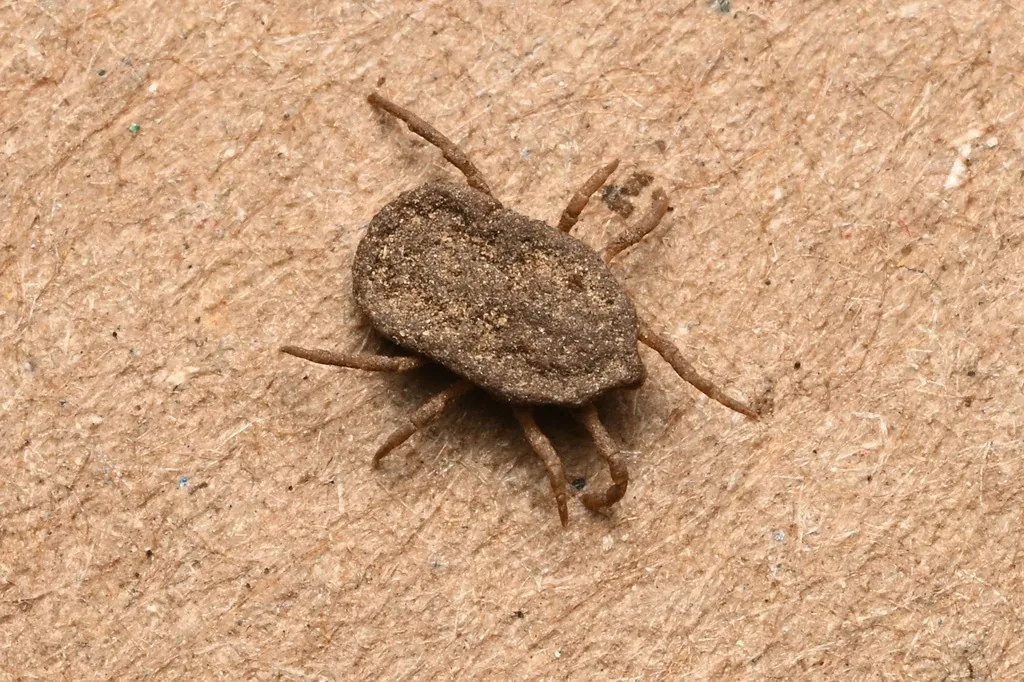
How to identify it
- Soft ticks lack the hard shield found behind the head of hard ticks, and their bodies are less evenly rounded.[4][5]
- Their mouthparts sit underneath the body, so they can't be seen from above, unlike the forward-pointing mouthparts of hard ticks.[4]
- They have several nymph stages, typically three to five, and can live 10 to 20 years because they survive long periods without food.[5]
- This page centers on Ornithodoros hermsi, the main relapsing fever tick of western mountains; O. turicata and O. parkeri look similar.[1][5]
Look-alikes
| Look-alike | How to tell them apart |
|---|---|
| Hard ticks | Hard ticks have a shield on the back and visible forward-pointing mouthparts, and they stay attached for days instead of feeding for minutes.[4][5] |
| Bed bugs | Soft ticks feed much like bed bugs, finding sleeping hosts and feeding quickly, but they live in rodent nests and are eight-legged arachnids.[5][6] |
Where it lives
Cases of soft tick relapsing fever occur mostly in mountainous western states at moderate to high elevations and in parts of Texas. In California, soft ticks are mainly found above 3,000 feet, such as the Sierra Nevada and Tahoe Basin.[1][3][6]
Biology and life cycle
Soft ticks live next to the nests of rodents such as squirrels, chipmunks and mice, and leave periodically, usually at night, to feed before returning.[4][6]
Bites last less than half an hour and are painless, so most people never know they were bitten.[1]
Each stage feeds several times; a feeding tick can increase its weight tenfold as its body stretches to hold the blood.[4][5]
Females mate off the host, can mate several times, and lay small batches of up to 500 eggs again and again.[5]
Indoors they hide between walls, under carpets and beneath floorboards; outdoors they shelter in rodent nests and shaded wood piles.[6]
Damage and signs
- The pajahuello tick, a California soft tick, is a notorious human biter known for causing whole-body allergic reactions in some people.[7]
Health risk
Soft tick relapsing fever causes repeated bouts of fever, headache, muscle aches and chills, typically about 3 days of fever followed by about 7 days without. It is treated with antibiotics and can be serious during pregnancy.[1][6][3]
Control
Prevention
When staying in a cabin, sleep on a bed or cot, pull it away from the wall and keep sheets from touching the floor.[6][2]
In caves where soft ticks occur, wear long sleeves and pants and use an EPA-registered repellent or permethrin-treated clothing.[2][1]
Keep them out
If you own a mountain cabin, look for droppings, gnaw marks and nests, and seal cracks and openings the width of a pencil or larger.[6]
Sanitation
Remove newspapers, cardboard and nearby wood piles that rodents use for nesting, and store food in sealed containers.[6]
Traps and physical control
Use snap traps for rodents rather than glue or live traps, and safely remove dead rodents, droppings and nests.[6]
When to call a professional
CDC advises having licensed professionals remove rodent nests and treat wall cracks with pesticides in infested buildings.[2][1]
Common questions
- How do people catch relapsing fever from ticks?
- Most U.S. cases happen when people stay overnight in rodent-infested cabins. In a CDC review of 2012 to 2021 cases, about three in four had visited cabins, and most western cases began between June and September.[1][3]
- What are the symptoms?
- Symptoms can start 4 to 21 days after exposure and include fever, headache, muscle aches and chills. See a doctor and mention any recent stay in a high-elevation cabin.[1][6]
- Will I see a soft tick on me in the morning?
- Probably not. Soft ticks feed for only minutes at night and then return to hiding, so many people never see the tick or realize they were bitten.[6][1]
Sources
- Centers for Disease Control and Prevention, “About Soft Tick Relapsing Fever (STRF).” www.cdc.gov/relapsing-fever/about/about-strf.html (accessed 2026-10-06)
- Centers for Disease Control and Prevention, “How Soft Tick Relapsing Fever Spreads.” www.cdc.gov/relapsing-fever/transmission/ (accessed 2026-10-06)
- Centers for Disease Control and Prevention, “Soft Tick Relapsing Fever - United States, 2012-2021 (MMWR 72(29), July 21, 2023).” www.cdc.gov/mmwr/volumes/72/wr/mm7229a1.htm (accessed 2026-10-06)
- Colorado State University Extension, “Colorado Ticks and Tick-Borne Diseases.” extension.colostate.edu/resource/colorado-ticks-and-tick-borne-diseases/ (accessed 2026-10-06)
- Utah State University Extension and Utah Plant Pest Diagnostic Laboratory, “Ticks and Tickborne Diseases of Utah (ENT-189-17, December 2017).” epi.utah.gov/wp-content/uploads/Ticks-and-Tickborne-Diseases-of-Utah.pdf (accessed 2026-10-06)
- California Department of Public Health, “Soft Tick Relapsing Fever.” www.cdph.ca.gov/Programs/CID/DCDC/Pages/SoftTickRelapsingFever.aspx (accessed 2026-10-06)
- Lane RS, Mun J, Peribáñez MA, Fedorova N (University of California, Berkeley), via PubMed Central, “Differences in prevalence of Borrelia burgdorferi and Anaplasma spp. infection among host-seeking Dermacentor occidentalis, Ixodes pacificus, and Ornithodoros coriaceus ticks in northwestern California (Ticks and Tick-borne Diseases 1:159-167, 2010).” pmc.ncbi.nlm.nih.gov/articles/PMC3044915/ (accessed 2026-10-06)
- iNaturalist, “Ornithodoros hermsi taxon page (order and family).” www.inaturalist.org/taxa/263523 (accessed 2026-10-06)