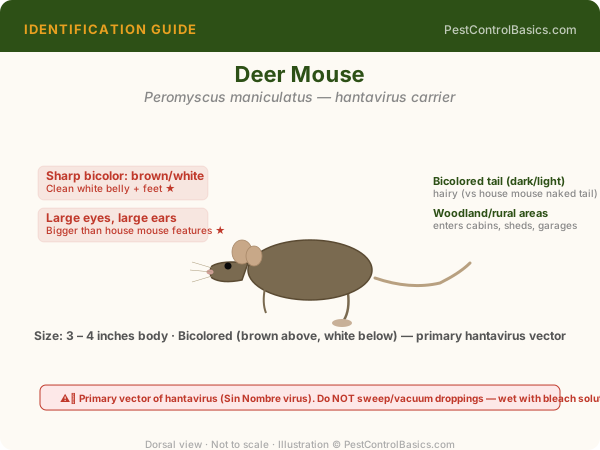
Deer mice look similar to house mice but carry hantavirus — a potentially fatal respiratory disease. The critical difference: disturbing dry deer mouse droppings creates genuine disease risk.
Original illustration by PestControlBasics.com. Use anatomical labels above to confirm your identification.
🔬
PestControlBasics Editorial Team
Reviewed by Derek Giordano · Updated 2026
🔍 Identification
Deer mouse: bicolored — brown/grey on top, white underneath (belly and feet white); white underside of tail (tail is bicolored). House mouse: uniformly grey/brown; no distinct bicoloring. Deer mouse ears are larger proportionally. Range: deer mice are widespread throughout North America, especially rural and western areas; most common in wooded and rural settings.
🧬 Biology & Behavior
Deer mice are the primary reservoir for Sin Nombre virus — the hantavirus species responsible for Hantavirus Pulmonary Syndrome (HPS) in the US. They shed the virus in urine, droppings, and saliva throughout their lives without becoming ill. Transmission to humans occurs primarily through inhalation of aerosolized dried rodent droppings or urine.
⚠️ Damage & Health Risk
Hantavirus Pulmonary Syndrome (HPS): fever, muscle aches followed by rapid respiratory failure; 35-40% fatality rate; no specific treatment. Most cases occur in rural/suburban western US. Highest risk: cleaning seldom-used cabins, barns, or sheds where deer mice have nested.
🔧 DIY Treatment
Prevention: seal all rodent entry points. Snap traps in affected areas. CRITICAL CLEANUP PROTOCOL: Ventilate the space for 30 minutes before entering. Wear N95 mask and rubber gloves. Wet droppings with bleach solution (1 part bleach:9 parts water) before pickup — NEVER sweep or vacuum dry droppings. Double-bag all material. Wash hands thoroughly.
👷 When to Call a Pro
For heavily infested structures (cabins, barns, outbuildings) with significant droppings accumulation, professional wildlife cleanup is recommended — the cleanup process itself creates the highest exposure risk.
❓ FAQ
How do I know if I have deer mice vs house mice?
Bicoloring is the key: deer mice have a sharply defined white belly and white feet against brown/grey back and sides. House mice are uniformly grey-brown throughout. Deer mice are typically found in rural and wooded areas; house mice dominate urban and suburban structures.
What should I do if I find deer mouse droppings in my cabin?
First: ventilate the cabin for at least 30 minutes before cleaning. Wear N95 mask and rubber gloves. Wet all droppings with bleach-water solution and let sit 5 minutes before wiping up with paper towels. Double-bag all material. Never sweep or vacuum — this aerosolizes the virus particles.
DG
Derek Giordano
Certified Pest Control Operator · Former Business Owner
Derek ran his own pest control company in Florida for several years, servicing thousands of regular customers. All content is based on hands-on field experience and current EPA & university extension guidelines.
Confirming a Deer Mouse & Hantavirus Risk infestation in the field
Misidentification is the most common reason home treatment fails for Deer Mouse & Hantavirus Risk. Look-alike species often respond to completely different active ingredients, so a 30-second confirmation step before any spraying or baiting saves the most time over a season. The practical workflow begins with where you found the specimen — kitchen, bathroom, garden, attic — because habitat narrows the candidate list faster than morphology alone.
Specific cues for Deer Mouse & Hantavirus Risk include body proportions, leg count, antenna shape, and any wing structure if present. Adults are usually the easiest stage to identify, but most real-world infestations show juveniles or evidence (frass, shed skins, webbing, damage patterns) more often than adults themselves. Photograph the specimen against a ruler or coin for scale, then compare against a regional reference rather than a global one — range maps from state Extension services beat generic online identification sites.
When two species look genuinely similar, the deciding factor is often where they congregate at dusk versus dawn, or whether they leave a visible trail. A test of three common DIY treatments — one bait, one residual spray, one mechanical barrier — applied in different areas can also confirm identity by which works.
When to escalate Deer Mouse & Hantavirus Risk control beyond DIY
Most Deer Mouse & Hantavirus Risk situations are within the range of a careful homeowner, but a handful of scenarios genuinely warrant a licensed applicator. Multi-unit buildings are at the top of that list — shared walls, plumbing, and ductwork mean a localized treatment in one unit often just relocates the population to a neighbor. Any infestation that involves wall voids, attic insulation, or sub-slab plumbing is also harder to reach with consumer products and benefits from professional equipment and labeled product concentrations.
Health-sensitive situations are the second escalation trigger. Pregnancy, infants, immunocompromised residents, and pets with known sensitivities all narrow the available product list considerably. A licensed professional can apply restricted-use products and reduced-risk reformulations that achieve control with lower household exposure than over-the-counter alternatives. The cost difference is usually less than two seasons of DIY spending once the time investment is factored in.
The third escalation point is recurrence. If the same pest returns within six weeks of an apparently successful treatment, the source is usually structural or environmental rather than chemical, and a professional inspection often finds the cause faster than a second round of self-treatment.
Most pest pressure traces back to one or two environmental conditions that are easier to fix than the infestation itself is to spray. For Deer Mouse & Hantavirus Risk, the highest-leverage changes typically involve moisture management, food access, and exclusion at structural entry points. Reducing standing water within 20 feet of the foundation eliminates more pest problems than any single chemical application, and the effect persists year over year rather than requiring a rebuy every quarter.
Exclusion work is unglamorous but durable. A common entry-point audit covers door sweeps, weep holes, utility penetrations, dryer vents, soffit gaps, and the base of siding. Most homes have between five and fifteen openings larger than the minimum required for the target pest to enter, and sealing even half of them measurably reduces indoor sightings within one season. Stainless steel mesh, copper wool, and exterior-grade sealant cover most situations; expanding foam alone is not sufficient because rodents and some insects chew through it.
Storage practices matter too. Pantry pests, fabric pests, and overwintering insects all exploit cardboard, paper, and natural-fiber storage in basements and garages. Switching to sealed plastic bins for seasonal storage removes a significant amount of harborage that is otherwise impossible to spray effectively.
Why timing changes everything with Deer Mouse & Hantavirus Risk
The same product applied two weeks apart can produce a complete kill or near-zero effect depending on where the Deer Mouse & Hantavirus Risk population sits in its life cycle. Egg-stage pests are nearly immune to contact sprays, so a perfectly applied treatment during a major hatch event will leave the next generation completely unaffected. The professional standard is two applications spaced 10 to 14 days apart for most household pests — the first kills the active adults, the second catches anything that emerges from eggs in the interim.
Temperature also drives treatment success. Most residual sprays lose efficacy above 90°F or below 50°F, and pyrethroid products in particular can repel rather than kill when applied during high heat. The best window is early morning when surface temperatures are still moderate and target pests are moving but not yet at peak activity. Indoor treatment is less weather-dependent but still benefits from being applied when household air movement is low — running ceiling fans during application redistributes droplets away from the intended surface.
Seasonal pressure for Deer Mouse & Hantavirus Risk usually has two or three predictable peaks per year. A treatment calendar built around those peaks costs less and works better than reactive spraying after a problem is already established.
Published: Jan 1, 2025 · Updated: Apr 7, 2026
Roof rats vs. Norway rats: identification and treatment differences
The two rat species common in U.S. residential settings — Norway rats and roof rats — present meaningful differences in behavior and treatment that affect control strategy. Norway rats are larger, more aggressive, ground- and burrow-dwelling, and prefer protein-rich diets; they're more common in the northeastern and midwestern U.S. and in urban environments. Roof rats (also called black rats or ship rats) are smaller, more cautious, climbing-oriented, and prefer fruits and vegetable matter; they're more common in the southeastern, southwestern, and west coast states and in residential areas with mature trees and vegetation. The behavioral differences drive trapping strategy: Norway rats are caught at ground level along walls and in basement-style locations with peanut butter or meat-based baits, while roof rats are trapped in attics, on rafters and ceiling joists, and along utility lines using fruit, nut butter, or seed-based baits. Misidentification leads to treatment failures because traps placed for ground-dwelling rats won't intercept arboreal roof rats, and vice versa. Identification typically requires seeing droppings (Norway rat droppings are blunt-ended and larger; roof rat droppings are tapered and smaller) or actually seeing animals.
When professional treatment is genuinely worth the cost
Professional pest control isn't always the right answer, but several specific situations genuinely justify the cost over DIY treatment. Severe bed bug infestations rarely yield to homeowner treatment because the required combination of vacuuming, encasements, structural treatment, and follow-up monitoring exceeds what most homeowners execute consistently. Subterranean termite treatment requires equipment (subslab injection) and product (commercial-grade termiticide quantities) not accessible to consumers, and inspection findings often dictate specific treatment that homeowners can't do safely. Roof and attic rodent problems benefit from professional exclusion that addresses access points consumers don't find. Mosquito reduction programs using barrier treatments and breeding-site management produce substantially better results than consumer foggers and yard sprays. Persistent cockroach problems in multi-unit buildings need coordination consumers can't provide. The pattern: professional treatment justifies itself when scale, access, regulatory product restrictions, or coordination requirements exceed what DIY can practically accomplish. Routine ant trails, occasional wasp nests, fruit fly outbreaks, and the like remain reasonable DIY targets where the cost-benefit math favors handling it yourself with the right products and information.
Rodent bait stations: when they're appropriate and when they aren't
Rodenticide bait stations have a specific role in rodent management but get misused frequently in residential settings. The appropriate use case is exterior, particularly for ongoing rat pressure from outdoor sources — well-secured tamper-resistant stations placed along the foundation perimeter at intervals of 25-50 feet, with regular monitoring of consumption. Interior bait station use is generally inadvisable: rodents that consume bait often die in walls or other inaccessible spots, producing odors that last weeks and attract secondary pests including flies and dermestid beetles. Non-target risk is the other major issue with interior use: pets, children, and protected wildlife can be exposed through the dying rodent or directly. For interior rodent control, trapping is almost always the better choice because dead rodents are removed promptly. Exterior baiting works well for properties with chronic outdoor pressure (commercial buildings, rural homes, properties adjacent to fields or wooded areas) but should always use tamper-resistant stations, not loose bait, to protect non-targets.
Nesting material identification: a diagnostic many inspectors skip
Rodent nesting material is often distinctive enough to identify the species and sometimes the source. House mice favor shredded paper, fabric, insulation, and pet bedding, and their nests are typically small, compact, and located in concealed voids — between drawers, in stove insulation, behind appliances, in stored linens. Roof rats build larger, more loosely organized nests using similar materials but often higher in the structure, in attics, in palm trees and ivy outside, and in the upper portions of garages. Norway rats nest at or below grade, often in burrows, basements, crawlspaces, and woodpiles, using coarser materials including grass, leaves, and stripped paper. Identifying nesting material during inspection — sometimes by tracking back along grease marks or droppings to a concealed nest — provides both species confirmation and a high-priority cleanup and exclusion target. Removing the nest and sealing the access often does more for long-term control than additional trapping, because nests are positional infrastructure that successive rodent generations will reuse if left intact. Skipping the nest search and focusing only on the trap line is one of the most common reasons that rodent problems recur within months of apparently successful trapping.
Coordinating pest control with renovation and construction work
Renovation work is one of the highest-value moments for pest intervention, and it's also one of the most consistently missed. When walls are open, when slabs are exposed, when crawlspaces are accessible, when sill plates are visible — these are the windows during which exclusion work, soil treatment, perimeter sealing, and harborage elimination can be done at a fraction of their normal cost and with dramatically better completeness. The same caulk-and-foam exclusion job that takes hours of awkward work after the fact can be done in minutes when the wall cavity is open. A pre-construction termite soil treatment is dramatically more effective than any post-construction equivalent, but it has to happen before the slab is poured. Even non-structural renovations like flooring replacement, kitchen rework, or basement finishing create windows during which the home's pest-relevant geometry can be improved. The cost of pulling in a pest professional during the renovation envelope, even just for an inspection and recommendations, is almost always recovered in reduced future treatment costs and avoided structural damage. The conversation to have with general contractors is whether they're willing to coordinate with a pest specialist during the open-wall phase, and most reputable contractors are, particularly on larger jobs where the small additional scheduling complexity is offset by the value-add for the homeowner.
Mouse versus rat behavior: the differences that change treatment
Mice and rats are often grouped together in pest control discussions, but their behavior differs in ways that matter for treatment. Mice are curious and explore new objects in their environment readily, which makes traps and bait stations effective relatively quickly after placement — a mouse will typically investigate a new trap within a few nights. Rats, particularly Norway rats, are neophobic — they avoid new objects in familiar environments for days or weeks before approaching, which means trap placement requires patience and pre-baiting before setting. Mice can squeeze through gaps as small as about a quarter inch; rats need larger openings but can chew through softer materials to enlarge gaps. Mice produce many small droppings spread across foraging areas; rats produce fewer, larger droppings concentrated near nest sites. Mice are largely indoor pests in temperate climates; Norway rats often nest outside and forage inside, which means outdoor habitat management is more relevant for rat control. Treatment that doesn't account for these differences — using mouse traps in rat territory, expecting rapid bait uptake from neophobic rats, or sealing only mouse-sized gaps when rats are the actual problem — produces predictable failure.
🗺️ US Distribution — Deer Mouse
Common Occasional Not Present
States Present
49
Occasional
2
Primary Region
Continental US
📊 Source: University extension services, USDA, CDC vector data, and published entomological surveys.