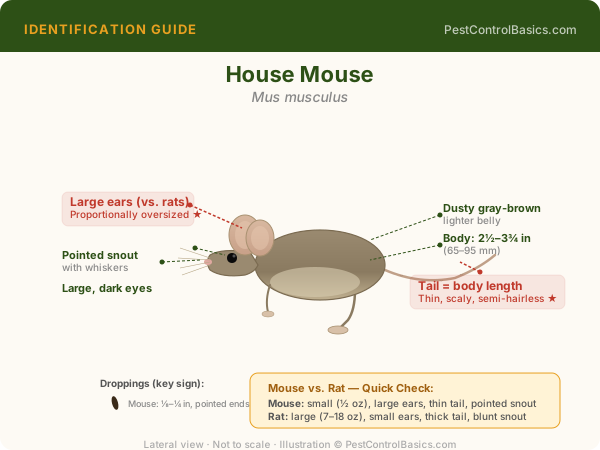
The world's most successful commensal rodent — found on every continent except Antarctica. 3–4 inches, curious (not neophobic), and capable of squeezing through a gap the width of a pencil. One mouse inside means a gap exists. Finding and sealing that gap matters more than any trap.
Entry gap1/4 inch — width of a pencil
Droppings/night50–75, rice-grain shaped
Curious?Yes — investigates new objects within hours
Litters/year5–10 litters of 5–6 pups
Best trapVictor snap or T-Rex Mouser
📐 FIELD GUIDE ILLUSTRATION
Original illustration by PestControlBasics.com. Use anatomical labels above to confirm your identification. For photo references, see the identification section below.
Why 12 Traps?
The single most common DIY mistake
The most common reason mouse control fails: too few traps. Two snap traps in a kitchen drawer is not a mouse strategy. House mice have a home range of 10–30 feet, travel multiple routes, and a single female produces up to 60 young per year. You need enough traps to intercept the entire active population simultaneously.
The 12-trap rule: Place a minimum of 12 snap traps throughout all active areas in a single session — one every 2–3 feet along every active wall. In a kitchen: inside every lower cabinet back corner, under the stove, under the refrigerator, along the pantry walls, and behind the washer/dryer if in the kitchen area.
Placement beats bait: Set traps perpendicular to the wall, trigger end facing the baseboard. Mice running along walls trigger the trap with their body before they even find the bait.
Check every 24 hours: A dead mouse left in a trap decomposes and deters others. Reset immediately after each catch.
Exclusion
The permanent fix — no gap left unsealed
Trapping eliminates current residents. Exclusion prevents new ones. A house mouse can compress its skull to fit through any gap 1/4 inch or larger — roughly the diameter of a pencil.
Priority entry points: Foundation-sill interface (the joint where wood framing meets concrete), gaps around all utility pipes and conduits, garage door weatherstripping, and any exterior door with a visible gap when closed.
Materials that work: Xcluder rodent-proof stainless mesh packed tightly into gaps, followed by Great Stuff PestBlock foam over the top. Rodents cannot chew through Xcluder. Foam alone will be chewed through — always use mesh first.
Verification: After 5–7 days with no catches and no new droppings, lay a thin strip of flour along suspected runways. No footprints in 48 hours confirms the problem is resolved.
✓ UV Light — Find Every Entry Point
Rodent urine fluoresces bright blue-white under UV blacklight. Shine a UV flashlight along all walls, under appliances, and across the basement floor. Urine trails reveal exactly where mice are traveling — and lead directly to their entry points.
DG
Derek Giordano
Certified Pest Control Operator · Former Business Owner
Derek ran his own pest control company in Florida for several years, servicing thousands of regular customers. All content is based on hands-on field experience and current EPA & university extension guidelines.
Reviewed by Derek GiordanoContent on PestControlBasics.com is developed with input from certified pest management professionals and cross-referenced against EPA, CDC, and university extension guidance. Last reviewed: April 2026.
Most House Mouse situations are within the range of a careful homeowner, but a handful of scenarios genuinely warrant a licensed applicator. Multi-unit buildings are at the top of that list — shared walls, plumbing, and ductwork mean a localized treatment in one unit often just relocates the population to a neighbor. Any infestation that involves wall voids, attic insulation, or sub-slab plumbing is also harder to reach with consumer products and benefits from professional equipment and labeled product concentrations.
Health-sensitive situations are the second escalation trigger. Pregnancy, infants, immunocompromised residents, and pets with known sensitivities all narrow the available product list considerably. A licensed professional can apply restricted-use products and reduced-risk reformulations that achieve control with lower household exposure than over-the-counter alternatives. The cost difference is usually less than two seasons of DIY spending once the time investment is factored in.
The third escalation point is recurrence. If the same pest returns within six weeks of an apparently successful treatment, the source is usually structural or environmental rather than chemical, and a professional inspection often finds the cause faster than a second round of self-treatment.
Prevention strategies that actually reduce House Mouse pressure
Most pest pressure traces back to one or two environmental conditions that are easier to fix than the infestation itself is to spray. For House Mouse, the highest-leverage changes typically involve moisture management, food access, and exclusion at structural entry points. Reducing standing water within 20 feet of the foundation eliminates more pest problems than any single chemical application, and the effect persists year over year rather than requiring a rebuy every quarter.
Exclusion work is unglamorous but durable. A common entry-point audit covers door sweeps, weep holes, utility penetrations, dryer vents, soffit gaps, and the base of siding. Most homes have between five and fifteen openings larger than the minimum required for the target pest to enter, and sealing even half of them measurably reduces indoor sightings within one season. Stainless steel mesh, copper wool, and exterior-grade sealant cover most situations; expanding foam alone is not sufficient because rodents and some insects chew through it.
Storage practices matter too. Pantry pests, fabric pests, and overwintering insects all exploit cardboard, paper, and natural-fiber storage in basements and garages. Switching to sealed plastic bins for seasonal storage removes a significant amount of harborage that is otherwise impossible to spray effectively.
Confirming a House Mouse infestation in the field
Misidentification is the most common reason home treatment fails for House Mouse. Look-alike species often respond to completely different active ingredients, so a 30-second confirmation step before any spraying or baiting saves the most time over a season. The practical workflow begins with where you found the specimen — kitchen, bathroom, garden, attic — because habitat narrows the candidate list faster than morphology alone.
Specific cues for House Mouse include body proportions, leg count, antenna shape, and any wing structure if present. Adults are usually the easiest stage to identify, but most real-world infestations show juveniles or evidence (frass, shed skins, webbing, damage patterns) more often than adults themselves. Photograph the specimen against a ruler or coin for scale, then compare against a regional reference rather than a global one — range maps from state Extension services beat generic online identification sites.
When two species look genuinely similar, the deciding factor is often where they congregate at dusk versus dawn, or whether they leave a visible trail. A test of three common DIY treatments — one bait, one residual spray, one mechanical barrier — applied in different areas can also confirm identity by which works.
Why timing changes everything with House Mouse
The same product applied two weeks apart can produce a complete kill or near-zero effect depending on where the House Mouse population sits in its life cycle. Egg-stage pests are nearly immune to contact sprays, so a perfectly applied treatment during a major hatch event will leave the next generation completely unaffected. The professional standard is two applications spaced 10 to 14 days apart for most household pests — the first kills the active adults, the second catches anything that emerges from eggs in the interim.
Temperature also drives treatment success. Most residual sprays lose efficacy above 90°F or below 50°F, and pyrethroid products in particular can repel rather than kill when applied during high heat. The best window is early morning when surface temperatures are still moderate and target pests are moving but not yet at peak activity. Indoor treatment is less weather-dependent but still benefits from being applied when household air movement is low — running ceiling fans during application redistributes droplets away from the intended surface.
Seasonal pressure for House Mouse usually has two or three predictable peaks per year. A treatment calendar built around those peaks costs less and works better than reactive spraying after a problem is already established.
Published: Jan 1, 2025 · Updated: Apr 7, 2026
Rodent exclusion: the specific gaps that matter most
Rodent exclusion produces the longest-lasting rodent control because it addresses access rather than just existing population, and the specific gaps that matter follow a predictable pattern. Mice can squeeze through openings as small as a quarter-inch (a hole the diameter of a pencil); rats need about a half-inch (the diameter of a thumb). The high-yield inspection targets: garage door bottom seals (where most house mice originally enter), foundation cracks particularly where utilities penetrate (gas lines, water service, electrical service mast, AC line set penetrations), gaps where siding meets foundation, dryer vents and exhaust vents (where deteriorated flaps allow entry), gaps around exterior faucets and hose bibs, weep holes in brick construction (which should be screened against rodents while still venting), and gaps around eaves and roofline penetrations including roof vents and chimney flashings. Repair materials matter: copper mesh stuffed into openings then sealed with appropriate sealant works far better than steel wool (which degrades) or expanding foam alone (which rodents chew through). Hardware cloth (1/4-inch) is appropriate for larger openings and vent screens.
How structural moisture issues drive pest problems most homeowners miss
A surprising fraction of pest problems are downstream of moisture issues that go uncorrected because they don't produce obvious damage. Subterranean termites require moist soil contact; correcting drainage and downspouts often reduces termite pressure more than any chemical treatment. Carpenter ants nest in damp or previously-damp wood; the colony moves in only after moisture has softened the substrate. Drain flies, fungus gnats, and springtails are all moisture-driven and resolve when the moisture source resolves. Mold mites and booklice indicate humidity that exceeds about 70%, often in unventilated bathrooms or basements. Even rodent activity correlates with moisture: rodents need accessible water and follow water-supply intrusions to bring themselves into structures. The diagnostic question worth asking on any chronic pest problem: is something wet that shouldn't be? Common offenders are clogged gutters, downspouts that drain near the foundation rather than away from it, condensate lines from HVAC systems and water heaters, slow plumbing leaks under sinks, sweating cold-water pipes in unconditioned spaces, and crawlspaces without adequate vapor barriers. Fixing the underlying moisture issue typically yields permanent improvement that chemical treatment alone cannot match.
Snap traps vs. glue boards vs. electronic traps: practical comparison
The three main consumer rodent traps each have practical use cases, and the choice depends more on the situation than on which is 'best.' Snap traps remain the most reliable for active mouse populations: cheap, effective, fast-killing, and easy to set in numbers. The key is using enough traps (six to twelve in a typical mouse infestation, not one or two) and placing them perpendicular to walls with the trigger toward the wall along observed runways. Glue boards have a specific niche — narrow corridors, behind appliances, voids — where snap traps don't fit, but they're inhumane (animals die slowly), they catch non-targets including snakes and small birds in some settings, and they aren't effective against rats, which generally pull free. Electronic traps (battery-powered devices that deliver a lethal shock) work well, are reusable, and present the kill conveniently, but the per-unit cost limits how many can be deployed. The practical recommendation: snap traps as the primary tool, glue boards for spots snap traps can't reach, electronic traps as a quality-of-life upgrade for ongoing monitoring rather than a primary tool.
Food source elimination as the primary control lever
Rodent infestation is, more than anything else, a function of available food, and trying to control rodent populations without addressing food sources is consistently less effective than addressing food sources and then dealing with what remains. The food sources homeowners commonly miss include bird seed in feeders and on the ground beneath them, pet food left in bowls overnight, compost without rodent-proof containment, fruit that drops from trees, and stored grain or feed in garages and outbuildings. Indoor food sources include pantry foods in non-rodent-proof packaging, grease accumulated behind stoves, food debris in cabinets and on counters overnight, and trash that's not in a sealed container. The behavioral shift required for rodent control is more demanding than for most pest categories — it requires consistent practice rather than periodic action — but it's the only approach that addresses the root condition rather than just the symptom. A property with consistent food source management supports a much smaller rodent population, and the trapping and exclusion that handle the remainder become tractable rather than overwhelming.
When neighborhood-level coordination matters for treatment
Some pests are house-scale problems and some are neighborhood-scale problems, and treating a neighborhood-scale problem as if it were house-scale leads to a familiar frustration: treatment works, then activity returns within weeks because the source was never inside your property. German cockroach problems in multi-unit buildings are the canonical example — treating one unit while the rest of the building is untreated produces temporary relief at best. Rodent infestations frequently span multiple adjacent properties, especially row houses, condo complexes, and dense suburban developments with shared boundary fencing or shared utility easements. Mosquito problems are obviously neighborhood-scale because adult mosquitoes don't respect property lines. The practical implication is that for these pests, isolated treatment is not just incomplete but in some cases economically wasteful. Coordinating with neighbors, talking to HOA or property management about whole-building or whole-block treatment, and identifying the actual sources rather than the symptom locations is what produces durable results. This is uncomfortable work in some neighborhoods, but no amount of treatment intensity in a single unit substitutes for it.
Utility penetrations as the single most important exclusion target
Across residential rodent control, the single most consistent finding during exclusion work is that the gaps around utility penetrations — where pipes, conduits, cables, and vents enter the structure — are the primary entry routes that rodents are using. These gaps exist on essentially every residential structure, they're often hidden behind siding or in mechanical closets where homeowners don't routinely look, and the construction techniques used in original installation rarely include rodent-proof sealing. A new utility installation by a plumber, electrician, or HVAC technician almost always leaves a gap, because their work is focused on the utility function rather than on the building envelope. The implication for rodent exclusion is that any thorough inspection has to include a systematic check of every penetration, including the ones in basements, crawlspaces, attic plates, and inside cabinets where supply lines enter walls. Sealing these gaps with appropriate materials — copper mesh, steel wool, urethane foam over a metal substrate, or commercial rodent exclusion sealant — typically eliminates the majority of entry routes and produces dramatic improvements in long-term rodent activity.
🗺️ US Distribution — House Mouse
Common Occasional Not Present
States Present
51
Occasional
0
Primary Region
All 50 states (indoor pest)
📊 Source: University extension services, USDA, CDC vector data, and published entomological surveys.