HomePest LibraryNorway Rat
Disease Vector — Requires Action
🐰

Norway Rat

Rattus norvegicus — Common Rat / Sewer Rat / Brown Rat

The largest common commensal rat — heavy-bodied, burrowing, and highly suspicious of anything new. Understanding neophobia is the key to trapping success. Without pre-baiting, most traps fail. With proper technique, Norway rats are very controllable.

Body length7–10 inches + tail
WeightUp to 1 lb
Neophobic?Yes — avoids new objects 3–7 days
Entry gap1/2 inch
Disease riskLeptospirosis, salmonella, hantavirus
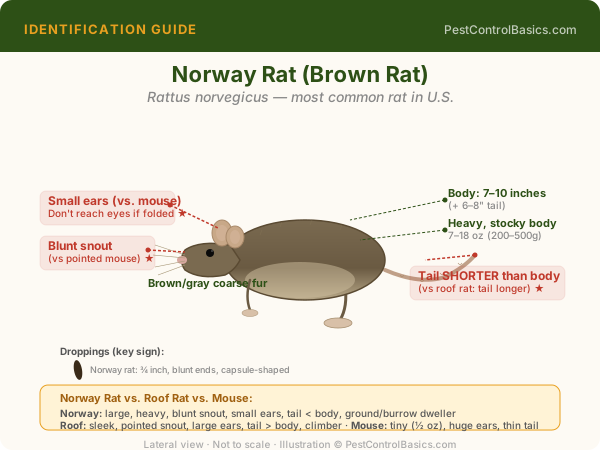
📐 FIELD GUIDE ILLUSTRATION
Norway Rat identification illustration with labeled anatomical features — PestControlBasics.com

Original illustration by PestControlBasics.com. Use anatomical labels above to confirm your identification. For photo references, see the identification section below.

Identification

Norway rat vs. roof rat — critical differences

Identifying which rat species you have determines where to set traps and how to approach exclusion. The two most common U.S. rats are Norway rats and roof rats — they rarely overlap in the same building.

Norway rat features: Heavy, stocky body. Blunt muzzle. Ears are small and lay close to the head. Tail is thick and shorter than the body. Found at ground level — burrows, sewers, under concrete slabs.

Droppings: Norway rat droppings are large (3/4 inch), capsule-shaped with blunt ends. Finding large blunt droppings at ground level confirms Norway rats. Smaller droppings with pointed ends = roof rats.

Burrow identification: Active Norway rat burrows have fresh, loose soil outside the entrance, no debris inside, and no cobwebs over the opening. Inactive burrows will have debris, spider webs, and settled soil.

Neophobia & Trapping

Why Norway rats avoid new traps — and how to overcome it

Norway rats are among the most cautious animals in the world when it comes to new objects in their territory. This trait — neophobia — evolved over thousands of years as a survival mechanism in environments where humans tried to poison or trap them.

The consequence: A snap trap placed in an active runway will often sit untouched for a week. The rat detects something new and avoids it. Most DIY rodent control fails because people place traps and check back to find them untouched — concluding traps don't work. The traps are fine — the pre-baiting step was skipped.

Pre-baiting protocol: Place unset traps in active areas for 3–5 consecutive days with attractive bait (bacon, peanut butter, or chocolate). Allow rats to feed freely from the unset traps. Once they are feeding consistently — trigger the trap and set all locations simultaneously on the same night. Catch rates with pre-baiting are typically 3–5× higher than without.

💡 Set Everything on the Same Night

After pre-baiting, set all traps in all active locations on the same evening. Rats that escape one encounter become exponentially harder to catch — they associate the trap with danger. Maximum simultaneous pressure is the strategy.

Exclusion

The permanent solution — closing every entry

Trapping without exclusion is temporary. Norway rats can squeeze through any gap 1/2 inch or larger. Entry points are typically at ground level: gaps around utility pipes, foundation-sill interface, crawlspace vents, and gaps under exterior doors.

Use Xcluder rodent-proof mesh (stainless steel fill fabric that rats cannot chew through) packed into gaps, followed by Great Stuff PestBlock foam over the top. For larger openings, use 1/4-inch hardware cloth secured with screws.

Also remove attractants: secure all garbage in rat-proof metal cans with lids, eliminate pet food left outdoors overnight, remove fallen fruit, and clear wood piles and debris that provide harborage adjacent to the structure.

⚠ Hantavirus Cleanup Protocol

Before cleaning any rat droppings, review the full hantavirus safety protocol. Spray all droppings with 1:10 bleach solution, wait 5 minutes, wipe up wet (never sweep dry). N95 respirator required. Read the full guide →

DG
Derek Giordano
Certified Pest Control Operator · Former Business Owner
Derek ran his own pest control company in Florida for several years, servicing thousands of regular customers. All content is based on hands-on field experience and current EPA & university extension guidelines.

Related Resources

📚 Full Pest Library🧪 DIY vs. Pro Quiz💰 Cost Guide🌿 IPM Guide🔍 Find a Pro
🔗 Related Pests
Roof Rat Muskrat
Compare similar pests to confirm your identification. → Use our ID Flowchart
🔮
Reviewed by Derek GiordanoContent on PestControlBasics.com is developed with input from certified pest management professionals and cross-referenced against EPA, CDC, and university extension guidance. Last reviewed: April 2026.
📚 Sources: CDC Rodent Control · EPA Rodenticide Safety
Published: Jan 1, 2025 · Updated: Apr 7, 2026

Outdoor rodent management around the structure

Reducing rodent pressure outside the structure reduces entry attempts and supports interior control. Specific changes: store firewood at least 20 feet from the structure and elevated off the ground, avoid heavy ground cover (English ivy, dense shrubs) against the foundation, store birdseed and pet food in metal containers (rodents chew through plastic), keep garbage in lidded containers and avoid leaving any out overnight uncontained, eliminate fruit drop from trees if possible, and seal openings into outbuildings, sheds, and garages. Bait stations along the foundation perimeter, at fence lines, and near outbuildings provide an interception layer for rodents traveling through the property. This perimeter approach reduces interior pressure significantly and is the standard for ongoing rodent management in higher-pressure rural and semi-rural settings.

Reading pesticide labels: what most homeowners miss

The pesticide label is the most important document in any pest control decision, and it's the document most people skim. Under FIFRA (the federal law that governs pesticide registration), the label is legally binding — using a product inconsistent with its label is a violation, regardless of intent. The label has several sections that homeowners should read fully before purchase, not after: the use sites (where it can legally be applied), the target pests (some products legal indoors are not for the specific pest), the mixing rate (overdosing wastes product without improving efficacy and increases drift risk; underdosing accelerates resistance), the PPE requirements (some require respirators, not just gloves), and the re-entry interval (how long until the treated area is safe for people and pets). The signal word — Caution, Warning, Danger — indicates acute toxicity but not chronic risk; that's elsewhere on the label. Reading labels well prevents nearly every common DIY misapplication.

What to do when rodents die inside walls

Rodenticide use occasionally results in rodents dying inside wall voids before they can be removed, producing an odor that lasts days to weeks. The remediation options: locate the carcass if possible (odor concentration helps narrow location, sometimes a flashlight inspection through outlets and switch boxes), remove if accessible, and use enzyme-based odor neutralizers (not air fresheners, which mask) for the duration. For inaccessible carcasses, the odor dissipates as the carcass dries — typically two to four weeks in dry conditions, longer in humid conditions. Activated charcoal bags in the affected room reduce perceptible odor during this period. The takeaway for future treatment: snap traps and bait stations placed in accessible locations (not blind voids) avoid this problem entirely, which is part of why interior treatment usually favors snap traps over bait.

Exclusion is the only durable rodent control

Trapping reduces a rodent population temporarily; baiting reduces it more durably; exclusion prevents reinvasion. Without exclusion, every successful control program is on a countdown to reinvasion from the surrounding rodent reservoir. Effective exclusion addresses gaps mice (1/4 inch and larger) and rats (1/2 inch and larger) can squeeze through. Common entry points missed by quick inspections: gaps where utility lines penetrate exterior walls, behind dryer vent flaps, dryer vent screens with corrosion damage, garage door bottom seals (especially at corners), gaps under sill plates, weep holes in brick veneer, and gaps where roof returns meet walls. Steel wool packed into voids and sealed with caulk handles most gaps; hardware cloth (1/4 inch) over larger openings holds long-term. A thorough exclusion pass takes a weekend and provides multi-year benefits.

How professional pest control programs differ from one-off treatments

A single treatment — DIY or professional — addresses what's visible today, but most pest pressure is cyclical. Professional pest control programs that work long-term are structured around inspection, monitoring, treatment, and follow-up as a recurring cycle rather than discrete events. The inspection phase identifies conducive conditions (moisture, harborage, food access, exclusion gaps) that one-time treatments don't address. The monitoring phase uses sticky traps, bait stations, or visual sweeps to catch population rebounds early, before they become visible infestations again. The treatment phase targets the specific life stages active during that visit — different than blanket spraying everything. The follow-up phase verifies treatment efficacy and adjusts. Homeowners can replicate this structure on a quarterly or seasonal schedule without buying expensive equipment, and the underlying logic — track, treat targeted, verify — produces consistently better results than reactive treatment after problems become obvious.

Roof rats vs. Norway rats: identification and treatment differences

The two rat species common in U.S. residential settings — Norway rats and roof rats — present meaningful differences in behavior and treatment that affect control strategy. Norway rats are larger, more aggressive, ground- and burrow-dwelling, and prefer protein-rich diets; they're more common in the northeastern and midwestern U.S. and in urban environments. Roof rats (also called black rats or ship rats) are smaller, more cautious, climbing-oriented, and prefer fruits and vegetable matter; they're more common in the southeastern, southwestern, and west coast states and in residential areas with mature trees and vegetation. The behavioral differences drive trapping strategy: Norway rats are caught at ground level along walls and in basement-style locations with peanut butter or meat-based baits, while roof rats are trapped in attics, on rafters and ceiling joists, and along utility lines using fruit, nut butter, or seed-based baits. Misidentification leads to treatment failures because traps placed for ground-dwelling rats won't intercept arboreal roof rats, and vice versa. Identification typically requires seeing droppings (Norway rat droppings are blunt-ended and larger; roof rat droppings are tapered and smaller) or actually seeing animals.

Reading product labels: the parts that matter and the parts that don't

Pesticide product labels are legal documents with specific use directions, but the parts that matter most for residential decisions aren't always the parts that get attention. The active ingredient and its concentration are essential — they determine what category of pest the product targets and how it compares to alternatives. The 'Directions for Use' section is binding (using a product against label instructions is technically a federal violation and may void product liability), but most homeowners skim it. The 'Precautionary Statements' section tells you exposure risks and required PPE. The 'First Aid' section matters in an emergency. What matters less in practice: marketing copy on the front of the package, brand-specific claims about superiority (federal regulations sharply limit what these can say), and 'natural' or 'organic' labeling (which can be technically accurate while still describing a product with meaningful exposure considerations — pyrethrin from chrysanthemums is 'natural' but still a neurotoxin in concentration). Reading labels critically — focusing on active ingredient, concentration, target pest list, application method, and precautions — gives a clearer picture than retail-shelf comparison ever does.

Rodent bait stations: when they're appropriate and when they aren't

Rodenticide bait stations have a specific role in rodent management but get misused frequently in residential settings. The appropriate use case is exterior, particularly for ongoing rat pressure from outdoor sources — well-secured tamper-resistant stations placed along the foundation perimeter at intervals of 25-50 feet, with regular monitoring of consumption. Interior bait station use is generally inadvisable: rodents that consume bait often die in walls or other inaccessible spots, producing odors that last weeks and attract secondary pests including flies and dermestid beetles. Non-target risk is the other major issue with interior use: pets, children, and protected wildlife can be exposed through the dying rodent or directly. For interior rodent control, trapping is almost always the better choice because dead rodents are removed promptly. Exterior baiting works well for properties with chronic outdoor pressure (commercial buildings, rural homes, properties adjacent to fields or wooded areas) but should always use tamper-resistant stations, not loose bait, to protect non-targets.

Nesting material identification: a diagnostic many inspectors skip

Rodent nesting material is often distinctive enough to identify the species and sometimes the source. House mice favor shredded paper, fabric, insulation, and pet bedding, and their nests are typically small, compact, and located in concealed voids — between drawers, in stove insulation, behind appliances, in stored linens. Roof rats build larger, more loosely organized nests using similar materials but often higher in the structure, in attics, in palm trees and ivy outside, and in the upper portions of garages. Norway rats nest at or below grade, often in burrows, basements, crawlspaces, and woodpiles, using coarser materials including grass, leaves, and stripped paper. Identifying nesting material during inspection — sometimes by tracking back along grease marks or droppings to a concealed nest — provides both species confirmation and a high-priority cleanup and exclusion target. Removing the nest and sealing the access often does more for long-term control than additional trapping, because nests are positional infrastructure that successive rodent generations will reuse if left intact. Skipping the nest search and focusing only on the trap line is one of the most common reasons that rodent problems recur within months of apparently successful trapping.

Coordinating pest control with renovation and construction work

Renovation work is one of the highest-value moments for pest intervention, and it's also one of the most consistently missed. When walls are open, when slabs are exposed, when crawlspaces are accessible, when sill plates are visible — these are the windows during which exclusion work, soil treatment, perimeter sealing, and harborage elimination can be done at a fraction of their normal cost and with dramatically better completeness. The same caulk-and-foam exclusion job that takes hours of awkward work after the fact can be done in minutes when the wall cavity is open. A pre-construction termite soil treatment is dramatically more effective than any post-construction equivalent, but it has to happen before the slab is poured. Even non-structural renovations like flooring replacement, kitchen rework, or basement finishing create windows during which the home's pest-relevant geometry can be improved. The cost of pulling in a pest professional during the renovation envelope, even just for an inspection and recommendations, is almost always recovered in reduced future treatment costs and avoided structural damage. The conversation to have with general contractors is whether they're willing to coordinate with a pest specialist during the open-wall phase, and most reputable contractors are, particularly on larger jobs where the small additional scheduling complexity is offset by the value-add for the homeowner.

Mouse versus rat behavior: the differences that change treatment

Mice and rats are often grouped together in pest control discussions, but their behavior differs in ways that matter for treatment. Mice are curious and explore new objects in their environment readily, which makes traps and bait stations effective relatively quickly after placement — a mouse will typically investigate a new trap within a few nights. Rats, particularly Norway rats, are neophobic — they avoid new objects in familiar environments for days or weeks before approaching, which means trap placement requires patience and pre-baiting before setting. Mice can squeeze through gaps as small as about a quarter inch; rats need larger openings but can chew through softer materials to enlarge gaps. Mice produce many small droppings spread across foraging areas; rats produce fewer, larger droppings concentrated near nest sites. Mice are largely indoor pests in temperate climates; Norway rats often nest outside and forage inside, which means outdoor habitat management is more relevant for rat control. Treatment that doesn't account for these differences — using mouse traps in rat territory, expecting rapid bait uptake from neophobic rats, or sealing only mouse-sized gaps when rats are the actual problem — produces predictable failure.

🗺️ US Distribution — Norway Rat

image/svg+xml
Common Occasional Not Present
States Present
51
Occasional
0
Primary Region
All 50 states (indoor pest)
📊 Source: University extension services, USDA, CDC vector data, and published entomological surveys.