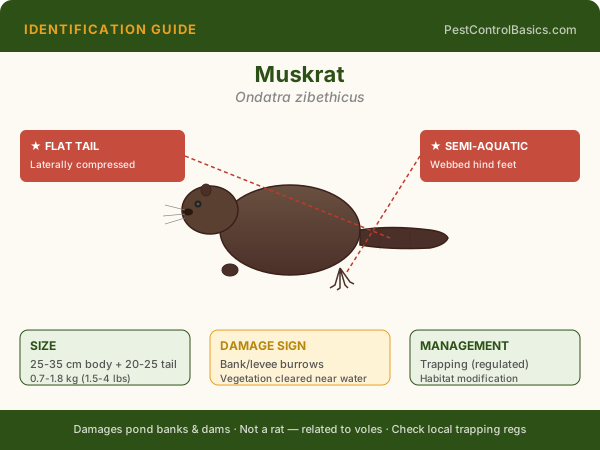
❓ Common Questions About 🦦 Muskrat
How do I confirm I actually have this pest (not something similar)?
The most reliable confirmation is a physical specimen — capture one and compare to reference images on this page. For cryptic pests (bed bugs, termites), look for secondary signs: frass, shed skins, mud tubes, or bites with a specific pattern. When uncertain, a professional inspection is faster than months of misidentification.
Can I treat this myself or do I need a professional?
DIY is effective for small, accessible infestations caught early. Professionals are worth the cost when: the infestation is inside wall voids or structural elements, multiple rooms are affected, you have health-risk pests (hantavirus, venomous species), or DIY has already failed twice.
How long until the infestation is completely gone?
Expect 3–8 weeks for most infestations with proper treatment. Insects with dormant life stages (pupae, eggs) extend the timeline because those stages are impervious to most insecticides. Follow-up treatments at 2 and 4 weeks catch each new cohort as they emerge.
What's the most common mistake people make treating this pest?
Treating only the visible pest population while ignoring the harborage site, entry point, or breeding location. Killing adults provides temporary relief but the population rebuilds from hidden egg cases, pupae, or new arrivals through unaddressed entry points.
Exclusion is the only durable rodent control
Trapping reduces a rodent population temporarily; baiting reduces it more durably; exclusion prevents reinvasion. Without exclusion, every successful control program is on a countdown to reinvasion from the surrounding rodent reservoir. Effective exclusion addresses gaps mice (1/4 inch and larger) and rats (1/2 inch and larger) can squeeze through. Common entry points missed by quick inspections: gaps where utility lines penetrate exterior walls, behind dryer vent flaps, dryer vent screens with corrosion damage, garage door bottom seals (especially at corners), gaps under sill plates, weep holes in brick veneer, and gaps where roof returns meet walls. Steel wool packed into voids and sealed with caulk handles most gaps; hardware cloth (1/4 inch) over larger openings holds long-term. A thorough exclusion pass takes a weekend and provides multi-year benefits.
Exclusion: the single highest-leverage long-term pest control investment
Across virtually every common household pest, exclusion — physically preventing entry — is more cost-effective long-term than recurring treatment. The exclusion targets vary by pest but the principle is consistent: pests don't enter homes randomly, they enter through specific access points, and closing those access points produces durable results. For rodents, gaps larger than 1/4 inch (mice) or 1/2 inch (rats) at the foundation, around utility penetrations, dryer vents, and roof returns are the standard entry points. For occasional invaders (stink bugs, lady beetles, boxelder bugs), window screens and weatherstripping around doors handle most entry. For ants and crawling insects, the foundation seam, threshold gaps, and weep holes in brick veneer are the recurring weak points. A weekend exclusion audit — flashlight, caulk, hardware cloth, expanding foam — produces returns measured in years of reduced treatment costs.
Outdoor rodent management around the structure
Reducing rodent pressure outside the structure reduces entry attempts and supports interior control. Specific changes: store firewood at least 20 feet from the structure and elevated off the ground, avoid heavy ground cover (English ivy, dense shrubs) against the foundation, store birdseed and pet food in metal containers (rodents chew through plastic), keep garbage in lidded containers and avoid leaving any out overnight uncontained, eliminate fruit drop from trees if possible, and seal openings into outbuildings, sheds, and garages. Bait stations along the foundation perimeter, at fence lines, and near outbuildings provide an interception layer for rodents traveling through the property. This perimeter approach reduces interior pressure significantly and is the standard for ongoing rodent management in higher-pressure rural and semi-rural settings.
Rodent signs to look for during home inspection
Active rodent presence usually leaves signs that are easy to spot if you know where to look. Droppings — mouse droppings are rice-grain sized, dark and pointed; rat droppings are larger, capsule-shaped. Gnaw marks on edges of doors, window sills, plastic food containers, and wires (chewed insulation is a fire risk). Greasy rub marks along baseboards and floor-wall junctions where rodents repeatedly travel. Nests in attics, basements, garages, and inside seldom-used appliances and stored cardboard. Sound — scratching or scurrying in walls, ceilings, or attics, especially at dusk and dawn. Pet behavior — dogs and cats focused on a wall or appliance often detect rodents people miss. Once signs are confirmed, both treatment and exclusion work need to start, not just one or the other.
Working with extension services and public resources
Every state has a Cooperative Extension Service — a university-affiliated public outreach program — and most homeowners don't know it exists. Extension publishes pest fact sheets specific to local conditions, offers free pest identification (often by photo submission), and runs Master Gardener volunteer programs that handle public inquiries. State departments of agriculture license and regulate pest control operators; their websites verify licenses and accept complaints. State and local health departments track vector-borne diseases and publish risk data that's more current than national averages. The EPA's pesticide product database lets you look up registered uses for any product before buying. The National Pesticide Information Center (1-800-858-7378) answers homeowner pesticide questions free of charge. These resources are paid for by taxes already; underusing them in favor of paid services is leaving money on the table.
Rodent exclusion: the specific gaps that matter most
Rodent exclusion produces the longest-lasting rodent control because it addresses access rather than just existing population, and the specific gaps that matter follow a predictable pattern. Mice can squeeze through openings as small as a quarter-inch (a hole the diameter of a pencil); rats need about a half-inch (the diameter of a thumb). The high-yield inspection targets: garage door bottom seals (where most house mice originally enter), foundation cracks particularly where utilities penetrate (gas lines, water service, electrical service mast, AC line set penetrations), gaps where siding meets foundation, dryer vents and exhaust vents (where deteriorated flaps allow entry), gaps around exterior faucets and hose bibs, weep holes in brick construction (which should be screened against rodents while still venting), and gaps around eaves and roofline penetrations including roof vents and chimney flashings. Repair materials matter: copper mesh stuffed into openings then sealed with appropriate sealant works far better than steel wool (which degrades) or expanding foam alone (which rodents chew through). Hardware cloth (1/4-inch) is appropriate for larger openings and vent screens.
The cost of doing nothing: implicit pest tolerance and its hidden expenses
Pest control discussions usually frame the costs of treatment without quantifying the costs of non-treatment, but the latter are often larger and almost always less visible. Cockroach allergens add measurable healthcare costs in homes with asthma. Rodent activity in attics damages insulation (reducing R-value and adding seasonal heating and cooling costs) and creates fire risk through wire chewing that doesn't show up until something fails. Termite damage in unmonitored properties produces structural repair bills in the five-figure range, often discovered during unrelated renovation. Stored-product pests destroy food inventory at rates that aren't tracked because items are discarded individually rather than tallied. The cumulative cost of doing nothing isn't a single line item but a sum of small chronic losses across years. The framing that helps: pest control isn't a luxury expense layered onto a working baseline; it's a maintenance expense that competes with the slow accumulating cost of allowing a problem to continue. Households running the comparison honestly almost always find that modest preventive spending is the cheaper path.
Snap traps vs. glue boards vs. electronic traps: practical comparison
The three main consumer rodent traps each have practical use cases, and the choice depends more on the situation than on which is 'best.' Snap traps remain the most reliable for active mouse populations: cheap, effective, fast-killing, and easy to set in numbers. The key is using enough traps (six to twelve in a typical mouse infestation, not one or two) and placing them perpendicular to walls with the trigger toward the wall along observed runways. Glue boards have a specific niche — narrow corridors, behind appliances, voids — where snap traps don't fit, but they're inhumane (animals die slowly), they catch non-targets including snakes and small birds in some settings, and they aren't effective against rats, which generally pull free. Electronic traps (battery-powered devices that deliver a lethal shock) work well, are reusable, and present the kill conveniently, but the per-unit cost limits how many can be deployed. The practical recommendation: snap traps as the primary tool, glue boards for spots snap traps can't reach, electronic traps as a quality-of-life upgrade for ongoing monitoring rather than a primary tool.
Nesting material identification: a diagnostic many inspectors skip
Rodent nesting material is often distinctive enough to identify the species and sometimes the source. House mice favor shredded paper, fabric, insulation, and pet bedding, and their nests are typically small, compact, and located in concealed voids — between drawers, in stove insulation, behind appliances, in stored linens. Roof rats build larger, more loosely organized nests using similar materials but often higher in the structure, in attics, in palm trees and ivy outside, and in the upper portions of garages. Norway rats nest at or below grade, often in burrows, basements, crawlspaces, and woodpiles, using coarser materials including grass, leaves, and stripped paper. Identifying nesting material during inspection — sometimes by tracking back along grease marks or droppings to a concealed nest — provides both species confirmation and a high-priority cleanup and exclusion target. Removing the nest and sealing the access often does more for long-term control than additional trapping, because nests are positional infrastructure that successive rodent generations will reuse if left intact. Skipping the nest search and focusing only on the trap line is one of the most common reasons that rodent problems recur within months of apparently successful trapping.
Coordinating pest control with renovation and construction work
Renovation work is one of the highest-value moments for pest intervention, and it's also one of the most consistently missed. When walls are open, when slabs are exposed, when crawlspaces are accessible, when sill plates are visible — these are the windows during which exclusion work, soil treatment, perimeter sealing, and harborage elimination can be done at a fraction of their normal cost and with dramatically better completeness. The same caulk-and-foam exclusion job that takes hours of awkward work after the fact can be done in minutes when the wall cavity is open. A pre-construction termite soil treatment is dramatically more effective than any post-construction equivalent, but it has to happen before the slab is poured. Even non-structural renovations like flooring replacement, kitchen rework, or basement finishing create windows during which the home's pest-relevant geometry can be improved. The cost of pulling in a pest professional during the renovation envelope, even just for an inspection and recommendations, is almost always recovered in reduced future treatment costs and avoided structural damage. The conversation to have with general contractors is whether they're willing to coordinate with a pest specialist during the open-wall phase, and most reputable contractors are, particularly on larger jobs where the small additional scheduling complexity is offset by the value-add for the homeowner.
Mouse versus rat behavior: the differences that change treatment
Mice and rats are often grouped together in pest control discussions, but their behavior differs in ways that matter for treatment. Mice are curious and explore new objects in their environment readily, which makes traps and bait stations effective relatively quickly after placement — a mouse will typically investigate a new trap within a few nights. Rats, particularly Norway rats, are neophobic — they avoid new objects in familiar environments for days or weeks before approaching, which means trap placement requires patience and pre-baiting before setting. Mice can squeeze through gaps as small as about a quarter inch; rats need larger openings but can chew through softer materials to enlarge gaps. Mice produce many small droppings spread across foraging areas; rats produce fewer, larger droppings concentrated near nest sites. Mice are largely indoor pests in temperate climates; Norway rats often nest outside and forage inside, which means outdoor habitat management is more relevant for rat control. Treatment that doesn't account for these differences — using mouse traps in rat territory, expecting rapid bait uptake from neophobic rats, or sealing only mouse-sized gaps when rats are the actual problem — produces predictable failure.