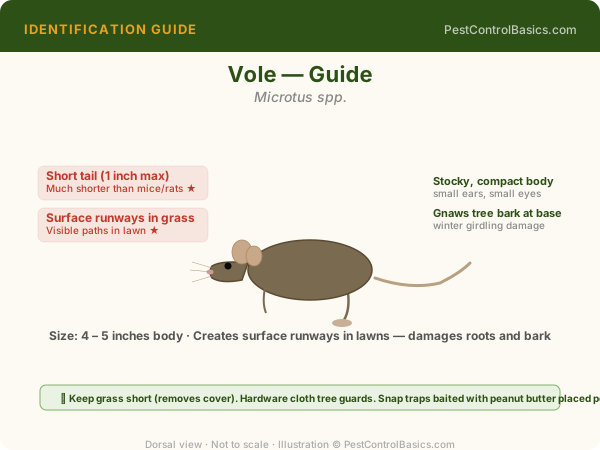
❓ Common Questions About 🐾 Vole vs. Mole — How to Tell Them Apart
How do I confirm I actually have this pest (not something similar)?
The most reliable confirmation is a physical specimen — capture one and compare to reference images on this page. For cryptic pests (bed bugs, termites), look for secondary signs: frass, shed skins, mud tubes, or bites with a specific pattern. When uncertain, a professional inspection is faster than months of misidentification.
Can I treat this myself or do I need a professional?
DIY is effective for small, accessible infestations caught early. Professionals are worth the cost when: the infestation is inside wall voids or structural elements, multiple rooms are affected, you have health-risk pests (hantavirus, venomous species), or DIY has already failed twice.
How long until the infestation is completely gone?
Expect 3–8 weeks for most infestations with proper treatment. Insects with dormant life stages (pupae, eggs) extend the timeline because those stages are impervious to most insecticides. Follow-up treatments at 2 and 4 weeks catch each new cohort as they emerge.
What's the most common mistake people make treating this pest?
Treating only the visible pest population while ignoring the harborage site, entry point, or breeding location. Killing adults provides temporary relief but the population rebuilds from hidden egg cases, pupae, or new arrivals through unaddressed entry points.
Exclusion is the only durable rodent control
Trapping reduces a rodent population temporarily; baiting reduces it more durably; exclusion prevents reinvasion. Without exclusion, every successful control program is on a countdown to reinvasion from the surrounding rodent reservoir. Effective exclusion addresses gaps mice (1/4 inch and larger) and rats (1/2 inch and larger) can squeeze through. Common entry points missed by quick inspections: gaps where utility lines penetrate exterior walls, behind dryer vent flaps, dryer vent screens with corrosion damage, garage door bottom seals (especially at corners), gaps under sill plates, weep holes in brick veneer, and gaps where roof returns meet walls. Steel wool packed into voids and sealed with caulk handles most gaps; hardware cloth (1/4 inch) over larger openings holds long-term. A thorough exclusion pass takes a weekend and provides multi-year benefits.
Reading pesticide labels: what most homeowners miss
The pesticide label is the most important document in any pest control decision, and it's the document most people skim. Under FIFRA (the federal law that governs pesticide registration), the label is legally binding — using a product inconsistent with its label is a violation, regardless of intent. The label has several sections that homeowners should read fully before purchase, not after: the use sites (where it can legally be applied), the target pests (some products legal indoors are not for the specific pest), the mixing rate (overdosing wastes product without improving efficacy and increases drift risk; underdosing accelerates resistance), the PPE requirements (some require respirators, not just gloves), and the re-entry interval (how long until the treated area is safe for people and pets). The signal word — Caution, Warning, Danger — indicates acute toxicity but not chronic risk; that's elsewhere on the label. Reading labels well prevents nearly every common DIY misapplication.
What to do when rodents die inside walls
Rodenticide use occasionally results in rodents dying inside wall voids before they can be removed, producing an odor that lasts days to weeks. The remediation options: locate the carcass if possible (odor concentration helps narrow location, sometimes a flashlight inspection through outlets and switch boxes), remove if accessible, and use enzyme-based odor neutralizers (not air fresheners, which mask) for the duration. For inaccessible carcasses, the odor dissipates as the carcass dries — typically two to four weeks in dry conditions, longer in humid conditions. Activated charcoal bags in the affected room reduce perceptible odor during this period. The takeaway for future treatment: snap traps and bait stations placed in accessible locations (not blind voids) avoid this problem entirely, which is part of why interior treatment usually favors snap traps over bait.
Rodent signs to look for during home inspection
Active rodent presence usually leaves signs that are easy to spot if you know where to look. Droppings — mouse droppings are rice-grain sized, dark and pointed; rat droppings are larger, capsule-shaped. Gnaw marks on edges of doors, window sills, plastic food containers, and wires (chewed insulation is a fire risk). Greasy rub marks along baseboards and floor-wall junctions where rodents repeatedly travel. Nests in attics, basements, garages, and inside seldom-used appliances and stored cardboard. Sound — scratching or scurrying in walls, ceilings, or attics, especially at dusk and dawn. Pet behavior — dogs and cats focused on a wall or appliance often detect rodents people miss. Once signs are confirmed, both treatment and exclusion work need to start, not just one or the other.
Choosing the right product formulation for the situation
Active ingredient gets most of the attention, but formulation often determines outcome. The same active ingredient in different formulations performs very differently: microencapsulated formulations last longer on porous surfaces and reduce human re-entry exposure, wettable powders give the longest residual on porous substrates but leave visible residue, suspended concentrates give a balance of residual and appearance, dusts are uniquely effective in wall voids and dry harborage but should never be broadcast indoors, baits are appropriate when pests must transport active to the colony or nest, and aerosols are appropriate for direct contact and quick knockdown but rarely give meaningful residual. Choosing formulation by the substrate (porous vs. nonporous), the access (open spray vs. crack-and-crevice vs. void), and the goal (knockdown vs. residual vs. transferable) routinely improves outcomes more than upgrading active ingredient.
Rodent bait stations: when they're appropriate and when they aren't
Rodenticide bait stations have a specific role in rodent management but get misused frequently in residential settings. The appropriate use case is exterior, particularly for ongoing rat pressure from outdoor sources — well-secured tamper-resistant stations placed along the foundation perimeter at intervals of 25-50 feet, with regular monitoring of consumption. Interior bait station use is generally inadvisable: rodents that consume bait often die in walls or other inaccessible spots, producing odors that last weeks and attract secondary pests including flies and dermestid beetles. Non-target risk is the other major issue with interior use: pets, children, and protected wildlife can be exposed through the dying rodent or directly. For interior rodent control, trapping is almost always the better choice because dead rodents are removed promptly. Exterior baiting works well for properties with chronic outdoor pressure (commercial buildings, rural homes, properties adjacent to fields or wooded areas) but should always use tamper-resistant stations, not loose bait, to protect non-targets.
When professional treatment is genuinely worth the cost
Professional pest control isn't always the right answer, but several specific situations genuinely justify the cost over DIY treatment. Severe bed bug infestations rarely yield to homeowner treatment because the required combination of vacuuming, encasements, structural treatment, and follow-up monitoring exceeds what most homeowners execute consistently. Subterranean termite treatment requires equipment (subslab injection) and product (commercial-grade termiticide quantities) not accessible to consumers, and inspection findings often dictate specific treatment that homeowners can't do safely. Roof and attic rodent problems benefit from professional exclusion that addresses access points consumers don't find. Mosquito reduction programs using barrier treatments and breeding-site management produce substantially better results than consumer foggers and yard sprays. Persistent cockroach problems in multi-unit buildings need coordination consumers can't provide. The pattern: professional treatment justifies itself when scale, access, regulatory product restrictions, or coordination requirements exceed what DIY can practically accomplish. Routine ant trails, occasional wasp nests, fruit fly outbreaks, and the like remain reasonable DIY targets where the cost-benefit math favors handling it yourself with the right products and information.
Roof rats vs. Norway rats: identification and treatment differences
The two rat species common in U.S. residential settings — Norway rats and roof rats — present meaningful differences in behavior and treatment that affect control strategy. Norway rats are larger, more aggressive, ground- and burrow-dwelling, and prefer protein-rich diets; they're more common in the northeastern and midwestern U.S. and in urban environments. Roof rats (also called black rats or ship rats) are smaller, more cautious, climbing-oriented, and prefer fruits and vegetable matter; they're more common in the southeastern, southwestern, and west coast states and in residential areas with mature trees and vegetation. The behavioral differences drive trapping strategy: Norway rats are caught at ground level along walls and in basement-style locations with peanut butter or meat-based baits, while roof rats are trapped in attics, on rafters and ceiling joists, and along utility lines using fruit, nut butter, or seed-based baits. Misidentification leads to treatment failures because traps placed for ground-dwelling rats won't intercept arboreal roof rats, and vice versa. Identification typically requires seeing droppings (Norway rat droppings are blunt-ended and larger; roof rat droppings are tapered and smaller) or actually seeing animals.
Nesting material identification: a diagnostic many inspectors skip
Rodent nesting material is often distinctive enough to identify the species and sometimes the source. House mice favor shredded paper, fabric, insulation, and pet bedding, and their nests are typically small, compact, and located in concealed voids — between drawers, in stove insulation, behind appliances, in stored linens. Roof rats build larger, more loosely organized nests using similar materials but often higher in the structure, in attics, in palm trees and ivy outside, and in the upper portions of garages. Norway rats nest at or below grade, often in burrows, basements, crawlspaces, and woodpiles, using coarser materials including grass, leaves, and stripped paper. Identifying nesting material during inspection — sometimes by tracking back along grease marks or droppings to a concealed nest — provides both species confirmation and a high-priority cleanup and exclusion target. Removing the nest and sealing the access often does more for long-term control than additional trapping, because nests are positional infrastructure that successive rodent generations will reuse if left intact. Skipping the nest search and focusing only on the trap line is one of the most common reasons that rodent problems recur within months of apparently successful trapping.
How regional pest pressure should shape what you buy
The retail pest control aisle is largely undifferentiated by region, but pest pressure is enormously regional, and the disconnect leads to predictable purchasing mistakes. A homeowner in the Gulf Coast facing year-round subterranean termite pressure and large peridomestic cockroach populations has dramatically different needs from a homeowner in the upper Midwest facing rodent invasion in October and bed bugs in apartments. The product mix that makes sense for each is different, the level of investment that's justified is different, and the cadence of application is different. Generic shopping advice and product reviews tend to wash out these regional patterns by averaging across users. The better approach is to identify the two or three pests that actually drive pressure in your specific area, then build a product and treatment plan around those rather than around the broad category. Local cooperative extension publications, state agricultural department pest fact sheets, and regional pest control company blog content tend to be more useful sources of guidance than national review sites, precisely because they're calibrated to the conditions you're actually treating.
Mouse versus rat behavior: the differences that change treatment
Mice and rats are often grouped together in pest control discussions, but their behavior differs in ways that matter for treatment. Mice are curious and explore new objects in their environment readily, which makes traps and bait stations effective relatively quickly after placement — a mouse will typically investigate a new trap within a few nights. Rats, particularly Norway rats, are neophobic — they avoid new objects in familiar environments for days or weeks before approaching, which means trap placement requires patience and pre-baiting before setting. Mice can squeeze through gaps as small as about a quarter inch; rats need larger openings but can chew through softer materials to enlarge gaps. Mice produce many small droppings spread across foraging areas; rats produce fewer, larger droppings concentrated near nest sites. Mice are largely indoor pests in temperate climates; Norway rats often nest outside and forage inside, which means outdoor habitat management is more relevant for rat control. Treatment that doesn't account for these differences — using mouse traps in rat territory, expecting rapid bait uptake from neophobic rats, or sealing only mouse-sized gaps when rats are the actual problem — produces predictable failure.