HomePest LibraryMole
Lawn Pest — Insectivore, Not a Rodent
🐰

Mole

Scalopus aquaticus & Parascalops breweri

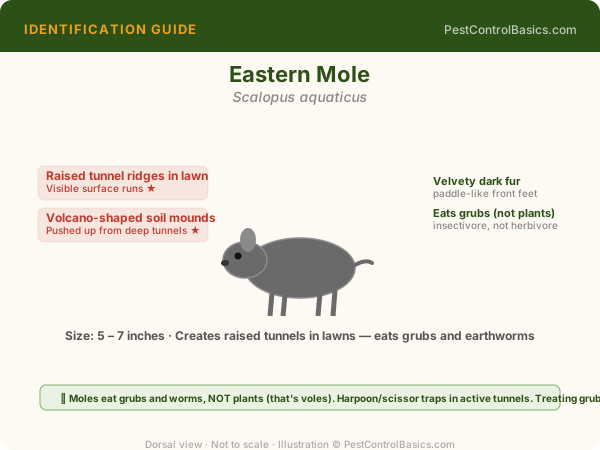
Enormous paddle-shaped front claws, tiny hidden eyes, velvety fur — moles are built for underground life. They eat earthworms and grubs (not plants) and create raised tunnel ridges and volcano-shaped mounds. The Macabee pincer trap in a confirmed main tunnel is the most effective control available.

DietEarthworms and grubs — NOT plants
Tunnel signsRaised ridges + volcano-shaped mounds
vs. VoleMoles: ridges/mounds; Voles: surface runways
Best trapMacabee pincer in confirmed main tunnel
Food reductionGrub control reduces long-term pressure
📐 FIELD GUIDE ILLUSTRATION
Mole identification illustration with labeled anatomical features — PestControlBasics.com

Original illustration by PestControlBasics.com. Use anatomical labels above to confirm your identification. For photo references, see the identification section below.

Biology

What moles actually eat — and why it matters

The most persistent mole myth: that they eat garden bulbs and plant roots. They don't. Moles are insectivores — their diet is almost entirely earthworms, supplemented with beetle grubs and other soil invertebrates. Their saliva contains a toxin that paralyzes earthworms, allowing moles to store live worms in underground "larders."

If your tulip bulbs are disappearing, your garden plants are dying from root damage, or you're seeing surface runways through the lawn — that's voles, not moles. Treating for moles when you have voles is a complete waste of time and money.

Why healthy lawns attract moles: A well-maintained, well-irrigated lawn with good organic matter has an excellent earthworm population. More earthworms = more moles. Moles are actually a sign of good soil biology, which is cold comfort when your lawn looks like a battlefield.

Feeding tunnels vs. main tunnels: The fresh raised ridges you see appearing after rain are shallow feeding tunnels — used once or twice to hunt earthworms near the surface. Main travel tunnels are deeper and reused daily. Trapping in feeding tunnels is largely ineffective. Find and trap main tunnels.

The Macabee Trap

Finding main tunnels and setting the trap correctly

Finding main tunnels: Press down a section of each raised ridge firmly with your foot. Check back in 24 hours. Sections that re-raise are active main tunnels — the mole is clearing the blockage daily. Sections that stay flat are abandoned. Focus all trap effort on re-raised sections.

Macabee placement: Dig into the tunnel just enough to set the trap inside it — the trigger plates sit in the tunnel floor. Set two traps back-to-back facing in opposite directions (the mole approaches from either direction). Cover the opening with soil and a board to block light — moles avoid light and will push through to clear their tunnel, triggering the trap.

Check every 24 hours: Macabee traps are designed to catch and hold — the mole won't decompose the way it would in a snap trap, but daily checking is still best practice.

Grub control: Apply imidacloprid (Scott's GrubEx or similar) in May–June to reduce white grub populations. This reduces the mole food supply and makes the property less attractive after trapping eliminates the current population. It won't solve an active mole problem but reduces re-infestation pressure long-term.

💡 Repellents — Temporarily Effective, Not a Solution

Castor oil-based repellents (Mole-Max, Repellex) create an olfactory deterrent that causes moles to relocate — to adjacent untreated areas. They return when the treatment degrades. Repellents are useful for protecting specific high-value areas temporarily, not for eliminating mole populations.

DG
Derek Giordano
Certified Pest Control Operator · Former Business Owner
Derek ran his own pest control company in Florida for several years, servicing thousands of regular customers. All content is based on hands-on field experience and current EPA & university extension guidelines.

Related Resources

📚 Full Pest Library🧪 DIY vs. Pro Quiz💰 Cost Guide🌿 IPM Guide🔍 Find a Pro
🔮
Reviewed by Derek GiordanoContent on PestControlBasics.com is developed with input from certified pest management professionals and cross-referenced against EPA, CDC, and university extension guidance. Last reviewed: April 2026.
📚 Sources: EPA Termite Guide · NPMA Termite Info
Published: Jan 1, 2025 · Updated: Apr 7, 2026

Sources used across this site

Editorial sources used consistently across this site: the EPA pesticide registration database for current product use directions and active ingredient information; CDC for public health context on pest-borne disease; the National Pesticide Information Center (NPIC) for homeowner pesticide questions; university Cooperative Extension publications (UC IPM, NC State Extension, Penn State Extension, University of Florida IFAS, and others) for region-specific identification and treatment guidance; the National Pest Management Association (NPMA) for industry context; and peer-reviewed entomological literature for biology, resistance management, and emerging issues. Product reviews reflect editorial testing and aggregated user-reported outcomes rather than manufacturer-supplied claims. Where regional information matters, we link to state and local extension publications rather than generalizing across regions.

Working with extension services and public resources

Every state has a Cooperative Extension Service — a university-affiliated public outreach program — and most homeowners don't know it exists. Extension publishes pest fact sheets specific to local conditions, offers free pest identification (often by photo submission), and runs Master Gardener volunteer programs that handle public inquiries. State departments of agriculture license and regulate pest control operators; their websites verify licenses and accept complaints. State and local health departments track vector-borne diseases and publish risk data that's more current than national averages. The EPA's pesticide product database lets you look up registered uses for any product before buying. The National Pesticide Information Center (1-800-858-7378) answers homeowner pesticide questions free of charge. These resources are paid for by taxes already; underusing them in favor of paid services is leaving money on the table.

How to use this guide effectively

This guide is one entry point in a connected library. Each pest profile, treatment guide, and tool on this site links to related references that go deeper than any single page can. Working through a pest problem effectively usually means starting with identification (so you know what you're treating), reading the species-specific treatment guide, checking the product or tool references for specific selection guidance, and confirming approach with the FAQ and troubleshooting sections. Bookmarking a few core references — the species profile, the relevant treatment guide, and one tool that supports the decision-making (product selector, cost estimator, treatment schedule) — gives you a workflow you can return to as the situation evolves. The structure is intentional: surface-level summary first, then increasing depth, with the deepest detail in the dedicated tool and reference pages.

How content is reviewed and updated

Content on this site is reviewed by Derek Giordano, a former pest control company owner and previously licensed Pest Control Operator in Florida with several years of field experience servicing thousands of regular customers. Reviews check treatment recommendations against current EPA-registered products and label use directions, cross-reference major treatment claims against university extension publications and CDC public health guidance, and verify that any product mentions reflect current registration status and reasonable consumer availability. Pages get updated as treatment recommendations evolve — pesticide products are deregistered, resistance patterns shift, regional pest distributions change. The 'Updated' date at the bottom of each page reflects the most recent review pass on that specific page; the site-wide approach to E-E-A-T (experience, expertise, authoritativeness, trustworthiness) follows Google's published guidance on health and safety topics.

Reading pesticide labels: what most homeowners miss

The pesticide label is the most important document in any pest control decision, and it's the document most people skim. Under FIFRA (the federal law that governs pesticide registration), the label is legally binding — using a product inconsistent with its label is a violation, regardless of intent. The label has several sections that homeowners should read fully before purchase, not after: the use sites (where it can legally be applied), the target pests (some products legal indoors are not for the specific pest), the mixing rate (overdosing wastes product without improving efficacy and increases drift risk; underdosing accelerates resistance), the PPE requirements (some require respirators, not just gloves), and the re-entry interval (how long until the treated area is safe for people and pets). The signal word — Caution, Warning, Danger — indicates acute toxicity but not chronic risk; that's elsewhere on the label. Reading labels well prevents nearly every common DIY misapplication.

Integrated pest management for households: the practical hierarchy

Integrated pest management (IPM) is a structured approach to pest control developed for agricultural and commercial settings that translates well to residential use. The hierarchy: prevention first (sanitation, exclusion, habitat modification to make conditions unfavorable for pests), monitoring second (sticky monitors, visual inspection, identifying pests at low population before infestation establishes), targeted intervention third (using the least disruptive effective method against an identified pest in an identified location), and broad chemical treatment last (when targeted approaches have failed or aren't feasible). The hierarchy matters because higher-level interventions are durable and address root causes, while lower-level chemical interventions address symptoms and require repeat application. Most residential pest control reverses this hierarchy — chemical treatment first, sometimes prevention later — and produces the predictable consequence of recurring problems. Households that adopt the IPM hierarchy (often without using the term) generally describe spending less time and money on pest issues over years even though specific incidents might take more thought to address than spray-and-forget approaches.

Reading product labels: the parts that matter and the parts that don't

Pesticide product labels are legal documents with specific use directions, but the parts that matter most for residential decisions aren't always the parts that get attention. The active ingredient and its concentration are essential — they determine what category of pest the product targets and how it compares to alternatives. The 'Directions for Use' section is binding (using a product against label instructions is technically a federal violation and may void product liability), but most homeowners skim it. The 'Precautionary Statements' section tells you exposure risks and required PPE. The 'First Aid' section matters in an emergency. What matters less in practice: marketing copy on the front of the package, brand-specific claims about superiority (federal regulations sharply limit what these can say), and 'natural' or 'organic' labeling (which can be technically accurate while still describing a product with meaningful exposure considerations — pyrethrin from chrysanthemums is 'natural' but still a neurotoxin in concentration). Reading labels critically — focusing on active ingredient, concentration, target pest list, application method, and precautions — gives a clearer picture than retail-shelf comparison ever does.

The role of local cooperative extension in pest decisions

State cooperative extension services — university-based educational and advisory programs in every state — are dramatically underused resources for residential pest decisions. Most state extensions employ entomologists who answer homeowner questions free of charge through county offices, online query forms, or scheduled call hours. The information available is specific to the state's pest pressure, climate, and recommended practices, and is typically much more locally accurate than national resources. Extension publications cover identification, life cycle, treatment options, and specific product recommendations for state conditions; the publications are peer-reviewed by university scientists and updated periodically based on current research. For any pest situation where identification is uncertain or treatment options are unclear, a clear photograph submitted to the state extension produces an identification, a brief biological explanation, and one or more treatment options within typically a few days. The benefit beyond any single inquiry is building familiarity with the local resource — extension contacts become a reference for future situations and produce better decisions than aggregated online advice.

Finding regional pest data sources worth trusting

The quality of pest information available to homeowners varies enormously by source, and finding the reliable sources for your specific region is a one-time investment that pays off across years of pest management decisions. Cooperative extension services associated with land grant universities in each state are usually the highest-quality regional resource, producing fact sheets, identification guides, and treatment recommendations specifically calibrated to local conditions, pest species, and regulatory environments. State department of agriculture pest fact sheets are typically similar in quality and orientation. Local pest control company blog content varies in quality but can be useful when produced by experienced practitioners writing about their actual work rather than generic SEO content. National pest control sites tend to be less useful for the specific reason that they average across regions and don't address the conditions you're actually facing. Bookmarking two or three high-quality regional resources at the outset, and consulting them before making significant pest management decisions, raises the average quality of your decisions dramatically without much ongoing effort.

The economics of preventive versus reactive treatment

Preventive treatment costs money in a year when nothing is happening, which is precisely why most households avoid it. The decision to spend on prevention requires a willingness to compare what you actually spend against a counterfactual you never directly observe — the infestations you would have had without it. This is a hard mental move, and it's why preventive pest control consistently underconsumed relative to its economic value. The way to think about it more clearly is to compute the expected annual cost of treatment for a property like yours given local pest pressure, then compare that against the cost of a preventive program. In most regions and for most property types, a preventive program comes in lower in expected value, sometimes substantially. The variance is also lower: instead of a year with zero pest spending followed by a year with a large unexpected expense, you have a small consistent line item that smooths out the cash flow. For households where unexpected expenses are particularly painful, that variance reduction is itself worth something even before counting the expected-value benefit.

Pest control and HOA dynamics: where they overlap

Homeowners' associations vary widely in how they engage with pest control, and the variations create practical issues that affect individual treatment decisions. Some HOAs maintain common-area pest treatment programs that handle perimeter spraying, mosquito treatment, or rodent monitoring on shared property; others leave all pest control to individual homeowners. Some have rules about treatment products or notification requirements; others don't. Some include treatment in the HOA fee structure; others bill separately. For homeowners in HOA communities dealing with persistent pest pressure, understanding what the HOA does and doesn't do is the first step in figuring out what additional individual action is needed. For HOAs without coordinated programs in areas with significant pressure, organizing a neighborhood-level treatment plan often produces dramatically better results than individual treatment efforts that don't coordinate timing or coverage. The conversations are sometimes politically awkward in HOA contexts, but the underlying problem — that some pests are neighborhood-scale and unit-level treatment can't address them — is structural rather than personal. Bringing the issue to an HOA meeting with concrete proposals tends to produce more constructive responses than complaint-style framing.

🗺️ US Distribution — Mole

image/svg+xml
Common Occasional Not Present
States Present
49
Occasional
2
Primary Region
Continental US
📊 Source: University extension services, USDA, CDC vector data, and published entomological surveys.