The short answer
- No-see-ums are about 1/16 inch or smaller, breed in wet mud and soggy organic matter, bite mostly around dawn and dusk, and leave itchy red welts. They slip through ordinary window screen.[2][3][1]
- Black flies are small, dark flies with a rounded back that breed only in running water, bite in the daytime around the head, hairline, arms and ankles, and are worst in spring.[4][5][7]
- Eye gnats don't bite. They breed in loose, moist, sandy soil with organic matter and persistently feed on eye and nose secretions.[9][3]
- To keep no-see-ums out, Clemson says use screen of 20 x 20 mesh or finer, and Arizona says 30 x 30. Standard 16 x 16 or 18 x 16 screen lets them through but is usually enough for eye gnats.[3][1]
- A ceiling fan or box fan on a porch helps, because these flies are weak fliers and get blown off course. Repellents made for mosquitoes help but often wear off sooner against these flies, so pair them with long sleeves, light colors and a head net.[3][2][5][4]
- Spraying the yard rarely solves it. Biting midges and black flies come from breeding sites you can't reach or treat, often from far away.[3][4][5][2]
Related profiles
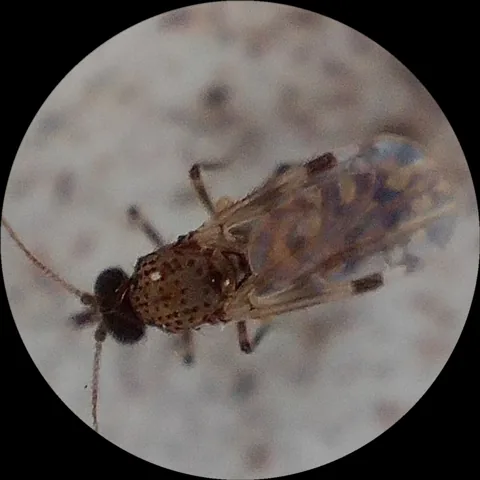 Biting Midges
Culicoides spp.
No-see-ums, also called biting midges, punkies, sand gnats or sand flies, are tiny flies, mostly in the genus Culicoides, whose bites itch intensely; most people feel them without ever seeing them.
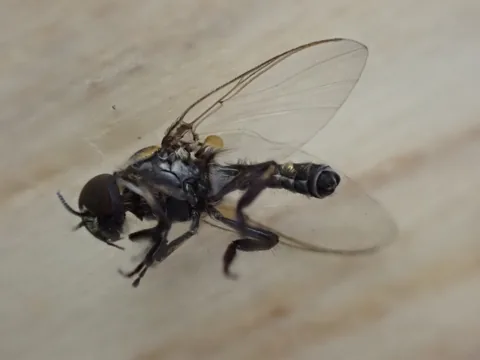 Black Flies
Simulium and related genera (family Simuliidae)
Black flies are tiny, stout, humpbacked biting flies, often called gnats or buffalo gnats. Their larvae live only in running water, and the females swarm around people and animals for blood, mostly in spring and early summer.
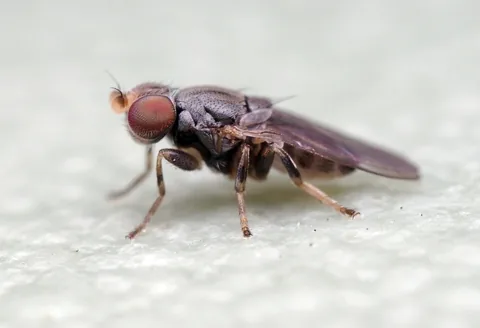 Eye Gnats
Liohippelates collusor and Hippelates species
Female eye gnats persistently feed at the eyes, nose, mouth and open wounds of people and animals, a severe nuisance near breeding sites. They swarm around the head and dart at the face, and brushing them away does little good.
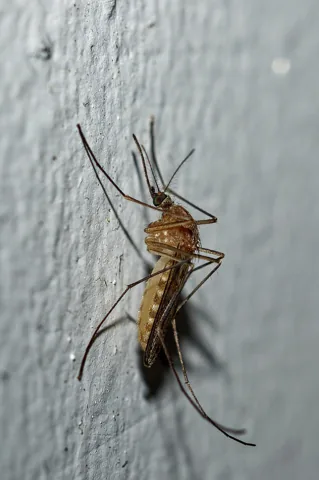 Mosquito
Culicidae (shown: Culex pipiens complex)
Mosquitoes are small, delicate flies whose females feed on blood and can pass on viruses such as West Nile; the control that works best goes after the larvae in standing water.
Which tiny biter is it?
Start with what the fly does and where you are. All three are small enough to be hard to see, but their habits are distinct.[3][9]
- No-see-ums (biting midges, also called punkies, sand gnats or sand flies): family Ceratopogonidae, mostly the genus Culicoides. Tiny dark flies that look like miniature mosquitoes under a lens. You feel the bite but often never see the fly. Common near marshes, swamps, ponds, stream edges and soggy ground.[1][2][3]
- Black flies (buffalo gnats, turkey gnats): family Simuliidae. Stout, dark, with a rounded, humped back, broad wings and short legs. Despite the name, Mississippi State notes some are gray, tan or even greenish. They swarm around the head, crawl into the ears, nose and up sleeves, and bite in daylight near streams and rivers.[4][6][5]
- Eye gnats (grass flies, eye flies): Liohippelates and Hippelates species, family Chloropidae. Shiny black or gray with yellow to orange-brown legs. They hover around the eyes, nose, mouth and any wounds, landing again and again even when brushed away, but don't break the skin.[9][3]
- Not every gnat swarm is a biter. Fungus gnats indoors aren't attracted to eyes, which UC IPM uses to separate them from eye gnats; see small flies in the house for those.[9]
No-see-ums (biting midges): ID, breeding and peak times
Size: Clemson gives about 1/16 inch and Arizona Extension less than 1/16 inch. They're short and stocky with a shiny thorax and are barely visible to the naked eye.[3][2][1]
Only the female bites. Both sexes feed on nectar, but the female needs a blood meal to develop her eggs, and in the genus Culicoides people are often the source.[1][2][3]
- Where they breed: eggs go on wet mud and other dark, damp spots rich in organic matter. Arizona lists the edges of springs, streams and ponds, swampy areas and tree holes, and in towns over-irrigated turf and mulch, poorly drained splash pads, new construction sites, indoor plant pots and water from air conditioners.[1][2][3]
- Larvae live a semi-aquatic life feeding on organic matter. Arizona says they can't survive drying out completely or water more than 2 inches deep, eggs hatch in 2 to 10 days, and the whole life cycle runs about 2 to 6 weeks depending on species and conditions.[1][2]
- How far they travel: females may disperse a little over 1 mile, but Arizona says heavy biting is most likely close to where they emerge.[1]
- When they bite: females feed mainly early and late in the day, around dawn and dusk. Numbers peak in summer, Arizona says mid- to late summer, and in places with warm winters they can be around all year. Clemson notes the first killing frost brings relief.[3][1][2]
Black flies: ID, breeding and peak times
Size: Minnesota Extension gives about 1/16 inch; the Pennsylvania Department of Environmental Protection gives 2 to 5 mm. Only females take blood, and most species feed on birds or other animals rather than people. Pennsylvania DEP estimates about 10% of North American species bite humans.[4][7][5]
- Where they breed: only in flowing water, from tiny spring-fed trickles to large rivers. Larvae cling to rocks and plants in the current and filter food from the water. Pennsylvania DEP says they're not found in lakes, ponds, swamps or other standing water. Large populations often mean clean streams, because most species don't tolerate organic pollution.[7][5][4]
- How far they travel: Minnesota says most adults can fly about 10 miles from where they bred and wind can carry them further.[4]
- Season: spring is the worst in northern states. Simulium venustum, one of New Hampshire's two main human biters, emerges in early to mid-May in the south of the state and late May to early June in the north. Some species have several generations and stay active into summer or fall; Mississippi's pest species show up from March to June.[4][5][6]
- Time of day: black flies are daytime biters and don't bite at night. Minnesota says they are most active a few hours after sunrise and before sunset. New Hampshire puts the peaks at about 9 to 11 a.m. and 4 to 7 p.m., and says they're most active on humid, cloudy days and just before storms.[5][4][6]
- Where they're worst: calm days, sheltered and shady spots, lowlands and dense vegetation. Windy days and open areas bring fewer of them.[4]
Eye gnats: ID, breeding and peak times
Eye gnats are 1/16 to 1/8 inch long. Only females feed at the eyes and wounds; they use spurs on their hind legs to scrape the skin and sponge-like mouthparts to soak up secretions, but they can't cut skin to draw blood.[9][3]
- Where they breed: loose, moist, sandy soil with plenty of fresh organic matter, especially soil that has been dug, plowed or graded. UC IPM says fields where plant waste is tilled in can send large numbers into nearby neighborhoods, and Clemson adds that manure increases breeding.[9][3]
- How far they travel: they aren't strong fliers, but the wind can carry them several miles from breeding sites.[9]
- Season: in warm, dry regions they can be present all year. UC IPM says they're most active between 70 and 90 degrees F and slow down below 70.[9]
- Life cycle: about 28 days on average. A female may lay 200 to 400 eggs just below the surface of freshly turned soil.[9]
What the bites look like and how to care for them
Reactions vary a lot from person to person. Medical and extension sources describe these patterns:[4][7]
- No-see-um bites: usually a small red welt about 1/8 inch across, or a small water-filled blister, that itches intensely. Clemson compares the raised spot to a mosquito bite. Scratched welts can break open and bleed, and sensitive people can have painful, itchy sores that last a long time.[2][1][3]
- Black fly bites: the fly cuts the skin and drinks from the small pool of blood that forms. Bites cluster on exposed skin, especially the head and neck, hairline, arms, ankles and feet, and range from small red spots with little irritation to marked itching and swelling.[7][4][6]
- Black fly fever: Pennsylvania DEP says severe allergic reactions can bring nausea, dizziness and fever. A published case report describes a man bitten many times while camping who developed swelling, swollen lymph nodes, aching joints and a 104 degree F (40 degrees C) fever.[7][16]
- Eye gnats: no bite, but Clemson and UC IPM say they can carry germs on their bodies; Clemson links them to pink eye (acute conjunctivitis).[3][9]
- Home care: wash the bite with soap and water, use a wrapped ice pack, and take an antihistamine or use an anti-itch cream if needed, per MedlinePlus. Arizona Extension says over-the-counter cortisone cream usually relieves the itch and an over-the-counter anti-inflammatory can help with pain or swelling. Watch over the next few days for spreading redness, swelling or pain that could mean infection.[10][1][2]
- Get help: call 911 for signs of a severe whole-body allergic reaction (anaphylaxis), and see a doctor or dermatologist for severe or long-lasting reactions.[10][1][2]
Screen mesh that actually keeps them out
Mesh size is the main reason no-see-ums get indoors. Standard window and door screen is too coarse for them, and they also get through rips and gaps.[1][2]
- For no-see-ums: Arizona says they pass through standard 16 x 16 and 18 x 16 mesh and recommends replacing it with 30 x 30 mesh where possible. Clemson says 20 x 20 mesh or smaller excludes biting midges on porches. The two sources differ, so the finer 30 x 30 is the safer choice where midges are bad.[1][3]
- For eye gnats: Clemson says 18 x 16 mesh is usually enough.[3]
- For black flies: Mississippi State says they hesitate to come indoors, so going inside is a simple escape when they're biting.[6]
- Upkeep: keep doors and windows shut where you can, don't prop doors open, and inspect and repair screens regularly.[1][2]
- Treated screens: Arizona Extension mentions treating existing screens with an approved insecticide such as permethrin. Use only a product whose label lists that use.[2]
Fans and breezes
Moving air is one of the cheapest fixes. Clemson says a ceiling fan on a covered porch or a box fan can keep gnats away because they're small enough to be blown off course, and Arizona Extension suggests fans to keep no-see-ums out of your immediate area.[3][2]
Black flies also struggle in wind. Mississippi State says they have a hard time flying in it and suggests large fans to protect poultry, and Minnesota says they're less of a nuisance on windy days and in open areas. For the same trick against mosquitoes, see the mosquito yard guide.[6][4]
Repellents: what helps and their limits
The repellents used for mosquitoes are the ones that help here. Arizona, New Hampshire and UC IPM all say mosquito repellents work against biting midges, black flies or eye gnats, and New Hampshire names DEET, picaridin and IR3535.[1][5][9]
Expect less from them than against mosquitoes. Arizona Extension says DEET seems only marginally effective against biting midges; Minnesota says repellents are not always effective against black flies; New Hampshire says they don't last as long against black flies; and Mississippi State says DEET may need frequent reapplication.[2][4][5][6]
- Field tests: in Scotland a eucalyptus-based repellent (PMD) and DEET both gave 98% protection from the midge Culicoides impunctatus 8 hours after application. A lemon eucalyptus repellent also held up well against Leptoconops biting midges in California, and four repellents including DEET cut biting by Leptoconops midges in Utah.[13][14][15]
- Labels are written for mosquitoes and ticks. EPA's repellent search tool and protection times cover mosquitoes and ticks, so the hours on a label won't necessarily match how long a product holds off midges or black flies.[12][11]
- Where to apply for black flies: they crawl up sleeves and under socks and trousers, so New Hampshire suggests repellent around the wrists, ankles and belt line.[5]
- Use it safely: put repellent only on exposed skin or clothing, not under clothing; spray your hands first and then apply to the face, keeping it away from the eyes and mouth; and wash it off when you come inside. Some oil of lemon eucalyptus products should not be used on children under 3, so check the label.[11]
- Plant-based products: Arizona says botanical repellents with citronella, eucalyptus or other plant extracts may give some protection. Mississippi State says vanilla extract may help against black flies but hasn't been proven.[2][6]
Clothing and head nets
Covering up works against all three and doesn't wear off.[4][5][1]
- Cover skin: long sleeves, long pants, shoes, socks and a hat. Against black flies, New Hampshire suggests tucking pants into socks or boots and keeping sleeves and shirt fronts closed; zippered shirts keep flies out better than button shirts.[4][5][1][2]
- Wear light colors: black flies are drawn to dark colors such as navy blue. New Hampshire lists orange, yellow and light blue as less attractive than dark green, brown and red, and Arizona advises light-colored clothing for no-see-ums.[4][5][6][1]
- Head nets: a fine-mesh head net or hat netting protects the face and neck, where many bites land. Arizona notes that mesh fine enough to stop no-see-ums is sold for head nets, jackets and pants.[1][2][4][5]
Yard measures and their limits
Unlike mosquitoes, most of these flies don't breed in containers you can dump, and spraying adults gives short relief at best.[3][5][2]
- No-see-ums: Arizona says to hold off irrigation near where bites are heavy and let wet spots drain and dry, which kills eggs and larvae. Fix soggy turf, leaky irrigation, poorly drained splash pads and air-conditioner drips, and don't overwater potted plants. Insecticides against the larvae aren't practical because breeding sites are scattered and hard to reach.[1][2]
- Mosquito dunks: Arizona Extension (one source) suggests dunks that release Bacillus thuringiensis in water features, birdbaths and livestock troughs may also reduce no-see-ums. The no-see-um larvae live mostly in wet mud rather than open water, so don't expect dunks alone to fix a midge problem.[2][1]
- Spraying adults: Clemson says area-wide control of biting midges and eye gnats is nearly impossible, because populations refill quickly from breeding sites and sprays would be needed almost daily.[3]
- Black flies: the larvae are in streams, often miles away. New Hampshire says homeowners shouldn't try to treat streams; the state requires a special permit and commercial license to apply pesticides to surface waters. Fogging adults gives only hours of relief, and Minnesota says no control measure reduces black flies in an area.[5][4]
- Black fly programs: some states run larval control. Pennsylvania DEP sprays Bti, a bacterial insecticide toxic to black fly and mosquito larvae, in its black fly program. It does not treat early-season species, saying treatment would be ineffective against them.[7][8]
- Eye gnats: UC IPM says to cut back on tilling fresh organic matter into beds, keep the soil surface drier, and consider a screen fence or barrier about 8 feet tall, which in research excluded more than 90% of eye gnats because they fly close to the ground.[9]
- Eye gnat traps: UC IPM describes a homemade trap of 4 eggs mixed into a gallon of water, poured into a 2-liter bottle with 3 or 4 holes in its upper third and hung 2 to 3 feet off the ground away from doors and patios. Refresh the bait at least every 14 days. Traps work best alongside repellents.[9]
- Eye gnat insecticides: UC IPM says they're rarely if ever warranted around homes. If used, pyrethrins or spinosad on turf and flowerbeds where adults rest can lower numbers temporarily; treating the soil for larvae doesn't work. With very high numbers, call your county vector control district.[9]
Do they spread disease?
For most people in the United States these flies are a nuisance and an itch rather than a disease risk, but each group has some links to illness.[2][4][9]
- No-see-ums: Arizona Extension says the main human problem is allergic reaction to the bites. Some Culicoides species carry diseases of livestock such as bluetongue in sheep and cattle, and in developing regions biting midges have been linked to parasitic skin infections in people.[2][1][3]
- Black flies: Minnesota says they aren't known to spread disease there, and Pennsylvania DEP says most Pennsylvania species don't feed on people. In tropical regions black flies transmit river blindness (onchocerciasis).[4][7]
- Eye gnats: Clemson links them to pink eye, and UC IPM says they can potentially spread disease organisms.[3][9]
Common questions
- Why can't I see what's biting me?
- Biting midges are about 1/16 inch or smaller and feed mainly at dawn and dusk, so people usually feel the bite and later find itchy red welts without seeing the fly. That's where the name no-see-um comes from.[3][2][1]
- Do no-see-ums get through window screens?
- Yes. They pass through standard 16 x 16 and 18 x 16 mesh. Clemson recommends 20 x 20 or finer and Arizona 30 x 30.[1][3]
- Does a fan keep no-see-ums away?
- It helps. Clemson and Arizona Extension say ceiling or box fans keep these tiny, weak fliers away from a porch or seating area.[3][2]
- Are black flies and no-see-ums the same thing?
- No. Black flies breed only in running water and bite in the daytime, mostly in spring. No-see-ums breed in wet mud and soggy organic matter and bite mostly at dawn and dusk.[7][5][1][3]
- Do eye gnats bite?
- No. They feed on eye, nose and wound secretions and can't cut skin, but they're persistent and may spread germs such as those that cause pink eye.[9][3]
- Does DEET work on no-see-ums and black flies?
- Partly. It helps, but sources say it seems less effective or wears off sooner than against mosquitoes, so pair it with long sleeves, light colors and a head net.[2][5][4][6]
Photo credits
- Biting Midges: Sinaloa Silvestre, public domain (CC0), via iNaturalist
- Black Flies: Stephen James McWilliam, public domain (CC0), via iNaturalist
- Eye Gnats: (c) Tom, some rights reserved (CC BY) — via iNaturalist, CC BY 4.0
- Mosquito: (c) Donald Davesne, some rights reserved (CC BY) — via iNaturalist, CC BY 4.0
Sources
- University of Arizona Cooperative Extension, “Something's Biting Me, but I Can't See It! No-See-Ums (S. Nair, D. H. Gouge, S. Li, 2018).” cales.arizona.edu/apmc/docs/No-See-Ums-IPMShort.pdf (accessed 2026-11-10)
- University of Arizona Cooperative Extension, Yavapai County, “"No-See-Um" Biting Flies, Backyard Gardener #59 (adapted from J. Schalau, 2023).” extension.arizona.edu/sites/extension.arizona.edu/files/barnesm/No-See-Um.pdf (accessed 2026-11-10)
- Clemson Cooperative Extension Home & Garden Information Center, “Gnats, HGIC 2489 (J. Ballew, 2018).” hgic.clemson.edu/factsheet/gnats/ (accessed 2026-11-10)
- University of Minnesota Extension, “Black flies (J. Hahn, reviewed 2024).” extension.umn.edu/yard-and-garden-insects/black-flies (accessed 2026-11-10)
- University of New Hampshire Extension, “Black Flies [fact sheet].” extension.unh.edu/resource/black-flies-fact-sheet (accessed 2026-11-10)
- Mississippi State University Extension, “What to Do about Black Flies (Buffalo Gnats), P3755 (J. Goddard).” extension.msstate.edu/publications/what-do-about-black-flies-buffalo-gnats (accessed 2026-11-10)
- Pennsylvania Department of Environmental Protection, “Black Fly Biology and Life History.” www.pa.gov/agencies/dep/programs-and-services/bureau-of-labs/vector-management/black-fly/biology (accessed 2026-11-10)
- Pennsylvania Department of Environmental Protection, “Bacillus thuringiensis israelensis (Bti).” www.pa.gov/agencies/dep/programs-and-services/bureau-of-labs/vector-management/black-fly/bti (accessed 2026-11-10)
- UC Statewide IPM Program, “Eye Gnats, Pest Notes (J. A. Bethke).” ipm.ucanr.edu/home-and-landscape/eye-gnats/ (accessed 2026-11-10)
- MedlinePlus, U.S. National Library of Medicine, “Insect bites and stings, Medical Encyclopedia.” medlineplus.gov/ency/article/000033.htm (accessed 2026-11-10)
- U.S. Environmental Protection Agency, “Using Insect Repellents Safely and Effectively.” www.epa.gov/insect-repellents/using-insect-repellents-safely-and-effectively (accessed 2026-11-10)
- U.S. Environmental Protection Agency, “Find the Repellent that is Right for You.” www.epa.gov/insect-repellents/find-repellent-right-you (accessed 2026-11-10)
- Journal of the American Mosquito Control Association (PubMed 8827615), “Trigg JK. Evaluation of a eucalyptus-based repellent against Culicoides impunctatus (Diptera: Ceratopogonidae) in Scotland. J Am Mosq Control Assoc 1996;12(2 Pt 1):329-30.” pubmed.ncbi.nlm.nih.gov/8827615/ (accessed 2026-11-10)
- Journal of the American Mosquito Control Association (PubMed 17067050), “Carroll SP, Loye J. Field test of a lemon eucalyptus repellent against Leptoconops biting midges. J Am Mosq Control Assoc 2006;22(3):483-5.” pubmed.ncbi.nlm.nih.gov/17067050/ (accessed 2026-11-10)
- Journal of Medical Entomology (PubMed 7616521), “Perich MJ et al. Field evaluation of four repellents against Leptoconops americanus (Diptera: Ceratopogonidae) biting midges. J Med Entomol 1995;32(3):306-9.” pubmed.ncbi.nlm.nih.gov/7616521/ (accessed 2026-11-10)
- BMC Infectious Diseases (PubMed 32414336), “Tabatabaei F et al. Blackfly fever and dermatitis caused by Simulium kiritshenkoi: a human case report in Iran. BMC Infect Dis 2020;20(1):348.” pubmed.ncbi.nlm.nih.gov/32414336/ (accessed 2026-11-10)