The short answer
- Once a week, empty and scrub, turn over, cover or throw out anything that holds water: tires, buckets, planters, toys, pools, birdbaths, flowerpot saucers and trash containers.[7][12]
- Clean clogged gutters and downspouts, keep rain barrels tightly covered or screened, drain tarps, and fill water-holding tree holes with expanding foam.[1][16][7]
- Treat water you can't dump or cover, such as ponds, rain barrels or an unused pool, with a Bti larvicide like mosquito dunks. Bti kills mosquito larvae and is not toxic to people.[7][14][18]
- Keep mosquitoes out of the house with repaired window and door screens, and close doors.[7]
- Protect yourself with an EPA-registered repellent and long sleeves, especially when the mosquitoes in your area are biting.[3][1]
- Treat yard sprays as short-term relief. Barrier sprays fade, mosquitoes fly back in, and the insecticides can harm bees, butterflies and aquatic life.[3][4]
- Skip bug zappers, ultrasonic repellers and citronella plants. Studies and extension services find they don't reduce bites.[1][3][21]
- If mosquitoes are bad across the neighborhood, call your local mosquito control district or health department.[13]
Mosquito profiles
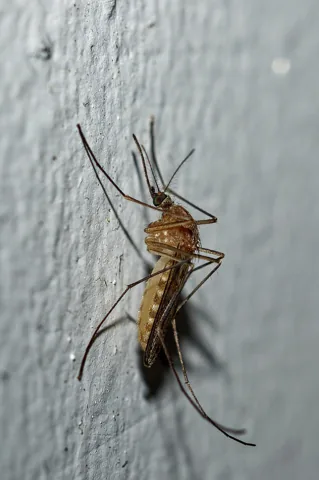 Mosquito
Culicidae (shown: Culex pipiens complex)
Mosquitoes are small, delicate flies whose females feed on blood and can pass on viruses such as West Nile; the control that works best goes after the larvae in standing water.
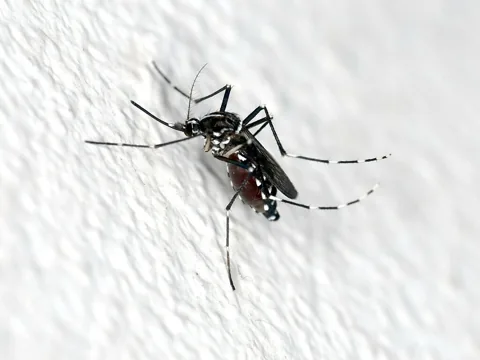 Asian Tiger Mosquito
Aedes albopictus
The Asian tiger mosquito is an invasive, aggressive mosquito that bites during the day and breeds in small water-holding containers around homes. First found at a tire dump near Houston in 1985, it spread rapidly through the southern United States and up the East Coast.
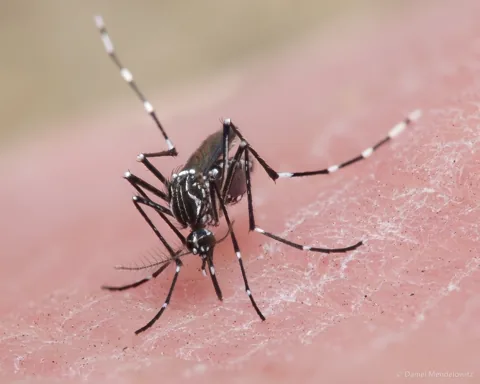 Yellow Fever Mosquito
Aedes aegypti
The yellow fever mosquito, Aedes aegypti, is a container-breeding mosquito that lives close to people and prefers to bite them. It lives indoors and outdoors, and the CDC calls it the main type of mosquito that spreads Zika, dengue and chikungunya viruses.
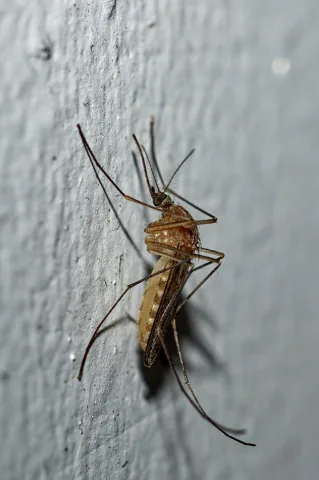 Northern House Mosquito
Culex pipiens
The northern house mosquito, Culex pipiens, is often the most common pest mosquito in cities and suburbs. It bites from dusk to dawn, breeds in stagnant and polluted water, and is a major carrier of West Nile virus in North America.
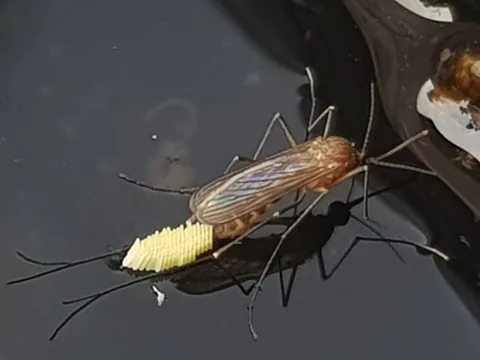 Southern House Mosquito
Culex quinquefasciatus
The southern house mosquito bites in the evening, at night and in the early morning, and Texas A&M calls it the most important carrier of West Nile virus and St. Louis encephalitis, especially in the eastern U.S. It prefers birds but will come through unscreened windows and open doors to bite sleeping people.
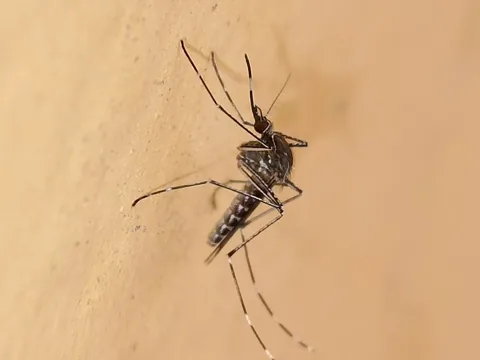 Western Encephalitis Mosquito
Culex tarsalis
The western encephalitis mosquito, Culex tarsalis, is the main mosquito that carries West Nile virus to people in the western United States. It feeds on birds, where the virus multiplies, and also on people and horses.
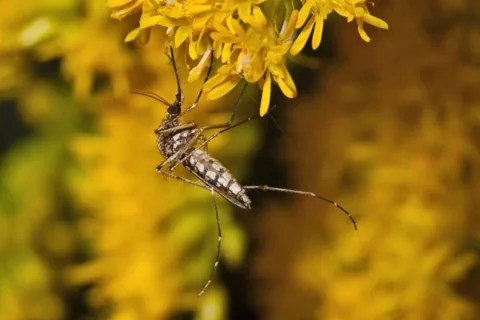 Inland Floodwater Mosquito
Aedes vexans
The inland floodwater mosquito is one of the most widespread pest mosquitoes in the world. Its eggs wait in dry ground for months or years, then hatch in huge numbers when rain or floodwater covers them.
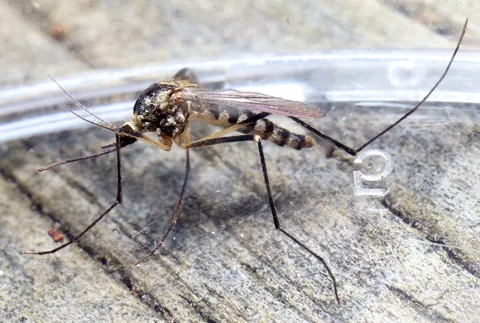 Eastern Treehole Mosquito
Aedes triseriatus
The eastern treehole mosquito is an aggressive daytime biter in and near deciduous woods and the primary vector of La Crosse virus. It lays its eggs in water held in tree holes and in containers, especially discarded tires.
Why standing water comes first
Every mosquito starts in water. Eggs hatch into larvae (wigglers), which become pupae (tumblers), and both stages live in water until the adult flies off. In summer the whole cycle can take a week or less, depending on water temperature, according to UC IPM. CDC gives 7 to 10 days from egg to adult for Aedes and Culex mosquitoes, and UW-Madison Extension roughly a week and a half to two weeks.[1][8][9][3]
That timing is why sources say to check for standing water weekly. Texas A&M AgriLife Extension notes mosquitoes breed especially in water that stands for at least 7 days, and that larvae feed on bacteria and other microorganisms in stagnant water with leaves, soil, droppings or grass clippings in it. Running streams and maintained swimming pools usually don't produce mosquitoes.[2][4]
UC IPM calls methods aimed at larvae the most effective controls. Removing water also reduces the need for sprays: CDC says controlling larvae and pupae can minimize the need for widespread use of insecticides that kill adult mosquitoes.[1][12]
Your yard isn't the only source. UC IPM says some adult mosquitoes can fly several miles from where they develop, so clearing your own yard may not end the biting. CDC asks households, neighbors and whole communities to take these steps.[1][7]
Step 1: Dump, scrub and drain every week
Walk the yard once a week. The full checklist, with rain barrels, ponds and pools, is in our guide to stopping mosquito breeding; these are the sources people miss most often.[7][12]
- Containers: buckets, cans, jars, flowerpot saucers, toys, wheelbarrows and tarps. Turn them over, cover them, drill drainage holes in containers you must store, or throw them away. UC IPM says even a bottle cap of water can support Aedes larvae.[7][2][5][1]
- Scrub, don't just dump: Aedes mosquitoes glue their eggs to the inside walls of containers just above the waterline. CDC says the eggs can survive drying out for up to 8 months, and weekly scrubbing removes them from the container walls.[8][16]
- Birdbaths, pet dishes and watering troughs: change the water every week.[1][7]
- Tires: old tires make excellent breeding sites. Cover them, store them where they can't fill with water, or get rid of them. The Asian tiger mosquito reached the United States in used tires.[2][7][5]
- Gutters and downspouts: leaves and twigs that block flow leave standing water where larvae grow. UC IPM says to remove gutter and downspout debris annually; clogged gutters are a listed breeding site for both the Asian tiger mosquito and the northern house mosquito.[1][5][6]
- Tree holes: if a hole in a trunk or branch holds water, CDC says to fill it with expanding foam made for home insulation. Don't use gravel, sand or concrete, and don't drill drain holes, which can damage the tree. Holes that stay dry can be left for wildlife.[16]
- Rain barrels and cisterns: cover them tightly, or screen openings with mesh smaller than an adult mosquito. Keep filters clean and check for leaks.[7][1][4]
- Pools and kiddie pools: drain and turn over small plastic pools when not in use. Keep chemical treatment up in swimming pools and keep water off pool covers.[7][1]
- Lawn and irrigation: avoid overwatering, keep irrigation systems in working order, and fill holes or low areas that hold water with sand or gravel.[1][2]
- Septic systems: repair cracks or gaps in the tank and cover open vent or plumbing pipes with mesh smaller than an adult mosquito.[7]
Step 2: Treat water you can't drain with Bti
Bti (Bacillus thuringiensis subspecies israelensis) is a soil bacterium sold as floating dunks, bits and granules. Larvae die after eating it. EPA says it affects only the larvae of mosquitoes, black flies and fungus gnats, has no toxicity to people, has minimal toxicity to honey bees, and has no documented resistance.[1][18][14]
Use it where water can't be dumped, covered or removed: ornamental ponds, water gardens, rain barrels, catch basins, unused pools and tree holes. Texas A&M AgriLife says Bti products are safe around pets and don't hurt fish or birds.[14][12][19][2]
- How long it lasts: one EPA-stamped dunk label says each dunk releases Bti for 30 days under typical conditions, at a rate of one dunk per 100 square feet of water surface (a quarter dunk for up to 25 square feet). Allow at least 48 hours for control, and replace dunks through the season.[19][1][2]
- What it won't do: Bti doesn't kill pupae, which don't feed, and it doesn't kill biting adult females. The label notes that some larvae hatching after treatment may partly develop before dying.[1][14]
- Other larvicides: methoprene is an insect growth regulator that stops larvae from becoming adults, and some formulations last more than 30 days. Spinosad is another bacterial-derived option. CDC notes the related bacterium Lysinibacillus sphaericus doesn't work on Aedes aegypti.[2][14][4]
- Big water: Clemson says dunks are for small containers, tree holes and ponds, and large bodies of water should be treated only by mosquito control professionals. Don't apply larvicide to finished drinking water.[5][19]
- Fish: mosquito-eating fish can control larvae in isolated ponds. Penn State says to avoid introducing non-native species and follow state fish rules; UC IPM says mosquitofish are illegal to release into California's natural waters, and many vector control districts supply them.[4][1]
- Moving water: UW-Madison Extension suggests a fountain or small pump to keep a permanent pond's water moving.[3]
Daytime biters vs dusk biters: Aedes and Culex
Which mosquitoes bite you, and when, changes what works. CDC says over 200 kinds of mosquitoes live in the United States and its territories, and about 12 spread germs. This page focuses on the two groups that breed around homes.[13]
- Aedes (Asian tiger and yellow fever mosquitoes): container breeders that lay eggs in buckets, bowls, tires, vases and anything else holding a little water. Clemson calls the Asian tiger mosquito the most common daytime-biting mosquito in the Carolinas, feeding mainly in daylight. CDC says Aedes mosquitoes can bite during the day and night, and Aedes aegypti lives indoors and outdoors while Ae. albopictus lives outdoors.[8][11][5]
- Aedes stay close to home. CDC says they fly only a few blocks in their lifetime, and Texas A&M AgriLife says they tend to live and bite within 200 to 300 yards of where they bred. Clemson's older fact sheet disagrees on distance, saying they can fly several miles and that one abandoned house or trash-filled yard can infest a whole neighborhood. Clemson adds that night fogging by control agencies often misses them because they are active by day.[8][2][5]
- Culex (northern and southern house mosquitoes, western encephalitis mosquito): lay rafts of 100 to 300 eggs on the surface of stagnant water, including storm drains, catch basins, ditches, unmaintained pools and septic seepage. CDC says adults are most active from dusk to dawn, rest by day in grass, shrubs and thick vegetation, and have been known to fly up to 2 miles.[9][6]
- Rutgers describes the northern house mosquito as usually the most common pest mosquito in urban and suburban settings and an indicator of polluted water nearby. Some Culex prefer to bite birds, which matters for West Nile virus.[6][9]
- Floodwater mosquitoes: UC IPM says some species lay eggs in moist soil or containers that won't hatch until flooding, months or even years later, and UW-Madison Extension says some species in Wisconsin can fly or be blown in from over 10 miles away. UC IPM says this is why even successful larval control on your own property may not end the biting.[1][3]
- Practical upshot: for evening Culex biters, limit time outdoors at dusk and in early morning and put screens and fans where you sit. For daytime Aedes biters, removing breeding containers matters most, in your yard and your neighbors'.[1][9][4][5][7]
Step 3: Protect yourself and keep them out of the house
Even a well-kept yard will have some mosquitoes, so personal protection does a lot of the work. UW-Madison Extension calls a completely mosquito-free yard all summer an unrealistic expectation.[3]
- Repellents: use EPA-registered products with DEET, picaridin, IR3535 or oil of lemon eucalyptus and follow the label. Our repellent guide compares them.[3][1]
- Clothing: wear long sleeves and long pants. UW-Madison Extension says mosquitoes are more attracted to dark clothing. Permethrin is used on clothing, never on skin; see the permethrin clothing guide.[3][1]
- Timing: UC IPM says some species are active at dawn and dusk and others through the day, so learn when they bite in your area.[1]
- Screens and doors: install or repair window and door screens, don't prop doors open, and use air conditioning when possible.[7]
- Indoors: CDC says mosquitoes that get inside can rest under sinks, in showers and closets and lay eggs in vases and flowerpot saucers, so empty and scrub those weekly too. Indoor sprays alone won't keep a home mosquito-free.[7]
Fans: a cheap fix for patios
UW-Madison Extension says mosquitoes, with their small body mass, have a hard time flying in a breeze, and suggests setting up a fan or two. Penn State Extension lists electric fans where people gather after dusk as one of its recommended steps.[3][4]
Research on this is limited. A 2002 field study in a Michigan wetland blew air through a DEET-treated screen with an electric fan toward a person and cut mosquito landings by 75% compared with no wind or DEET. That test combined wind with DEET vapor, so it doesn't measure a plain fan alone.[20]
Barrier sprays, foggers and misting systems
Yard spray services and DIY products put pyrethroid insecticides on shrubs, foliage and surfaces where adult mosquitoes rest. Our barrier spray guide covers products, timing and how to choose a service. The short version:[3][2]
- Relief is temporary. UW-Madison Extension says barrier and perimeter treatments reduce mosquito activity for a short time but don't address where mosquitoes develop, so populations return. Texas A&M AgriLife says residual sprays can suppress mosquitoes for up to a month, and foggers for several hours or more, which makes foggers best used just before an outdoor event.[3][2]
- Pollinators: barrier treatments stay on plants for days to weeks. UW-Madison Extension says some studies found monarchs and honey bees harmed several weeks after a treatment, and Texas A&M AgriLife rates the long-lasting pyrethroid sprays in its table as high risk to beneficial insects.[3][2]
- If you spray: CDC says don't apply adulticides to plants in bloom or plants that bees, butterflies and other pollinators visit, don't spray fruits and vegetables, and keep people and pets out until the spray has dried, usually about an hour. Texas A&M AgriLife suggests spraying in the evening.[15][2]
- Water and streams: Penn State says pyrethroids are very toxic to many aquatic organisms, can stay active one to two months, and persist longer in stream sediments. It says to avoid treating areas next to waterways or plants that pollinators visit.[4]
- Resistance: repeated use can make mosquitoes resistant to these insecticides.[2][17]
- Focus the spray: CDC says mosquitoes rest under plants, in dense brush and tall grass, on leaf undersides, under eaves, decks and porches, and in moist, shady spots. Penn State says to treat only those resting sites rather than the whole lawn.[15][4]
- Misting systems: CDC does not recommend timed misting systems for homeowners or residential areas. They spray whether or not mosquitoes are present, can hit pollinators and people, and CDC says no effectiveness data are collected on them. UC IPM also advises against systems that continuously release insecticide.[17][1]
- Hiring a service: UW-Madison Extension suggests asking whether the applicator is certified, inspects for standing water, which active ingredient and rate they use, the re-entry interval, and how they protect pollinators and nearby water.[3]
Mosquito traps: what the evidence says
Traps can catch a lot of mosquitoes without making much difference to how often you get bitten.[1][2]
- Carbon dioxide and scent traps: Texas A&M AgriLife says these must be at least as attractive as a person and run continuously while mosquitoes are active, and results vary with wind. UC IPM says they capture only a small proportion of the mosquitoes they attract, and a single trap may not be enough because adults disperse widely.[2][1]
- Egg-laying (gravid) traps: these containers of water attract females looking for a place to lay eggs. Penn State says community-wide use can give some relief with little effect on other insects, working best against short-range container breeders like the Asian tiger mosquito, and typically when at least 80% of homes in a neighborhood use at least two traps each. UC IPM likewise says 2 or more traps per yard are needed.[4][1]
- Retail ovitraps: Texas A&M AgriLife says few are on the market and they haven't been thoroughly tested.[2]
- Sugar-bait sprays: attract-and-kill products mixing sugar water with an insecticide haven't been well tested, though Texas A&M AgriLife says the idea shows some promise.[2]
What doesn't work
Many backyard gadgets and remedies are sold on claims that haven't held up. Our bug zapper and electronic repeller guide goes through the evidence in more detail.[3]
- Bug zappers: UC IPM calls them counterproductive because many of the insects they kill prey on mosquitoes. Texas A&M AgriLife says they kill many beneficial insects and don't control the females of biting species.[1][2][3]
- Ultrasonic and electronic repellers: a 2007 Cochrane review found 10 field studies, and all 10 found no difference in the number of mosquitoes caught on people's bare skin with or without the device. UC IPM and UW-Madison Extension also say they don't work.[21][1][3]
- Citronella plants: UW-Madison Extension says citronella's repellent compounds are released only when the plant is crushed or processed into oil, not from simply growing it. UC IPM lists the so-called mosquito plant (Pelargonium x citrosum) as ineffective.[3][1]
- The studies agree: a 1996 field test against Aedes mosquitoes found no significant difference between people treated with the citrosa plant and untreated people, while 75% DEET cut biting by over 90% for up to 8 hours. A 2026 California field study found neither citronella-scented geranium nor prostrate rosemary reduced mosquito catches, even with the leaves damaged.[23][22]
- Citronella candles and coils: UW-Madison Extension says their effectiveness is often very limited, and UC IPM says they work best when there's little air movement. In a 1998 Illinois field test, topical DEET beat every non-topical product tried, including a sonic repeller, an ultraviolet killing grid, citronella candles and the citrosa plant; smoke coils and a DEET-impregnated wristband did reduce landings compared with no treatment.[3][1][24]
- Garlic and vitamin B: UW-Madison Extension says research hasn't found evidence they reduce mosquito attraction, and UC IPM lists vitamin B1 and brewer's yeast with garlic as ineffective.[3][1]
Working with your mosquito control district
Mosquito control in the United States is mostly handled locally, by county or city governments and mosquito control districts, and what they offer varies a lot from place to place. UC IPM notes that some low-density areas of California have no organized mosquito control at all.[13][1]
Programs use integrated mosquito management: trapping and identifying mosquitoes, testing them for viruses, removing breeding sites, treating larvae, and spraying adults when surveillance shows rising numbers or virus activity.[12]
- Report problems: if you notice a lot of mosquitoes, or standing water you can't fix yourself, such as a drainage ditch, call your local mosquito control district or program or your local or state health department.[13][1]
- Ask what's being used: your district or health department can tell you which products are being applied in your area. EPA says to watch local news and social media for announced aerial spraying dates.[13][18]
- Services: districts may treat storm drains and other public water, collect dumped tires, and run cleanup events. UC IPM says many districts supply mosquitofish for ponds and neglected pools.[12][1]
- Large water on your land: for agricultural areas, low-lying pastures or wastewater sites on or near your property, CDC suggests contacting your district or a licensed professional.[9]
- Support community programs: CDC says acting quickly when infected mosquitoes are found can stop further spread.[13]
Disease risk, per CDC
Most mosquitoes are a nuisance, but some carry disease. Here's what CDC and UC IPM say about the main threats in the United States.[13][1]
- West Nile virus: CDC calls it the leading cause of mosquito-borne disease in the contiguous United States. It cycles between birds and mosquitoes, especially Culex, and people are dead-end hosts. There's no vaccine or medicine to prevent it in people, so preventing bites is the best protection.[10][1]
- Symptoms: UC IPM says about 80% of infected people have no symptoms, about 20% get mild illness such as fever, headache, body aches and sometimes a rash, and about 1 in 150 develop serious neurological illness that can be fatal.[1]
- Other Culex-borne viruses: CDC says Culex mosquitoes in U.S. states can also spread St. Louis encephalitis and eastern equine encephalitis viruses.[9]
- Dengue, Zika and chikungunya: spread by Aedes aegypti and Aedes albopictus, the container breeders that can bite day or night. CDC says these mosquitoes prefer to bite people and live near them.[11]
- Pets: mosquitoes also transmit dog heartworm.[1][5]
A season plan
- At the start of the season: clean gutters, fill tree holes, cover or screen rain barrels, and get rid of old tires and containers. CDC says Aedes eggs can survive drying out for up to 8 months, and even a winter in the southern United States.[1][16][8]
- Every week through the season: dump, scrub and drain; change birdbath and pet water; check tarps and saucers.[7][3]
- Every 30 days: replace Bti dunks in water you can't drain.[19][2]
- Before an event: a fogger or a single targeted spray of resting sites can give short-term relief. Keep it off blooming plants.[2][3][15]
- All season: repellent, long sleeves, screens and a fan on the patio. Call your district when the problem is bigger than your yard.[3][7][13]
Common questions
- What is the best way to get rid of mosquitoes in my yard?
- Remove or treat their breeding water. Empty and scrub containers weekly, clear gutters, and use Bti dunks in water you can't drain. Sprays against adults give only temporary relief.[1][7][3]
- Do mosquito yard sprays work?
- For a while. Barrier sprays cut mosquito activity for days to a few weeks, but mosquitoes move back in and the pyrethroids used can harm bees, butterflies and aquatic life. A one-time spray before an event is more defensible than a regular schedule.[3][2][4]
- Are mosquito dunks safe for pets, fish and birds?
- Yes, used as labeled. Bti affects only mosquito, black fly and fungus gnat larvae; EPA says it has no toxicity to people, and Texas A&M AgriLife says it doesn't hurt fish or birds and is safe around pets.[18][2]
- Why do mosquitoes bite me during the day?
- Daytime biters are usually Aedes, such as the Asian tiger mosquito. They breed in small containers and stay within a few blocks, so check your yard and your neighbors' for water-holding items.[5][8][11]
- Do citronella plants keep mosquitoes away?
- No. Field studies found no reduction in bites or mosquito catches near citronella-scented plants, and extension services say the oil only works when it's extracted.[23][22][3]
- Do mosquito traps work?
- Not well on their own. Carbon dioxide traps catch a small share of the mosquitoes they attract. Egg-laying traps help only when most homes in a neighborhood use them.[1][4]
Photo credits
- Mosquito: (c) Donald Davesne, some rights reserved (CC BY) — via iNaturalist, CC BY 4.0
- Asian Tiger Mosquito: (c) Rafael Carbonell Font, some rights reserved (CC BY) — via iNaturalist, CC BY 4.0
- Yellow Fever Mosquito: (c) Dan Mendelowitz, some rights reserved (CC BY) — via iNaturalist, CC BY 4.0
- Northern House Mosquito: (c) Donald Davesne, some rights reserved (CC BY) — via iNaturalist, CC BY 4.0
- Southern House Mosquito: (c) Lek Khauv, some rights reserved (CC BY) — via iNaturalist, CC BY 4.0
- Western Encephalitis Mosquito: (c) Diego López, some rights reserved (CC BY) — via iNaturalist, CC BY 4.0
- Inland Floodwater Mosquito: Dennis White, public domain (CC0), via iNaturalist
- Eastern Treehole Mosquito: (c) Chris Baer, some rights reserved (CC BY) — via iNaturalist, CC BY 4.0
Sources
- University of California Statewide IPM Program, “Pest Notes: Mosquitoes (Home and Landscape).” ipm.ucanr.edu/home-and-landscape/mosquitoes/ (accessed 2026-11-10)
- Texas A&M AgriLife Extension Service, “Do-It-Yourself Backyard Mosquito Control (ENTO-054).” agrilifeextension.tamu.edu/wp-content/uploads/2025/07/Mosquitoes-Backyard-Mosquito-Control-1.pdf (accessed 2026-11-10)
- University of Wisconsin-Madison Extension, “Making Informed Mosquito Control Decisions.” hort.extension.wisc.edu/articles/making-informed-mosquito-control-decisions/ (accessed 2026-11-10)
- Penn State Extension, “Watershed Friendly Mosquito Control.” extension.psu.edu/watershed-friendly-mosquito-control (accessed 2026-11-10)
- Clemson Cooperative Extension Home & Garden Information Center, “Asian Tiger Mosquito (HGIC 2471).” hgic.clemson.edu/factsheet/asian-tiger-mosquito/ (accessed 2026-11-10)
- Rutgers University Center for Vector Biology, “Culex pipiens: The Northern House Mosquito.” vectorbio.rutgers.edu/outreach/species/cxpip.htm (accessed 2026-11-10)
- Centers for Disease Control and Prevention, “Mosquito Control at Home.” www.cdc.gov/mosquitoes/mosquito-control/mosquito-control-at-home.html (accessed 2026-11-10)
- Centers for Disease Control and Prevention, “Life Cycle of Aedes Mosquitoes.” www.cdc.gov/mosquitoes/about/life-cycle-of-aedes-mosquitoes.html (accessed 2026-11-10)
- Centers for Disease Control and Prevention, “About Culex Mosquitoes.” www.cdc.gov/mosquitoes/about/life-cycle-of-culex-mosquitoes.html (accessed 2026-11-10)
- Centers for Disease Control and Prevention, “West Nile: Causes and How It Spreads.” www.cdc.gov/west-nile-virus/causes/index.html (accessed 2026-11-10)
- Centers for Disease Control and Prevention, “How Dengue Spreads.” www.cdc.gov/dengue/transmission/index.html (accessed 2026-11-10)
- Centers for Disease Control and Prevention, “What Mosquito Control Programs Do.” www.cdc.gov/mosquitoes/mosquito-control/mosquito-control-programs.html (accessed 2026-11-10)
- Centers for Disease Control and Prevention, “Mosquito Control in a Community.” www.cdc.gov/mosquitoes/mosquito-control/mosquito-control-in-a-community.html (accessed 2026-11-10)
- Centers for Disease Control and Prevention, “Larvicides.” www.cdc.gov/mosquitoes/mosquito-control/larvicides.html (accessed 2026-11-10)
- Centers for Disease Control and Prevention, “Adulticides.” www.cdc.gov/mosquitoes/mosquito-control/adulticides.html (accessed 2026-11-10)
- Centers for Disease Control and Prevention, “Fill Tree Holes to Reduce Mosquitoes.” www.cdc.gov/mosquitoes/mosquito-control/fill-tree-holes-to-reduce-mosquitoes.html (accessed 2026-11-10)
- Centers for Disease Control and Prevention, “Misting Systems for Mosquitoes.” www.cdc.gov/mosquitoes/mosquito-control/misting-systems-for-mosquitoes.html (accessed 2026-11-10)
- U.S. Environmental Protection Agency, “Bti for Mosquito Control.” www.epa.gov/mosquitocontrol/bti-mosquito-control (accessed 2026-11-10)
- U.S. EPA Pesticide Product Label System, “Dunks (Bti) master label, EPA Reg. No. 6218-87 (EPA-stamped, Feb. 11, 2026).” www3.epa.gov/pesticides/chem_search/ppls/006218-00087-20260211.pdf (accessed 2026-11-10)
- Journal of Medical Entomology, abstract via PubMed, “Hoffmann & Miller 2002, Reduction of mosquito attacks on a human subject by combination of wind and vapor-phase DEET repellent.” pubmed.ncbi.nlm.nih.gov/12495196/ (accessed 2026-11-10)
- Cochrane Database of Systematic Reviews, abstract via PubMed, “Enayati et al. 2007, Electronic mosquito repellents for preventing mosquito bites and malaria infection (Cochrane review).” pubmed.ncbi.nlm.nih.gov/17443590/ (accessed 2026-11-10)
- Journal of Medical Entomology, abstract via PubMed, “Novelo et al. 2026, Evaluation of 2 ornamental plants, citronella-scented geranium and prostrate rosemary, for spatial repellency of host-seeking mosquitoes.” pubmed.ncbi.nlm.nih.gov/42535915/ (accessed 2026-11-10)
- Journal of the American Mosquito Control Association, abstract via PubMed, “Matsuda et al. 1996, Essential oil analysis and field evaluation of the citrosa plant Pelargonium citrosum as a repellent against Aedes mosquitoes.” pubmed.ncbi.nlm.nih.gov/8723261/ (accessed 2026-11-10)
- Journal of the American Mosquito Control Association, abstract via PubMed, “Jensen et al. 2000, Field efficacy of commercial antimosquito products in Illinois.” pubmed.ncbi.nlm.nih.gov/10901639/ (accessed 2026-11-10)