The short answer
- Expect temporary relief. Texas A&M says residual sprays can suppress mosquito activity for up to a month; UW-Madison Extension says barrier treatments reduce activity for a short time and populations can return.[1][2]
- Field trials agree they work for a while against the Asian tiger mosquito. In Kentucky, yards treated with bifenthrin or lambda-cyhalothrin had 85.1 and 89.5% fewer Asian tiger mosquito bites than untreated yards, and in New Jersey a lambda-cyhalothrin barrier kept the reduction above 70% for 2 to 4 weeks.[10][11]
- The sprays also kill pollinators and other beneficial insects. Spray in the evening, keep spray off blooming plants, and skip areas next to water.[1][3][4][7]
- Reducing standing water and managing mosquito habitat are the most effective ways to lower mosquito numbers; sprays don't replace them.[2][5][9]
- A single treatment before an outdoor event may be warranted when mosquitoes are bad, but regularly scheduled sprays all season raise concerns for non-target insects.[2][5]
Mosquitoes these sprays target
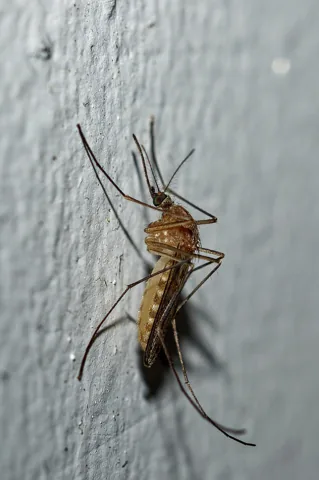 Mosquito
Culicidae (shown: Culex pipiens complex)
Mosquitoes are small, delicate flies whose females feed on blood and can pass on viruses such as West Nile; the control that works best goes after the larvae in standing water.
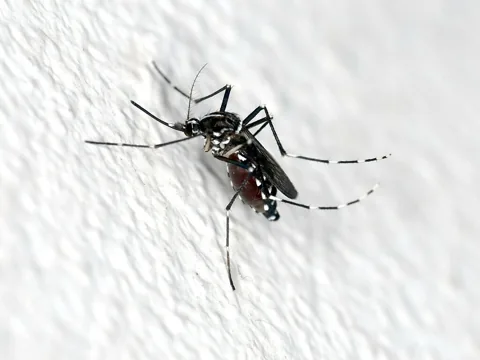 Asian Tiger Mosquito
Aedes albopictus
The Asian tiger mosquito is an invasive, aggressive mosquito that bites during the day and breeds in small water-holding containers around homes. First found at a tire dump near Houston in 1985, it spread rapidly through the southern United States and up the East Coast.
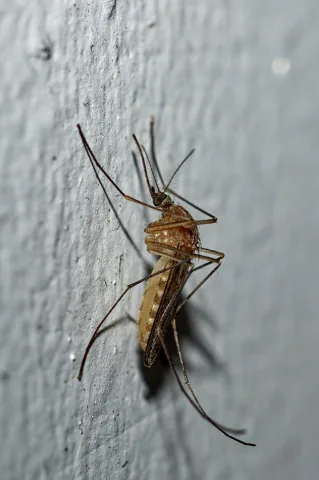 Northern House Mosquito
Culex pipiens
The northern house mosquito, Culex pipiens, is often the most common pest mosquito in cities and suburbs. It bites from dusk to dawn, breeds in stagnant and polluted water, and is a major carrier of West Nile virus in North America.
What a barrier spray is
Barrier treatments are applied to vegetation and surfaces around buildings to create a treated zone that affects mosquitoes, and other insects, when they land. They typically use pyrethroid products that stay active for several weeks, depending on the formulation, and the same products are usually labeled for other yard and household pests too.[2][7]
The targets are mosquito resting sites: the sides of the house, doorways, tall grass, shrubs and even backyard trees.[1]
CDC lists more of the places mosquitoes rest: under plants, in dense brush and tall grass, on the undersides of leaves on trees and bushes, under eaves, under decks and porches, and in moist, shady areas. Penn State adds woodpiles, hollow trees, crawlspaces and basements.[7][3]
CDC notes that residual spraying is not often used by local government mosquito control districts; it is more commonly done by pest control professionals.[7]
Pyrethroids are synthetic insecticides modeled on pyrethrins, natural compounds from chrysanthemum flowers, and were developed to last longer. Both are harmful to many beneficial insects. Residual products Texas A&M lists include cyfluthrin, deltamethrin and lambda-cyhalothrin.[2][1][7][3]
How well and how long they work
Professional mist blowers push spray several yards into the air and through dense foliage and tree canopies. Hose-end and pump sprayers have a harder time reaching the undersides of leaves and deep foliage, but even do-it-yourself treatments can reduce biting mosquitoes for days.[1]
Field studies of professional barrier treatments show what a well-applied spray can do. A University of Kentucky study treated 24 suburban properties with bifenthrin or lambda-cyhalothrin at their maximum label concentrations. Treated yards had 85.1 and 89.5% fewer Asian tiger mosquito bites than untreated ones, and in lab tests, treated leaves still showed significant activity against that mosquito up to 6 weeks after spraying.[10]
The same Kentucky study found that neither insecticide reduced Culex mosquitoes, including Culex pipiens, one of the two species that dominated the traps. The authors concluded that sprays on low vegetation don't properly target where Culex rest by day, and suggested that treating the upper tree canopy might reduce them.[10]
In New Jersey, Rutgers researchers found that a lambda-cyhalothrin barrier, alone or with the growth regulator pyriproxyfen, cut adult Asian tiger mosquitoes by 74 to 78 percent compared with untreated yards and kept the reduction above 70% for 2 to 4 weeks. Pyriproxyfen alone did not reduce adult numbers. A North Carolina study likewise found fewer host-seeking mosquitoes, mostly Asian tiger mosquitoes, at yards sprayed with bifenthrin than at unsprayed ones.[11][12]
Sources differ on how long a treatment lasts. Texas A&M says up to a month; UW-Madison says the pyrethroids can stay active for several weeks but reduce mosquito activity only for a short time; the Kentucky leaf tests showed residual activity up to 6 weeks; and the New Jersey trial met its effectiveness threshold for 2 to 4 weeks. Texas A&M notes that residual life varies with temperature, sunlight, water and the surface the spray lands on.[1][2][10][11]
The residue is meant to stay on plants and surfaces for days to weeks. Studies have found detectable residues on vegetation, highest in treated yards, with smaller amounts sometimes nearby.[2]
More residue did not mean fewer mosquitoes in the North Carolina study: the amount of bifenthrin measured on leaves from treated yards was not correlated with mosquito numbers.[12]
Adults are the hardest mosquito stage to control because they are mobile, widely spread and rest in protected spots, so adult treatments need large amounts of insecticide over large areas to work.[3]
Mosquitoes also move back in. Some Wisconsin species can fly or be blown in from more than 10 miles away.[2]
UW-Madison says new mosquitoes can quickly move into treated areas, and Penn State notes that many species have long flight ranges and can find resting sites elsewhere.[2][3]
UC IPM's summary: outdoor sprays and repellent devices vary widely in effectiveness, give only a temporary drop in adult mosquitoes, and have no lasting effect.[5][4]
The trade-offs
- Beneficial insects: pollinators and predatory insects often live in the same shady, leafy places mosquitoes rest, and the same sprays harm them.[4][1]
- Lingering exposure: insects that land on treated plants can be exposed, some residue levels have been high enough to suggest risk to pollinators, and studies have found monarchs and honeybees harmed several weeks after a barrier treatment.[2]
- Streams: even with careful application, pesticides sometimes move off target into creeks, streams and other water. Pyrethroids are very toxic to many aquatic organisms, including the stoneflies, caddisflies and mayflies at the base of stream food webs; they break down more slowly in water and persist longer in sediments. EPA adds that permethrin is very highly toxic to fish.[3][6]
- Resistance: using these insecticides repeatedly can lead some mosquitoes to develop resistance.[1][3][8]
- Resistance isn't a given after one season. A North Carolina study of a neighborhood with bifenthrin barrier sprays found no bifenthrin resistance in the mosquitoes it caught, though the authors said more study is needed on how resistance changes with repeated applications.[12]
- Unknowns: UW-Madison Extension notes that several common pyrethroids, including bifenthrin, cyfluthrin and lambda-cyhalothrin, are considered PFAS compounds, and the impact of regular yard applications is not known.[2]
If you spray
- Read the label and follow it; it sets where you can spray, how much, and the precautions.[1][6][7][5]
- Spray in the evening and keep spray off blooming plants to reduce harm to beneficial insects.[1][7]
- CDC's label-following basics for homeowners: don't apply more product than recommended or reapply more often than the label allows, don't spray fruits and vegetables in the garden, and keep people and pets out of the treated area until the spray has dried, usually about an hour.[7]
- Treat only where adult mosquitoes rest or shelter during the day, such as shrubs, tall grass and piles of wood or debris. Leave out areas next to streams and ponds, and plants that pollinators visit.[3][1][7]
- Spraying around doorways can help keep mosquitoes from getting into the house.[1]
- Spraying is one step, not the plan. CDC's home control steps start with emptying and scrubbing, turning over, covering or throwing out anything that holds water once a week.[9]
- If you'd rather hire it out, UNH Extension suggests a licensed professional applicator.[4][7]
Questions to ask a mosquito spray service
UW-Madison Extension suggests asking these before you sign up, and being wary of all-natural claims.[2]
- Are you certified to apply pesticides? Do you follow integrated pest management and inspect for standing water and other breeding habitat?[2]
- What is the active ingredient, how does it work, and how long will it last, including after rain?[2]
- What is the re-entry interval, and what precautions apply afterward for irrigation, pets and people?[2]
- How much product will you apply for the size of the area? Can I see the label and safety data sheet before you spray?[2]
- How will you protect pollinators and other beneficial insects, and any nearby water?[2]
Automatic misting systems
Outdoor residential misting systems spray pesticide in a fine mist through nozzles mounted around the house, yard or fence. EPA says some are turned on at preset intervals by a timer and others by a remote or a switch; CDC describes them as spraying at timed intervals from nozzles along the eaves, fencing or landscaping. The products used most often contain pyrethrins and permethrin, sometimes with piperonyl butoxide.[6][8]
EPA does not expect risks of concern to people when these chemicals are used in outdoor residential systems according to labeling for that use. But pyrethrins and permethrin can kill honeybees, lady beetles, butterflies and other non-target insects, and permethrin is very highly toxic to fish.[6]
CDC does not recommend misting systems for homeowners or residential areas. They spray on a schedule rather than when mosquitoes are present, can spray while bees and butterflies are active, can expose neighbors, landscapers, children and pets who don't know when they will go off, and can coat outdoor furniture and toys if poorly maintained. Users also can't monitor for resistance.[8]
Evidence that they work is thin. EPA says residential misting systems haven't been studied enough to document their effectiveness against mosquitoes, and CDC says mosquito control professionals don't collect data on it. UC IPM says systems that continuously release small amounts of insecticide are not recommended, and Texas A&M calls them expensive and controversial and says continual use may contribute to resistant mosquitoes.[6][8][5][1]
EPA does not regulate the misting equipment itself. Some states restrict certain pesticides or any pesticides in residential misting systems or require posted signs, so check with your state pesticide agency first.[6][8]
- Use installers who meet your state's licensing and certification rules, and have the system calibrated to no more than the label's maximum daily rate.[6]
- Keep nozzles less than 10 feet off the ground and aimed away from eating areas, pools, fish ponds and air-conditioner intakes; lock the reservoir away from children.[6]
- Add wind, rain and motion sensors where practical, set timers for when people and pets aren't around, and don't run it in wind over 10 mph, rain, fog, or below 50°F.[6]
Common questions
- How long does a mosquito barrier spray last?
- Estimates run from 2 to 4 weeks to about a month. Texas A&M says residual sprays can suppress mosquito activity for up to a month, UW-Madison says the pyrethroids can stay active for several weeks, and field trials found good control for 2 to 4 weeks in New Jersey and leaf residues still active up to 6 weeks in Kentucky. Mosquitoes return because the sprays don't touch breeding sites.[1][2][11][10]
- Are barrier sprays safe for bees and butterflies?
- They are broad-spectrum insecticides, so they can kill pollinators that visit or rest on treated plants, sometimes for weeks afterward. If you spray, do it in the evening and keep it off blooming plants.[2][1][4][7]
- Do barrier sprays work on every kind of mosquito?
- Not equally. In a Kentucky trial, sprays on low vegetation cut Asian tiger mosquito bites sharply but did not reduce Culex mosquitoes; the authors said those sprays don't properly target where Culex rest by day.[10]
- Do natural mosquito yard sprays work?
- Be wary of all-natural claims. EPA hasn't evaluated the risks or effectiveness of minimum-risk pesticides used in misting systems.[2][6][8]
- Should I install an automatic mosquito misting system?
- CDC does not recommend misting systems for homeowners or residential areas, and EPA says their effectiveness hasn't been documented. If you install one anyway, check your state's rules first and follow EPA's installation and use precautions.[8][6]
Photo credits
- Mosquito: (c) Donald Davesne, some rights reserved (CC BY) — via iNaturalist, CC BY 4.0
- Asian Tiger Mosquito: (c) Rafael Carbonell Font, some rights reserved (CC BY) — via iNaturalist, CC BY 4.0
- Northern House Mosquito: (c) Donald Davesne, some rights reserved (CC BY) — via iNaturalist, CC BY 4.0
Sources
- Texas A&M AgriLife Extension, “ENTO-054: Do-It-Yourself Backyard Mosquito Control (June 2016).” agrilifeextension.tamu.edu/wp-content/uploads/2025/07/Mosquitoes-Backyard-Mosquito-Control-1.pdf (accessed 2026-11-10)
- University of Wisconsin-Madison Extension, Wisconsin Horticulture, “Making Informed Mosquito Control Decisions (published August 6, 2026).” hort.extension.wisc.edu/articles/making-informed-mosquito-control-decisions/ (accessed 2026-11-10)
- Penn State Extension, “Watershed Friendly Mosquito Control (updated June 15, 2026).” extension.psu.edu/watershed-friendly-mosquito-control (accessed 2026-11-10)
- University of New Hampshire Extension, “Dealing with Backyard Mosquitoes (July 2018).” extension.unh.edu/blog/2018/07/dealing-backyard-mosquitoes (accessed 2026-11-10)
- University of California Statewide IPM Program, “Pest Notes: Mosquitoes (Home and Landscape).” ipm.ucanr.edu/home-and-landscape/mosquitoes/ (accessed 2026-11-10)
- U.S. Environmental Protection Agency, “Mosquito Misting Systems.” www.epa.gov/mosquitocontrol/mosquito-misting-systems (accessed 2026-11-10)
- Centers for Disease Control and Prevention, “Adulticides (June 25, 2026).” www.cdc.gov/mosquitoes/mosquito-control/adulticides.html (accessed 2026-11-10)
- Centers for Disease Control and Prevention, “Misting Systems for Mosquitoes (May 14, 2024).” www.cdc.gov/mosquitoes/mosquito-control/misting-systems-for-mosquitoes.html (accessed 2026-11-10)
- Centers for Disease Control and Prevention, “Mosquito Control at Home (April 16, 2024).” www.cdc.gov/mosquitoes/mosquito-control/mosquito-control-at-home.html (accessed 2026-11-10)
- Journal of Medical Entomology (PubMed 17547233), “Trout RT, Brown GC, Potter MF, Hubbard JL. Efficacy of two pyrethroid insecticides applied as barrier treatments for managing mosquito populations in suburban residential properties. J Med Entomol 2007;44(3):470-7.” pubmed.ncbi.nlm.nih.gov/17547233/ (accessed 2026-11-10)
- Journal of Medical Entomology (PubMed 29244157), “Unlu I, Williams GM, Rochlin I, et al. Evaluation of lambda-cyhalothrin and pyriproxyfen barrier treatments for Aedes albopictus management in urbanized areas of New Jersey. J Med Entomol 2018;55(2):472-476.” pubmed.ncbi.nlm.nih.gov/29244157/ (accessed 2026-11-10)
- Pest Management Science (PubMed 26174607), “VanDusen AE, Richards SL, Balanay JA. Evaluation of bifenthrin barrier spray on foliage in a suburban eastern North Carolina neighborhood. Pest Manag Sci 2016;72(5):1004-12.” pubmed.ncbi.nlm.nih.gov/26174607/ (accessed 2026-11-10)