The short answer
- Read the label first. EPA's 2013 bee language for non-agricultural products says not to apply while bees are foraging, not to apply to plants that are flowering, and to apply only after all the flower petals have fallen off.[1][2][9]
- Mow flowering weeds such as white clover and dandelions before you treat a lawn. In a University of Kentucky study, bumble bee colonies that foraged on blooming clover in clothianidin-treated turf produced no new queens, while colonies put on the same turf after it was mown and had reflowered showed no adverse effects.[7][8][13]
- When you have a choice, pick a lower-hazard formulation. UC IPM ranks baits, granules and pellets lowest, and dusts, wettable powders, microencapsulated products, dry flowables and liquids labeled F or L highest, because their small particles stick to bee hairs and get carried back to the hive.[6][7][9]
- Apply when few bees are foraging, such as early morning or late evening, not when the wind is over 5 to 6 miles per hour, and never onto hives, nest sites or water that bees drink from.[7][4][9]
- If you think a pesticide killed bees, report it to your state pesticide regulatory agency, which can investigate. EPA also accepts bee kill reports.[3][1][10]
Bees around the home
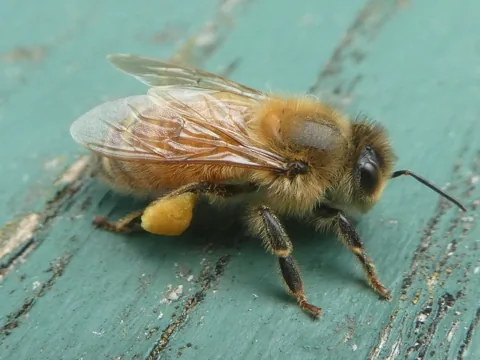 Western Honey Bee
Apis mellifera
Honey bees are important pollinators, but a colony that moves into a wall void or attic can become a stinging hazard. A swarm is temporary and usually best left alone, while an established colony in a building should be removed along with its comb.
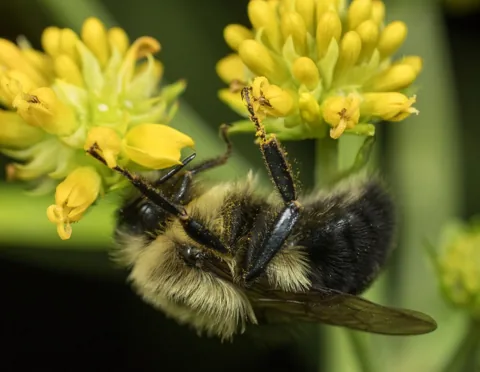 Common Eastern Bumble Bee
Bombus impatiens
Bumble bees are social bees that form annual colonies in soil cavities, old rodent burrows and similar voids; they are valuable pollinators and defend their nests only when disturbed.
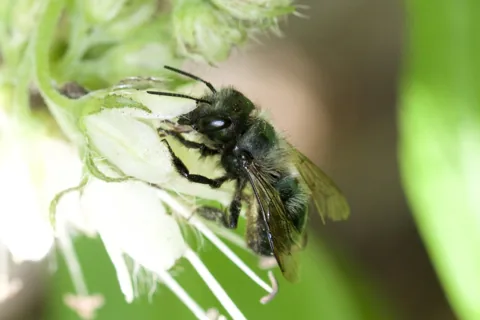 Mason Bees
Osmia species (e.g., O. lignaria, the blue orchard bee)
Mason bees are solitary native bees that nest in existing holes and crevices, walling off each egg chamber with mud. They are gentle, active only in early spring, and prized as fruit-tree pollinators, so they are worth welcoming rather than controlling.
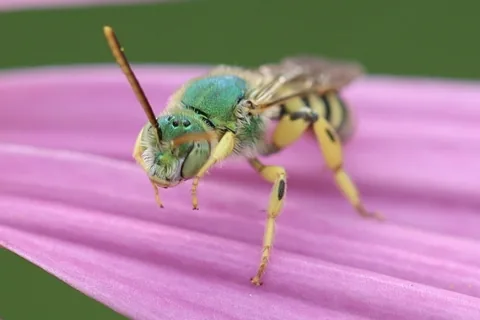 Sweat Bees
Family Halictidae (e.g., Halictus, Lasioglossum and Agapostemon)
Sweat bees are small native bees, many of them shiny metallic green or blue, that are drawn to human perspiration for its moisture and salt. They are not aggressive and are important pollinators of wildflowers and crops.
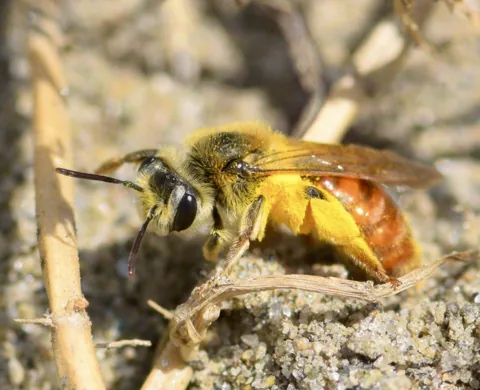 Mining Bees
Andrena species
Mining bees, genus Andrena, are solitary native bees that nest in the ground, often in dense spring aggregations in lawns and bare soil. They pollinate spring flowers and fruit crops, aren't aggressive, and Penn State says they aren't considered pests.
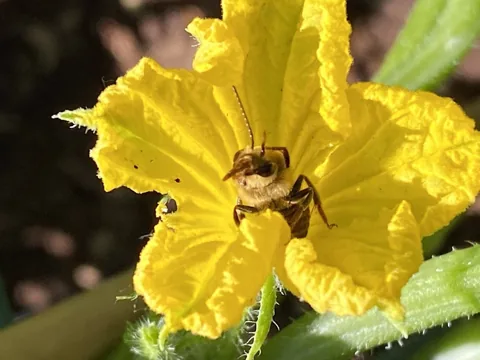 Squash Bees
Xenoglossa pruinosa (formerly Peponapis pruinosa)
Squash bees are native, solitary bees that collect pollen only from squash, pumpkin and gourd flowers, and they are usually the first bees in the blossoms at sunrise.
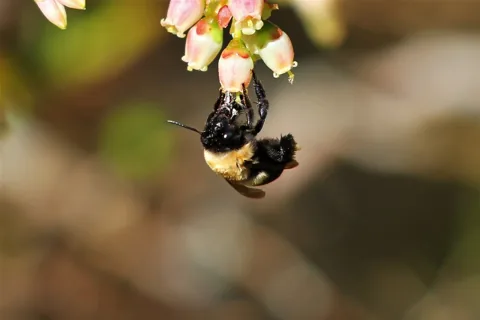 Southeastern blueberry bee
Habropoda laboriosa
The southeastern blueberry bee is a native, solitary bee that specializes in blueberry flowers. It looks like a small bumble bee, flies only around blueberry bloom, and shakes pollen loose by buzz pollination, which makes it a highly efficient blueberry pollinator.
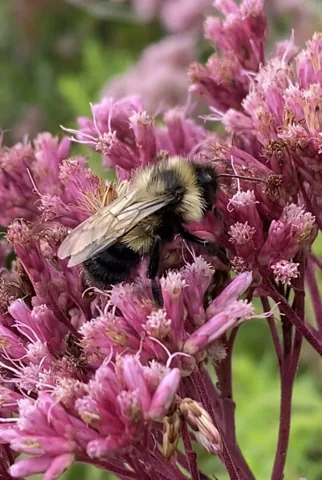 Rusty-patched bumble bee
Bombus affinis
The rusty patched bumble bee was once common across the northern part of eastern North America. The U.S. Fish and Wildlife Service listed it as endangered in 2017, making it the first federally protected bumble bee and the first bee on the endangered species list, and it now survives in low numbers in a small part of its former range.
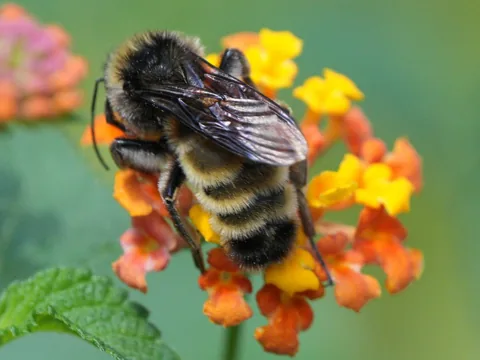 American bumble bee
Bombus pensylvanicus
The American bumble bee was once one of the most common and widespread bumble bees in the eastern and southeastern United States. MDC puts its North American decline at nearly 90 percent between 2000 and 2020, and the U.S. Fish and Wildlife Service cites a 2014 assessment that found an 89 percent drop in abundance relative to other bees sharing its habitat. Losses are worst in the northern part of its range.
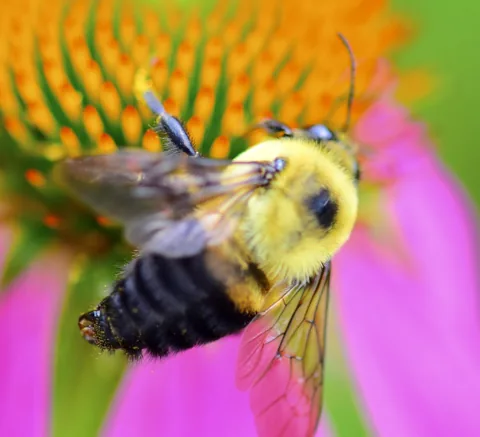 Brown-belted bumble bee
Bombus griseocollis
The brown-belted bumble bee takes its name from a thin belt of rusty or reddish-brown hair across the second segment of its abdomen. It has one of the largest ranges of any U.S. bumble bee, from coast to coast, and UW-Madison describes its populations as stable, even in highly urbanized landscapes; an Indiana study of museum records going back to the early 1900s found the share of counties where it occurs has risen over time.
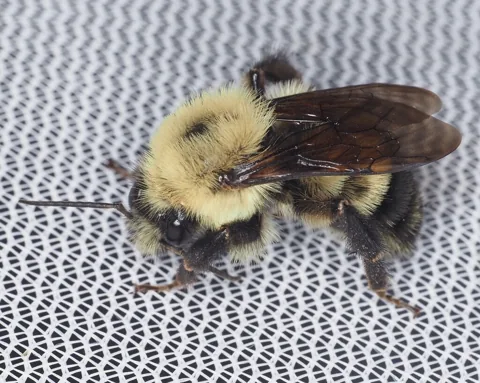 Two-spotted bumble bee
Bombus bimaculatus
The two-spotted bumble bee is a common bumble bee of the eastern United States, with a yellow W on its second abdominal segment that looks like a pair of spots. Its queens are the first bumble bees out in spring, and while several bumble bees have declined, this one has held steady or increased in Wisconsin and Indiana and has spread into new parts of Canada.
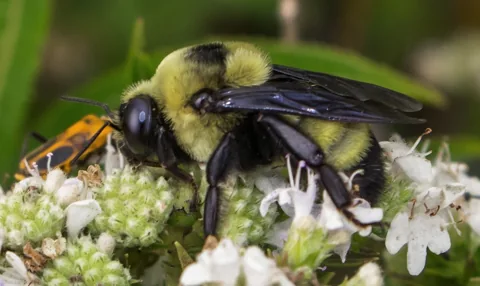 Black-and-gold bumble bee
Bombus auricomus
The black-and-gold bumble bee is one of the largest bumble bees in Wisconsin, and UW-Madison says one flying past your head sounds like a helicopter. It is a bee of prairies, pastures and other open, flower-rich ground, and it is relatively common in Missouri. It closely resembles the American bumble bee, a species of conservation concern.
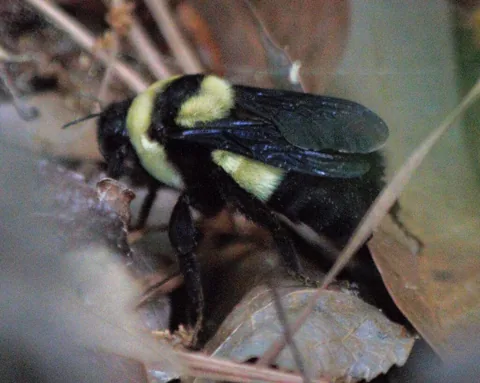 Southern plains bumble bee
Bombus fraternus
The southern plains bumble bee is a prairie specialist: in Missouri it is usually found only in native prairie. Once widespread across the eastern United States and into northeastern Mexico, it has been declining since the early 20th century, partly because nearly all native prairie has been converted to farmland, and it has been proposed for listing as federally endangered.
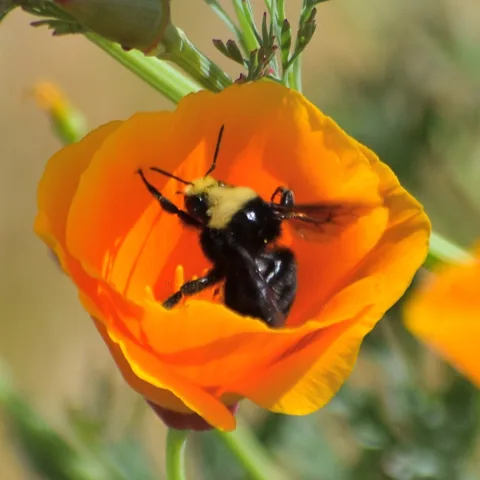 Yellow-faced bumble bee
Bombus vosnesenskii
The yellow-faced bumble bee, also called the Vosnesensky bumble bee, is a very common bumble bee of coastal California, Oregon and Washington, and the Forest Service guide suggests it may even be increasing. It is also one of three bumble bee species sold commercially in North America for pollination.
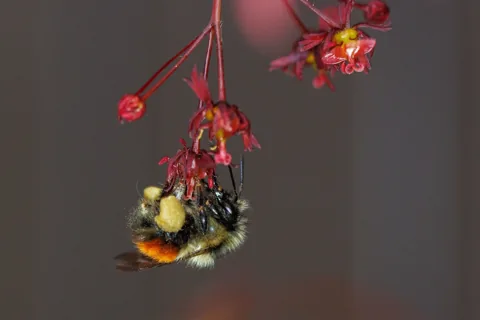 Black-tailed bumble bee
Bombus melanopygus
The black-tailed bumble bee is a common bumble bee from the Pacific coast east to the Colorado Rocky Mountains. It comes in two color forms: in most of California the middle of the abdomen is black, while farther north and east the same segments are orange-red, and the two forms meet in southern Oregon and northern California.
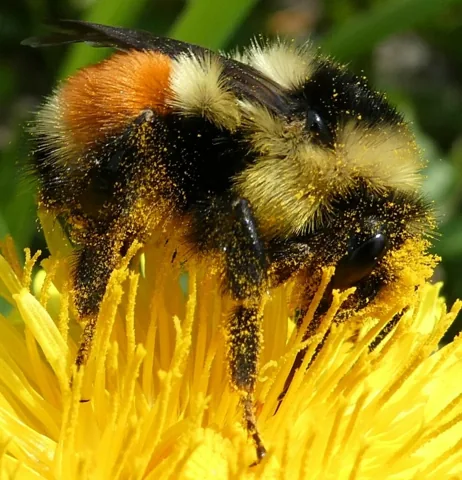 Tri-colored bumble bee
Bombus ternarius
The tri-colored bumble bee wears yellow, orange and black: a yellow thorax and first abdominal segment, two orange segments behind them, then a yellow band and a black tip. The Forest Service guides call it common in the eastern United States but rare in the West, and Wisconsin's bumble bee guide rates it generally stable.
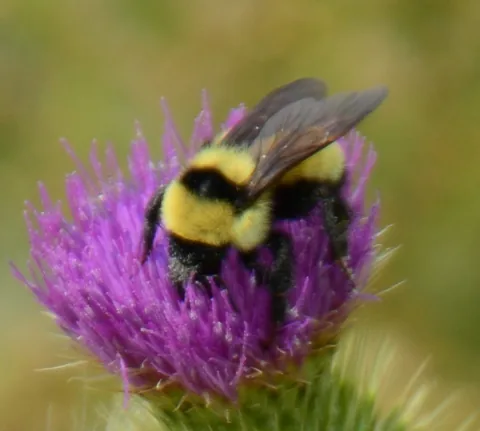 Golden northern bumble bee
Bombus fervidus
The golden northern bumble bee, called the yellow bumble bee in the Forest Service and University of Wisconsin guides, is almost entirely yellow except for the end of its abdomen. It is found across most of the continental United States except west of the Sierra-Cascade crest; the western guide calls it common, but in the East it may be declining.
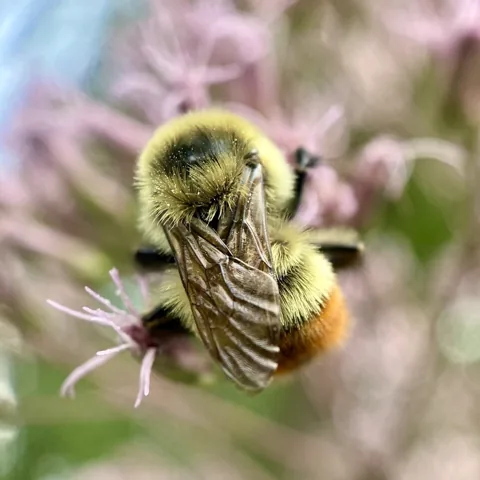 Red-belted bumble bee
Bombus rufocinctus
The red-belted bumble bee is a small bumble bee with unusually variable colors: the University of Wisconsin guide counts more than 30 color forms. The Forest Service guides list it as common across the northern half of the United States and in the southern Rocky Mountains and the Sierra Nevada.
No photo yet
Eastern cranberry bee
Melitta americana
The eastern cranberry bee is a native solitary bee that specializes on cranberry and blueberry flowers, collecting their pollen and nectar. It nests in loose soil and sand and is often one of the most frequent pollinators of these crops in North America. It is a beneficial insect, not a pest.
How pesticides reach bees
EPA's model bee label language lists the routes: direct contact during a foliar spray, contact with residues on plant surfaces afterward, and eating residues in nectar and pollen. Residues can reach nectar and pollen when a product goes on as a seed treatment, a soil treatment or a tree injection, as well as from foliar sprays. Drift onto beehives or onto pollinator-attractive plants outside the treated area can cause bee kills. The Connecticut Agricultural Experiment Station explains why systemic products matter here: they move upward in the plant's sap and can reach every above-ground part, so there is concern they could poison pollinators that feed on its pollen or nectar.[1][12]
Bees forage on plants when they flower, shed pollen or produce nectar. Lawn grass rarely flowers and is a poor source of nectar and pollen, but weeds blooming in it, such as white clover, dandelion and bird's-foot trefoil, draw foraging pollinators into the turf.[1][7]
Honey bee brood is generally shielded inside the hive unless a product is applied to the hive illegally or drifts onto it. Exposure usually happens when adult workers carry pesticide home, and workers exposed to the more toxic products may die quickly or become unable to fly or find their way back.[6]
About 4,000 bee species live in the United States, and their sensitivity to pesticides may differ. Unlike honey bees, which return to the hive, some bees spend the night on plants or in the soil of the site you treat.[6][4]
Bees aren't the only visitors at risk. NPIC lists butterflies, hummingbirds, flies, beetles, bats and lizards among the animals that pollinate plants, and the Connecticut station warns that systemic insecticides on milkweeds can be expected to harm the development of monarch caterpillars.[9][12]
What the label's bee language means
EPA's page on new labeling for neonicotinoid pesticides describes steps it took to change pesticide labels so they better protect bees, with clearer and more precise directions such as 'Do not apply this product while bees are foraging.' The documents behind the change, all dated 2013, are a bee advisory box and two letters to registrants, one of them about products containing imidacloprid, dinotefuran, clothianidin or thiamethoxam.[2][1]
The model language starts with a 'Protection of Pollinators' box saying that application restrictions exist because of the risk to bees, and it marks each use direction that carries restrictions with a bee hazard icon. It tells users to minimize exposure of bees foraging on attractive plants around the application site and to minimize drift onto hives or off-site pollinator habitat.[1]
For non-agricultural products the directions are short: do not apply while bees are foraging, do not apply to plants that are flowering, and apply only after all flower petals have fallen off. The exceptions written into the same language, such as applying after sunset or when it's below 55°F, are for food crops and commercially grown ornamentals, not non-agricultural products.[1]
UC IPM says to read the Environmental Hazards and pollinator protection statements closely and time applications by them. Before plants bloom, it advises against insecticides and miticides with long residual toxicity or systemic activity, and against products whose labels say 'highly toxic to bees,' 'toxic to bees,' 'residual times' or 'extended residual toxicity.' Residual toxicity to bees ranges from hours to a week or more, depending on the product. NPIC likewise says to pay special attention to the label's Environmental Hazards section, and to learn what the extended residual toxicity or residual time (ERT or RT) means: how long residues may be expected to stay harmful to bees.[4][9]
The label sets the legal minimum, and UC IPM notes that it can fall short for bees. Some fungicides, bactericides and herbicides carry no bee warning even though some of them are toxic to bees, tank mixes can be more toxic than each product alone, and systemic products can persist in or move into nectar and pollen. Where it doesn't conflict with the label or regulations, you can take more protective steps.[6]
Look up the active ingredient's bee rating
UC IPM's Bee Precaution Pesticide Ratings rate active ingredients by their reported toxicity to adult and developing honey bees. The ratings are not the label's pollinator statements, and some listed pesticides aren't registered or approved for use, so make sure a use is legal before you rely on a rating.[5]
The ratings draw on standard EPA measures where those are available, including the LD50, the dose that kills half of a group of test bees, and the RT25, the length of time after application during which residues kill 25 percent of tested bees. EPA's RT25 data come from a laboratory test in which adult bees are confined for 24 hours on treated foliage that has aged for set times after application. EPA says the values depend on application rate, the chemical's properties, how fast it dissipates, the crop and the formulation, so they vary considerably even for one product.[6][11]
- Rating I: don't apply it to flowering plants, including weeds, or let it drift onto them, and keep it out of water bees can reach, puddles included.[5]
- Rating II: the same precautions, except that it may be applied between sunset and midnight if the label and regulations allow it.[5]
- Rating III: no bee precaution beyond what the label or regulations require.[5]
- Some ratings from the database for common home and garden insecticides: imidacloprid, clothianidin, dinotefuran, acetamiprid, bifenthrin, permethrin, pyrethrins, carbaryl and malathion are rated I; spinosad, azadirachtin (neem) and narrow-range oil are rated II; insecticidal soap, Bacillus thuringiensis kurstaki, chlorantraniliprole and iron phosphate slug bait are rated III.[5]
- The ratings are for honey bees. A rating II product applied at night protects honey bees in their hives but may not protect bumble bees spending the night on plants or bees nesting in soil.[6]
- Herbicides mostly harm bees indirectly, by reducing the flowering plants that supply nectar, pollen and nesting material. According to the information UC IPM reviewed, most herbicides aren't toxic to bees.[5]
Choose the formulation with the least bee exposure
Products with the same active ingredient come in different formulations, often marked on the label by a one- to three-letter code such as WP for wettable powder, and some formulations are more hazardous to bees than others.[6]
- Most hazardous: dusts (D), dry flowables or water-dispersible granules (DF, WDG), liquids (F, L), microencapsulated products (M) and wettable powders (WP). The small particles stick to bee hairs, are carried to the hive and may be fed to brood.[6]
- Moderate: emulsifiable concentrates (EC), soluble powders (SP) and solutions (S), with ultralow-volume applications possibly more hazardous, plus systemic applications to soil, bark or foliage. Sprays and residues can puddle, and systemics are taken up by plants.[6]
- Lowest: baits (B), granules (GR), pellets (P) and seed coatings without a systemic pesticide, which give bees little direct exposure unless dust or water contamination occurs.[6]
- UGA Extension also considers granules less hazardous to pollinators than liquids. Granule residues are absorbed by roots and move to leaves and flowers, and UGA says the amounts that end up in flowers or nectar are generally too low to harm foraging pollinators. NPIC also suggests granules over liquids, because granules are less likely to leave residue on plant surfaces.[7][9]
- UC IPM still advises holding systemic products until plants have finished their seasonal flowering, and keeping dust from forming and moving when you spread granules or pellets.[6][4]
Lawns: deal with the flowering weeds first
Despite label precautions against applying them to blooming plants, neonicotinoids and other residual systemic insecticides may go onto lawns for preventive pest control while spring weeds are in flower.[8]
University of Kentucky researchers tested that situation. They sprayed turf mixed with blooming white clover at label rates with either clothianidin, a neonicotinoid, or chlorantraniliprole, watered it in lightly, and once the residues dried, confined bumble bee colonies there to forage for six days. Colonies on the clothianidin plots gained weight more slowly and produced no new queens; colonies on the chlorantraniliprole plots developed normally.[8]
The bees didn't avoid treated clover: bumble bees and honey bees visited treated and untreated plots in similar numbers. Nectar from clover blooms hit directly by the clothianidin spray averaged 171 parts per billion of the insecticide. A follow-up study by the same group measured far higher levels, 2882 to 2992 ng/g of clothianidin in nectar from directly sprayed clover blooms, and found that nectar acutely toxic to a small bug the researchers used as a test insect.[8][13]
Mowing changed the result. When the turf was mown to remove the blooms that were there at treatment and new blooms had formed, neither insecticide harmed the colonies foraging on it. In the follow-up study, residues were 99.4% to 99.8% lower in nectar of blooms that formed after mowing, and that nectar was nontoxic to the test insect; the authors conclude the hazard can be reduced by following label precautions and mowing off blooms that get sprayed by mistake.[8][13]
- Mow before you apply, so there are no weed flowers to draw bees in. If the label says not to mow before application, consider mowing the treated flowers right after.[7][13]
- Wait if you can. Most weeds flower in early spring, and UGA suggests delaying an insecticide application by a month, where possible, until they've finished.[7]
- Keep weeds from getting started: control them with herbicides or by hand, mow often, which also discourages flowering, and keep the lawn well watered and fertilized so weeds have less opportunity to move in.[7]
- Under some conditions, watering treated turf, especially in the morning, washes residues off the flowers and leaves or lowers their concentration.[7]
- For soil insects, UGA suggests considering chlorantraniliprole, which controls many soil-dwelling pests with minimal effects on pollinators. Neonicotinoids are often used for soil pests and pyrethroids and carbamates for surface pests.[7][8]
- Use less insecticide. Resistant grass species or varieties, endophyte-treated grasses and less thatch can reduce the need for it, and insect-killing nematodes and fungi sold for white grubs and mole crickets are less disruptive to natural enemies.[7]
Trees and shrubs that bees visit
Flowering trees and shrubs draw bees in large numbers. NPIC warns that treating trees that may attract bees while they're in bloom can create a lethal situation for honey bees and other pollinators, and UC IPM advises holding systemic products until plants have finished their seasonal flowering.[9][6]
- Plants that aren't sources of nectar or pollen pose no exposure risk to pollinators, the Connecticut Agricultural Experiment Station says, so they can be treated by the label. Keep soil and trunk treatments from reaching flowering plants growing nearby.[12]
- For a plant bees do visit, the Connecticut station suggests treating after bloom when that still controls the pest and picking a shorter-residual product. It names acetamiprid as about 3,000 times less toxic to honey bees than imidacloprid or dinotefuran; UC IPM's ratings still list acetamiprid, like those two, as rating I.[12][5]
- Skip systemic insecticides on lindens and on plants grown for insects, such as butterfly garden plants, bee forage plants and milkweeds. The Connecticut station says European lindens have nectar that is toxic to bees and that systemic treatments on these trees have proven especially harmful.[12]
- Our guide to systemic insecticides for trees and shrubs covers application methods and timing around bloom in more detail.[12][6]
Timing, drift, water and tank mixes
- Apply during low pollinator activity. Pollinators forage actively during warm parts of the day, so early morning and late evening applications reduce direct exposure. NPIC adds that spraying in the evening, after bees have gone back to their hives, gives residues the night to dry.[7][9]
- Evening spraying mainly helps honey bees, which go back to the hive. Some bees spend the night on plants or in the soil at the site.[4][6]
- Don't spray when the wind is over 5 to 6 miles per hour, and keep spray and drift off nearby blooming plants, including weeds. NPIC's advice is to apply as close as possible to the target pest so less drifts away.[7][4][9]
- Never spray bees, beehives or bee nesting sites directly. Cover or remove water sources before you spray, or put out new, clean water afterward. NPIC points out that bees need water too, and that some products meant to kill mosquitoes in birdbaths can be toxic to pollinating insects.[4][9]
- Don't tank-mix insecticides or miticides with fungicides for plants in bloom, weeds included. Some combinations raise toxicity to bees, such as DMI fungicides in FRAC group 3 (propiconazole, tebuconazole or triflumizole) with insecticides in IRAC groups 3A or 4A; the ratings database lists bifenthrin, permethrin and pyrethrins as 3A and imidacloprid and clothianidin as 4A.[4][6][5]
- If a fungicide or herbicide must go on during bloom and the label allows it, UC IPM advises applying between sunset and midnight, when bees aren't active.[4]
- Follow any state and local regulations that apply, as well as the label.[4]
If you think pesticides killed bees
EPA's model label language says bee kills should be reported right away to the state or tribal pesticide lead agency, and also to the National Pesticide Information Center or to EPA.[1]
To ask for an investigation for possible enforcement, report the incident to your state pesticide regulatory agency. EPA takes reports through its Ecological Pesticide Incident Reporting portal or by email at beekill@epa.gov, and uses incident data to spot patterns of bee kills tied to particular pesticides.[3]
NPIC gives the same first stop: report pesticide incidents involving wildlife, bees included, to your state pesticide regulatory agency, and consider your state environmental agency too. It also suggests telling the product's manufacturer, since manufacturers are required by law to report adverse effects to EPA. NPIC answers questions by phone, email or chat on weekdays.[10]
Common questions
- Can I spray blooming plants in the evening?
- Not if the label says not to apply to flowering plants; EPA's model language for non-agricultural products gives no evening exception. In UC IPM's ratings, products rated I shouldn't go on flowering plants at all, and products rated II may be applied between sunset and midnight if the label permits; that timing protects honey bees in the hive, not bees resting on flowers or nesting in soil.[1][5][6]
- Are granular lawn insecticides safe for bees?
- Granules are among the lowest-hazard formulations because bees get little direct contact, but systemic ingredients are taken up by roots and can move into flowers. Mow off blooming weeds before you apply.[6][7][8][9]
- Is there a lawn insecticide that's easier on bees?
- UC IPM rates chlorantraniliprole III, with no bee precaution beyond the label, UGA suggests it as an option with minimal effects on pollinators, and bumble bee colonies foraging on clover in turf sprayed with it developed normally in the Kentucky study.[5][7][8]
- Where do I report a bee kill?
- Your state pesticide regulatory agency, which can investigate. You can also report it to EPA through the Ecological Pesticide Incident Reporting portal or at beekill@epa.gov.[3][1][10]
- What does 'extended residual toxicity' or RT25 mean?
- It's how long residues on treated leaves stay toxic to bees. EPA's RT25 is the time after application during which residues still kill 25 percent of test bees, measured on treated foliage in a lab. UC IPM warns against products with long residual toxicity before bloom and says residual toxicity can run from hours to a week or more.[11][6][4]
- If I mow right after spraying a lawn with clover, does that help bees?
- It can. UGA suggests mowing contaminated flowers right after treatment when the label says not to mow beforehand, and a University of Kentucky study found neonicotinoid residues 99.4% to 99.8% lower in the nectar of clover blooms that formed after mowing.[7][13]
Photo credits
- Western Honey Bee: (c) Doug Miller, some rights reserved (CC BY) — via iNaturalist, CC BY 4.0
- Common Eastern Bumble Bee: Jesse Rorabaugh, public domain (CC0), via iNaturalist
- Mason Bees: (c) Owen Strickland, some rights reserved (CC BY) — via iNaturalist, CC BY 4.0
- Sweat Bees: (c) eebee, some rights reserved (CC BY) — via iNaturalist, CC BY 4.0
- Mining Bees: (c) Bernie Paquette, some rights reserved (CC BY) — via iNaturalist, CC BY 4.0
- Squash Bees: (c) Frances Oliver, some rights reserved (CC BY) — via iNaturalist, CC BY 4.0
- Southeastern blueberry bee: (c) Joshua Liverman, some rights reserved (CC BY) — via iNaturalist, CC BY 4.0
- Rusty-patched bumble bee: Milwaukee County Parks - Natural Areas Program, public domain (CC0), via iNaturalist
- American bumble bee: (c) Linda Watson, some rights reserved (CC BY) — via iNaturalist, CC BY 4.0
- Brown-belted bumble bee: (c) Bernie Paquette, some rights reserved (CC BY) — via iNaturalist, CC BY 4.0
- Two-spotted bumble bee: (c) Rosario Douglas, some rights reserved (CC BY) — via iNaturalist, CC BY 4.0
- Black-and-gold bumble bee: (c) aarongunnar, some rights reserved (CC BY) — via iNaturalist, CC BY 4.0
- Southern plains bumble bee: Raven Dandridge, public domain (CC0), via iNaturalist
- Yellow-faced bumble bee: Anne Parsons, public domain (CC0), via iNaturalist
- Black-tailed bumble bee: (c) Jeff Bartlett, some rights reserved (CC BY) — via iNaturalist, CC BY 4.0
- Tri-colored bumble bee: Bruce Cook, public domain (CC0), via iNaturalist
- Golden northern bumble bee: (c) earl woolsey, some rights reserved (CC BY) — via iNaturalist, CC BY 4.0
- Red-belted bumble bee: (c) Michelle Orcutt, some rights reserved (CC BY) — via iNaturalist, CC BY 4.0
Sources
- U.S. Environmental Protection Agency, “Letter to registrants on pollinator protection labeling, August 15, 2013, with the model Protection of Pollinators label language.” www.epa.gov/sites/default/files/2013-11/documents/bee-label-info-ltr.pdf (accessed 2026-11-11)
- U.S. Environmental Protection Agency, “New Labeling for Neonicotinoid Pesticides.” www.epa.gov/pollinator-protection/new-labeling-neonicotinoid-pesticides (accessed 2026-11-11)
- U.S. Environmental Protection Agency, “Report Bee Kills.” www.epa.gov/pollinator-protection/report-bee-kills (accessed 2026-11-11)
- University of California Statewide IPM Program, “Best Management Practices to Protect Bees From Pesticides.” ipm.ucanr.edu/mitigation/protect_bees.html (accessed 2026-11-11)
- University of California Statewide IPM Program, “Bee Precaution Pesticide Ratings.” ipm.ucanr.edu/bee-precaution-pesticide-ratings/ (accessed 2026-11-11)
- University of California Statewide IPM Program, “Bee Precaution Pesticide Ratings: Frequently Asked Questions.” ipm.ucanr.edu/bee-precaution-pesticide-ratings/frequently-asked-questions-faqs/ (accessed 2026-11-11)
- University of Georgia Cooperative Extension, “Management of Turfgrass Insect Pests and Pollinator Protection, Circular 1127 (reviewed June 2025).” fieldreport.caes.uga.edu/wp-content/uploads/2025/08/C-1127_4.pdf (accessed 2026-11-11)
- PLoS ONE, via PubMed Central, “Larson, Redmond and Potter (2013), Assessing Insecticide Hazard to Bumble Bees Foraging on Flowering Weeds in Treated Lawns, PLoS ONE 8(6):e66375.” pmc.ncbi.nlm.nih.gov/articles/PMC3680470/ (accessed 2026-11-11)
- National Pesticide Information Center (Oregon State University and EPA), “Pollinator Protection.” npic.orst.edu/envir/pollinator.html (accessed 2026-11-11)
- National Pesticide Information Center (Oregon State University and EPA), “Pesticide Emergencies and Incidents.” npic.orst.edu/incidents.html (accessed 2026-11-11)
- U.S. Environmental Protection Agency, “Residual Time to 25% Bee Mortality (RT25) Data.” www.epa.gov/pollinator-protection/residual-time-25-bee-mortality-rt25-data (accessed 2026-11-11)
- The Connecticut Agricultural Experiment Station, “Use of Neonicotinoids in the Home Landscape (fact sheet, March 2015).” portal.ct.gov/-/media/caes/documents/publications/fact_sheets/valley_laboratory/useofneonicotinoidsinthehomelandscapecowlesmarch2015pdf.pdf (accessed 2026-11-11)
- Environmental Toxicology and Chemistry, via PubMed, “Larson, Redmond and Potter (2015), Mowing mitigates bioactivity of neonicotinoid insecticides in nectar of flowering lawn weeds and turfgrass guttation, Environmental Toxicology and Chemistry 34(1):127-132.” pubmed.ncbi.nlm.nih.gov/25319809/ (accessed 2026-11-11)