How to identify it
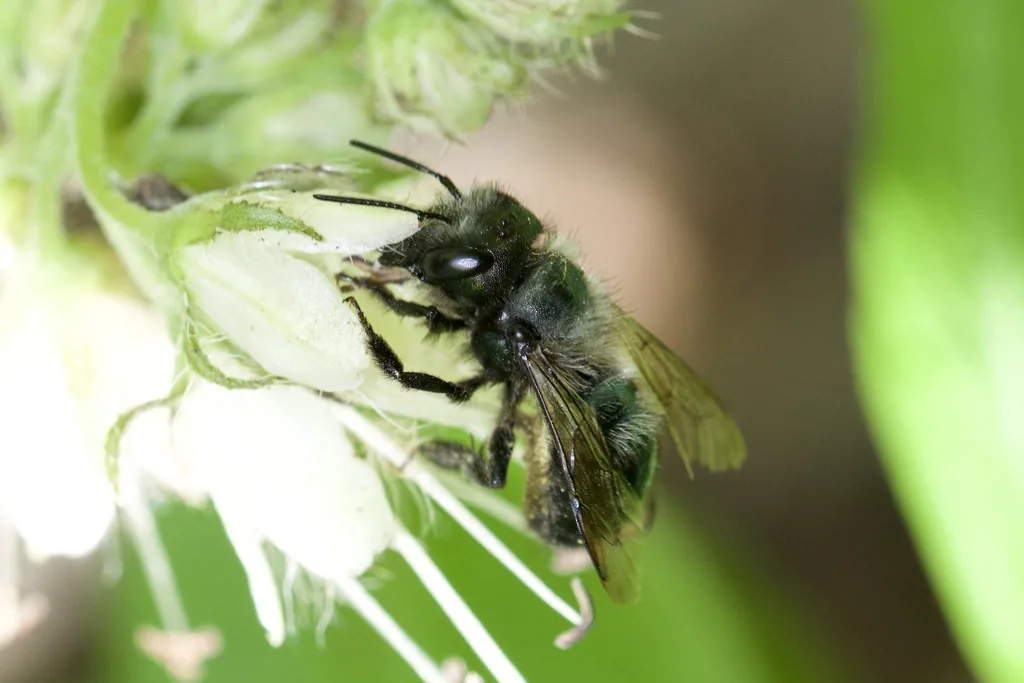
- Small to medium, robust bees with round, broad heads; most are dark metallic blue or blue-green rather than striped.[4][3][1]
- The blue orchard bee is about the size of a honey bee; males are slightly smaller, with longer antennae and a tuft of pale hair on the face.[3][2][1]
- Females carry pollen in a patch of hairs on the underside of the abdomen instead of in balls on the hind legs.[4][3]
- Look for nest holes plugged with mud in early spring, in crevices, old beetle tunnels or nesting tubes.[1][3]
Look-alikes
| Look-alike | How to tell them apart |
|---|---|
| Carpenter bee | Carpenter bees are large black bees that bore their own round holes into wood; mason bees are about honey bee size and can only use holes that already exist.[5][1][3] |
| Honey bee | Honey bees are striped brown and orange and carry pollen on their hind legs; mason bees are dark metallic blue and carry pollen on their bellies.[3] |
Where it lives
About 140 to 150 Osmia species live in North America. The blue orchard bee is native across the U.S. and Canada, in eastern and western forms split by the Rocky Mountains, but is absent from Florida and parts of the Gulf Coast.[3][4][2]
Biology and life cycle
Mason bees have one generation a year; adults chew out of their cocoons in early spring once temperatures reach about 50 to 55 degrees F, males first.[1][2]
Each female stocks a nest hole with balls of pollen and nectar, lays one egg on each, and walls them off with mud, building 5 to 11 cells before plugging the entrance.[1][2][3]
They are solitary, with no queen, hive or honey, but like to nest close together.[1][3]
Larvae finish feeding in about two weeks, spin cocoons and become adults by fall, then stay dormant in the nest until the next spring.[1][2]
Adults are active only a few weeks in spring and usually forage within about 200 to 300 feet of the nest.[1]
Damage and signs
Health risk
Mason bees are relatively nonaggressive and sting only if handled roughly or trapped under clothing.[1]
Control
Prevention
No chemical control is recommended for mason bees; WSU advises avoiding regular use of broad-spectrum pesticides so these pollinators can thrive.[4]
Gardeners who want them can provide nesting tubes or blocks facing south or southeast, spring flowers nearby, and a source of moist clay mud.[1][2]
Sanitation
In bee houses, use liners or tubes that can be opened and replaced each year, since old tubes build up mites, mold and pathogens.[1][2]
Common questions
- Will mason bees damage my house like carpenter bees?
- No. Mason bees can't excavate wood; they only move into holes and crevices that already exist and seal them with mud.[1][5]
- Do mason bees sting?
- Rarely. They are gentle and sting only when roughly handled or trapped against the skin, which is why they suit backyard gardens.[1]
- Do mason bees make honey?
- No. They are solitary bees with no hive; each female feeds her young on balls of pollen and nectar sealed in mud cells.[1][3]
Sources
- Oregon State University Extension Service, “Nurturing Mason Bees in Your Backyard in Western Oregon (EM 9130).” extension.oregonstate.edu/pub/em-9130 (accessed 2026-10-06)
- University of Florida IFAS Extension (EDIS), “Blue Orchard Bee, Osmia lignaria Say (Featured Creatures, IN982).” edis.ifas.ufl.edu/publication/IN982 (accessed 2026-10-06)
- USDA Forest Service, “Blue Orchard Mason Bee (Osmia lignaria), Pollinator of the Month.” www.fs.usda.gov/wildflowers/pollinators/pollinator-of-the-month/mason_bees.shtml (accessed 2026-10-06)
- Washington State University Extension, “Megachilidae: Mason Bees (Osmia spp.) (HortSense).” hortsense.cahnrs.wsu.edu/fact-sheet/megachilidae-mason-bees-osmia-spp/ (accessed 2026-10-06)
- University of Kentucky Entomology, “ENTFACT-611: Carpenter Bees.” entomology.mgcafe.uky.edu/ef611 (accessed 2026-10-06)
- iNaturalist, “Osmia lignaria taxon page (order and family).” www.inaturalist.org/taxa/121507 (accessed 2026-10-06)