On this page
How to identify it
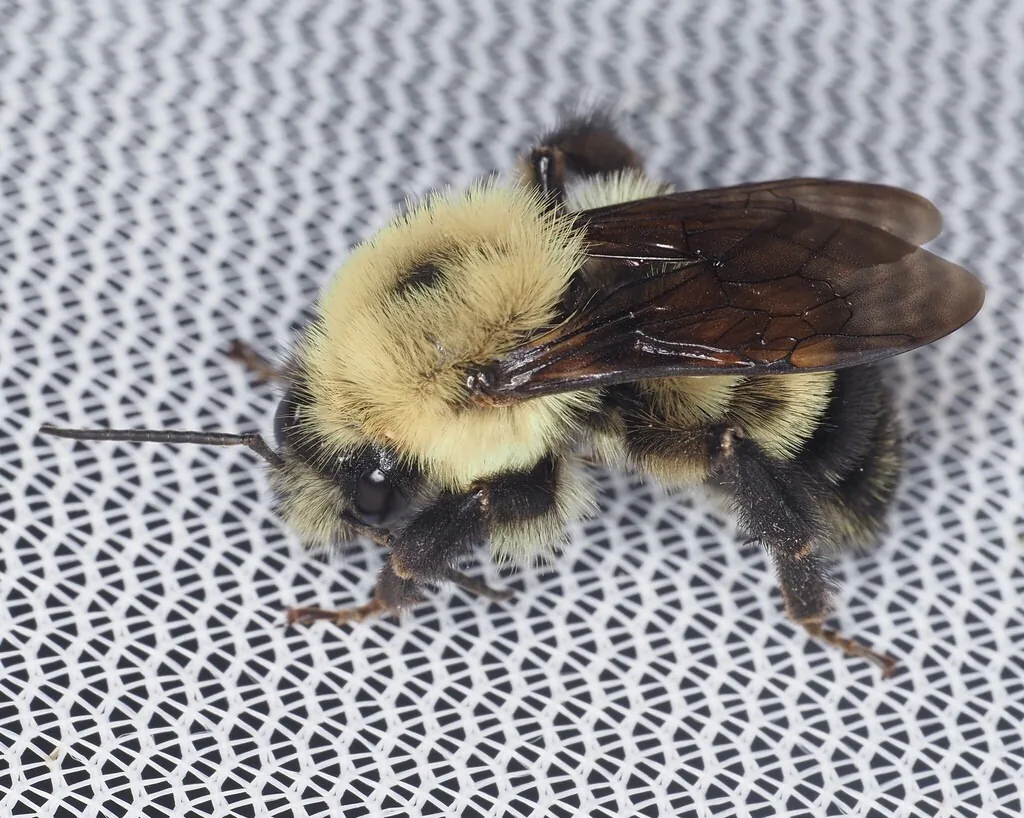
- From above, a worker's first abdominal segment is all yellow, and the second is black with a rounded yellow W in the middle that looks like two spots. The sides of the second segment stay black.[1][2]
- The top of the head has yellow hair, and there is a yellow patch on the front of the face.[1]
- The thorax is mostly yellow with a round black spot between the wing bases, and the body hair is long and uneven.[2][1]
- MDC gives body lengths of 3/8 to 5/8 inch for workers, 5/8 to 7/8 inch for queens and about 5/8 inch for males. Males vary in color, sometimes unevenly from side to side, usually have some yellow hair on the face, and lack the pollen baskets that females carry on their hind legs.[1][2]
Look-alikes
| Look-alike | How to tell them apart |
|---|---|
| Brown-belted bumble bee | The brown-belted bumble bee's mark on the second segment is more brownish and shaped like a crescent or wide U that stretches toward the sides as a band, without reaching as far back. It also has black hair on top of the head, not yellow.[1] |
| Common eastern bumble bee | The common eastern bumble bee has yellow on the first abdominal segment only; the second is all black, with no yellow W. The bare spot on its thorax is teardrop-shaped and its yellow hair looks grayish.[5] |
| Carpenter bees | About the same size, shape and color, but with a shiny, hairless black abdomen instead of a fuzzy one; carpenter bees nest in holes they carve in dead wood.[6] |
Where it lives
MDC describes a wide distribution across the eastern United States, and it is found statewide in Missouri. In Wisconsin it lives mostly south of a line through Wausau and Stevens Point but appears to be expanding its range. In Canada it has only recently spread west into Manitoba and Saskatchewan and east into New Brunswick, Nova Scotia and Prince Edward Island, according to a 2023 study based on new specimens and confirmed iNaturalist records.[1][2][4]
Biology and life cycle
Mated queens spend the winter in hibernation and are the first bumble bees active once warm weather returns, emerging along with the spring wildflowers. They feed on woodland ephemerals such as Dutchman's breeches and on spring-flowering trees such as wild plums, serviceberry and buckeyes.[2][1]
Nests are usually underground in old rodent burrows or in other cavities, such as hollow logs.[1]
It has a relatively short colony cycle. Worker numbers peak at the end of June and in early July; the queen begins producing males and new queens from late June into July, and those are out from early July to August. All but the new queens die as winter begins.[2][1]
Though small for a bumble bee, it has a fairly long tongue and excels at tubular mint-family flowers such as beebalm, horsemint, wild bergamot and dead nettle. It also visits thistles, coneflowers, clovers, hairy vetch, columbines, milkweeds, St. John's wort and sweet clovers.[1][2]
It lives in prairies, pastures, sunny wetlands, roadsides and railroad edges, and in towns and suburbs where flowers grow.[1]
Like other bumble bees it can buzz-pollinate, vibrating its flight muscles to shake pollen loose from flowers that hold it tightly, something honey bees cannot do. MDC adds that red clover is rarely pollinated by bees other than bumble bees.[1]
It is one of the bumble bees attacked by thick-headed (conopid) flies, which lay eggs inside living bees. MDC says about 70 percent of two-spotted bumble bees parasitized by one of these flies, Physocephala tibialis, burrow into the ground before they die, sheltering the fly larva.[1]
Damage and signs
Health risk
MDC says there's no need to fear it: it can sting if molested or if its nest is endangered, but it is not aggressive.[1]
Control
Prevention
No control is called for. If you find a nest, MDC suggests leaving it alone and enjoying the bees through the season, because many bumble bees are in decline.[1]
Missouri residents can report bumble bees to the Missouri Bumble Bee Atlas, a community science project MDC sponsors.[1]
A bumble bee that is holding its own
UW-Madison reports that while a number of Wisconsin bumble bees declined over the past 30 years, this species stayed stable or perhaps increased, coping well with disturbance and farmland.[2]
An Indiana study of preserved-specimen records from the early 1900s to 2022 found that its likelihood of occurring in a given county rose over time, one of four species with that trend. The same study notes that only 47 of Indiana's 92 counties have bumble bee specimen records since 1990.[3]
In Canada, Sheffield and Palmier describe it as common in central North America and document a recent spread into the prairie provinces and the Maritimes.[4]
If a two-spotted bumble bee stings
Whole-body allergic reactions to bumble bee stings are uncommon. A 2023 allergy position paper says bumble bees rarely cause them, while wasps cause the most and honey bees are second.[7]
MedlinePlus says most stings can be treated at home: wash with soap and water, use a wrapped ice pack in 10-minute on-and-off cycles, and take an antihistamine or apply an anti-itch cream if needed.[8]
Get emergency help (call 911) if someone has trouble breathing or swallowing, face or mouth swelling, chest pain, vomiting or faintness after a sting. NIOSH tells people with a history of severe reactions to carry their emergency medicine and a medical ID.[8][9]
Common questions
- What bumble bee is out on the first warm days of spring?
- Often the two-spotted bumble bee. Its queens are the first bumble bees to emerge once warm weather returns, visiting early flowers such as Dutchman's breeches, wild plums and serviceberry.[2][1]
- How do I tell the two-spotted bumble bee from the common eastern bumble bee?
- Look at the second abdominal segment. The two-spotted bumble bee has a yellow W there, while the common eastern bumble bee's second segment is all black.[1][5]
- Is the two-spotted bumble bee in trouble?
- Apparently not. UW-Madison calls it stable or perhaps increasing in Wisconsin, an Indiana study found its county-level occupancy rising over time, and it has expanded its range in Canada.[2][3][4]
Sources
- Missouri Department of Conservation, “Two-Spotted Bumblebee (Field Guide).” mdc.mo.gov/discover-nature/field-guide/two-spotted-bumblebee (accessed 2026-11-11)
- University of Wisconsin-Madison, Department of Entomology, “Two-Spotted Bumble Bee (Bumble Bees of Wisconsin online guide).” wisconsinbumblebees.entomology.wisc.edu/online-guide/species/two-spotted-bumble-bee/ (accessed 2026-11-11)
- Environmental Entomology, via PubMed, “Modeling long-term occupancy trends in Indiana bumble bees (Kernen et al. 2026).” pubmed.ncbi.nlm.nih.gov/41574493/ (accessed 2026-11-11)
- Biodiversity Data Journal, via PubMed, “Range expansion of Bombus (Pyrobombus) bimaculatus Cresson in Canada (Sheffield and Palmier 2023).” pubmed.ncbi.nlm.nih.gov/37305447/ (accessed 2026-11-11)
- Missouri Department of Conservation, “Common Eastern Bumblebee (Field Guide).” mdc.mo.gov/discover-nature/field-guide/common-eastern-bumblebee (accessed 2026-11-11)
- Missouri Department of Conservation, “Bumblebees (Field Guide, genus Bombus).” mdc.mo.gov/discover-nature/field-guide/bumble-bees (accessed 2026-11-11)
- Allergy, via PubMed, “Allergy to stings and bites from rare or locally important arthropods: worldwide distribution, available diagnostics and treatment (Sturm et al. 2023, position paper).” pubmed.ncbi.nlm.nih.gov/37191880/ (accessed 2026-11-11)
- MedlinePlus, U.S. National Library of Medicine, “Insect bites and stings (Medical Encyclopedia).” medlineplus.gov/ency/article/000033.htm (accessed 2026-11-11)
- CDC National Institute for Occupational Safety and Health (NIOSH), “Insects and Scorpions at Work.” www.cdc.gov/niosh/outdoor-workers/about/insects-and-scorpions.html (accessed 2026-11-11)
- iNaturalist, “Bombus bimaculatus taxon page (order and family).” www.inaturalist.org/taxa/52779 (accessed 2026-11-09)