On this page
How to identify it
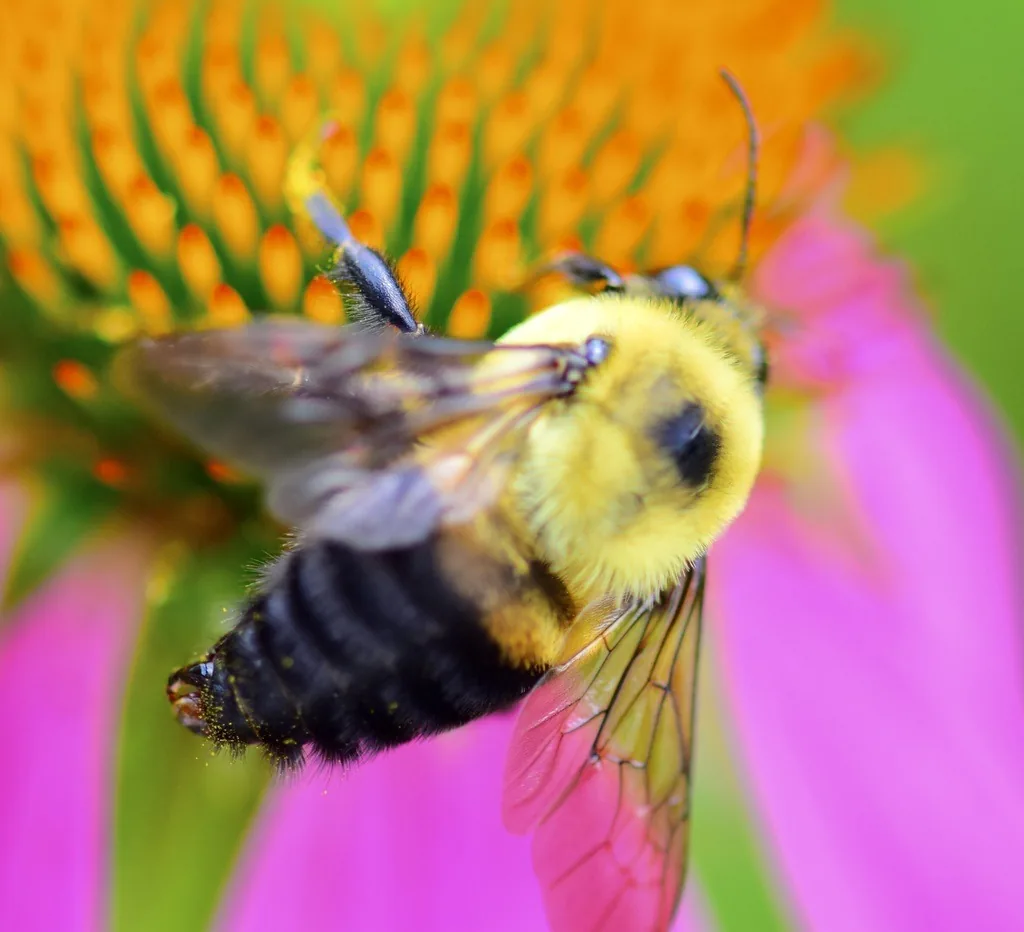
- Seen from above, a worker has a yellow first abdominal segment, then a brownish-yellow to rusty crescent across the front of the second segment. The crescent is a wide U that reaches far toward the sides, so it reads as a band; the rest of the abdomen is black.[1][2]
- The thorax is mostly yellow with a round black spot between the wing bases.[2][1]
- Hair on top of the head is black, and MDC notes a dense patch of yellow hair on the face.[1]
- Queens often lack the brown belt and have the whole second segment yellow. Males resemble workers but have yellow hair on the front of the face and no pollen baskets on the hind legs.[2]
- Missouri gives body lengths of 3/8 to 5/8 inch for workers, 5/8 to 7/8 inch for queens and about 5/8 inch for males. The hair is short and even.[1][2]
- To check the pattern, look down on the bee and count abdominal segments from the thorax back: the first is all yellow, and the rusty band sits on the front half of the second. Females have six visible segments, males seven.[1]
Look-alikes
| Look-alike | How to tell them apart |
|---|---|
| Rusty patched bumble bee | The federally endangered rusty patched bumble bee also has brownish hair on the front half of the second segment, but the rest of that segment is yellow, not black. Its black thorax spot carries a stripe of black hairs pointing backward, and its eyes are smaller. Missouri calls it rare in that state.[1] |
| Two-spotted bumble bee | On the two-spotted bumble bee the second segment is black except for a yellow, shallow W that looks like two spots; it doesn't stretch toward the sides like a band but runs back almost to the third segment.[1] |
| Common eastern bumble bee | The common eastern bumble bee has yellow only on the first abdominal segment, with no brownish band on the second, and the bare spot on its thorax is teardrop-shaped rather than round.[3][1] |
Where it lives
It ranges across the United States from coast to coast; Missouri's conservation department describes a wide distribution across the northern and southeastern states. It is found statewide in Missouri and throughout Wisconsin, where UW-Madison calls it likely the third most common bumble bee. Researchers rearing it for crop pollination describe it as broadly distributed throughout the U.S. GBIF's public U.S. records since 1990 (about 114,000) come from 46 states on the map, most from Minnesota, Illinois and Missouri.[1][2][7][13]
Biology and life cycle
It lives in open, flower-filled places such as prairies, sunny wetlands, pastures, roadsides and railroad edges, and in urban and suburban areas wherever flowers grow.[1][2]
The nest is usually underground. Queens that mated the previous fall come out of hibernation in spring, stock a nest site with pollen and nectar and lay eggs; the first brood are all female workers, which take over foraging, nest care and defense while the queen keeps laying.[1]
Colonies stay small, usually fewer than 50 bees by Missouri's count. In captive rearing at a USDA bee lab, it started nests more reliably than any of 15 western species tested, but its colonies produced fewer worker and male cells than some larger-colony species.[1][8]
Worker numbers peak in July. New queens and males are out from late June to September; the queens mate in fall and hibernate, and the rest of the colony dies as winter begins.[2][1]
Males search high places for mates and have even been found at the top of the Empire State Building, 102 stories up.[2]
Males pitch in at home before they leave: a study of nests found newly emerged males sitting on pupae to warm them, raising pupal temperature 4 to 6 degrees C, less than workers or queens manage.[10]
It forages on a wide range of wildflowers, especially in the sunflower, milkweed, pea and mint families: coneflowers, black-eyed Susans, goldenrods, milkweeds, clovers, vetches, beebalm and wild bergamot. UW-Madison lists thistles, milkweeds and sunflowers as favorites.[1][2]
Thick-headed (conopid) flies lay eggs inside foraging bumble bees, and the fly larva eventually kills its host. Missouri notes the brown-belted bumble bee seems relatively resistant, and a Virginia study agrees: it mounted a stronger immune response than two related bumble bees and more often killed the fly larva before dying itself.[1][9]
Damage and signs
Health risk
A brown-belted bumble bee will sting if it is handled roughly or its nest is threatened, but Missouri's conservation department describes bumble bees as social insects that are not aggressive. MedlinePlus says bee stings are usually painful and most can be treated at home: wash the site with soap and water and apply ice wrapped in a cloth, 10 minutes on and 10 off. NIOSH advises having someone stay with a stung person to watch for an allergic reaction. Call 911 for trouble breathing or wheezing, swelling of the face or mouth, throat tightness or trouble swallowing; a severe allergic reaction (anaphylaxis) can be life-threatening.[1][11][12]
Control
Prevention
Leave it be. MDC's advice for a bumble bee nest found on your property is to leave it alone and watch the colony over the season, since many bumble bee species are declining.[1]
If a nest sits where people or pets will bump into it, keep traffic away until the colony dies out as winter begins; only the new queens survive to hibernate.[1]
Common questions
- Why is it called the brown-belted bumble bee?
- Workers have a thin belt of reddish-brown hair on the second abdominal segment, just behind the yellow first segment.[2][1]
- Is this the endangered rusty patched bumble bee?
- Look closely at the second segment. Both have brownish hair on the second segment, but on the brown-belted bumble bee the rest of that segment is black, while on the rusty patched it is yellow; the rusty patched also has a backward-pointing stripe of black hairs in its thorax spot.[1]
- Is the brown-belted bumble bee declining?
- Not by most measures. UW-Madison describes its populations as stable, and an Indiana analysis of specimen records found its county-level occupancy rising over the past century. One caution: a genetic study in the St. Louis area found the local population inbred, even though the species is thought to be thriving across North America.[2][5][6]
- Can I buy brown-belted bumble bees for pollination?
- Not yet. The common eastern bumble bee is the only species widely sold in North America, and researchers in Utah have been testing the brown-belted bumble bee as a regional alternative because it nests readily in captivity; its lab-reared workers had an average critical thermal maximum of 43.5 degrees C.[7][8]
Sources
- Missouri Department of Conservation, “Brown-Belted Bumblebee (Field Guide).” mdc.mo.gov/discover-nature/field-guide/brown-belted-bumblebee (accessed 2026-11-11)
- University of Wisconsin-Madison, Department of Entomology, “Brown Belted Bumble Bee (Bumble Bees of Wisconsin online guide).” wisconsinbumblebees.entomology.wisc.edu/online-guide/species/brown-belted-bumble-bee/ (accessed 2026-11-11)
- Missouri Department of Conservation, “Common Eastern Bumblebee (Field Guide).” mdc.mo.gov/discover-nature/field-guide/common-eastern-bumblebee (accessed 2026-11-11)
- iNaturalist, “Bombus griseocollis taxon page (order and family).” www.inaturalist.org/taxa/120215 (accessed 2026-11-11)
- Environmental Entomology, via PubMed, “Modeling long-term occupancy trends in Indiana bumble bees (Kernen et al. 2026).” pubmed.ncbi.nlm.nih.gov/41574493/ (accessed 2026-11-11). Cited from the PubMed abstract.
- Scientific Reports, via PubMed, “Bumble bees exhibit body size clines across an urban gradient despite low genetic differentiation (Austin et al. 2022).” pubmed.ncbi.nlm.nih.gov/35264687/ (accessed 2026-11-11). Cited from the PubMed abstract.
- Journal of Insect Science, via PubMed, “Captive rearing success and critical thermal maxima of Bombus griseocollis (Christman et al. 2022).” pubmed.ncbi.nlm.nih.gov/36398850/ (accessed 2026-11-11). Cited from the PubMed abstract.
- Journal of Insect Science, via PubMed, “Variation in North American bumble bee nest success and colony sizes under captive rearing conditions (Strange et al. 2023).” pubmed.ncbi.nlm.nih.gov/37279765/ (accessed 2026-11-11). Cited from the PubMed abstract.
- Oecologia, via PubMed, “Species differences in bumblebee immune response predict developmental success of a parasitoid fly (Davis et al. 2015).” pubmed.ncbi.nlm.nih.gov/25795253/ (accessed 2026-11-11). Cited from the PubMed abstract.
- Proceedings of the National Academy of Sciences, via PubMed, “Brood care by male bumble bees (Cameron 1985).” pubmed.ncbi.nlm.nih.gov/16593608/ (accessed 2026-11-11). Cited from the PubMed abstract.
- MedlinePlus, U.S. National Library of Medicine, “Insect bites and stings (Medical Encyclopedia).” medlineplus.gov/ency/article/000033.htm (accessed 2026-11-11)
- CDC, National Institute for Occupational Safety and Health (NIOSH), “Insects and Scorpions at Work.” www.cdc.gov/niosh/outdoor-workers/about/insects-and-scorpions.html (accessed 2026-11-11)
- Global Biodiversity Information Facility (GBIF), “Bombus griseocollis: occurrence records in the U.S., 1990-2026 (GBIF occurrence search).” api.gbif.org/v1/occurrence/search?taxonKey=1340409&country=US&hasGeospatialIssue=false&occurrenceStatus=PRESENT&year=1990%2C2026&facet=stateProvince&facetLimit=400&limit=0 (accessed 2026-11-11). State counts are records reported (iNaturalist research-grade, museum specimens, surveys), not abundance.