On this page
How to identify it
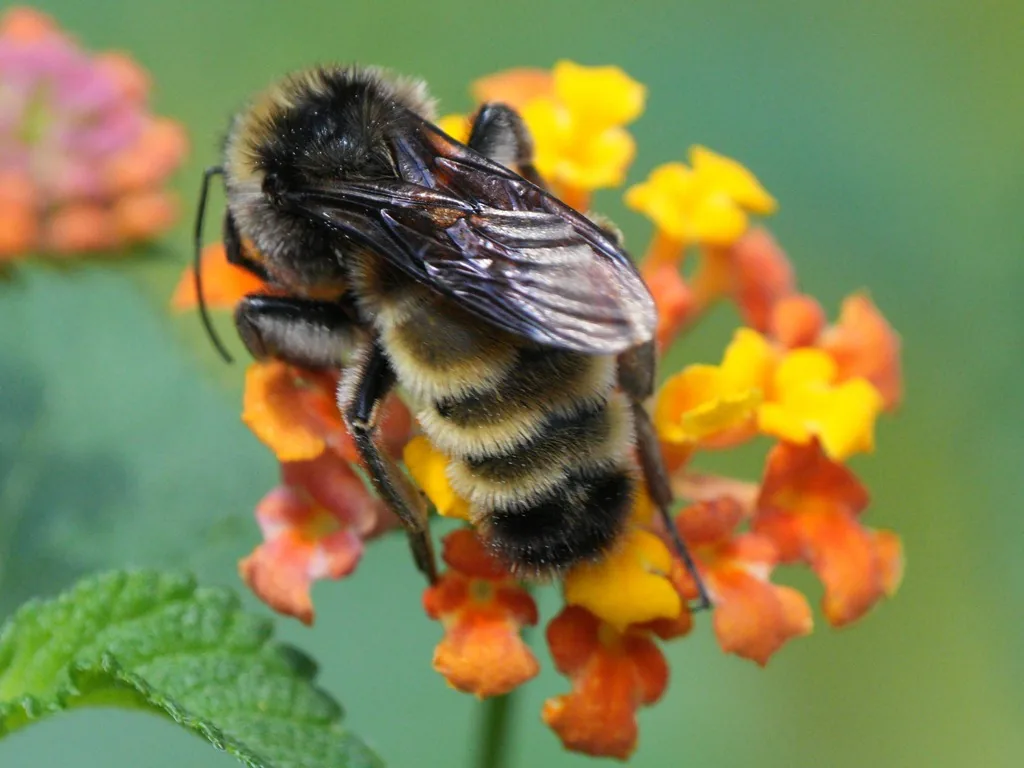
- Workers have the second and third abdominal segments entirely yellow and the end of the abdomen black. The first segment is mixed: MDC describes it as often black on the front half and yellow on the hind half, UW-Madison as often yellow in the middle.[1][3]
- The hair on top of the head is black. The thorax carries yellow, mostly toward the front, and the hair is short and even.[1][3]
- The wings are very dark, which UW-Madison says gives the bee a formal look.[3]
- Males are slender and mostly yellow, with a black bar across the thorax between the wing bases and dark, hairless lines between the abdominal segments; the tip of the abdomen is sometimes orange. UW-Madison says males typically have an entirely yellow abdomen.[1][3]
- MDC gives body lengths of 5/8 to 3/4 inch for workers, 3/4 to 1 inch for queens and 5/8 to 7/8 inch for males. UW-Madison notes the queens are large, close in size to black-and-gold bumble bee queens.[1][3]
Look-alikes
| Look-alike | How to tell them apart |
|---|---|
| Black-and-gold bumble bee | The black-and-gold bumble bee usually has the first abdominal segment all black, with at most some yellow at the sides, and yellow hair on top of the head instead of black.[1] |
| Yellow bumble bee (males) | Male yellow bumble bees (Bombus fervidus) look much like male American bumble bees but differ in the hair colors on the thorax and the last abdominal segment. In Missouri the yellow bumble bee is critically imperiled.[1] |
| Common eastern bumble bee | The common eastern bumble bee has yellow only on the first abdominal segment, with the rest of the abdomen black, so its yellow hair doesn't reach the second and third segments the way it does on the American bumble bee.[4][1] |
| Carpenter bees | Similar in size, shape and color, but a carpenter bee's abdomen is shiny, hairless and black, while a bumble bee always has some fuzz on its abdomen. Carpenter bees carve nest holes in dead wood.[5] |
Where it lives
It occurs throughout the eastern United States and statewide in Missouri, but its range has contracted rapidly in the north. UW-Madison says current records in Wisconsin are rare and describes it as in sharp decline across the Midwest. A 2019 to 2021 statewide survey in Rhode Island did not find it at all, though it is among the state's 12 historically recorded bumble bees.[3][1][6]
Biology and life cycle
It lives in grasslands, pastures and other sunny, open places with plenty of wildflowers; the Fish and Wildlife Service says it favors farmland and open fields.[1][2]
Nests are typically in grasslands, including underground in burrows such as old rodent burrows, but this species may also nest in hay bales, old bird nests, bird houses and barns.[1]
Colonies run well into August and can reach about 200 workers by late summer, which is large for a bumble bee: MDC's overview says most bumble bee nests rarely hold more than a hundred workers at a time. In Wisconsin, worker numbers peak in late July, and new queens and males appear from late July to September.[1][5][3]
Only the newly mated queens survive the winter, in hibernation. The rest of the colony dies when winter sets in.[1]
It has a long tongue, so it can reach nectar deep in long-throated flowers that short-tongued bees can't pollinate, and it forages as far as 1.5 miles from the nest, far for a bumble bee. It visits native wildflowers and crops, especially in the bean and sunflower families; UW-Madison lists vetches, clovers and goldenrod as preferred flowers.[1][3]
Skunks, raccoons and birds eat bumble bees, and crab spiders and ambush bugs wait on flowers to catch them. One robber fly, the Florida bee killer, preys on bees and looks specifically like the American bumble bee.[1]
Damage and signs
Health risk
It can sting if handled or if its nest is in danger, and workers will defend the colony, but MDC notes that bumble bees are not aggressive.[1][5]
Control
Prevention
No control is needed. Because many bumble bees are declining, MDC asks people who find a bumble bee nest on their property to leave it alone and enjoy watching it through the season.[1]
Check plant labels before you buy. MDC warns that neonicotinoid insecticides, often used on bedding plants and hanging baskets, move into a plant's nectar and pollen and gradually poison the bees that feed there.[1]
In Missouri, volunteers can help track bumble bees through the Missouri Bumble Bee Atlas community science project.[1]
Why it is declining
MDC links the decline to the loss of native grasslands and of hedgerows and thickets with diverse wildflowers, to development, to pesticides, and to diseases that can spread from escaped greenhouse bumble bees.[1]
The Fish and Wildlife Service lists pesticides, habitat loss or degradation, urban development, climate change and diseases that can be introduced by non-native bees.[2]
A national study comparing eight U.S. bumble bee species found that the declining species had lost up to 96 percent of their relative abundance and carried more of the pathogen Nosema bombi, with lower genetic diversity, than stable species. The authors note that cause and effect remain uncertain.[7]
The disease link is still debated. A 2016 follow-up found that Nosema bombi became much more common in U.S. bumble bees in the mid- to late 1990s, when commercial bumble bee rearing stocks had an outbreak, but found no conclusive evidence that it came from abroad: the strain in declining U.S. bees was already present before the commercial colony trade.[8]
In central Illinois, its populations became more genetically divided between 1969-1972 and 2008, while the stable common eastern bumble bee showed no such change.[9]
In 2025, a team that included USDA Agricultural Research Service scientists published a reference genome for the species, which they describe as a model for studying the patterns and possible causes of bumble bee decline.[10]
If you are stung
Bumble bees seldom cause severe allergic reactions. An international allergy position paper says they rarely trigger whole-body (systemic) sting reactions; wasps cause most of those, followed by honey bees.[11]
For an ordinary sting, MedlinePlus advises washing the site with soap and water, applying ice wrapped in a washcloth for 10 minutes on and 10 minutes off, and using an antihistamine or anti-itch cream if needed. Watch the spot for signs of infection over the next several days.[12]
Call 911 for signs of anaphylaxis, such as trouble breathing or swallowing, swelling of the face or mouth, chest pain, or fainting. CDC's NIOSH advises people with a history of severe sting reactions to carry their emergency allergy medicine and wear a medical identification bracelet or necklace.[12][13]
Common questions
- How do I tell an American bumble bee from a black-and-gold bumble bee?
- Check the head and the first abdominal segment. The American bumble bee has black hair on top of the head and often some yellow on the first segment; the black-and-gold bumble bee has a yellow-haired head and a mostly black first segment.[1][3]
- Is the American bumble bee endangered?
- Its federal status is worded differently even within one agency's pages: MDC's species account says it has been proposed for listing as federally endangered, while MDC's bumble bee overview says it has been petitioned for listing under the Endangered Species Act. Missouri lists it as a species of conservation concern.[1][5]
- When will I see American bumble bees?
- Mostly in summer. In Wisconsin, worker numbers peak in late July, colonies keep going well into August, and new queens and males fly from late July into September.[3]
- Why is it disappearing?
- Sources point to habitat loss, pesticides, development, disease and, in the Fish and Wildlife Service's list, climate change. Researchers still disagree about how much of the decline disease explains.[1][2][7][8]
Sources
- Missouri Department of Conservation, “American Bumblebee (Field Guide).” mdc.mo.gov/discover-nature/field-guide/american-bumblebee (accessed 2026-11-11)
- U.S. Fish and Wildlife Service, “American Bumble Bee (Bombus pensylvanicus) species profile.” www.fws.gov/species/american-bumble-bee-bombus-pensylvanicus (accessed 2026-11-11)
- University of Wisconsin-Madison, Department of Entomology, “American Bumble Bee (Bumble Bees of Wisconsin online guide).” wisconsinbumblebees.entomology.wisc.edu/online-guide/species/american-bumble-bee/ (accessed 2026-11-11)
- Missouri Department of Conservation, “Common Eastern Bumblebee (Field Guide).” mdc.mo.gov/discover-nature/field-guide/common-eastern-bumblebee (accessed 2026-11-11)
- Missouri Department of Conservation, “Bumblebees (Field Guide, genus Bombus).” mdc.mo.gov/discover-nature/field-guide/bumble-bees (accessed 2026-11-11)
- Environmental Entomology, via PubMed, “Bumble bees of Rhode Island: species richness, relative abundance, and floral visitation (Varkonyi et al. 2025).” pubmed.ncbi.nlm.nih.gov/40411769/ (accessed 2026-11-11)
- Proceedings of the National Academy of Sciences, via PubMed, “Patterns of widespread decline in North American bumble bees (Cameron et al. 2011).” pubmed.ncbi.nlm.nih.gov/21199943/ (accessed 2026-11-11)
- Proceedings of the National Academy of Sciences, via PubMed, “Test of the invasive pathogen hypothesis of bumble bee decline in North America (Cameron et al. 2016).” pubmed.ncbi.nlm.nih.gov/27044096/ (accessed 2026-11-11)
- Molecular Ecology, via PubMed, “Comparative genetic analyses of historical and contemporary collections highlight contrasting demographic histories for the bumble bees Bombus pensylvanicus and B. impatiens in Illinois (Lozier and Cameron 2009).” pubmed.ncbi.nlm.nih.gov/19344350/ (accessed 2026-11-11)
- G3: Genes, Genomes, Genetics, via PubMed, “New reference genome assembly for the declining American bumble bee, Bombus pensylvanicus (Lozier et al. 2025).” pubmed.ncbi.nlm.nih.gov/40795878/ (accessed 2026-11-11)
- Allergy, via PubMed, “Allergy to stings and bites from rare or locally important arthropods: worldwide distribution, available diagnostics and treatment (Sturm et al. 2023, position paper).” pubmed.ncbi.nlm.nih.gov/37191880/ (accessed 2026-11-11)
- MedlinePlus, U.S. National Library of Medicine, “Insect bites and stings (Medical Encyclopedia).” medlineplus.gov/ency/article/000033.htm (accessed 2026-11-11)
- CDC National Institute for Occupational Safety and Health (NIOSH), “Insects and Scorpions at Work.” www.cdc.gov/niosh/outdoor-workers/about/insects-and-scorpions.html (accessed 2026-11-11)
- iNaturalist, “Bombus pensylvanicus taxon page (order and family).” www.inaturalist.org/taxa/56887 (accessed 2026-11-09)