On this page
How to identify it
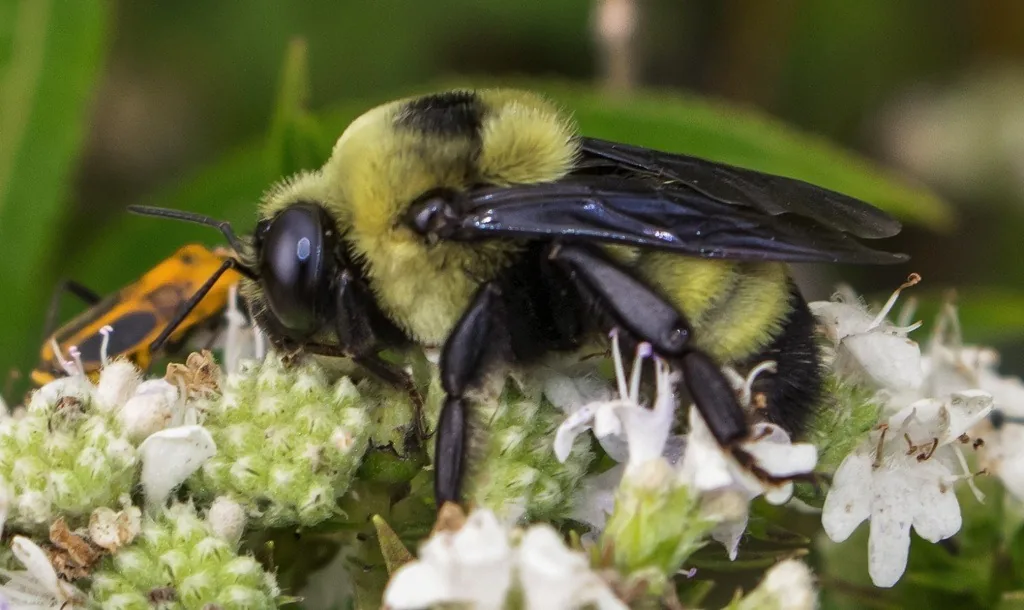
- A worker's first abdominal segment is black, sometimes with a little yellow at the sides. The second and third segments are yellow, and the tip of the abdomen is black.[1][3]
- The hair on top of the head is yellow.[1]
- Seen from above, the thorax is mostly black, with yellow only at the front.[1]
- Workers and queens are very large: workers about 3/4 to 7/8 inch and queens 7/8 to 1 inch long. The hair is short and even.[1][3]
- Males have an entirely yellow first abdominal segment and conspicuous yellow hair on the face, and they lack pollen baskets.[3]
Look-alikes
| Look-alike | How to tell them apart |
|---|---|
| American bumble bee | The American bumble bee looks very similar, but its first abdominal segment often has yellow on the hind half, and the hair on top of its head is black rather than yellow.[1][2] |
| Common eastern bumble bee | The common eastern bumble bee has the opposite pattern on the abdomen: a yellow first segment followed by all black.[4][1] |
Where it lives
It is found statewide in Missouri. Historical data suggest a mostly southern distribution, but in Wisconsin it seems to be doing well in agricultural areas and may be expanding northward as the climate changes.[1][3]
Biology and life cycle
It lives in native prairies and other grasslands, pastures, roadsides, flower gardens and other open, flowery places, and is not generally found in wooded areas.[1]
Colonies are small: usually a queen and about 35 workers.[1]
Queens are active through the whole season, but workers and males appear only late, in July and August.[3]
Favorite flowers in Wisconsin include bee balm, plants in the nightshade genus Solanum, and clovers.[3]
Damage and signs
Health risk
It isn't aggressive, according to MDC, though it can sting when molested and will defend a nest it senses is in danger.[1]
Control
Prevention
No control is needed. MDC's guidance for anyone who finds a bumble bee nest is to let it be and watch it through the season, given how many bumble bees are declining. Missouri residents can also take part in the Missouri Bumble Bee Atlas, a statewide community science project that tracks native bumble bees.[1]
Common questions
- When are black-and-gold bumble bees active?
- Queens fly all season, but workers and males appear only late, in July and August.[3]
- Is the black-and-gold bumble bee declining?
- Not as far as is known. UW-Madison rates it stable, and historical records suggest it may even be increasing, though more data are needed for a firm assessment.[3]
- How can I tell it from the American bumble bee?
- Check the top of the head: yellow on the black-and-gold bumble bee, black on the American bumble bee. The black-and-gold's first abdominal segment is also mostly black.[1][2]
Sources
- Missouri Department of Conservation, “Black and Gold Bumblebee (Field Guide).” mdc.mo.gov/discover-nature/field-guide/black-gold-bumblebee (accessed 2026-11-09)
- Missouri Department of Conservation, “American Bumblebee (Field Guide).” mdc.mo.gov/discover-nature/field-guide/american-bumblebee (accessed 2026-11-09)
- University of Wisconsin-Madison, Department of Entomology, “Black and Gold Bumble Bee (Bumble Bees of Wisconsin online guide).” wisconsinbumblebees.entomology.wisc.edu/online-guide/species/black-and-gold-bumble-bee/ (accessed 2026-11-09)
- Missouri Department of Conservation, “Common Eastern Bumblebee (Field Guide).” mdc.mo.gov/discover-nature/field-guide/common-eastern-bumblebee (accessed 2026-11-09)
- iNaturalist, “Bombus auricomus taxon page (order and family).” www.inaturalist.org/taxa/198856 (accessed 2026-11-09)