On this page
How to identify it
- Queens and workers are small-bodied, a bit smaller than other common bumble bees, with a short face; the cheeks are clearly shorter than they are wide.[1][2][3]
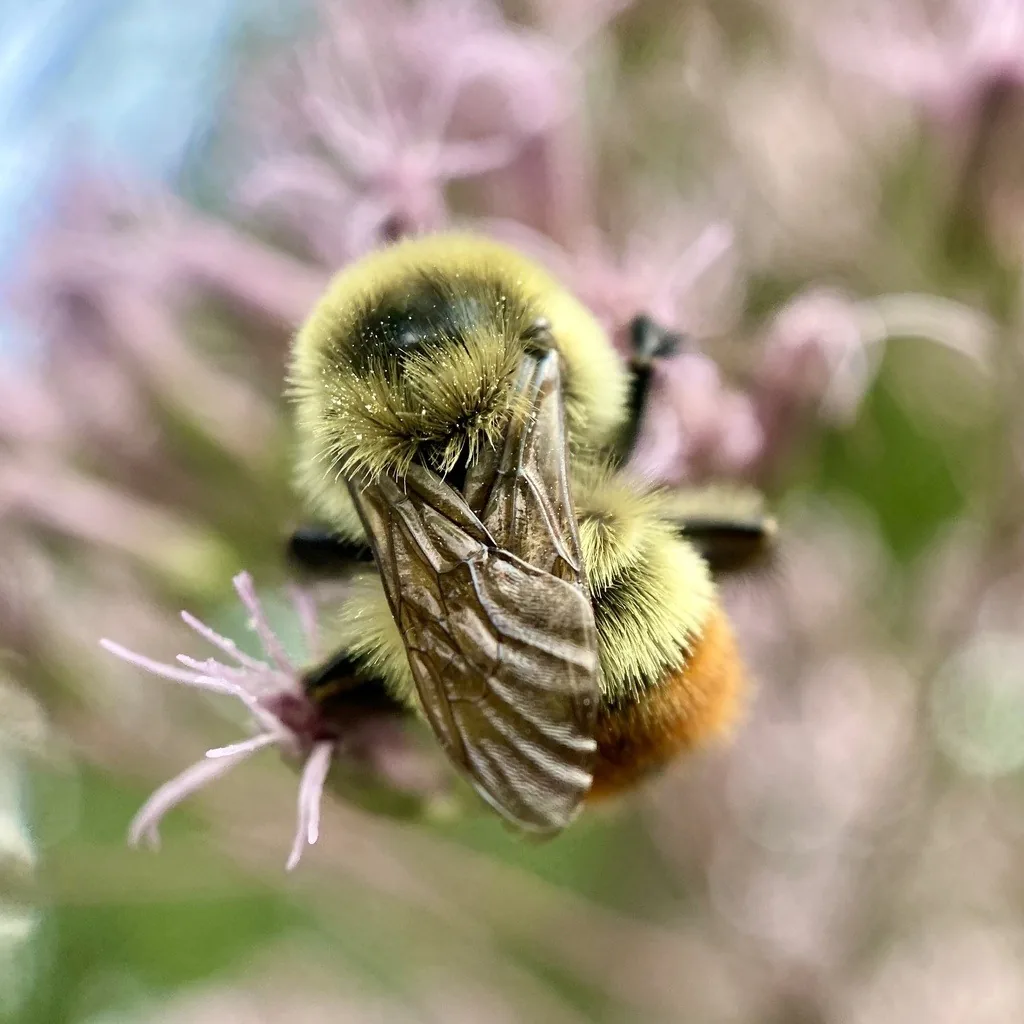
- The thorax is yellow with a black band between the wings. In the light form the abdomen runs yellow, yellow, red, red, black, black from front to back; in the dark form it runs black, black, yellow, black, yellow, black.[3]
- Its many other color combinations resemble patterns worn by other bumble bees, so body size and the short face are more reliable clues than color alone.[1][2]
- Males vary in color as much as females but have an obvious yellow beard in the middle of the face.[3]
Look-alikes
| Look-alike | How to tell them apart |
|---|---|
| Tri-colored bumble bee | The light form can be mistaken for the tri-colored bumble bee, which has orange on the second and third abdominal segments, a yellow fourth segment and a round face.[3][1] |
| Black and gold bumble bee | The dark form can be mistaken for the black and gold bumble bee, one of the largest bumble bees, whose thorax is black on the front third and mostly black behind, with yellow on the second and third abdominal segments.[3][4] |
| Black-tailed bumble bee | In the West, the black-tailed bumble bee has a yellow first segment, orange or black second and third segments, a square face and uneven hair of medium length.[2] |
Where it lives
It is broadly distributed across the northern half of the United States and throughout the southern Rocky Mountains and the Sierra Nevada. In Wisconsin it occurs statewide but makes up fewer than 10 percent of historical and current bumble bee records.[2][3]
Biology and life cycle
It has a short tongue and nests both underground and on the ground surface.[1][2]
Favorite flowers include clovers, sweet clovers, thistles, goldenrods, asters, Eupatorium, burdocks and tansies.[1][2][3]
Its colonies are long-lived, much like those of the common eastern bumble bee. Numbers peak in July, when queens, workers and males are all present, and new queens appear in late July and early August.[3]
Damage and signs
Health risk
Bumble bees are capable of stinging, but MDC notes they do not aggressively defend their colonies the way some wasps and Africanized honey bees do.[5]
Control
Prevention
No control is needed. Its true status is hard to judge because it is not very common in places such as Wisconsin, and MDC asks that bumble bee nests found on private property be left alone.[3][5]
Common questions
- Why is the red-belted bumble bee hard to identify?
- It has more than 30 color forms, and many of them resemble other bumble bee species. Look for a small bee with a short face rather than relying on color alone.[3][1]
- Is it declining?
- It appears stable. The Forest Service guides list it as common, while the Wisconsin guide calls it seemingly stable but says more data on its distribution and abundance are needed to be sure.[1][2][3]
- When are red-belted bumble bees most numerous?
- In July, when colonies hold queens, workers and males at the same time. New queens appear in late July and early August.[3]
Sources
- USDA Forest Service and the Pollinator Partnership, “Bumble Bees of the Eastern United States (S. Colla, L. Richardson and P. Williams, 2011).” www.fs.usda.gov/wildflowers/pollinators/documents/BumbleBeeGuideEast2011.pdf (accessed 2026-11-09)
- USDA Forest Service and the Pollinator Partnership, “Bumble Bees of the Western United States (J. Koch, J. Strange and P. Williams, 2012).” www.fs.usda.gov/wildflowers/pollinators/documents/BumbleBeeGuideWestern2012.pdf (accessed 2026-11-09)
- University of Wisconsin-Madison, Department of Entomology, “Red-belted Bumble Bee (Bumble Bees of Wisconsin online guide).” wisconsinbumblebees.entomology.wisc.edu/online-guide/species/red-belted-bumble-bee/ (accessed 2026-11-09)
- University of Wisconsin-Madison, Department of Entomology, “Black and Gold Bumble Bee (Bumble Bees of Wisconsin online guide).” wisconsinbumblebees.entomology.wisc.edu/online-guide/species/black-and-gold-bumble-bee/ (accessed 2026-11-09)
- Missouri Department of Conservation, “Bumblebees (Field Guide).” mdc.mo.gov/discover-nature/field-guide/bumble-bees (accessed 2026-11-09)
- iNaturalist, “Bombus rufocinctus taxon page (order and family).” www.inaturalist.org/taxa/144011 (accessed 2026-11-09)