On this page
How to identify it
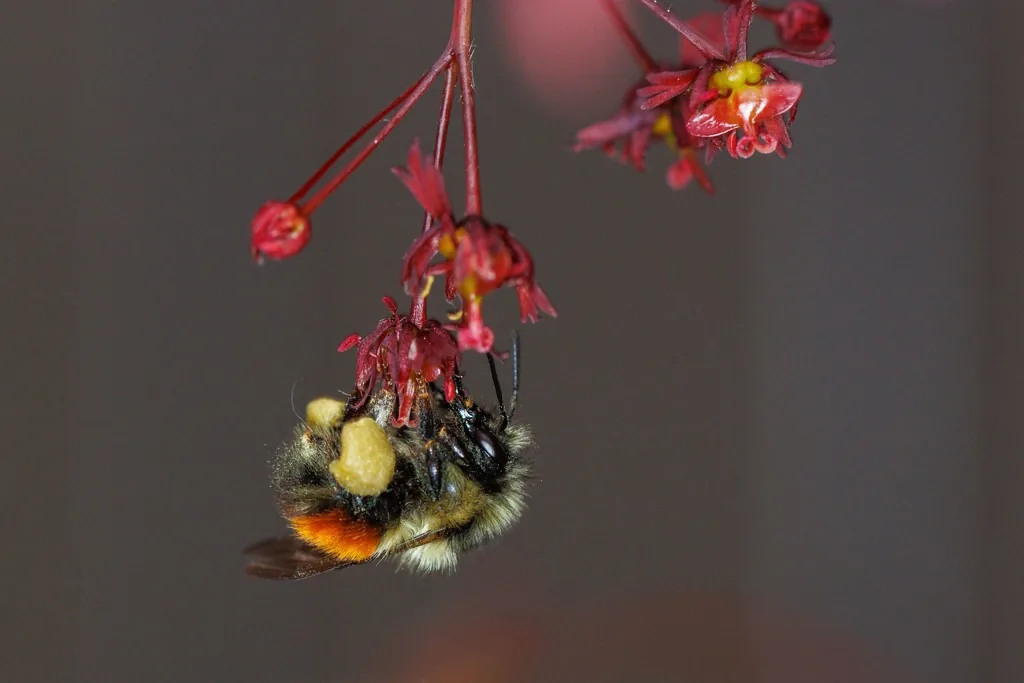
- Females have a yellow first abdominal segment. The second and third segments are orange to rusty red in the red form and black in the dark form.[1][2]
- The fourth and fifth abdominal segments are yellow, at least at the sides, or yellow clouded with black hairs.[1]
- On the thorax, the yellow hair ahead of the black band between the wing bases is clouded with black hairs. The scutellum, at the back of the thorax, is yellow and is sometimes split by a black triangle pointing backward.[1]
- The face is square, with mostly yellow hair on the face and top of the head mixed with some black. Hair length is medium and uneven, and the fringes of the pollen baskets are red and black.[1]
Look-alikes
| Look-alike | How to tell them apart |
|---|---|
| Hunt bumble bee (Bombus huntii) | The Hunt bumble bee also has orange second and third segments and yellow on the first and fourth, but its fifth segment is black, its face and the top of its head are entirely yellow, and its hair is even. It ranges from the Sierra-Cascade crest east to the Colorado Rockies and the Black Hills.[1] |
| Red-belted bumble bee | The red-belted bumble bee is small-bodied with a very short face, and its coloration is highly variable.[1] |
Where it lives
It is found from the Pacific coast east to the Colorado Rocky Mountains and north through Oregon to Alaska and Canada. The dark form lives mainly in California and southern Oregon and the red form to the north and east; the two occur together only in southern Oregon and northern California.[1][2]
Biology and life cycle
Its tongue is of medium length. Food plants listed in the Forest Service guide include lupines (Lupinus), clovers (Trifolium), fireweed (Chamerion), Rubus (blackberries and their relatives), Senecio and beardtongues (Penstemon).[1]
The color difference comes down to a single gene with two versions. When colonies were reared from queens caught where both forms occur, the red version proved dominant over the black one.[2]
The black form was once described as a separate species, Bombus edwardsii. Enzyme and wing-shape comparisons found no reliable difference, so it is treated as part of B. melanopygus, and from north to south the red version of the gene is entirely replaced by the black one over about 600 km (roughly 370 miles).[2][1]
The two colors are an example of Muellerian mimicry. Across western North America, several bumble bee species shift the middle abdominal segments from red to black in parallel, so species living in the same area look alike. In this bee, the switch is controlled by a stretch of DNA between two Hox genes, abd-A and Abd-B, that help set the identity of the abdominal segments.[3][4]
Where the forms meet, the color change happens over a narrower band, and farther west, than in other bumble bees sharing the same mimicry. Genetic data suggest the two forms developed in isolation and later came back into contact, and genes still flow between them.[4]
Damage and signs
- None of the sources reports any damage. The Forest Service guide describes bumble bees as important pollinators of wildland plants.[1]
Health risk
The Forest Service guide advises keeping an epinephrine auto-injector on hand when handling bumble bees, because about 3 percent of adults are truly allergic to bee stings. In those people a sting can cause hives, itching and swelling over the whole body and, rarely, anaphylactic shock.[1]
Control
Prevention
Leave nests alone: MDC points out that many bumble bees are declining and asks people who find a nest on their property not to disturb it. Nests are hard to find anyway, since they are often underground in old rodent burrows, so the Forest Service guide suggests watching for bumble bees at flowers instead.[5][1]
Common questions
- Why are some black-tailed bumble bees red and others black?
- A single gene controls the color of the middle abdominal segments, and the red version is dominant. Northern and eastern populations carry the red version, while in California it has been replaced by the black one, in step with other bumble bees that share the local color pattern.[2][3]
- Where do the two color forms meet?
- In southern Oregon and northern California. There, mitochondrial DNA types shift farther south than the color pattern does, and both change over shorter distances toward the south.[2][4]
- Is the black-tailed bumble bee rare?
- No. The Forest Service guide lists its status as common.[1]
Sources
- USDA Forest Service and the Pollinator Partnership, “Bumble Bees of the Western United States (J. Koch, J. Strange and P. Williams, 2012).” www.fs.usda.gov/wildflowers/pollinators/documents/BumbleBeeGuideWestern2012.pdf (accessed 2026-11-09)
- Entomological Society of America (Journal of Insect Science), “Owen RE, Whidden TL, Plowright RC. Genetic and morphometric evidence for the conspecific status of the bumble bees, Bombus melanopygus and Bombus edwardsii. Journal of Insect Science 10:109 (2010) (abstract).” doi.org/10.1673/031.010.10901 (accessed 2026-11-09)
- National Academy of Sciences (PNAS), “Tian L et al. A homeotic shift late in development drives mimetic color variation in a bumble bee. Proceedings of the National Academy of Sciences 116(24):11857-11865 (2019) (abstract).” doi.org/10.1073/pnas.1900365116 (accessed 2026-11-09)
- John Wiley & Sons (Ecology and Evolution), “Wham BE, Rahman SR, Martinez-Correa M, Hines HM. Mito-nuclear discordance at a mimicry color transition zone in bumble bee Bombus melanopygus. Ecology and Evolution 11(24):18151-18168 (2021) (abstract).” doi.org/10.1002/ece3.8412 (accessed 2026-11-09)
- Missouri Department of Conservation, “Bumblebees (Field Guide).” mdc.mo.gov/discover-nature/field-guide/bumble-bees (accessed 2026-11-09)
- iNaturalist, “Bombus melanopygus taxon page (order and family).” www.inaturalist.org/taxa/130222 (accessed 2026-11-09)