On this page
How to identify it
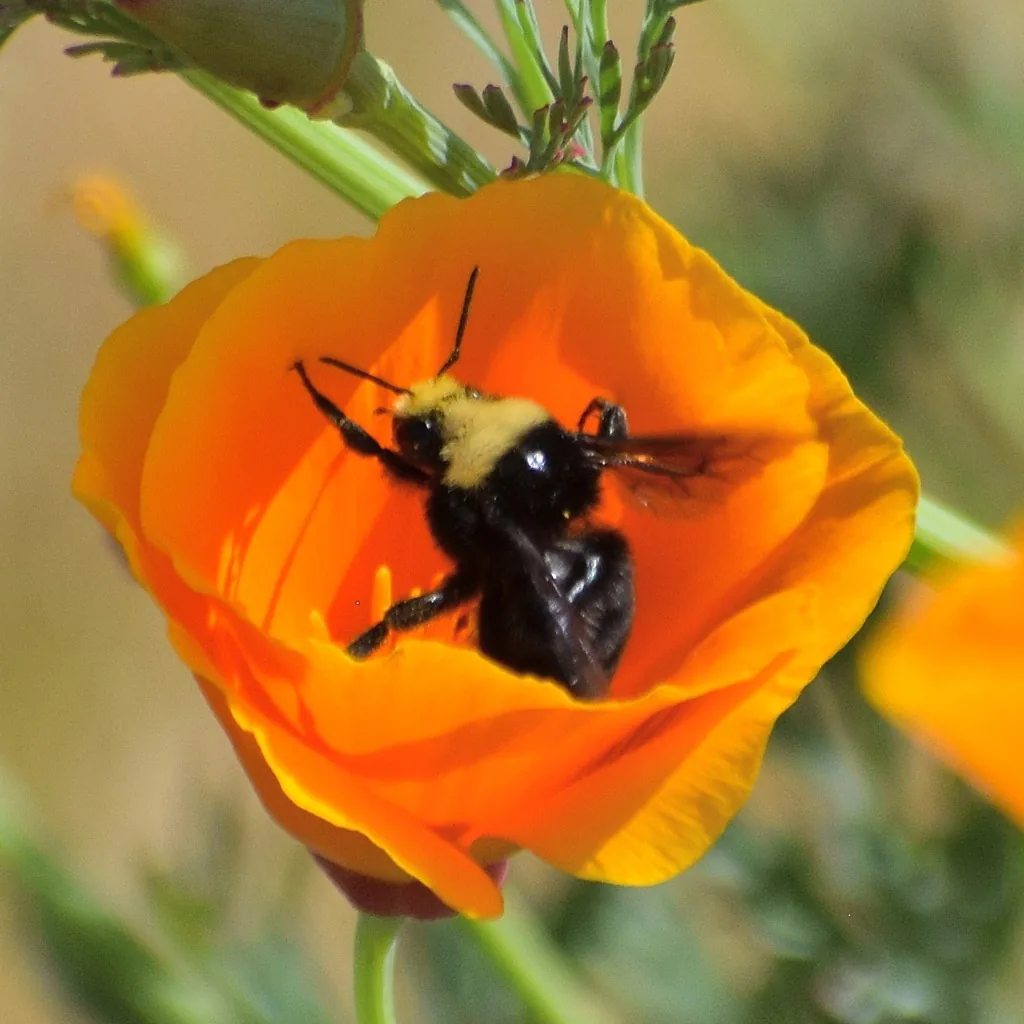
- Females are mostly black. The front of the thorax, ahead of a black band between the wing bases, is yellow, and so are the face and the top of the head.[1]
- On the abdomen, the first three segments are black, the fourth carries a single yellow band, and the last two are black again.[1]
- The hair is of medium length and even, the face is square, and the fringe hairs around the pollen baskets on the hind legs are black.[1]
- On the side of the thorax, the lower front part is covered in long, mostly black hair.[1]
Look-alikes
| Look-alike | How to tell them apart |
|---|---|
| Obscure bumble bee (Bombus caliginosus) | It has the same pattern from above, with yellow on the fourth abdominal segment, but its hair is uneven and the third and fourth segments on the underside carry long yellow hairs at their tips. It is uncommon and lives along the coast from northern Washington to southern California.[1] |
| Van Dyke bumble bee (Bombus vandykei) | Its yellow abdominal band sits on the third segment, at least along the rear edge, with the fourth through sixth segments black, and its cheeks are longer than they are wide. It is uncommon in the Pacific states from Washington to southern California.[1] |
| Western bumble bee (Bombus occidentalis) | The western bumble bee has a white tip to the abdomen, a round face and reddish pollen-basket fringes. It is now rare through much of its range after a severe decline west of the Sierra-Cascade crest.[1] |
Where it lives
It lives in coastal California, Oregon and Washington, east as far as the Sierra-Cascade crest, and is uncommon but present in Nevada.[1]
Biology and life cycle
Its tongue is of medium length. Food plants named in the Forest Service guide include lupines (Lupinus), thistles (Cirsium), wild buckwheats (Eriogonum), Phacelia, Clarkia and Ericameria.[1]
Like other social bumble bees, it lives in a colony started each spring by a single queen. The queen lives only one year, and new queens spend the winter alone in a small cavity they dig in the ground.[1]
Researchers who reared this species in 2023 noted that little had been documented about its colony life cycle. Of 125 wild-caught young queens set up in their lab, about 62 percent started a nest and 43 percent raised at least one worker; queens from high elevations nested more successfully, but colonies from low elevations grew larger and produced more new queens.[2]
Damage and signs
- None of the sources reports any damage. Bumble bees are the main pollinators of crops grown in greenhouses and are especially effective on tomatoes, peppers and eggplant.[1]
Health risk
Bumble bees can sting if they are molested or their nest is endangered, but MDC notes they do not defend their colonies aggressively the way some wasps do. About 3 percent of adults are truly allergic to bee stings, and most stings can be treated with ice and, if needed, an antihistamine.[5][1]
Control
Prevention
No control is needed for this pollinator. MDC's advice for any bumble bee nest found on your property is to leave it alone, and bumble bee colonies do not usually survive the winter.[5]
Common questions
- How do I tell a yellow-faced bumble bee from other black-and-yellow bumble bees?
- Look at the abdomen: it is black except for one yellow band on the fourth segment, and the face is yellow. The obscure bumble bee has the same pattern but uneven hair and long yellow hairs under the abdomen, and the Van Dyke bumble bee carries its yellow band one segment farther forward.[1]
- Is it declining like the western bumble bee?
- No. The Forest Service guide lists it as very common and possibly increasing. The western bumble bee, by contrast, has declined dramatically, most likely because European parasites and diseases arrived with the international trade in bumble bees for greenhouse pollination.[1]
- Do pesticides affect yellow-faced bumble bees?
- A 2025 laboratory study kept 175 wild-caught foragers on diets containing glyphosate (a herbicide), tebuconazole (a fungicide), imidacloprid (an insecticide) or a combination. Bees collected from an alpine meadow survived best and bees from a suburban park worst, partly because of body size and conopid parasitoids at two of the sites, and where the bees came from affected survival on the herbicide, fungicide and combined diets.[3]
Sources
- USDA Forest Service and the Pollinator Partnership, “Bumble Bees of the Western United States (J. Koch, J. Strange and P. Williams, 2012).” www.fs.usda.gov/wildflowers/pollinators/documents/BumbleBeeGuideWestern2012.pdf (accessed 2026-11-09)
- Entomological Society of America (Journal of Insect Science), “Christman ME et al. It is buzziness time: rearing, mating, and overwintering Bombus vosnesenskii (Hymenoptera: Apidae). Journal of Insect Science 23(5):18 (2023) (abstract).” doi.org/10.1093/jisesa/iead089 (accessed 2026-11-09)
- The Royal Society (Royal Society Open Science), “Tatarko AR, Vannette RL, Frese S, Leonard A. A wild bumble bee shows intraspecific differences in sensitivity to multiple pesticides. Royal Society Open Science 12:250281 (2025) (abstract).” doi.org/10.1098/rsos.250281 (accessed 2026-11-09)
- American Genetic Association (Journal of Heredity), “Ballare KM et al. Genome assemblies of two bumble bee species: Bombus sonorus and Bombus vosnesenskii. Journal of Heredity 117(3):611-622 (2026) (abstract).” doi.org/10.1093/jhered/esaf109 (accessed 2026-11-09)
- Missouri Department of Conservation, “Bumblebees (Field Guide).” mdc.mo.gov/discover-nature/field-guide/bumble-bees (accessed 2026-11-09)
- iNaturalist, “Bombus vosnesenskii taxon page (order and family).” www.inaturalist.org/taxa/57689 (accessed 2026-11-09)