On this page
How to identify it
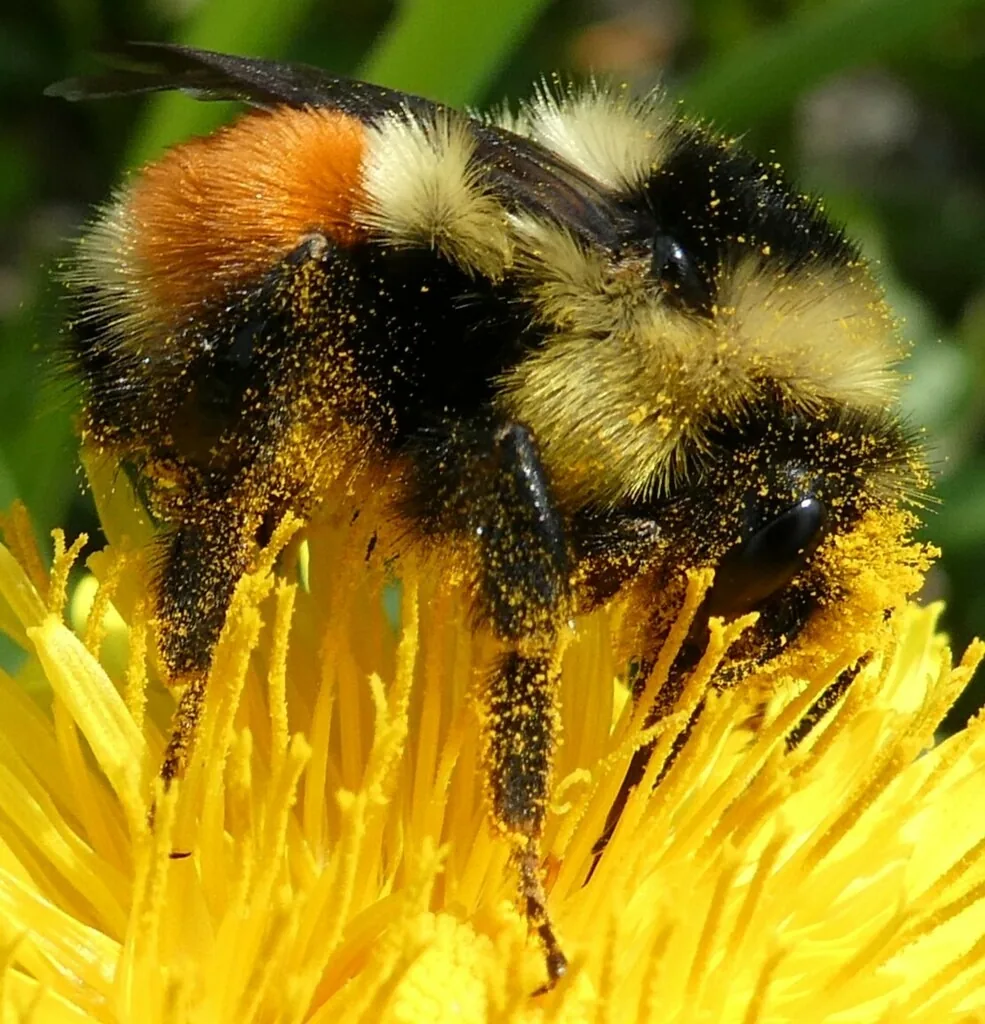
- Females have yellow hair on the thorax and the first abdominal segment, orange on the second and third segments, yellow again on the fourth, and black on the fifth.[1][3]
- A well-defined black band runs between the wing bases and extends backward down the middle of the scutellum, giving a T shape that splits the yellow there in two.[1][3]
- The hair is short and even. The face is round, with black hair mixed with patches of yellow on the face and top of the head.[1][3]
- Males are colored like the workers, with some extra yellow on the last abdominal segments, and they lack pollen baskets on the hind legs.[3]
Look-alikes
| Look-alike | How to tell them apart |
|---|---|
| Red-belted bumble bee | The light form of the red-belted bumble bee runs yellow, yellow, red, red, black, black down the abdomen, so its second segment is yellow rather than orange. It is also a small-bodied bee with a short face.[4][1] |
| Hunt bumble bee (Bombus huntii) | In the West, the Hunt bumble bee has nearly the same banding, but its face and the top of its head are entirely yellow and its hair is of medium length. It ranges from the Sierra-Cascade crest east to the Colorado Rockies and the Black Hills.[2][3] |
Where it lives
It occurs from eastern Montana and the Black Hills east to New England. In Wisconsin it is found statewide but is especially tied to woodlands and wetlands, with most historical records from the central and northern parts of the state.[2][3]
Biology and life cycle
Queens come out early in the season and colonies keep going well into September. In Wisconsin, worker numbers peak in late July, and new queens and males are out from late July through September.[3]
It nests underground. Food plants named in the Forest Service and Wisconsin guides include milkweeds, blackberries and their relatives (Rubus), goldenrods, rhododendrons, Vaccinium, clovers, tansies, rabbitbrush (Chrysothamnus), bee balms, yarrow and wild buckwheats.[1][2][3]
Damage and signs
Health risk
Bumble bees can sting if they are molested or their nest is threatened, but MDC describes them as not aggressive and says they don't defend their colonies the way some wasps do.[5]
Control
Prevention
No control is needed. If you find a bumble bee nest on your property, MDC recommends leaving it alone, since many bumble bees are declining.[5]
Common questions
- Is the tri-colored bumble bee rare?
- Not in the East. The eastern Forest Service guide lists it as common, and Wisconsin's guide rates it generally stable, while noting that more data on its current distribution and abundance are needed. In the western United States it is rare.[1][3][2]
- How is it different from the red-belted bumble bee?
- Check the second abdominal segment and the face. The tri-colored bumble bee has orange on segments two and three and a round face, while the light form of the red-belted bumble bee has a yellow second segment, reddish third and fourth segments and a short face.[1][4]
- When is it active?
- Queens emerge early in the season, and colonies last well into September. New queens and males appear from late July.[3]
Sources
- USDA Forest Service and the Pollinator Partnership, “Bumble Bees of the Eastern United States (S. Colla, L. Richardson and P. Williams, 2011).” www.fs.usda.gov/wildflowers/pollinators/documents/BumbleBeeGuideEast2011.pdf (accessed 2026-11-09)
- USDA Forest Service and the Pollinator Partnership, “Bumble Bees of the Western United States (J. Koch, J. Strange and P. Williams, 2012).” www.fs.usda.gov/wildflowers/pollinators/documents/BumbleBeeGuideWestern2012.pdf (accessed 2026-11-09)
- University of Wisconsin-Madison, Department of Entomology, “Tri-colored Bumble Bee (Bumble Bees of Wisconsin online guide).” wisconsinbumblebees.entomology.wisc.edu/online-guide/species/tri-colored-bumble-bee/ (accessed 2026-11-09)
- University of Wisconsin-Madison, Department of Entomology, “Red-belted Bumble Bee (Bumble Bees of Wisconsin online guide).” wisconsinbumblebees.entomology.wisc.edu/online-guide/species/red-belted-bumble-bee/ (accessed 2026-11-09)
- Missouri Department of Conservation, “Bumblebees (Field Guide).” mdc.mo.gov/discover-nature/field-guide/bumble-bees (accessed 2026-11-09)
- iNaturalist, “Bombus ternarius taxon page (order and family).” www.inaturalist.org/taxa/127905 (accessed 2026-11-09)