On this page
How to identify it
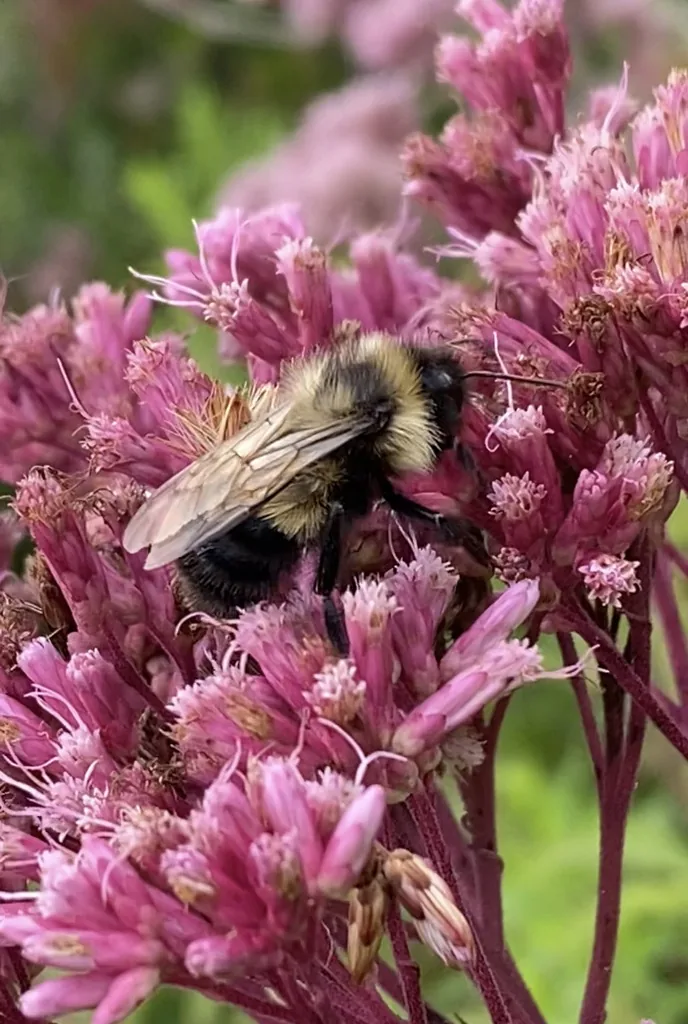
- On workers and males, the first abdominal segment is yellow, and the second is mostly yellow with a central patch of rusty brown to orange hair at its front edge reaching about halfway back. The rear edge and sides of that segment stay yellow, and the segments behind it are black.[1][3][2]
- The thorax is mostly yellow with a black spot or T-shaped band between the wings, the 'thumbtack': the bar of the T lies between the wings and a thin line runs back down the middle. The underside of the thorax is black.[1][3][2]
- It is the only North American bumble bee whose queens are colored differently from the workers. Queens usually lack both the rusty patch and the thumbtack, with the first two abdominal segments all yellow; look instead for a short, round face, mostly black hair on top of the head and neatly cropped hair on the thorax.[1][3][2]
- Males are colored like workers, sometimes with more brown hair on the second segment, and they lack the pollen baskets (corbiculae) on the hind legs.[3]
- Size varies within and between castes; queens are the largest.[2]
Look-alikes
| Look-alike | How to tell them apart |
|---|---|
| Brown-belted bumble bee | It is the species most often confused with the rusty patched. It also has brown hair on the second abdominal segment, but the patch is bordered by black hair behind and on the sides, and there is no black thumbtack on the thorax. On the rusty patched bumble bee the patch is surrounded by yellow.[1][3][2] |
| Tricolored bumble bee | Its bright orange hair covers both the second and third abdominal segments.[1] |
| Half-black bumble bee | Rusty patched queens are the ones most easily confused with it, since both have the first two abdominal segments yellow. Half-black queens have a longer face, mostly yellow hair on top of the head and longer, messier thorax hair, and are usually smaller and slimmer. On workers, a darker spot on the second segment is just skin showing through thin hair, and there is no thumbtack.[1][2] |
| Red-belted bumble bee | Some red-belted bumble bees have orange hair on the second segment, but they lack the thumbtack.[1] |
Where it lives
Historically it ranged across the eastern United States and upper Midwest into southern Quebec and Ontario, south along the Appalachians to the northeast corner of Georgia and west to the eastern edges of North and South Dakota. A decline has been documented across its U.S. range since about 2007, and UW-Madison puts the loss at more than 90 percent of its range. Known populations now center on urban areas of the Midwest, such as Minneapolis-St. Paul and Madison, Wisconsin, and a genetically distinct group survives in the Appalachians. In Missouri it is considered accidental.[2][3][1][5][6][4][7]
Biology and life cycle
Colonies last a single year. Queens that mated the previous fall come out in spring, usually nest in an abandoned rodent burrow 1 to 4 feet underground, and raise the first workers on their own. Before winter the old queen, workers and males die, and only new queens overwinter.[2]
A healthy colony can hold more than a thousand workers and produce dozens to hundreds of new queens.[2]
Workers fly from late June through September and males in August and September. In southern Wisconsin, queens are out in spring and again in late summer and fall, and worker numbers peak in July and August.[2][3][1]
It is active above ground roughly March 15 to October 10 south of 42° latitude and April 10 to October 10 farther north, one of the first bumble bees out in spring and the last into hibernation.[2]
It is a short-tongued generalist that needs flowers blooming from early spring into fall, including woodland spring wildflowers. UW-Madison lists sunflowers, goldenrods and bee balm among its preferred flowers, and the Missouri Department of Conservation calls it a key pollinator of Dutchman's breeches.[2][3][7]
It has been found in prairies, woodlands, marshes, farmland and residential parks and gardens.[2][6]
Health risk
Like other bumble bees it can sting if handled or if its nest is threatened, but bumble bees are not aggressive. With this species there is no reason to handle one: it is protected.[7][3]
Control
Prevention
Never try to control it. It is protected under the Endangered Species Act, and handling or netting one without a U.S. Fish and Wildlife Service permit is illegal.[3][2]
If you think you've seen one, check for both the rusty patch and the thumbtack and take photos from the top, side and head. Upload them to Bumble Bee Watch or another community science site, or report the sighting to the U.S. Fish and Wildlife Service or, in Wisconsin, the DNR's Bumble Bee Brigade.[2][1][3]
What it needs is habitat: flowers blooming from early spring through fall, undisturbed nesting spots near them and sheltered places for queens to overwinter.[2]
Why it declined
The exact cause is unknown. USFWS says evidence points to an introduced pathogen acting together with pesticide exposure, specifically insecticides and fungicides, and that the remaining populations are exposed to several interacting stressors, including pathogens, pesticides, habitat loss, non-native and managed bees and climate change.[2]
USFWS wrote a species status assessment in 2016, listed the bee in 2017 and finalized a recovery plan in 2021. Canada listed it as endangered in 2012.[2][6]
A 2024 range-wide genetic study found low colony numbers at the sites sampled, high inbreeding and populations split along an east-to-west gradient, with the Appalachian bees genetically distinct from the rest.[4]
Targeted searches still turn up new sites: a 2026 study confirmed the bee in 54 percent of sampled survey grids where it had not been recorded before, extending its known distribution by 5,700 square kilometers.[5]
Where sources disagree
Queen emergence: UW-Madison gives late spring, typically early May, in Wisconsin; USFWS says queens fly roughly April through May in southern Wisconsin.[3][2]
Cities: in Minnesota surveys it was found most often in developed areas and least in farmland, but a 2026 study outside urban centers found no link between occupancy and the amount of developed land.[6][5]
Common questions
- How can I tell a rusty-patched bumble bee from a brown-belted bumble bee?
- Both can show brown hair on the second abdominal segment. On the rusty patched bumble bee the patch is surrounded by yellow hair and the thorax carries a black thumbtack; the brown-belted's patch is edged with black, and it has no thumbtack.[1][3][2]
- Can I catch a rusty-patched bumble bee to identify it?
- No. Handling or netting this species without a U.S. Fish and Wildlife Service permit is illegal, so photograph it instead.[3][2]
- Why don't some rusty-patched bumble bees have a rusty patch?
- Queens usually don't. They are colored differently from workers and males, with the first two abdominal segments all yellow, which makes them easy to mistake for the half-black bumble bee.[1][3][2]
- When can I see rusty patched bumble bees?
- Roughly mid-March or mid-April to early October, depending on latitude. Workers are out from late June through September, males in August and September, and queens in spring and again in late summer and fall.[2][1]
Sources
- University of Minnesota Bee Lab, “Rusty-patched bumble bee (identification guide).” beelab.umn.edu/rusty-patched-bumble-bee (accessed 2026-11-11)
- U.S. Fish and Wildlife Service, “Rusty Patched Bumble Bee (Bombus affinis).” www.fws.gov/species/rusty-patched-bumble-bee-bombus-affinis (accessed 2026-11-11)
- University of Wisconsin-Madison, Department of Entomology, “Rusty-patched Bumble Bee (Bumble Bees of Wisconsin online guide).” wisconsinbumblebees.entomology.wisc.edu/online-guide/species/rusty-patched-bumble-bee/ (accessed 2026-11-11)
- Journal of Insect Science, via PubMed, “Mola and others (2024), Range-wide genetic analysis of an endangered bumble bee (Bombus affinis) reveals population structure, isolation by distance, and low colony abundance.” pubmed.ncbi.nlm.nih.gov/38569059/ (accessed 2026-11-11)
- Scientific Reports, via PubMed, “Otto and others (2026), A hierarchical approach for finding undiscovered populations of an endangered bumble bee.” pubmed.ncbi.nlm.nih.gov/42056150/ (accessed 2026-11-11)
- Environmental Entomology, via PubMed, “Boone, Portman, Lane and Rao (2023), Occupancy of Bombus affinis in Minnesota is highest in developed areas when standardized surveys are employed.” pubmed.ncbi.nlm.nih.gov/37681665/ (accessed 2026-11-11)
- Missouri Department of Conservation, “Bumblebees (Field Guide).” mdc.mo.gov/discover-nature/field-guide/bumble-bees (accessed 2026-11-11)
- iNaturalist, “Bombus affinis taxon page (order and family).” www.inaturalist.org/taxa/121519 (accessed 2026-11-08)