On this page
How to identify it
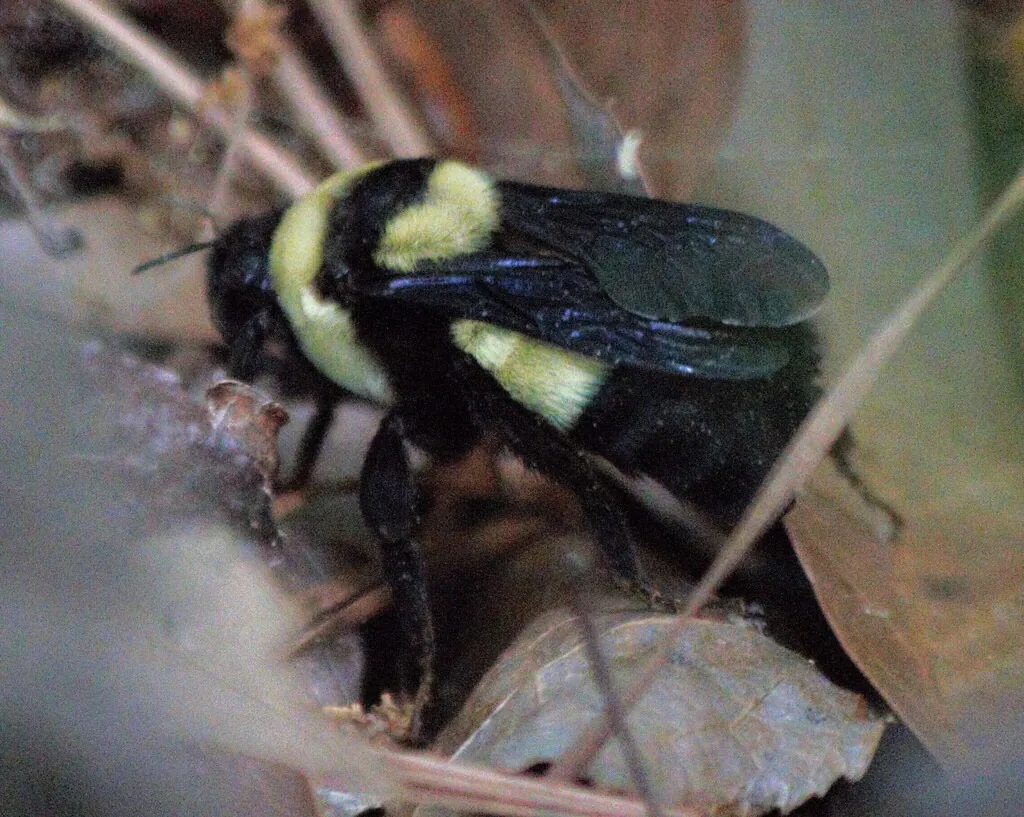
- Seen from above, the first two abdominal segments are yellow and the rest of the abdomen is black.[1][2]
- The hair is very short and even and lies flat against the body instead of looking fluffy. The abdomen is nearly rectangular and slightly flattened.[1][2]
- Between the wing bases, the thorax has a broad black band stretching from one wing to the other rather than a round spot.[1][2]
- Workers are about 1/2 to 3/4 inch long, males about 3/4 inch and queens 7/8 to 1 inch.[1]
- The Forest Service guide warns that it can be confused with the rusty patched and brown-belted bumble bees.[2]
Look-alikes
| Look-alike | How to tell them apart |
|---|---|
| Brown-belted bumble bee | The brown-belted bumble bee has a yellow first segment but a mostly black second segment with a brownish crescent, and a round black spot on the thorax instead of a band.[3][1] |
| Rusty patched bumble bee | The rusty patched bumble bee's second segment is brownish on the front half and yellow behind, and its thorax spot has a stripe of black hairs pointing backward.[3] |
| Common eastern bumble bee | The common eastern bumble bee has yellow only on the first abdominal segment, and the bare spot on its thorax is teardrop-shaped.[4] |
Where it lives
Its historical range covered much of the eastern United States and reached into northeastern Mexico, but that range has been contracting. The Forest Service guide rates it uncommon; in Missouri it can turn up statewide wherever native prairie remains.[1][2]
Biology and life cycle
It favors native prairies and other open habitats with plenty of wildflowers, and is named for the Southern Great Plains.[1]
Its tongue is short compared with other bumble bees, and it relies on a narrower set of nectar plants, especially prairie flowers, which ties it to native prairie.[1][2]
Favorite flowers include milkweeds, coneflowers, ironweeds, blazing stars, goldenrods, native peas and clovers. The Forest Service guide adds St. John's worts, bee balms, sumacs, nightshades and their relatives, asters and thistles.[1][2]
Damage and signs
- Neither source reports any damage. MDC notes that some plants can be pollinated only by bumble bees, and that this species is tied to prairie, a habitat that can hold hundreds of plant species in a few square yards.[1]
Health risk
Like other bumble bees it is able to sting if molested or if its nest is threatened, but MDC describes bumble bees as not aggressive.[1]
Control
Prevention
No control is needed. If a bumble bee nest turns up on your property, MDC asks that you leave it alone, since many bumble bees are declining.[1]
This bee depends on native prairie, and MDC names the conversion of nearly all of the continent's native prairie to agriculture as one reason for its decline. Across Missouri, the Bumble Bee Atlas project relies on volunteers to track and conserve native bumble bees.[1]
Common questions
- Is the southern plains bumble bee endangered?
- It has been proposed for listing as federally endangered and is a Missouri species of conservation concern. Its numbers have been falling since the early 20th century.[1]
- Why is it found only in prairies?
- It has a short tongue and a narrow set of preferred nectar plants, mostly prairie wildflowers, so in Missouri it is usually seen only in native prairie.[1][2]
- How do I recognize it?
- Look for short, flat-lying yellow hair on the first two abdominal segments, a black rear half of the abdomen, and a broad black bar across the thorax between the wings.[1][2]
Sources
- Missouri Department of Conservation, “Southern Plains Bumblebee (Field Guide).” mdc.mo.gov/discover-nature/field-guide/southern-plains-bumblebee (accessed 2026-11-09)
- USDA Forest Service and the Pollinator Partnership, “Bumble Bees of the Eastern United States (S. Colla, L. Richardson and P. Williams, 2011).” www.fs.usda.gov/wildflowers/pollinators/documents/BumbleBeeGuideEast2011.pdf (accessed 2026-11-09)
- Missouri Department of Conservation, “Brown-Belted Bumblebee (Field Guide).” mdc.mo.gov/discover-nature/field-guide/brown-belted-bumblebee (accessed 2026-11-09)
- Missouri Department of Conservation, “Common Eastern Bumblebee (Field Guide).” mdc.mo.gov/discover-nature/field-guide/common-eastern-bumblebee (accessed 2026-11-09)
- iNaturalist, “Bombus fraternus taxon page (order and family).” www.inaturalist.org/taxa/308937 (accessed 2026-11-09)