On this page
How to identify it
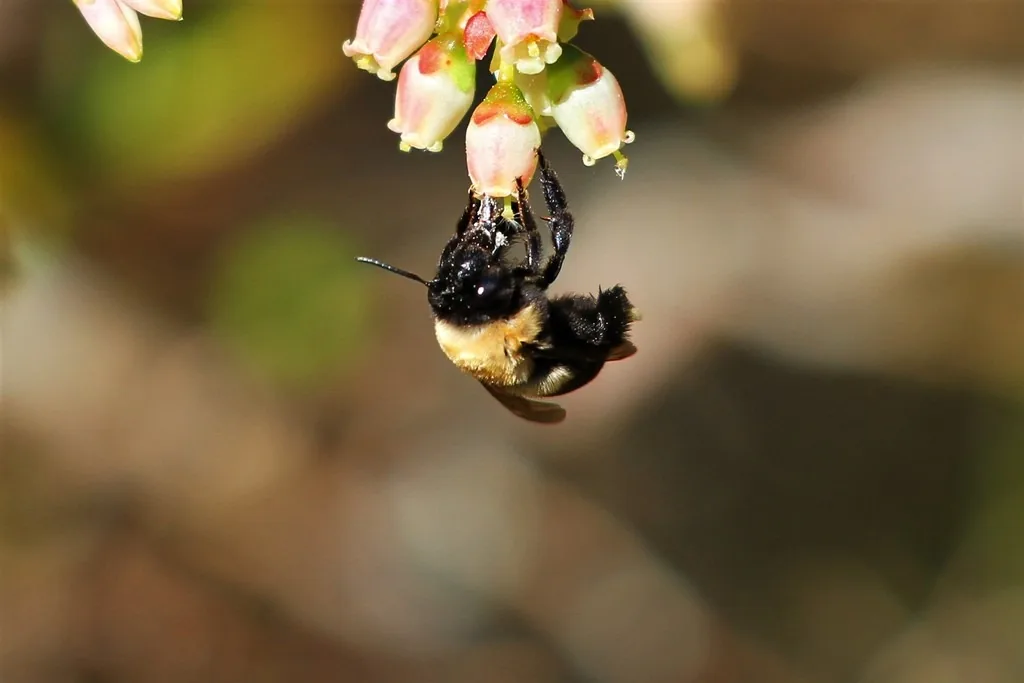
- It resembles a small, fuzzy bumble bee, with a stocky body covered in dense hair.[1][2]
- Males have a pale-colored face; females' faces are black.[1]
- At a blueberry flower it grips the bloom and vibrates the muscles of its thorax at high frequency, which shakes the pollen out.[1][2]
- It flies only during blueberry bloom; in Florida its foraging season runs from February to April.[1][2]
Look-alikes
| Look-alike | How to tell them apart |
|---|---|
| Bumble bees | Bumble bees are social bees with annual colonies, and in Florida they are active from February to November. The blueberry bee lives alone, nests in sandy soil, and forages only from February to April.[2] |
| Large carpenter bees | Florida's two large carpenter bees also resemble bumble bees and visit blueberry blossoms, but they nest in tunnels they excavate in wood and slit the petals to rob nectar, so they pollinate blueberries poorly.[2] |
Where it lives
UF/IFAS describes it as a native blueberry specialist in Florida, and NC State lists it among the blueberry specialist bees of North Carolina.[2][1]
Biology and life cycle
It depends on blueberries and is strongly drawn to them, often foraging on nothing else, although NC State notes that blueberry specialists may use other plants before and after bloom.[2][1]
Females nest underground in sandy soil, often in large groups of nests close together.[2]
NC State says these ground-nesting blueberry specialists nest within about a city block of their host plants and avoid mulch and dense turf, preferring bare or sparsely vegetated soil or a thin layer of pine straw.[1]
A single female may visit 50,000 blueberry flowers in her lifetime, enough to produce more than 6,000 ripe berries.[1]
Adults emerge close to wild blueberry bloom, toward the end of southern highbush bloom, so in Florida there may be too few of them to pollinate early-blooming cultivars without managed bees.[2]
Buzz pollination matters because blueberry flowers are cup-shaped and their pollen is heavy and sticky. In humid weather, when flowers shed pollen less readily, buzz pollinators like this bee may be especially needed, and honey bees can't buzz pollinate.[1][2]
Health risk
UF/IFAS and NC State discuss it only as a pollinator and mention no stings or other risk to people.[2][1]
Control
Prevention
No control is needed; it is a beneficial pollinator. To keep it around, NC State suggests leaving patches of bare, undisturbed soil near blueberries, limiting mulch, and choosing pollinator-friendly pest control that keeps pesticide use low.[1]
UF/IFAS suggests planting flowers that bloom in late winter and early spring, at a different time from the blueberries, along field edges, and notes that late-blooming blueberry cultivars suit this bee especially well.[2]
Common questions
- Is the fuzzy bee on my blueberry flowers a bumble bee?
- It may be a southeastern blueberry bee, which looks like a small bumble bee and appears during blueberry bloom; males have pale faces. Unlike bumble bees, it lives alone rather than in a colony.[1][2]
- Do blueberries need these bees if honey bees are around?
- They help. Honey bees can't buzz pollinate, while this bee and bumble bees can, and UF/IFAS notes that wild pollinators like it can be more efficient than honey bees, so farms with many wild bees may need fewer hives.[1][2]
- When are southeastern blueberry bees active?
- Only around blueberry bloom. In Florida they forage from February to April, emerging near the time wild blueberries flower.[1][2]
Sources
- NC State Extension, “Blueberry Pollination: The Role of Specialist Bees (E. Payne, guest post on E. Youngsteadt's Pollinators blog, April 18, 2025).” pollinators.ces.ncsu.edu/2025/04/blueberry-pollination-the-role-of-specialist-bees (accessed 2026-11-08)
- UF/IFAS Extension (EDIS), “Pollination Best Practices in Southern Highbush Blueberry in Florida, ENY-172 (R. E. Mallinger and D. A. Phillips, January 2019).” journals.flvc.org/edis/article/download/106992/117951/177746 (accessed 2026-11-08). EDIS PDF hosted on the Florida Virtual Campus journal system.
- iNaturalist, “Habropoda laboriosa taxon page (order and family).” www.inaturalist.org/taxa/121510 (accessed 2026-11-08)