How to identify it
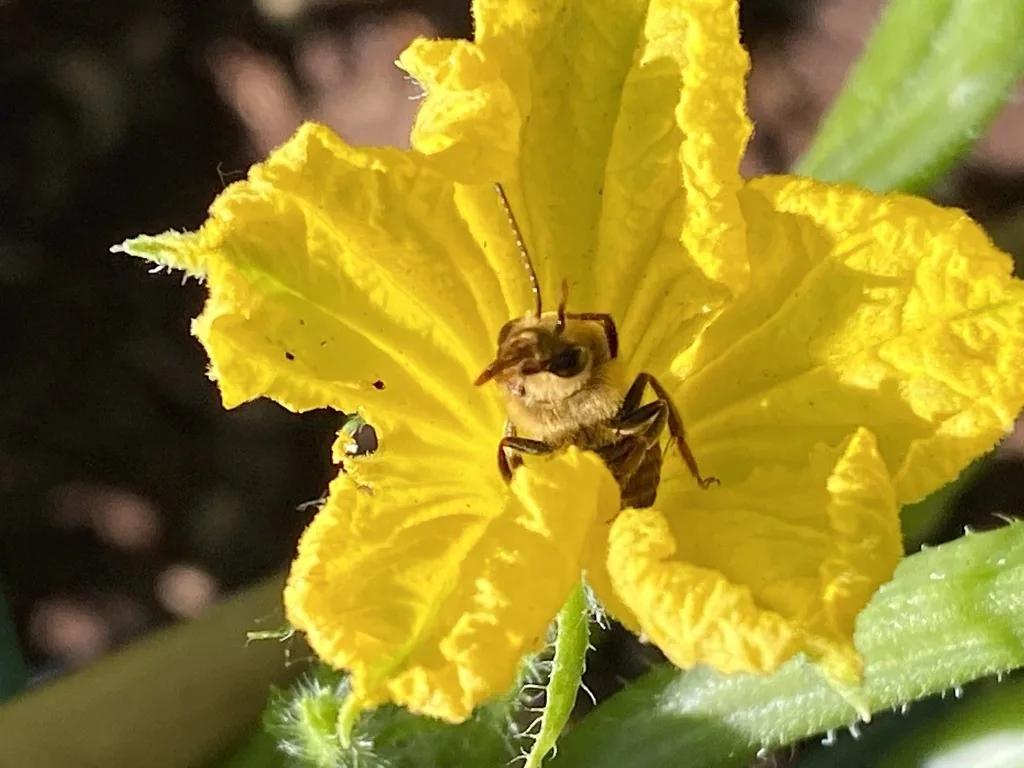
- They resemble honey bees but are larger and bulkier, with longer antennae and rounder faces; Oregon State describes them as hairy honeybee look-alikes with well-defined white bands on the abdomen.[1][2]
- Females have very fuzzy hind legs that may be covered all over in loose pollen, and males have a yellow spot on the face.[1]
Look-alikes
Where it lives
They occur throughout much of the United States and Mexico; Oregon State reports the first record in Oregon, in the southern part of the state, in 2016.[1][2]
Biology and life cycle
Each female digs her own nest in the soil, usually building nest cells 6 to 12 inches underground, often right under the squash plants.[1]
In North Carolina, adults are active from June to August; the rest of the year the next generation develops sealed in the nest cells.[1]
They forage from dawn until the squash flowers close around midday.[1][2]
Damage and signs
Health risk
They are solitary bees that don't live in a hive or colony; neither source reports a stinging problem.[1][2]
Control
Prevention
Tilling a squash bed at any time of year can destroy nests; one farm census found three times more squash bees on no-till farms, though a second study found no such effect.[1]
If you must treat flowering squash for pests, check the label for pollinator warnings; some insecticides should not be used at all, and others only in the evening when bees aren't active.[1]
Systemic insecticides applied before flowering can still reach toxic levels in squash pollen; one study found an 89 percent drop in squash bee reproduction where squash was drenched with imidacloprid.[1]
Common questions
- Is the bee in my squash flower a honey bee?
- It may be a squash bee, which is larger and bulkier with longer antennae and a rounder face.[1][2]
- Why do I only see squash bees early in the morning?
- Squash flowers open at dawn and close around midday, and squash bees forage on that schedule.[1][2]
- Does tilling harm squash bees?
- It can; they nest 6 to 12 inches underground, often under the squash plants, though studies disagree on how much tilling matters.[1]
Sources
- NC State Extension, “Squash Bees in the Home Garden.” content.ces.ncsu.edu/squash-bees-in-the-home-garden (accessed 2026-10-15)
- Oregon State University Extension Service, “Squash bees (published August 2020, reviewed 2024).” extension.oregonstate.edu/catalog/squash-bees (accessed 2026-10-15)
- iNaturalist, “Xenoglossa pruinosa taxon page (order and family).” www.inaturalist.org/taxa/1594041 (accessed 2026-10-06)