On this page
How to identify it
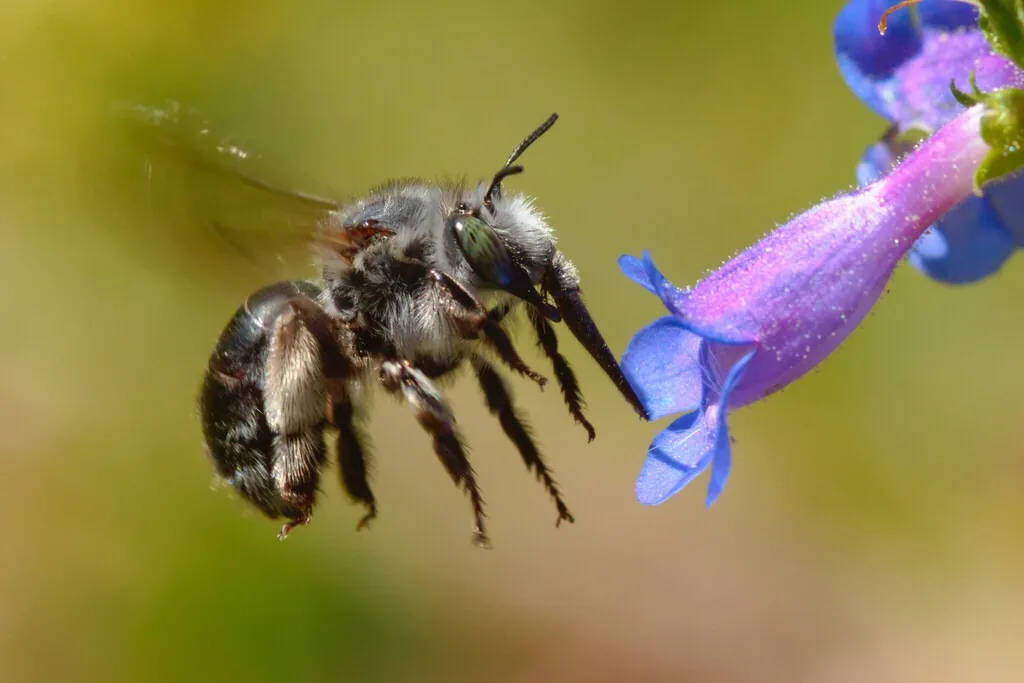
- Robust, hairy bees from about half an inch to an inch long; Utah State puts the common ones at about three-quarters of an inch.[3][1]
- Usually grey with bold stripes, looking like a small, fast, sometimes grayish bumble bee.[1][2]
- The wings are proportionally smaller than those of other bees, and the bees hover low to the ground and fly very fast.[1]
- Nest holes in dry soil, often many together, frequently with a mud chimney or turret built around each entrance.[1][2]
- Long-tongued bees that favor deep flowers such as beardtongue (Penstemon).[4]
Look-alikes
| Look-alike | How to tell them apart |
|---|---|
| Chimney bee (Anthophora abrupta) | One eastern digger bee species that builds large aggregations with mud turrets on vertical clay banks; this page covers the genus as a whole.[2] |
| Bumble bees | Digger bees look like small grayish bumble bees but are solitary ground nesters with proportionally smaller wings and a faster, hovering flight.[1][2] |
| Mining bees | Andrena mining bees also nest in ground aggregations in spring but are generally smaller and lack the mud chimneys.[1][2] |
| Habropoda digger bees | A smaller related genus with 15 US species, most in the West; the southeastern blueberry bee is the eastern one.[3] |
Where it lives
About 100 Anthophora species occur in North America (more than 50 north of Mexico by the Missouri count); the Missouri Department of Conservation records the family statewide and Utah State lists digger bees among Utah's common native bees.[3][2][1]
Biology and life cycle
Digger bees burrow into dry soil using their jaws and legs. Nests are made in the ground, often in large groupings, and many species build a mud chimney around the entrance. Some, such as the abrupt digger, nest in big aggregations on vertical dirt surfaces like the bottoms of cliffs or banks.[1][2]
Although they nest in crowds, digger bees are solitary: each female digs and provisions her own tunnel.[2]
In Utah they are active from March to October, with peak activity from April to June.[1]
Anthophora is a large genus with more than 400 species worldwide and about 100 in North America; the related Habropoda has 15 US species, mostly western.[3]
Like other long-tongued bees in the family Apidae, they favor deep flowers; the pollen they carry is caught in the branched hairs that distinguish bees from wasps.[4]
Damage and signs
Health risk
Utah State and the Missouri Department of Conservation both describe digger bees as not aggressive toward humans or pets.[1][2]
Control
Prevention
No control is needed. Digger bees are docile native pollinators that nest in dry ground; leave the nesting patches alone, plant native flowers, and avoid regular broad-spectrum insecticide use if you want to keep them and other beneficial insects in the yard.[1][2][3]
Common questions
- Dozens of fast grey bees are hovering over bare dirt with little mud tubes. What are they?
- Digger bees. They nest in the ground in large groupings and many species build a mud chimney around each entrance; they hover low and fly fast but are not aggressive.[1][2]
- Are digger bees a kind of bumble bee?
- No. They look like small, fast, grayish bumble bees, but they are solitary bees in the genus Anthophora that dig individual tunnels in dry soil.[2][1]
- When will they go away?
- Utah State reports digger bees active from March to October with a peak from April to June; the nesting aggregations are seasonal and the bees need no control.[1]
Sources
- Utah State University Extension, “Beginner's Guide to Common Native Bees (May 2021).” extension.usu.edu/planthealth/research/beginners-guide-to-common-native-bees.php (accessed 2026-11-10)
- Missouri Department of Conservation, “Apid Bees (Field Guide).” mdc.mo.gov/discover-nature/field-guide/apid-bees (accessed 2026-11-10)
- Washington State University Extension, “Apidae: Digger Bees (Anthophora and Habropoda spp.) (Hortsense pollinator fact sheet, reviewed April 2026).” hortsense.cahnrs.wsu.edu/fact-sheet/apidae-digger-bees-anthopthora-and-habropoda-spp/ (accessed 2026-11-10)
- USDA Forest Service and Pollinator Partnership, “Bee Basics: An Introduction to Our Native Bees (Beatriz Moisset and Stephen Buchmann).” www.fs.usda.gov/wildflowers/pollinators/documents/BeeBasics.pdf (accessed 2026-11-10)
- iNaturalist, “Anthophora taxon page (order and family).” www.inaturalist.org/taxa/57682 (accessed 2026-11-10)