On this page
How to identify it
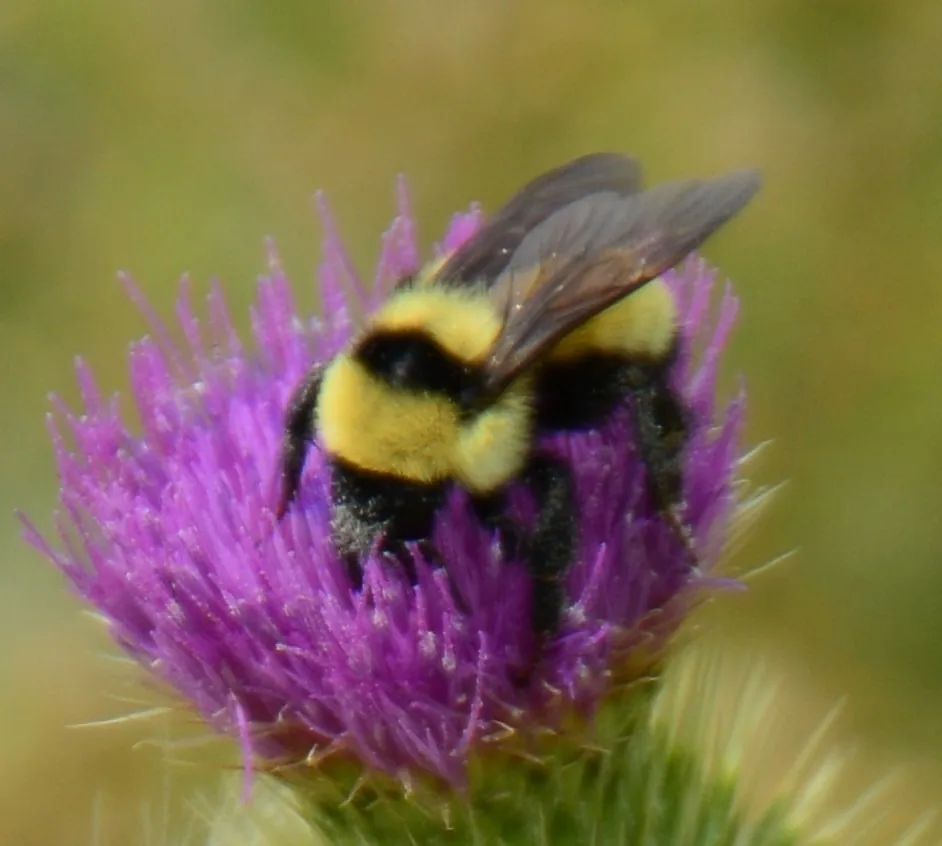
- Females have yellow hair on the first four abdominal segments and black on the fifth and sixth.[1][3]
- The thorax is mostly yellow, usually with a black band between the wing bases that can be very narrow and mixed with yellow hairs; now and then the thorax is entirely yellow.[1][3]
- The face is black and long, the cheeks are clearly longer than they are wide, and the sides of the thorax are yellow at least in their upper half.[1][2]
- Queens are distinctly larger than workers. Males usually have yellow hair on the face forming a beard or mustache.[3]
Look-alikes
| Look-alike | How to tell them apart |
|---|---|
| Northern amber bumble bee (Bombus borealis) | It is also yellow over the first four abdominal segments, but its face hair is yellow or grayish yellow rather than black, and the sides of its thorax are mostly black, with yellow only on the upper half.[1] |
| California bumble bee (Bombus californicus), yellow form | The yellow form, found mainly in the Intermountain West and Rocky Mountains, has mostly black hair on the lower front of the side of the thorax. Males of the two can be extremely hard to tell apart, and the western guide notes they may be one species.[2] |
| Common eastern bumble bee | The common eastern bumble bee has yellow only on the first abdominal segment, with the rest of the abdomen black. In Wisconsin, golden northern queens come out slightly after common eastern queens, in May.[4][3] |
Where it lives
It is found across most of the continental United States, except west of the Sierra-Cascade crest. In Wisconsin, historical records place it throughout the state, though the university's guide says more thorough surveys are needed.[2][3]
Biology and life cycle
It has a long tongue and is most common in open fields and meadows. Food plants listed in the Forest Service guides include thistles, clovers, beardtongues, honeysuckles, loosestrifes, vetches, bee balms, Phacelia, sunflowers and teasels (Dipsacus).[1][2][3]
It nests both on the ground surface and underground.[1]
Its colony life cycle appears to be fairly standard for a bumble bee, but the Wisconsin guide notes that little is known about this species beyond historical records.[3]
Damage and signs
Health risk
Bumble bees can sting when they are molested or when their nest is endangered. MDC says there is no need to fear them, because they are not aggressive.[5]
Control
Prevention
No control is needed. This bee may be declining, and MDC's general advice for any bumble bee nest found on a property is to leave it in place.[1][3][5]
Common questions
- Is the golden northern bumble bee declining?
- Possibly, in the East. The eastern Forest Service guide lists it as uncommon and possibly in decline, and the Wisconsin guide says historical and museum records suggest a decline, though little effort has gone into finding current populations. The western guide calls it common in the West.[1][3][2]
- How do I tell it from the northern amber bumble bee?
- Look at the face and the sides of the thorax. The golden northern bumble bee has a black face and yellow thorax sides, while the northern amber bumble bee has a yellow or grayish yellow face and mostly black lower thorax sides.[1]
- Where should I look for it?
- In open fields and meadows, on flowers such as thistles, clovers and bee balm.[1][3]
Sources
- USDA Forest Service and the Pollinator Partnership, “Bumble Bees of the Eastern United States (S. Colla, L. Richardson and P. Williams, 2011).” www.fs.usda.gov/wildflowers/pollinators/documents/BumbleBeeGuideEast2011.pdf (accessed 2026-11-09)
- USDA Forest Service and the Pollinator Partnership, “Bumble Bees of the Western United States (J. Koch, J. Strange and P. Williams, 2012).” www.fs.usda.gov/wildflowers/pollinators/documents/BumbleBeeGuideWestern2012.pdf (accessed 2026-11-09)
- University of Wisconsin-Madison, Department of Entomology, “Yellow Bumble Bee (Bumble Bees of Wisconsin online guide).” wisconsinbumblebees.entomology.wisc.edu/online-guide/species/yellow-bumble-bee/ (accessed 2026-11-09)
- Missouri Department of Conservation, “Common Eastern Bumblebee (Field Guide).” mdc.mo.gov/discover-nature/field-guide/common-eastern-bumblebee (accessed 2026-11-09)
- Missouri Department of Conservation, “Bumblebees (Field Guide).” mdc.mo.gov/discover-nature/field-guide/bumble-bees (accessed 2026-11-09)
- iNaturalist, “Bombus fervidus taxon page (order and family).” www.inaturalist.org/taxa/52774 (accessed 2026-11-09)