The short answer
- Start when the first beetles show up (June in Kentucky, late June or early July in Minnesota) and check plants daily. Knock or handpick beetles into a bucket of soapy water, ideally in the morning or evening when they are sluggish. Beetle-damaged leaves give off odors that draw in more beetles, so keeping numbers down early matters.[1][2]
- Don't hang Japanese beetle traps in your yard. University of Kentucky research found the traps attract many more beetles than they catch, so nearby plants often get more damage than with no trap at all.[1][2][3]
- Cover prized plants with fine netting or cheesecloth during peak beetle activity, but not plants in bloom that need pollinators to set fruit.[1][2]
- If you spray, pick a product labeled for the plant. Pyrethroids last about 2 to 3 weeks and carbaryl 1 to 2 weeks, but both are toxic to bees; chlorantraniliprole lasts 2 to 4 weeks and is low risk to bees; neem and pyrethrins give only a few days. Don't spray open flowers or plants bees are visiting.[1][2]
- Treat lawn grubs only to protect the lawn: a preventive product before egg-laying if you have a history of grub damage, or a curative one in late summer while the grubs are small. Commercial milky spore products have not shown a benefit in modern university trials.[2][4]
Related profiles
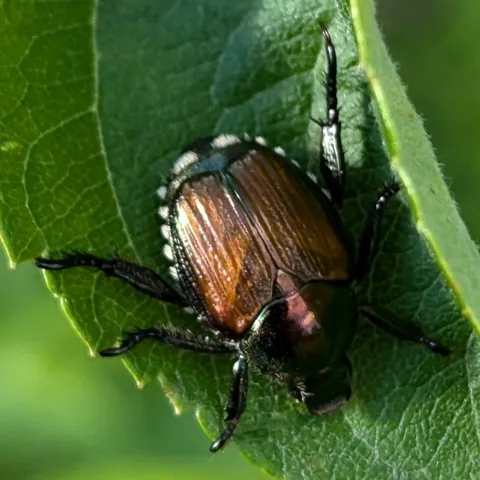 Japanese Beetle
Popillia japonica
The Japanese beetle damages landscapes twice: metallic green adults chew the leaves, flowers and fruit of hundreds of plants in early summer, and their white grubs feed on grass roots underground. A review of its biology calls it the most widespread and destructive insect pest of turf, landscapes and nursery crops in the eastern United States.
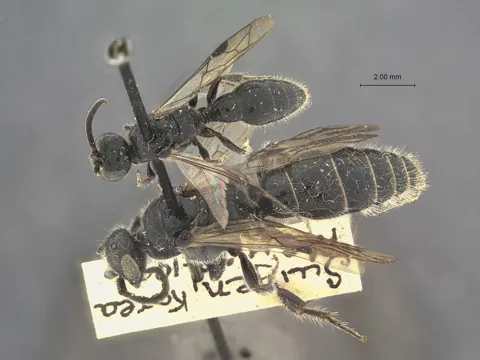 Spring tiphia
Tiphia vernalis
Spring tiphia is a small black wasp brought from Korea in the 1920s and early 1930s to fight Japanese beetles. Each spring the females dig into the soil, paralyze a Japanese or oriental beetle grub and lay an egg on it, and the wasp larva eats the grub. It now occurs on its own wherever Japanese beetles are present across much of the central and eastern United States.
Life cycle and timing
Japanese beetles have one generation a year. Adults are metallic green with copper-brown wing covers and a row of white hair tufts along each side under the edges of the wing covers. Size estimates vary by source: Kentucky gives 7/16-inch long, Clemson 0.3 to 0.5 inch, and NC State 5/8 inch (16mm).[5][1][4][3]
Adults start coming out of the ground in June in Kentucky and in late June or early July in Minnesota. Activity is heaviest for about 4 to 6 weeks starting in late June; Minnesota says they feed for six to eight weeks, mostly in July and August, with a few into September. A single beetle lives about 30 to 45 days.[1][2]
After mating, females burrow into the soil to lay eggs, then come back up to feed, repeating the cycle until each has laid 40 to 60 eggs. Sources put the egg depth at 1 to 3 inches (Minnesota), 2 to 3 inches (Kentucky) and 2 to 6 inches (NC State). Eggs hatch in about two weeks; Clemson gives 10-14 days and NC State 8 to 9 days.[5][2][1][3][4]
Females are drawn to moist, grassy areas for egg-laying, so irrigated lawns often have the most grubs, especially in otherwise dry summers. Dry soil can kill eggs and young grubs, which means fewer beetles the next year.[1][2]
The grubs feed on grass roots through late summer and fall and are nearly full size, about 1 inch long, by late August. As the soil cools they move deeper, most spending the winter 2 to 6 inches down. In spring they return to the root zone, feed for 4-6 weeks, and pupate; adults emerge about 2 weeks after pupating.[1][5][2]
Adults and grubs are separate problems
Adults feed on about 300 species of plants, chewing out the tissue between leaf veins so leaves look like lace, and eating flowers and ripe or wounded fruit. They feed in groups, usually starting at the top of a plant, and prefer plants in full sun on warm, sunny days.[1][2][5]
Adults are strong fliers that can come from several miles away. Because of that, Kentucky and Minnesota both say controlling grubs in your lawn will not protect your landscape plants from adult feeding. Treat grubs only if the lawn itself is being damaged.[1][2][3]
For most plants the adult damage is cosmetic. Healthy, mature trees and shrubs can tolerate a lot of feeding; young or weak plants can be stunted or killed by severe, repeated feeding, and roses usually survive even though the blossoms are ruined.[2]
Handpicking into soapy water
For small plantings and modest numbers of beetles, physical removal can give enough protection on its own. Shake or knock beetles into a bucket of soapy water, which kills them.[1][2]
Do it early and often. The best times are morning or evening when the beetles are cool and sluggish, though Minnesota says any time you can do it still helps. Check plants daily: beetles on a plant and the odor of their damage attract more beetles, so a plant you keep clear stays less attractive.[1][2]
Before you drop a beetle in the bucket, look for small white dots on its back or head. Those are eggs of the winsome fly, Istocheta aldrichi, a parasite of adult Japanese beetles. Minnesota asks gardeners not to kill beetles carrying these eggs, since one egg is enough to parasitize the beetle and conserving the fly helps it build up.[2]
Why Japanese beetle traps backfire
Store-bought traps combine a lure that mimics the scent of virgin females, which draws males, with a sweet floral food lure that draws both sexes. Together they can pull in thousands of beetles a day.[1][2]
Research at the University of Kentucky found that the traps attract many more beetles than they catch. Plants along the beetles' flight path and near the traps are likely to be damaged more than if no trap were used. Kentucky says that in most landscapes the traps probably do more harm than good, and Minnesota and NC State advise homeowners not to use them.[1][2][3]
The traps were developed to monitor where Japanese beetles are, not to protect plants. That is still how agencies use them: Oregon's survey traps carry a pheromone and a floral lure and contain no insecticide. If you experiment with a trap anyway, Kentucky says to place it well away from gardens and landscape plants.[2][7][1]
Plants they favor and plants they leave alone
Choosing less-preferred plants is Kentucky's main advice for avoiding a yearly fight with Japanese beetles. Plants especially prone to damage include roses, grapes, lindens, sassafras, Norway maple, Japanese maple and purple-leaf plum, and many flowering crabapples, though some crabapple cultivars resist. Minnesota adds apple, cherry, plum, birch, elm, raspberry, currant, basil, Virginia creeper, hollyhock, marigold, corn silks and soybean.[1][2]
Plants Minnesota lists as usually not damaged include boxwood, clematis, chrysanthemum, conifers such as arborvitae, spruce, fir and pine, daylily, geranium, ginkgo, Japanese tree lilac, forsythia, common lilac, magnolia, red and silver maple, oak, white poplar, redbud, rhododendron and yew. USDA APHIS also names red maple, boxwood, hosta and begonia as resistant.[2][5]
A University of Kentucky choice test confirmed older ratings: tuliptree, lilac, dogwood and Bradford callery pear were rejected, while sassafras, cherry plum, Virginia creeper and littleleaf linden were readily eaten. Beetles held on the rejected species also survived poorly and laid few eggs.[13]
Flower color matters on roses. In field tests more beetles landed on yellow and white flower models, and yellow-flowered rose cultivars were more susceptible than red ones regardless of fragrance; the researchers suggest roses with relatively dark, small blooms may draw fewer beetles.[14]
Weedy hosts keep beetles coming. Kentucky lists bracken, elder, multiflora rose, Indian mallow, poison ivy, smartweed and wild grape, and suggests removing them where practical.[1]
Netting and row covers
Highly valued plants such as roses can be protected by covering them with cheesecloth or other fine netting during peak beetle activity.[1]
Mind the bloom. Minnesota warns not to cover plants in bloom that need pollination, such as fruits, because the cover keeps pollinators out. Handpick until the plant has finished blooming and started to set fruit, then cover it.[2]
Home remedies and companion plants that don't work
Kentucky rates insecticidal soap, garlic, hot pepper and orange-peel extracts, and companion planting as generally ineffective against Japanese beetles.[1]
In a field test on linden, sprays of capsaicin, rotenone plus pyrethrins, kaolin particle film, D-limonene and garlic extract were ineffective, and the D-limonene and garlic products badly damaged the linden leaves.[11]
Companion planting failed when tested. Rue, zonal geranium and garlic chives interplanted with roses did not reduce beetle numbers, and geraniums actually increased them. Bags of crushed red pepper, fennel seed, cedar shavings or osage orange hung around roses also drew more beetles on some dates, not fewer.[12]
Four o'clocks (Mirabilis jalapa) are often said online to kill Japanese beetles. Minnesota Extension says those claims come with no evidence, and a 2013 Colgate University study saw no dead beetles when they were fed only four o'clocks, and the sap irritates human skin.[2]
Insecticides for adult beetles
Many insecticides are labeled for adult Japanese beetles. Spray foliage and flowers thoroughly and expect to repeat during the adult flight, since new beetles keep arriving. Make sure the product is registered for the plant, and for food crops note the days required between the last spray and harvest.[1][2]
Pyrethroids such as bifenthrin, cyfluthrin, lambda-cyhalothrin, deltamethrin and permethrin generally protect foliage for 2-3 weeks, carbaryl for 1-2 weeks. In a Kentucky field test, all the pyrethroids except permethrin out-performed carbaryl after 14 days of weathering. Pyrethroids, carbaryl and acephate are all toxic to bees.[1][2][11]
Chlorantraniliprole (Acelepryn) gives two to four weeks of protection and is low risk to bees, according to Minnesota.[2]
Lower-impact choices give short protection. Neem products and Pyola (pyrethrins in canola oil) deterred feeding for about 3-4 days in Kentucky's guidance; neem is low risk to bees but less effective when many beetles are present. Pyrethrins work only when sprayed directly on the beetles and are toxic to bees too.[1][2][11]
Bacillus thuringiensis galleriae (Btg, sold as BeetleGone or BeetleJus) gave one to two weeks of protection in Minnesota's summary and is not toxic to bees. Research also found Btg sprays killed 97-100% of young monarch caterpillars feeding on treated milkweed, so don't use it in gardens with milkweed or other host plants of butterflies you want to keep.[2][10]
Systemic soil treatments with imidacloprid or dinotefuran need only one application a year, but both are very toxic to pollinators. Minnesota says not to apply them within 4-5 feet of pollinator-attractive plants, or to wait until plants have finished blooming. Trunk injections should be done by a certified tree care professional.[2]
Protecting bees: spray timing around bloom
Avoid spraying in wind or when bees are foraging, and don't spray open blooms of plants bees visit. Kentucky and Minnesota both give this warning.[1][2]
Lawn grub products need the same care when clover or dandelions are blooming. In a University of Kentucky study, bumble bee colonies that foraged on blooming white clover sprayed with clothianidin gained weight more slowly and produced no new queens, while colonies on chlorantraniliprole-treated clover developed normally.[8]
Mowing fixed most of the problem. Colonies were not harmed on treated turf after it was mowed to remove the blooms present at spraying and new blooms had formed, and a follow-up study found neonicotinoid residues in nectar of blooms that formed after mowing were 99.4% to 99.8% lower. Minnesota's advice is to mow flowering weeds just before or right after applying a grub insecticide, and to avoid areas with ground-nesting bees.[8][9][2]
Grubs in the lawn: checking and timing
Grub-damaged turf wilts and yellows, and in bad cases dies in patches that roll back like a carpet because the roots are gone. Yellowing or browning grass in August is an early sign, but other problems cause it too, so look under the grass first. Clemson suggests cutting three sides of a 12-inch square, folding the sod back and counting grubs in the root zone and upper 1-3 inches of soil.[1][2][4]
Healthy turf can usually tolerate up to 10 grubs per square foot. Clemson says six to eight per square foot may be a safer threshold, because skunks, raccoons and other animals tearing up the lawn for grubs add damage.[2][4]
Preventive products (labels often say "season-long") are insurance for lawns with a recent history of grub damage or after a heavy beetle flight. Minnesota times them for the month or so before adults emerge and lay eggs, mid-June to mid-July there; Clemson, in South Carolina, recommends April through May. Chlorantraniliprole is effective and low risk to bees; imidacloprid and clothianidin work too but can harm bees foraging on lawn weeds.[2][4]
Curative products (often labeled "24-hour") go on once grubs are present: late July to mid-September in Minnesota, July through August in South Carolina, while the grubs are 1/2 inch or less. Trichlorfon, clothianidin and carbaryl are the effective curatives Minnesota lists, and all three are toxic to bees. Water granular products in right away, per Clemson.[2][4]
Late and spring treatments disappoint. A September rescue treatment on nearly full-size grubs gives only partial control, and once grubs move down in late fall insecticides don't reach them. Minnesota advises against spring treatment: the large grubs are hard to kill, feed only briefly and rarely damage turf then.[2]
Milky spore, nematodes and other biological grub controls
Milky spore disease is caused by Paenibacillus popilliae (formerly Bacillus popilliae), a soil bacterium that infects only Japanese beetle grubs and has no effect on beneficial organisms. It occurs naturally and infects a small share of grubs.[2][4]
The evidence for buying it is weak. Minnesota says applying commercial milky spore products has not shown any benefit in modern university research trials, and Clemson says results of biological controls vary widely with the site and conditions. In a field trial in California published in 2000, soil treated with the milky disease bacterium and then tested against Japanese beetle grubs did not cause substantial mortality, while diazinon and the nematode Steinernema kushidai did.[2][4][16]
Parasitic nematodes such as Heterorhabditis bacteriophora are sold for grubs, but Minnesota calls their results inconsistent. If you try them, apply after eggs have hatched and grubs are small, and water before and after, since nematodes dry out easily.[2][4]
Granular Btg grub products (grubGONE, grubHALT) gave inconsistent results in university trials; one Kentucky study found granular Btg failed to control young or older Japanese beetle grubs under several turfgrass species at multiple field sites.[2][10]
Two natural enemies have been released in Minnesota: the winsome fly on adults and the spring tiphia wasp (Tiphia vernalis) on grubs. The winsome fly parasitized 16% to 30% of beetles at the Minnesota Landscape Arboretum in 2024 and is likely suppressing beetle numbers in parts of the state.[2]
In the West: quarantines and eradication
Japanese beetle arrived in New Jersey in 1916 and has spread through most of the eastern and central United States, with infested areas west of the Mississippi River. USDA APHIS regulates air cargo from airports in quarantined states to keep hitchhiking beetles from reaching western states.[5][1]
Washington first detected Japanese beetle in the south of the state in 2020, and trapping collected over 23,000 beetles in both 2021 and 2022. Modeling by Washington State University and the state agriculture department predicted the beetle could spread across Washington within 20 years without management. WSDA runs an eradication project with treatments and a quarantine area from which plants, yard debris and soil shouldn't be moved.[15][6]
Oregon's largest infestation was found in 2016 in Washington County. The Oregon Department of Agriculture treats with a granular chlorantraniliprole product sold only to licensed pesticide applicators, and reports treatments from 2017 through 2025 cut the population 92%. ODA thinks the infestation most likely came in on a potted plant moved from an infested area, and asks residents in the area not to move plants, including outdoor potted plants, or join plant swaps.[7]
If you live in a western state and find a beetle that looks like a Japanese beetle outside a known treatment area, report it to your state agriculture department or invasive species hotline. Oregon notes that many beetles seen inside homes in late fall are boxelder bugs, not Japanese beetles.[7][5]
Common questions
- What kills Japanese beetles instantly?
- Knocking them into a bucket of soapy water kills them and needs no pesticide. Contact sprays like pyrethrins kill only beetles they hit directly, and new beetles keep flying in, so no single treatment ends the problem for the season.[1][2]
- Do Japanese beetle traps work?
- They catch a lot of beetles, but University of Kentucky research showed they attract many more than they catch, so plants near a trap usually get more damage. Extension services in Kentucky, Minnesota and North Carolina advise against them in home landscapes.[1][2][3]
- Will treating my lawn for grubs stop the beetles?
- No. Adults fly in from other properties and can travel several miles, so grub control protects your lawn but not your roses or grapes.[1][2]
- Does milky spore work for Japanese beetle grubs?
- Commercial milky spore products have not shown a benefit in modern university trials, according to the University of Minnesota. The bacterium does occur naturally and infects a small share of grubs.[2][4]
- When are Japanese beetles active?
- Adults emerge in June to early July and feed for roughly 4 to 8 weeks, mostly in July and August. Grubs are in the soil from late summer through the following spring.[1][2]
- Are there plants that repel Japanese beetles?
- No plant reliably repels them. Garlic chives, rue and geraniums planted with roses didn't reduce beetles in a field test, and geraniums increased them. What helps is growing plants they seldom eat, such as boxwood, lilac, red maple, oak and yew.[12][1][2]
Photo credits
- Japanese Beetle: (c) Emmett Collins-Sussman, some rights reserved (CC BY) — via iNaturalist, CC BY 4.0
- Spring tiphia: Smithsonian National Museum of Natural History, public domain (CC0), via Smithsonian Open Access
Sources
- University of Kentucky Entomology, “Japanese Beetles in the Urban Landscape (ENTFACT-451; D.A. Potter, M.F. Potter, L.H. Townsend; revised 3/26).” entomology.ca.uky.edu/ef451 (accessed 2026-11-10)
- University of Minnesota Extension, “Japanese beetles in yards and gardens.” extension.umn.edu/yard-and-garden-insects/japanese-beetles (accessed 2026-11-10)
- NC State Extension, “Japanese Beetle.” content.ces.ncsu.edu/japanese-beetle (accessed 2026-11-10)
- Clemson Cooperative Extension Home & Garden Information Center, “White Grub Management in Turfgrass (HGIC).” hgic.clemson.edu/factsheet/white-grub-management-in-turfgrass/ (accessed 2026-11-10)
- USDA Animal and Plant Health Inspection Service, “Japanese Beetle.” www.aphis.usda.gov/plant-pests-diseases/japanese-beetle (accessed 2026-11-10)
- Washington State Department of Agriculture, “Japanese Beetle.” agr.wa.gov/departments/insects-pests-and-weeds/insects/japanese-beetle (accessed 2026-11-10)
- Oregon Department of Agriculture, “Japanese Beetle (Insect Pest Prevention and Management).” www.oregon.gov/oda/ippm/survey-treatment/pages/japanese-beetle.aspx (accessed 2026-11-10)
- PLoS One, via PubMed, “Larson, Redmond and Potter (2013), Assessing insecticide hazard to bumble bees foraging on flowering weeds in treated lawns, PLoS One.” pubmed.ncbi.nlm.nih.gov/23776667/ (accessed 2026-11-10)
- Environmental Toxicology and Chemistry, via PubMed, “Larson, Redmond and Potter (2015), Mowing mitigates bioactivity of neonicotinoid insecticides in nectar of flowering lawn weeds and turfgrass guttation, Environ Toxicol Chem.” pubmed.ncbi.nlm.nih.gov/25319809/ (accessed 2026-11-10)
- Pest Management Science, via PubMed, “Redmond et al. (2020), Strengths and limitations of Bacillus thuringiensis galleriae for managing Japanese beetle adults and grubs, Pest Manag Sci.” pubmed.ncbi.nlm.nih.gov/31240825/ (accessed 2026-11-10)
- Journal of Economic Entomology, via PubMed, “Baumler and Potter (2007), Knockdown, residual, and antifeedant activity of pyrethroids and home landscape bioinsecticides against Japanese beetles, J Econ Entomol.” pubmed.ncbi.nlm.nih.gov/17461070/ (accessed 2026-11-10)
- Journal of Economic Entomology, via PubMed, “Held, Gonsiska and Potter (2003), Evaluating companion planting and non-host masking odors for protecting roses from the Japanese beetle, J Econ Entomol.” pubmed.ncbi.nlm.nih.gov/12650348/ (accessed 2026-11-10)
- Environmental Entomology, via PubMed, “Keathley and Potter (2008), Quantitative resistance traits and suitability of woody plant species for a polyphagous scarab, Popillia japonica Newman, Environ Entomol.” pubmed.ncbi.nlm.nih.gov/19161699/ (accessed 2026-11-10)
- Journal of Economic Entomology, via PubMed, “Held and Potter (2004), Floral characteristics affect susceptibility of hybrid tea roses to Japanese beetles, J Econ Entomol.” pubmed.ncbi.nlm.nih.gov/15154455/ (accessed 2026-11-10)
- Journal of Economic Entomology, via PubMed, “Zhu et al. (2023), Potential distribution and spread of Japanese beetle in Washington State, J Econ Entomol.” pubmed.ncbi.nlm.nih.gov/37319330/ (accessed 2026-11-10)
- Journal of Economic Entomology, via PubMed, “Koppenhofer et al. (2000), Biological control agents for white grubs in anticipation of the establishment of the Japanese beetle in California, J Econ Entomol.” pubmed.ncbi.nlm.nih.gov/14658514/ (accessed 2026-11-10)