On this page
How to identify it
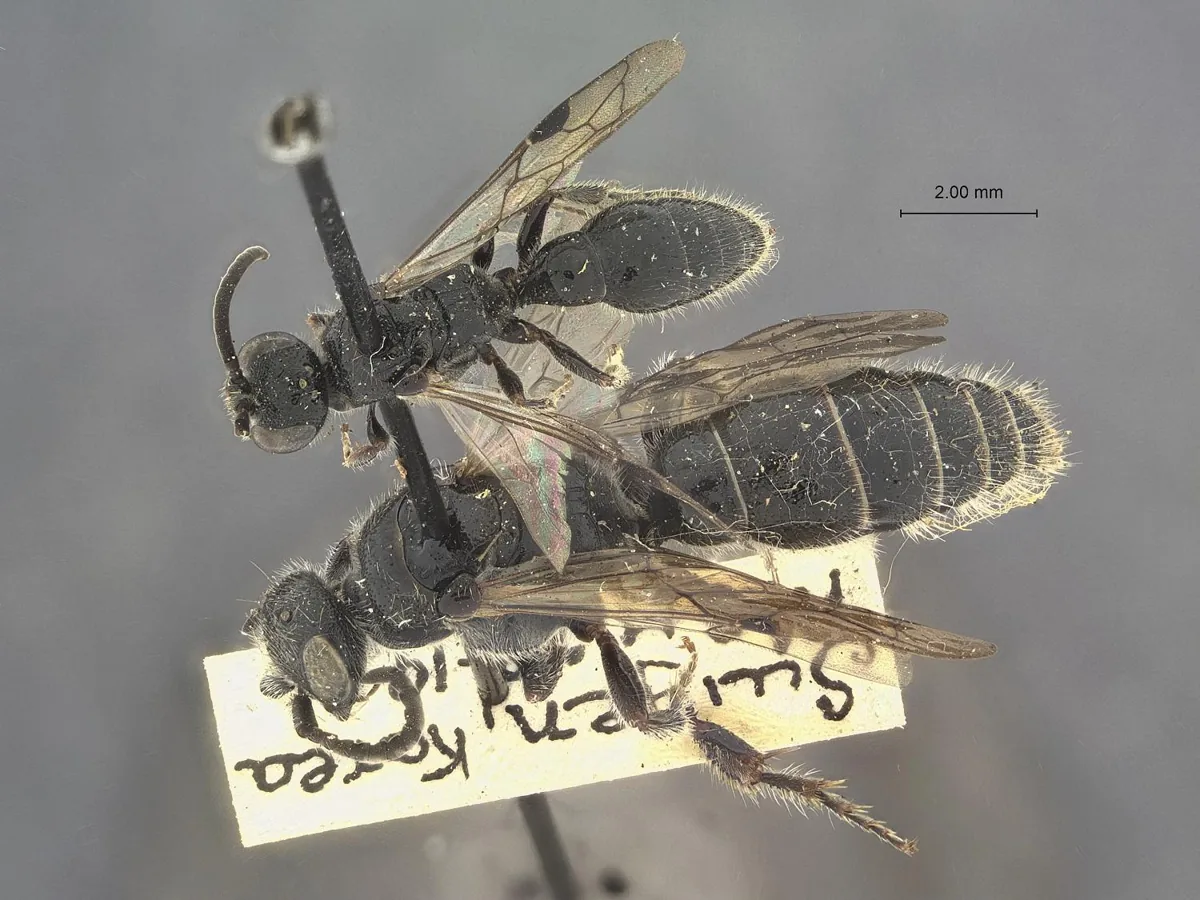
- A shiny black, solitary wasp; females are about 1/2 inch long and males about 3/8 inch. It does not build nests or form swarms.[1]
- Adults fly in spring: in Connecticut from the first week of May to early June, peaking around the last week of May; a laboratory study describes adults feeding from mid-April to late June.[1][4]
- Look for them feeding on the nectar on peony buds, on honeydew on the leaves of aphid-infested maples, cherries and other plants, and on tulip tree flowers.[1]
- In the soil, a parasitized grub carries the wasp's egg, and then its larva, at a specific spot between the grub's thorax and abdomen; the full-grown larva spins a silken, rust-brown cocoon.[1]
Where it lives
A non-native species found in the central and eastern United States, established in Connecticut, Massachusetts, southern New Hampshire, Rhode Island, New Jersey, Pennsylvania, Maryland, Kentucky, Missouri, Ohio, Tennessee and North Carolina. Ohio State notes it is one of several imported parasites of Japanese beetle established in eastern states.[1][2]
Biology and life cycle
After mating, the female burrows into the soil to hunt for third-stage grubs of Japanese or oriental beetles. She stings the grub to paralyze it and attaches a single egg; the wasp larva feeds on the grub and kills it.[1]
There is one generation a year. Adults live on nectar and honeydew, and in laboratory tests sugar water stretched their life from an average of 6 days to 30.[1]
Plant odors help the wasps find grubs: they were strongly attracted to odors given off by grub-infested tall fescue and Kentucky bluegrass.[1]
It attacks only Japanese and oriental beetle grubs, not native scarab beetles.[1]
Damage and signs
- None; it is a beneficial insect. Studies credit it with attacking about 60 percent of Japanese beetle grubs on average, 33 percent of oriental beetle grubs in Connecticut turf surveys and 13 to 30 percent in Ohio nurseries.[1]
- Ohio State is more cautious, noting that the imported parasites of Japanese beetle, including the tiphias, do not seem to hold beetle numbers below damaging levels reliably, though the tiphias appear more effective in southern states.[2]
Health risk
A beneficial wasp. The female uses her sting to paralyze grubs underground, and Cornell's fact sheet describes the adults as solitary wasps that do not live in nests or swarms.[1]
Control
Prevention
Feed the wasps: peonies, whose buds carry extrafloral nectar during the wasps' flight, have increased grub parasitism nearby, and tulip trees and aphid honeydew also feed them.[1]
Time preventive grub treatments for after the wasps have flown. Spring applications of imidacloprid lowered parasitism and left wasps less able to parasitize grubs for at least one to two weeks, while waiting until June or July helps conserve them.[3]
Biological control
No need to buy or release it. Spring tiphia was released in the 1920s and early 1930s as a classical biological control agent and now occurs naturally in rural and urban areas, gardens, farms and landscapes wherever Japanese beetles are found.[1]
It is compatible with milky disease bacteria (Paenibacillus popilliae).[1]
Pesticides
Avoid broad-spectrum insecticides while adults are active. In laboratory tests bifenthrin, chlorpyrifos and imidacloprid shortened adult survival and carbaryl killed more males than females, while halofenozide had little effect; the herbicides and fungicides tested did not reduce female survival.[1][4]
Common questions
- Do I need to buy spring tiphia wasps for my lawn?
- No. It is a classical biological control agent that was released once and persists on its own wherever Japanese beetles occur, so there is nothing to buy or release.[1]
- How well does spring tiphia control Japanese beetles?
- It parasitizes about 60 percent of Japanese beetle grubs on average in studies cited by Cornell, but Ohio State notes the imported parasites do not reliably keep beetles below damaging levels, though the tiphias seem more effective farther south.[1][2]
- When should I apply grub control so I don't kill the wasps?
- Research on imidacloprid found that spring applications reduced parasitism, and that postponing preventive grub treatments until June or July, after the wasps' flight period, helps conserve spring tiphia.[3]
Sources
- Cornell University, Cornell Integrated Pest Management, “Spring Tiphia (Tiphia vernalis), Cornell IPM Biocontrol Fact Sheet (A. Legrand, February 2022).” cals.cornell.edu/integrated-pest-management/outreach-education/fact-sheets/spring-tiphia-tiphia-vernalis (accessed 2026-11-08)
- Ohio State University Extension (Ohioline), “Japanese Beetle, ENT-46.” ohioline.osu.edu/factsheet/ENT-46 (accessed 2026-11-08)
- Journal of Economic Entomology, “Effects of spring imidacloprid application for white grub control on parasitism of Japanese beetle by Tiphia vernalis (M. E. Rogers and D. A. Potter), Journal of Economic Entomology 96(5):1412-1419 (2003), abstract.” pubmed.ncbi.nlm.nih.gov/14650513/ (accessed 2026-11-08)
- Journal of Economic Entomology, “Survival of adult Tiphia vernalis after insecticide, fungicide, and herbicide exposure in laboratory bioassays (J. B. Oliver and others), Journal of Economic Entomology 99(2):288-294 (2006), abstract.” pubmed.ncbi.nlm.nih.gov/16686125/ (accessed 2026-11-08)
- iNaturalist, “Tiphia vernalis taxon page (order and family).” www.inaturalist.org/taxa/321378 (accessed 2026-11-08)