The short answer
- Match the species to the pest. Steinernema carpocapsae waits near the surface for caterpillars such as armyworms and cutworms; Heterorhabditis bacteriophora hunts deeper for white grubs and root weevils.[1][2][7][6]
- Apply to moist, not soggy, soil in the early morning or evening, and water again right afterward. The sources set different soil-temperature floors: UC IPM says not below 60°F, Cornell and Washington State say Heterorhabditis typically works above 68°F, and Washington State calls 77°F to 82°F ideal for all species.[1][2][3][7]
- Apply when the target larvae are present, and repeat about 2 weeks later to improve control. Utah State notes that several applications may be needed.[1][11]
- Commercial nematodes generally don't persist from season to season, so plan to reapply. Washington State says Heterorhabditis bacteriophora persists only a few days in the soil.[2][4][7]
- Expect mixed results on lawn grubs. Penn State calls research results against white grubs inconsistent, though Penn State and Colorado State both say Heterorhabditis usually does better on grubs than Steinernema.[8][6]
Pests nematodes are used on
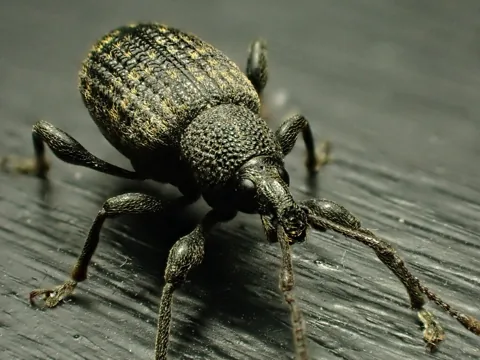 Black Vine Weevil
Otiorhynchus sulcatus
The black vine weevil is a European root weevil now widespread in North American landscapes. Its grubs feed on the roots of yew, rhododendron, azalea and many other plants, and adults sometimes wander into homes in late summer and fall.
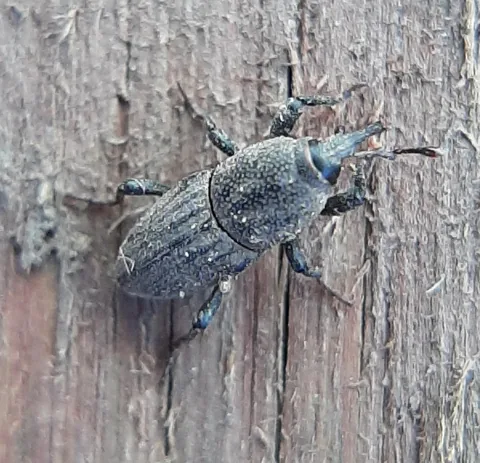 Billbugs
Sphenophorus species, e.g., S. parvulus (bluegrass billbug) and S. venatus vestitus (hunting billbug)
Billbugs are small weevils with a long snout. Their legless grubs bore inside grass stems and later feed on crowns and roots, killing scattered patches that are one of the most commonly misdiagnosed lawn problems.
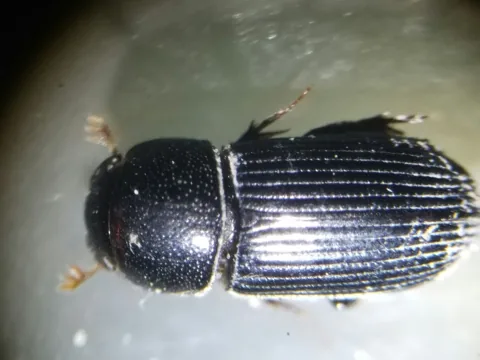 Black Turfgrass Ataenius
Ataenius spretulus
The black turfgrass ataenius is a small scarab beetle whose tiny white grubs feed on grass roots. It is mainly a golf course pest of greens, tees and fairways, and it only occasionally damages home lawns.
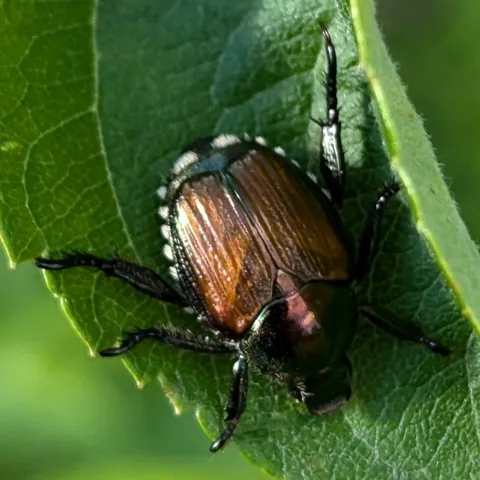 Japanese Beetle
Popillia japonica
The Japanese beetle damages landscapes twice: metallic green adults chew the leaves, flowers and fruit of hundreds of plants in early summer, and their white grubs feed on grass roots underground. A review of its biology calls it the most widespread and destructive insect pest of turf, landscapes and nursery crops in the eastern United States.
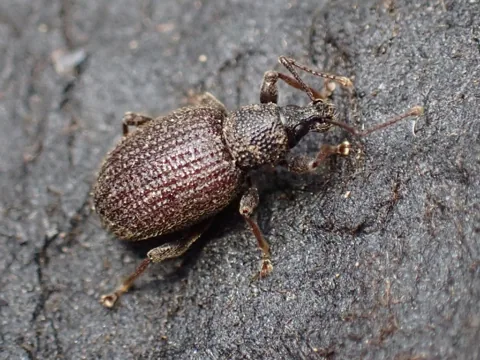 Rough strawberry root weevil
Otiorhynchus rugosostriatus
The rough strawberry root weevil, Otiorhynchus rugosostriatus, is one of the most common root weevils in Colorado and one of the root weevils that attack strawberries. The adults chew notches in leaf edges at night, but the C-shaped grubs in the soil do the real harm, tunneling in roots and crowns.
How insect-killing nematodes work
Nematodes are applied as infective juveniles that seek out a host, enter it through natural openings such as the mouth, anus or breathing pores and reproduce inside; the bacteria they carry kill the insect within a few days. Larvae and other immature stages are the most susceptible.[1][2][6][7]
How fast that happens depends on the source. UC IPM says the host dies within a few days, and Colorado State says the nematodes typically kill it within two to three days after getting inside; Washington State says the bacteria can kill it within 24 to 48 hours under optimal conditions. Colorado State notes that the dead insect generally keeps its shape instead of decaying normally.[1][6][7]
They don't harm plants or animals and have little impact on insects and other arthropods they don't target. Colorado State says they can't attack or cause disease in birds, mammals or fish, and that earthworms are occasionally infected after being wounded but there's no evidence field applications harm earthworm populations. Washington State reports negligible effects on nontarget insects in crop fields. One caveat from Colorado State: the insects they can infect include some natural enemies of pests.[2][6][7]
Under the right conditions they can be very effective: most of the pests on Cornell's list for Heterorhabditis were reduced by at least 70% in field trials when the nematodes were applied correctly. Washington State's table of current uses lists only pests where the nematodes gave at least 75% suppression in field or greenhouse experiments.[2][7]
UC IPM says releases of purchased natural enemies are unlikely to give satisfactory control in most garden situations, but it names nematodes as one of the few that can be effectively added, against certain tree-boring and lawn-feeding insects.[5]
They work in moist, dark places. Colorado State says control of insects on foliage is poor in field applications, and Washington State says they're generally not effective in the leaf canopy; soil insects and, Colorado State adds, borers inside woody plants are the better targets. Colorado State also says maggots, crickets, grasshoppers and termites appear less susceptible to the commonly sold strains.[6][7]
Colorado State and Washington State both note that these nematodes are exempt from federal pesticide registration requirements.[6][7]
Matching the nematode to the pest
- Steinernema carpocapsae is a sit-and-wait forager that infects hosts moving near the soil surface and doesn't go far into the soil. It's sold at many retail nurseries and targets armyworms, cutworms, billbugs, black turfgrass ataenius, crane flies and lawn moths. Washington State calls it an ambusher that stays at or near the soil surface and is most effective against highly mobile surface insects such as webworms, cutworms and armyworms, at soil-surface temperatures between 70°F and 85°F. Colorado State says it's less effective against white grubs, root maggots, rootworms and black vine weevil.[1][7][6]
- Steinernema glaseri targets white grubs. Washington State notes that it's expensive and difficult to produce and manage.[1][7]
- Heterorhabditis bacteriophora actively searches for prey below the soil surface. UC IPM lists black turfgrass ataenius, fiery skipper and white grubs as targets; infected hosts turn reddish. Cornell adds billbugs, black vine weevil, Japanese beetle, citrus root weevil and carrot weevil. Colorado State says field trials consistently show Heterorhabditis outperforms Steinernema on white grubs and that it controls root-zone nursery pests such as black vine weevil and citrus root weevils, though it's harder to rear and more sensitive to environmental extremes. Washington State describes it as a cruiser that moves through the soil and finds hosts by sensing carbon dioxide or other volatiles they release.[1][2][6][7]
- For black vine weevil, UC IPM says nematodes drenched onto the soil under infested plants can reduce larvae if the soil is well drained, such as soil high in organic matter or sandy soil, and not compacted. Apply when larvae are expected, midsummer to fall. Colorado State says Heterorhabditis is the most effective for root weevil larvae and is best applied after most eggs have hatched and the soil is warm, typically mid-July to mid-September.[3][10]
- Fungus gnats in potting mix: UC IPM, Colorado State and Washington State name Steinernema feltiae. UC IPM says it's effective at 60° to 90°F in moist conditions and that, unlike Bti, it can give season-long control after several initial applications establish it. Washington State says it stays infective even below 50°F. Our fungus gnat guide covers the indoor details.[12][13][7]
- Fleas and crane flies: Washington State's table lists Steinernema carpocapsae against cat fleas in home yards and turf and against crane flies in turf, and says S. feltiae also attacks crane flies; UC IPM lists crane flies among S. carpocapsae's targets.[7][1]
- Mole crickets: Washington State lists S. carpocapsae, S. riobrave and S. scapterisci. Whether you can buy a mole cricket nematode is unclear: Clemson's home lawn fact sheet says the only commercially available nonchemical product uses a beneficial nematode, which can be slow and may not work as well as chemical control, while Clemson's turf IPM page says no product containing S. scapterisci is currently for sale.[7][14][15]
Buying and checking nematodes
- Buy fresh, infective-stage nematodes from a reputable supplier, and follow the supplier's directions for storage, rate and timing. Penn State says to check the expiration date on each package, because these nematodes don't have a long shelf life.[1][2][8]
- Time the order. Washington State advises ordering only 3 to 4 days before you plan to apply, overnight shipping, and using them within 1 to 2 days of arrival, refrigerated in the shipping container until then. Colorado State is more generous, saying most packaged nematodes keep for several weeks or even months refrigerated. Never let them freeze or get hotter than about 90 degrees.[7][6]
- Check that they're alive when they arrive and again before use. Under a hand lens, live nematodes move and have a bend; ones that are perfectly straight and don't move when prodded are likely dead. Cornell suggests examining a drop of the well-mixed solution to see whether more than 20% are dead. Washington State adds that the shipping container shouldn't feel warm, a strong ammonia smell means they're likely dead, S. carpocapsae rests in a J shape and moves only when prodded, and a 10% death rate is typical. Both say to contact the supplier if more than 20% are dead, and Cornell says not to use them.[2][7]
- Use enough, and follow the product's rate. Cornell cites research calling for at least 25 nematodes per square centimeter, or about 24,000 per square foot, and Washington State recommends the same 250,000 per square meter for small areas. Utah State's turf rate against cutworms and armyworms is 25 million per 1000 square feet, while Colorado State gives a typical range of approximately 6,000 to 46,000 per square foot.[2][7][11][6]
How to apply them
- Water the area first. The soil must be moist but not soggy. After a long dry spell, Washington State says to break the crust and irrigate beforehand, preferably to a depth of 4 to 6 inches, and to remove plant debris that would keep nematodes from reaching the soil. Colorado State notes that watering first can also bring white grubs closer to the surface.[1][3][7][6]
- Check the soil temperature, and expect the sources to differ. UC IPM says not to apply below 60°F; Cornell and Washington State say Heterorhabditis is typically effective above 68°F, and Colorado State says temperatures below about 55 degrees inactivate most Heterorhabditis species. Washington State calls 77°F to 82°F ideal for all species, says soil above 85°F can reduce the effect of some species, and notes that S. feltiae can work at 57°F. Colorado State warns that short exposure above 90 to 95 degrees can kill common S. carpocapsae strains.[1][3][2][7][6]
- Mix the nematodes in cool water (UC IPM specifies distilled) and apply with a sprayer. Cornell's guidance is a nozzle with openings larger than 50 microns, pressure under 290 psi, and stirring the mix about every 5 minutes so the nematodes stay suspended and get oxygen. Washington State says to mix them no more than one hour ahead, rinse the shipping container with cool water (about 60°F) into the tank, remove screens finer than 50-mesh, keep the tank below 86°F and avoid heavy recirculation; it lists pressures of up to 300 psi as acceptable. Most labels call for 2 to 6 gallons of water per 1,000 square feet, aimed at the soil.[1][2][7]
- Apply in the early morning or evening, especially in hot weather; sunlight and heat kill nematodes. Washington State also suggests a cool, overcast day.[1][2][3][7][11]
- Water again right after applying and keep the soil moist. For black vine weevil, UC IPM says to keep the soil moist for 2 weeks, irrigating every 2 to 3 days if needed. Cornell says soil moisture is typically maintained for at least 2 weeks. Washington State says to irrigate lightly to wash them in but not to over-irrigate, because saturated soil lacks the oxygen they need.[1][3][2][7]
- Heavy clay soils make it harder for nematodes to establish, and sandy soils may need more irrigation. Washington State explains that clay may hold too little oxygen and its small pores restrict movement. Colorado State adds that heavy thatch can keep nematodes from reaching the root zone where grubs feed, and watering after treatment helps push them through.[2][7][6]
When to apply
Apply when the pest's grub or caterpillar stage is present and active, which for most pests is late spring through summer.[1]
For white grubs, UC IPM advises later summer or early fall, when more mature larvae are active. Penn State's Japanese beetle advice is to apply Heterorhabditis or Steinernema every year after the ground has warmed in late spring, following the application directions precisely. Clemson says the best time is when grubs are small, in an early larval stage.[1][4][9]
A second application about 2 weeks after the first improves control. Utah State says several applications may be necessary.[1][11]
Checking the results
About a week after each application, dig and look for infected larvae or pupae, which turn red or yellow-brown. Colorado State says caterpillars killed by Heterorhabditis may be reddish-brown.[1][6]
Digging up dead insects is slow work, so Washington State describes a bait test: bury 2–3 waxworms (sold as fishing bait) in a tea strainer 4 inches deep, using 3–4 strainers for a garden, dig them up after 2 days, rinse them and keep them on moist paper towel in a dark spot at room temperature, and check them over the next 7–10 days. Waxworms infected by Steinernema turn yellow, tan or brown, those infected by Heterorhabditis turn pink or purple, and black ones likely died of something else.[7]
Nearly all commercially available nematodes don't survive at levels that control pests from year to year, so assume you'll need to reapply. Colorado State says there are no reliable guidelines on persistence yet, and that cold, drying or high summer temperatures likely kill them off under Colorado conditions.[2][6]
Before combining nematodes with pesticides or fertilizers, check compatibility; Cornell says it varies by product and concentration. On fertilizer the sources disagree: Colorado State says nitrogen fertilizers are nontoxic to S. carpocapsae and most insecticides have little effect, while Washington State says not to mix nematodes with nitrogen fertilizers, particularly urea, and that they're sensitive to certain insecticides and nematicides. Use equipment that is clean and free of pesticide residues.[2][6][7]
Common questions
- Are beneficial nematodes safe for pets and plants?
- Yes. They don't harm plants or animals, and they have little impact on non-target arthropods. Colorado State says they can't attack or cause disease in birds, mammals or fish.[2][6]
- Why didn't my nematodes work?
- The usual problems are the wrong species for the pest, nematodes that were dead on arrival, soil that was too cold or too dry, exposure to sunlight, or thick thatch. Even with good technique, Penn State calls results against white grubs inconsistent. Check them under a lens, water before and after, and apply in the evening.[2][1][8][6]
- When should I apply nematodes for lawn grubs?
- When grubs are present and active. UC IPM favors later summer or early fall; Penn State applies after the ground warms in late spring. Clemson says to treat while grubs are small. Repeat about 2 weeks later.[1][4][9]
- How long can I keep beneficial nematodes before using them?
- Not long. Washington State says to use them within 1 to 2 days of arrival, refrigerated in their shipping container until then, and to expect 70–100% of them to be dead once the storage life runs out. Colorado State says refrigerated packages can last several weeks or even months, with S. carpocapsae the most tolerant of storage.[7][6]
- Can I spray beneficial nematodes on plant leaves?
- It rarely works. Colorado State says control of insects on foliage is poor in field applications, and Washington State says they're generally not effective in the leaf canopy. Colorado State explains that drying and ultraviolet light kill them, so aim them at moist soil.[6][7]
Photo credits
- Black Vine Weevil: (c) Jarro Nevsbaru, some rights reserved (CC BY) — via iNaturalist, CC BY 4.0
- Billbugs: (c) Will Linnard, some rights reserved (CC BY) — via iNaturalist, CC BY 4.0
- Black Turfgrass Ataenius: (c) Tyler Bishop, some rights reserved (CC BY) — via iNaturalist, CC BY 4.0
- Japanese Beetle: (c) Emmett Collins-Sussman, some rights reserved (CC BY) — via iNaturalist, CC BY 4.0
- Rough strawberry root weevil: (c) Adrien Cozannet, some rights reserved (CC BY) — via iNaturalist, CC BY 4.0
Sources
- University of California Statewide IPM Program, “The UC Guide to Healthy Lawns: Beneficial nematodes.” ipm.ucanr.edu/TOOLS/TURF/PESTS/innem.html (accessed 2026-11-10)
- New York State Integrated Pest Management Program, Cornell University, “Heterorhabditis bacteriophora, Beneficial Hb Nematode (NYSIPM Biocontrol Fact Sheet, June 2022).” cals.cornell.edu/integrated-pest-management/outreach-education/fact-sheets/heterorhabditis-bacteriophora-beneficial-hb-nematode (accessed 2026-11-10)
- University of California Statewide IPM Program, “Pest Notes: Black Vine Weevil (Home and Landscape).” ipm.ucanr.edu/home-and-landscape/black-vine-weevil/ (accessed 2026-11-10)
- Penn State Extension, “Japanese Beetles in the Home Garden (updated June 8, 2026).” extension.psu.edu/japanese-beetles-in-the-home-garden (accessed 2026-11-10)
- University of California Statewide IPM Program, “Pest Notes: Biological Control and Natural Enemies of Invertebrates (Home and Landscape).” ipm.ucanr.edu/home-and-landscape/biological-control-and-natural-enemies-of-invertebrates/ (accessed 2026-11-10)
- Colorado State University Extension, “Insect Parasitic Nematodes, Fact Sheet 5.573.” extension.colostate.edu/resource/insect-parasitic-nematodes/ (accessed 2026-11-10)
- Washington State University Extension (Pacific Northwest Extension publication), “Using Entomopathogenic Nematodes for Crop Insect Pest Control, PNW544 (revised May 2012, archived).” wpcdn.web.wsu.edu/wp-ecommerce/uploads/sites/2/product-4269-sku-PNW544.pdf (accessed 2026-11-10)
- Penn State Extension, “White Grubs in Home Lawns.” extension.psu.edu/white-grubs-in-home-lawns (accessed 2026-11-10)
- Clemson Cooperative Extension Home & Garden Information Center, “White Grub Management in Turfgrass (HGIC).” hgic.clemson.edu/factsheet/white-grub-management-in-turfgrass/ (accessed 2026-11-10)
- Colorado State University Extension, “Root Weevils, Fact Sheet 5.551.” extension.colostate.edu/resource/root-weevils/ (accessed 2026-11-10)
- Utah State University Extension, “Armyworms and Cutworms in Turfgrass (Hodgson, June 2007).” extension.usu.edu/planthealth/research/armyworms-and-cutworms-in-turfgrass (accessed 2026-11-10)
- University of California Statewide IPM Program, “Fungus Gnats (Pest Notes).” ipm.ucanr.edu/home-and-landscape/fungus-gnats/ (accessed 2026-11-10)
- Colorado State University Extension, “Fungus Gnats as Houseplant and Indoor Pests.” extension.colostate.edu/topic-areas/insects/fungus-gnats-as-houseplant-and-indoor-pests-5-584/ (accessed 2026-11-10)
- Clemson Cooperative Extension Home & Garden Information Center, “Mole Cricket Management in Turfgrass (HGIC).” hgic.clemson.edu/factsheet/mole-cricket-management-in-turfgrass/ (accessed 2026-11-10)
- Clemson University Turfgrass and Ornamental IPM (TandoIPM), “Mole Crickets Information.” blogs.clemson.edu/tandoipm/mole-crickets (accessed 2026-11-10)