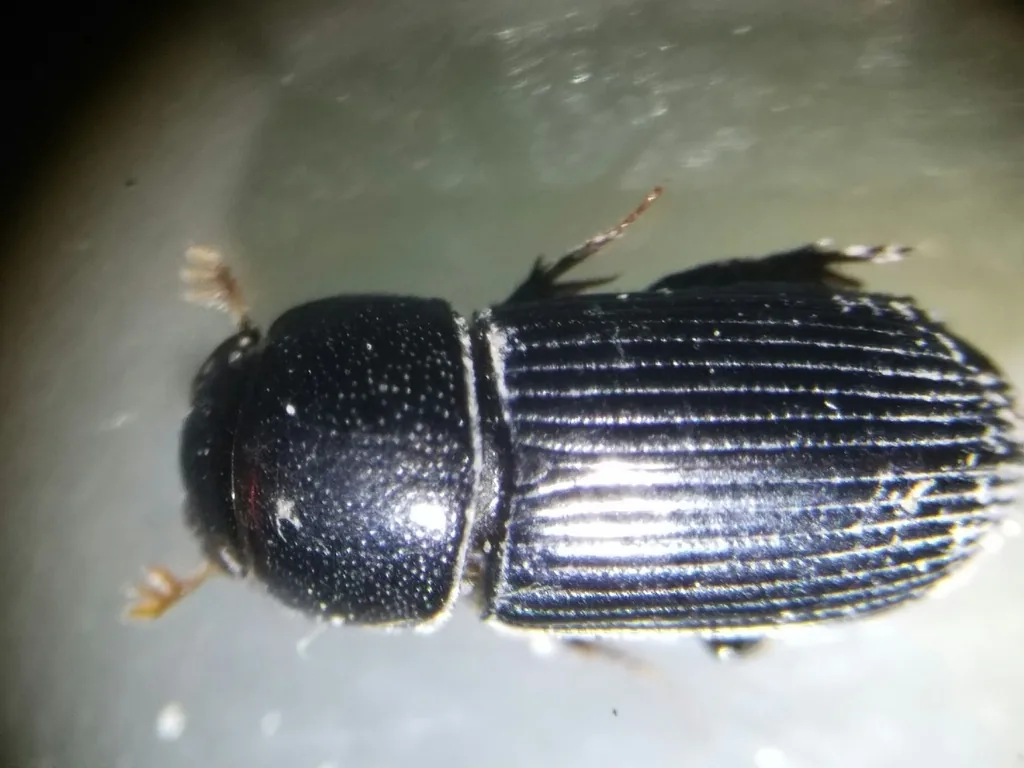
How to identify it
- Adults are shiny jet-black beetles only about 3/16 to 1/5 inch long, with clubbed antennae and parallel grooves along the wing covers.[1][2]
- Grubs are whitish and C-shaped with six legs and reddish heads, but they stay small, reaching only about 1/3 inch.[1][2]
- Under a magnifier, the last abdominal segment shows scattered bristles and a pair of pads at the very tip.[1]
Look-alikes
| Look-alike | How to tell them apart |
|---|---|
| Other white grubs (masked chafers, Japanese beetle, May/June beetles) | Ataenius grubs stay tiny, barely 5/16 inch, so finding larger grubs points to masked chafers, Japanese beetles or May and June beetles instead.[2] |
| Ground beetles | Some predaceous ground beetles and Aphodius beetles look similar to ataenius adults, so check the size, grooved wing covers and clubbed antennae.[1] |
Where it lives
Found throughout North America; it can seriously damage golf course turf, though in Kansas it rarely causes damage despite large evening flights.[2]
Biology and life cycle
Unlike most lawn grubs, it spends the winter as an adult, sheltered beneath soil debris.[2][3]
Adults become active in late March and early April, and females lay eggs in grassy sites in late spring.[2][3]
Grubs feed through June into early July, then pupate; in many years new adults lay eggs for a second generation in late July.[3][2]
Besides roots, the larvae also thrive on decomposing thatch.[2]
Host grasses include annual bluegrass, creeping bentgrass, Kentucky bluegrass and perennial ryegrass.[1]
Damage and signs
- Grub feeding causes irregular patches of brown or dead turf that look drought-stressed and can be confused with root diseases such as summer patch.[1]
- Turf with heavy root loss peels off the soil easily, and damage can be worse where soil organic matter is high.[1][3]
- Each grub eats little root tissue, so it takes large numbers to cause visible injury.[2]
Health risk
Black turfgrass ataenius is a turf pest: the grubs feed on grass roots and thatch, and the concern is damage to golf and lawn turf.[1][2]
Control
Prevention
Check for grubs when you see damage or about two weeks after adults appear, cutting into the turf 2 to 4 inches deep and looking for tiny grubs.[1][3]
Look for shiny black adults at outdoor lights around dawn, or flush them to the surface of short turf with a soapy drench.[1][3]
Treatment is usually needed only at high counts: UC suggests more than 40 grubs per square foot and Kansas State 30 to 50.[1][2]
Most damage occurs in turf stressed by overwatering, heat, heavy traffic or very low mowing, so aerate, raise the mowing height and water properly.[1]
Biological control
Beneficial nematodes are effective when applied while grubs are active.[1]
Pesticides
If counts exceed the threshold, a grub insecticide labeled for turf may be needed; follow the label for timing.[1]
Common questions
- What are the tiny shiny black beetles on my lawn in spring?
- They may be black turfgrass ataenius adults, which overwinter as beetles, become active in early spring, and are often seen on short turf on warm sunny days.[2][3]
- Do black turfgrass ataenius grubs damage home lawns?
- Occasionally. They are mainly a golf course pest of very short turf, and it takes large numbers to damage a lawn.[1][3][2]
Sources
- University of California Statewide IPM Program, “Black turfgrass ataenius (UC Guide to Healthy Lawns).” ipm.ucanr.edu/TOOLS/TURF/PESTS/inbta.html (accessed 2026-10-06)
- Kansas State University Research and Extension, “Turfgrass Insects (MF2901, April 2015).” bookstore.ksre.ksu.edu/pubs/MF2901.PDF (accessed 2026-10-06)
- UMass Amherst Center for Agriculture, Food, and the Environment, “Professional Turf IPM Guide, Section 4: Turf Insects, Damage and Scouting.” www.umass.edu/agriculture-food-environment/turf/professional-turf-ipm-guide/section-4-insect-management/turf-insects-damage-scouting (accessed 2026-10-06)
- iNaturalist, “Ataenius spretulus taxon page (order and family).” www.inaturalist.org/taxa/214536 (accessed 2026-10-06)